
In this guide
Project costing for Pune engineering and consulting firms means collecting every cost attributable to a single engagement, setting it against the agreed fee and reporting the margin while the work is still live. For a design consultancy in Kharadi or an engineering-services firm serving the Hinjewadi corridor, the profit and loss account only tells you whether the whole practice made money last year. It never tells you which projects paid and which quietly bled. This guide explains, in plain terms, how a service firm builds that per-project view, the costing method that fits, and how the same numbers feed statutory reporting. The commercial engagement itself belongs to our Service Sector Accounting (Project Billing) Pune page; here we stay on the how.
What project costing means for a service firm
In a factory, cost accounting traces cost to a unit of production. In a consultancy there is no unit of production, so cost is traced to a unit of service: a billable hour, a phase or a whole project. The main cost pool for a Pune engineering firm is engineer time, loaded with a fair share of office rent, software licences, support salaries and equipment depreciation. Everything a client pays for ultimately comes out of that pool. Project costing simply asks each engagement to carry its own share and report what is left after the fee.
This is different from bookkeeping, which records what was spent by nature of expense (salaries, rent, travel). Costing re-cuts the same data by engagement. Your service sector accounting should produce both views from one ledger, using operational cost centres rather than a second set of books.
Which costing method fits project-based companies
Job costing is the right method for project-based firms, with every project carrying its own cost sheet for labour hours, subcontracting, travel and directly attributable overhead. Process costing, which averages cost across identical output, does not fit, because no two assignments consume the same inputs. A structural survey in Pimpri and a feasibility study in Baner may both be billed at similar fees, yet one is travel-heavy and the other software-heavy. Only a per-job sheet shows that.
The building block of job costing in a service firm is the loaded (or fully absorbed) hourly rate. You take the annual cost pool, divide by expected billable hours, and get a rate that already carries overhead. Every hour a consultant books to a project then draws that rate, so the project sheet fills itself from timesheets. Firms serving IT clients around Hinjewadi often run this alongside SaaS accounting services (IT & SaaS) or full IT and software company accounting services for their product-side subsidiaries, but the costing logic is the same.
How to build a project cost sheet, step by step
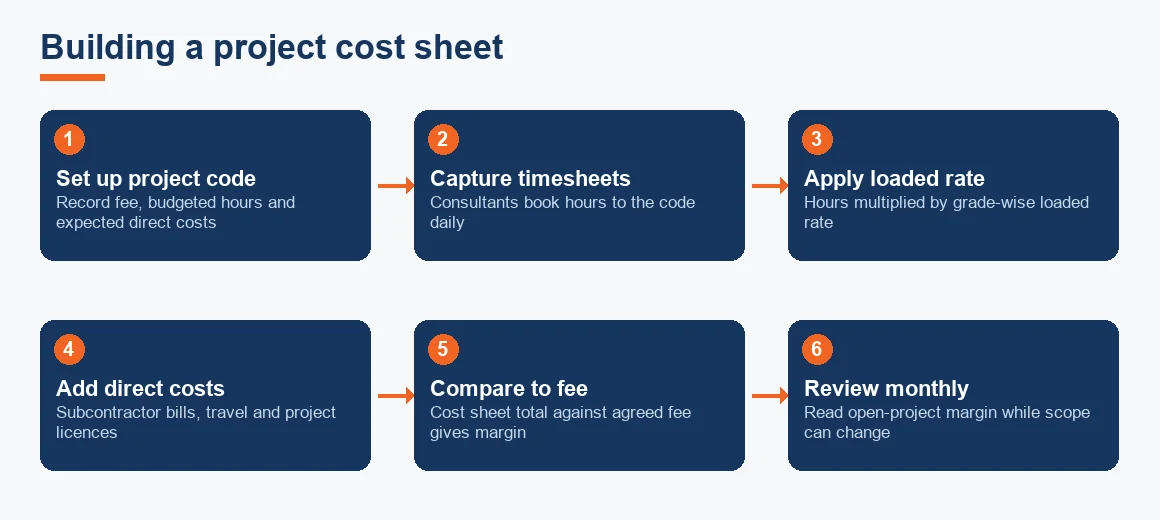
- Set up the project code and budget. Record the agreed fee, the estimated hours by grade, and any expected subcontract or travel spend.
- Capture timesheet hours daily. Every consultant books hours to a project code. This is the single most important discipline; a firm that skips it has no costing.
- Apply the loaded rate. Multiply hours by grade-wise loaded rates to get labour cost carrying overhead.
- Add direct costs. Post subcontractor bills, travel and any project-specific licences straight to the code.
- Compare against the fee. The cost sheet total against the agreed fee gives committed margin to date.
- Review monthly. Read every open project's margin at each month-end, while scope and staffing can still change.
A tidy monthly close matters here. Our monthly bookkeeping and MIS checklist for Pune businesses covers the wider close; the project margin review is one extra line in that routine.
Worked example: from cost pool to project margin
Take a mid-sized Pune engineering consultancy. First it builds the loaded rate from its annual cost pool, then it applies that rate to one engagement. All figures are illustrative.
| Step and item | Amount (Rs) |
|---|---|
| Billable engineer salaries | 72,00,000 |
| Support and admin salaries | 24,00,000 |
| Office rent (Kharadi) | 12,00,000 |
| Software licences | 7,20,000 |
| Other overhead and depreciation | 4,80,000 |
| Total annual cost pool | 1,20,00,000 |
| Expected billable hours (year) | 24,000 |
| Loaded rate per hour (1,20,00,000 / 24,000) | 500 |
| Project labour: 1,800 hours at Rs 500 | 9,00,000 |
| Subcontractor (specialist testing) | 40,000 |
| Site travel to Chakan and Pimpri | 20,000 |
| Total project cost | 9,60,000 |
| Agreed fixed fee | 11,00,000 |
| Project margin (11,00,000 less 9,60,000) | 1,40,000 |
The margin of Rs 1,40,000 is 12.7 per cent of the fee. Just as useful, the firm now knows a similar assignment cost about Rs 9.6 lakh, so it can quote the next one properly instead of guessing. That is the quiet return on running project costing at all.
Choosing a billing model to match the costing
The way you bill changes how cost is read and when revenue is recognised. Most Pune service firms run one of three models, and many run all three across different clients.
| Billing model | How cost is tracked | Revenue recognition | Main risk to watch |
|---|---|---|---|
| Time and material | Hours at loaded rate, billed as incurred | As services are delivered each period | Weak timesheets leak billable hours |
| Fixed fee | Full cost sheet against a set price | Over time by progress, or on milestone | Cost overruns erode a capped fee |
| Monthly retainer | Hours tracked against an implied budget | Straight-line over the retainer period | Scope creep beyond the retained hours |
The distinction between milestone and retainer billing is not just admin; it decides when you may recognise revenue and how you value work still in progress.
Recognising revenue when projects run long
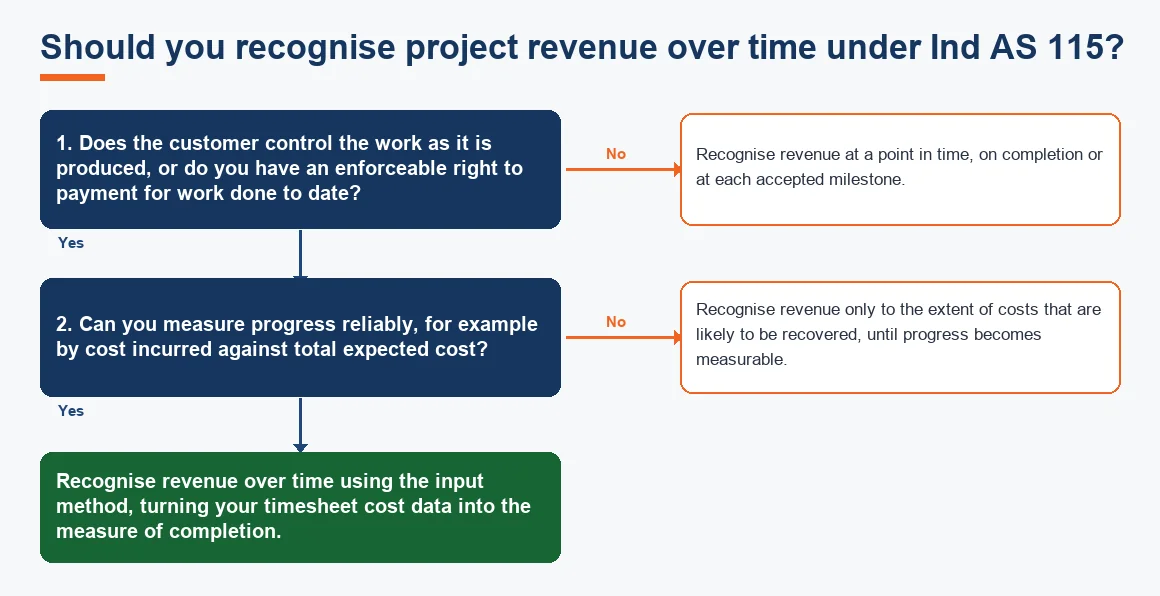
Where a project runs beyond a reporting date, the same timesheet data becomes an accounting record, not just a management tool. Under Ind AS 115 revenue recognition, revenue is recognised over time when the customer controls the work as it is produced or the firm has an enforceable right to payment for work done to date. Progress is often measured by an input method, cost incurred against total expected cost, which turns your cost sheet into the measure of completion. The Percentage of Completion Method, or POCM, applies the same idea for firms still on AS 7 style measurement. The Ministry of Corporate Affairs publishes the notified standards at mca.gov.in, and the ICAI guidance sits at icai.org.
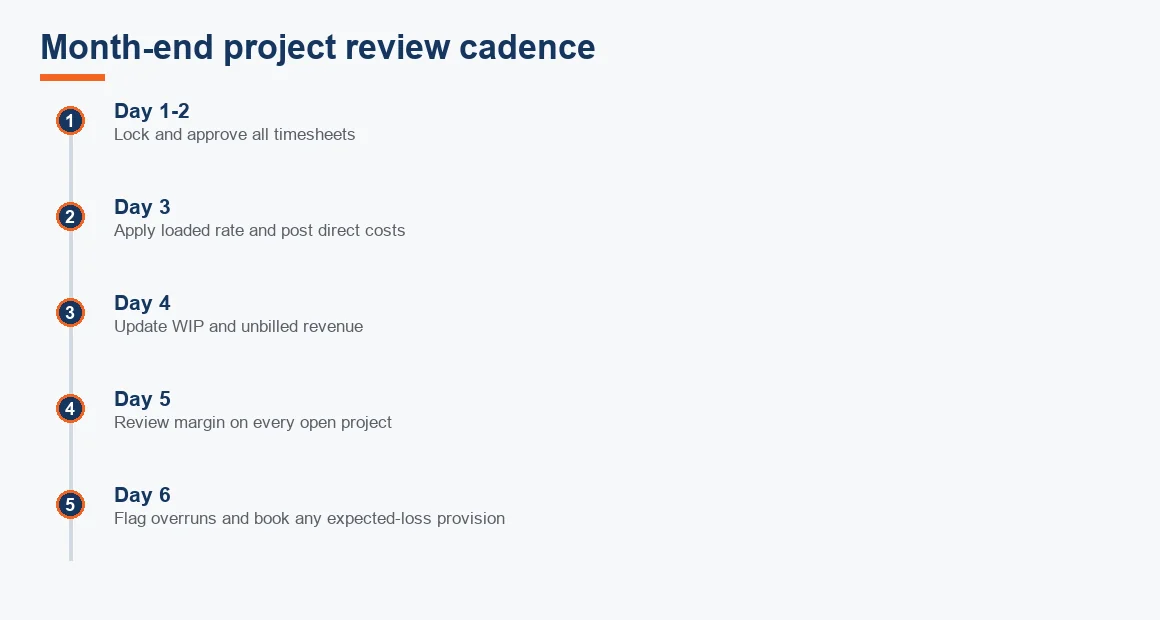
Hours worked but not yet invoiced sit as unbilled revenue (WIP hours) on the balance sheet, and the underlying valuation follows work-in-progress valuation rules. Getting this right keeps your margin honest across a year-end.
Reading project margin, not just firm margin
Once every engagement carries its own sheet, you can rank projects and clients by project-wise profitability margin. This is where costing earns its keep. You will usually find a handful of clients subsidise the rest, and one or two engagements that look busy but lose money. That insight informs which work to chase, which fees to renegotiate and which clients to let go. It is a very different conversation from the annual profit figure, and it is one your accountant should be putting in front of you monthly. If yours is not, our note on choosing an accountant in Pune covers what to expect.
The Pune context: where project costing bites hardest
Pune's service economy is unusually project-shaped. Engineering-design houses feed the Chakan and Pimpri auto-component cluster, IT-services firms cluster around Hinjewadi and Kharadi, and a long tail of consultancies serves them all. Two local realities make costing discipline non-negotiable. First, engineer salaries have risen sharply, so a loose loaded rate quickly understates true cost. Second, many firms take on subcontracting for the same manufacturing clients they advise, blurring the line between a service margin and a pass-through cost. Firms that also handle physical inventory for those clients should read our piece on costing and inventory accounting for Pune Chakan-Pimpri auto-component makers, which sits on the other side of the same supply chain. For benchmarking what good bookkeeping should cost you locally, see the cost of accounting and bookkeeping in Pune: 2026 benchmarks.
Younger practices and spin-outs, common around Hinjewadi, often bolt project costing onto a thin finance function too late. If that is you, our startup accounting services India guidance and the Pune pages for accounting and bookkeeping and SaaS accounting (IT & SaaS) in Pune set out how to build it in from the start. To check whether Ind AS even applies to your entity yet, run the Ind AS Applicability Checker before you change your revenue policy.
Key terms
- Unbilled Revenue (WIP Hours): hours worked but not yet invoiced, carried as an asset until billed.
- Project-Wise Profitability Margin: the profit on a single engagement after its own costs, not the firm's overall margin.
- Percentage of Completion Method (POCM): recognising revenue in step with the share of total cost incurred.
- Milestone vs Retainer Billing: billing on delivered stages versus a fixed monthly fee for ongoing work.
- Work-in-Progress (WIP) Valuation: valuing part-finished engagements at cost or recoverable amount at a reporting date.
Key takeaways
- Project costing shows the margin on each engagement while it is live, which the profit and loss account never does.
- Use job costing built on a loaded hourly rate: annual cost pool divided by expected billable hours.
- Daily timesheets against a project code are the foundation; without them there is no costing.
- For long engagements, the same cost data drives revenue recognised over time under Ind AS 115, and an expected loss on a fixed fee is provided for immediately.
- Rank clients and projects by margin monthly; the commercial engagement itself belongs on the Pune service-sector service page.
Decision guide