In this guide
Choosing an accountant in Pune comes down to three checks done in order: confirm the person is a qualified, practising chartered accountant, test that they can actually close a real month of your books, and agree a written scope before any money changes hands. The rest of this guide walks through how to run those checks, what Maharashtra rules a Pune accountant must handle from day one, and the single number that usually decides whether you hire in-house or outsource. This is a vetting guide, not a services pitch; when you are ready to engage a firm, the commercial options sit on our Accounting & Bookkeeping Services in India page.
Confirm the accountant is actually qualified
Anyone can print "accountant" or "tax consultant" on a visiting card. Only a member of the Institute of Chartered Accountants of India holding a valid certificate of practice may sign an audit report or certify financial statements. Before you discuss fees, ask for two numbers: the ICAI membership number and the certificate of practice number. A firm should also quote its firm registration number, which appears on every audit report and on filings made with the Ministry of Corporate Affairs.
Verify the name yourself in the member search on the ICAI website. This takes two minutes and rules out the most common problem in the market: an unqualified bookkeeper presenting as a CA. A qualified accountant will not be offended by the check; a reluctant one has told you something useful.
What a Pune accountant should set up in the first month
Pune sits in Maharashtra, so a few state registrations apply that an out-of-state accountant may miss. A competent local accountant will raise these unprompted in your first meeting.
- Professional tax: PTEC at Rs 2,500 a year for the entity and its directors, payable by 30 June, and PTRC once staff are on the payroll.
- Shops and Establishment: registration applies from 10 workers, with a Form F intimation below that number.
- GST: registration follows once turnover crosses the threshold or the first inter-state supply is made, filed through the GST portal.
If the accountant cannot name the professional tax due date or the Shops and Establishment threshold from memory, they are not close enough to Maharashtra compliance for a Pune business. For the month-by-month routine that follows setup, our monthly bookkeeping and MIS checklist for Pune businesses lays out the recurring tasks.
In-house accountant or outsourced team: which fits your Pune business?
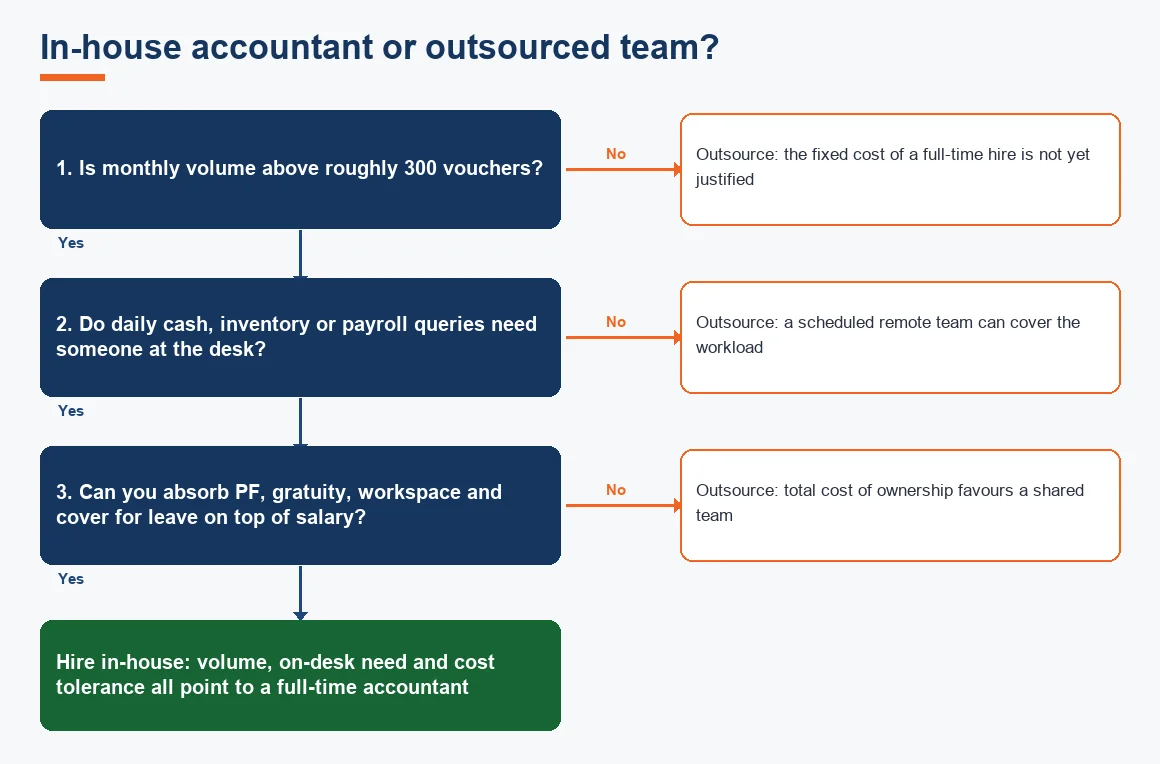
This is the question most Pune owners get wrong by deciding on gut feel. The honest answer turns on monthly volume. Outsourcing is usually cheaper until you pass roughly 300 vouchers a month; beyond that, and especially once daily cash, inventory or payroll queries need someone physically at the desk, an in-house hire starts to earn its keep.
| Factor | In-house accountant | Outsourced team |
|---|---|---|
| Typical monthly cost (Pune) | Rs 25,000 to Rs 40,000 salary plus PF and gratuity | Rs 8,000 to Rs 20,000 (Exl GST, indicative) |
| Best below / above 300 vouchers | Above | Below |
| Covers leave, illness, exits | You carry the gap | Team covers continuity |
| GST, TDS, ROC breadth | Depends on one person's skill | Specialist per area |
| On-desk for daily queries | Yes | Remote, scheduled |
Neither option is universally better. A Chakan auto-component unit with heavy inventory and a daily stores desk leans in-house; a Hinjewadi SaaS studio with clean, low-volume billing leans outsourced. For detailed local fee benchmarks by business size, see our cost of accounting and bookkeeping in Pune benchmarks rather than relying on a single quote.
Worked example: the true monthly cost of in-house versus outsourced
The salary figure is never the full cost of an in-house accountant. Below is a like-for-like monthly comparison for a mid-sized Pune private limited company. All amounts are indicative and Exl GST where a professional fee applies.
| Cost line | In-house accountant | Outsourced team |
|---|---|---|
| Gross salary / retainer | Rs 32,000 | Rs 15,000 |
| Employer PF (13% of Rs 15,000 wage ceiling) | Rs 1,950 | Nil |
| Gratuity accrual (4.81% of salary) | Rs 1,539 | Nil |
| Workspace, laptop, software share | Rs 3,500 | Nil |
| GST at 18% on professional fee | Not applicable | Rs 2,700 |
| Total monthly cost | Rs 38,989 | Rs 17,700 |
At this volume the outsourced team costs less than half the in-house desk, and the GST of Rs 2,700 is input tax credit you can set off if you are registered. The maths flips once volume and on-site need rise: add a second book-keeper's workload and the in-house line stays roughly flat while the outsourced retainer climbs. Run your own numbers before deciding, not the other way round.
How to test capability before you hand over your books
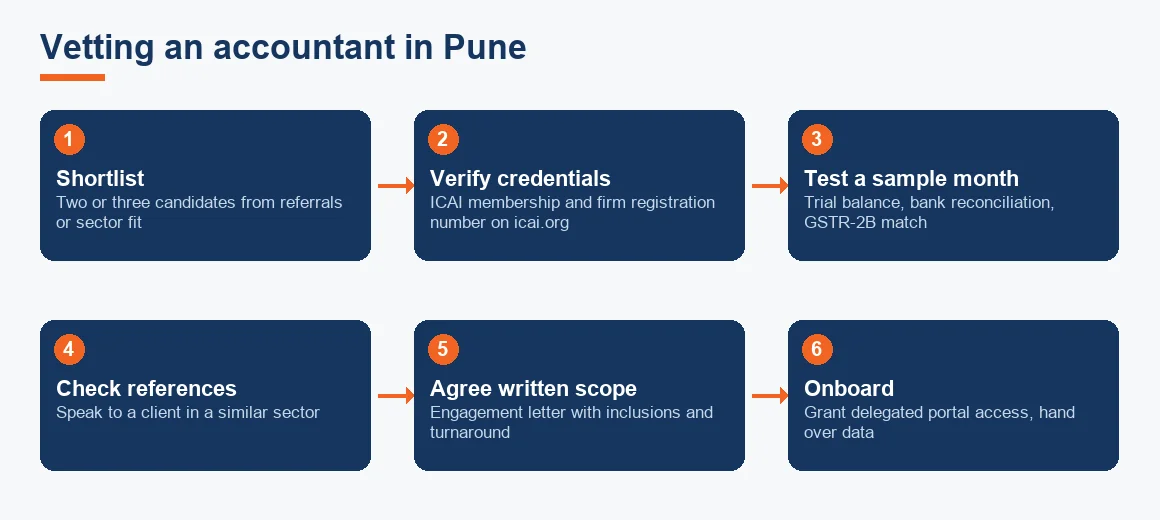
References and certificates tell you what someone has done, not what they will do for you. Test capability on a real, recent sample month before you commit. A capable accountant will welcome this; it is how they win the work.
- Hand over one month of bank statements, sales and purchase registers and ask them to produce a trial balance that ties out.
- Ask them to run a bank reconciliation and explain any timing differences in plain language.
- Give them your GST data for the month and check whether their GSTR-2B input tax credit matching catches missing or mismatched invoices.
- Ask what their month-end close checklist looks like and how many working days after month end you will receive numbers.
- Confirm the software: Tally, Zoho or Xero, and whether you keep ownership of the data file.
Judge them on how they explain the differences, not only on whether the numbers match. An accountant who can teach you why a reconciliation is off is worth more than one who simply forces it to balance.
Red flags when hiring an accountant
Some warning signs are worth walking away from regardless of price:
- Reluctance to share the ICAI membership or firm registration number.
- A fee that is far below the market with no explanation; corners are being cut somewhere you will pay for later.
- Insisting on keeping sole control of your GST and income tax portal credentials rather than giving you owner access.
- No written scope, no engagement letter and no clarity on what is included versus billed separately.
- Vague answers on turnaround: "we will manage it" is not a service level.
The credential and control red flags matter most. You should always hold the master login to your own Income Tax and GST accounts and grant the accountant delegated access, never the reverse.
Matching the accountant to your Pune locality and sector
Pune is not one market. The right accountant for a Hinjewadi software exporter is rarely the right one for a Pimpri fabrication unit, because the accounting problems differ.
Hinjewadi, Kharadi and Baner: IT, SaaS and services
Here the issues are export invoicing, foreign currency receipts, SOFTEX or EDF filing and recognising subscription revenue correctly. Ask about experience with software exports and multi-currency books.
Chakan, Talegaon and Pimpri-Chinchwad: manufacturing and auto components
Inventory valuation, job-work tracking and factory overhead costing dominate. An accountant who has never handled a bill of materials will struggle. Our note on costing and inventory accounting for Pune auto-component makers covers what to probe for.
D2C and online sellers across the city
Marketplace settlement reconciliation and TCS under GST are the recurring headaches; the Amazon and Flipkart settlement reconciliation guide for Pune D2C sellers shows the depth required. When you are ready to engage for your sector, the local accounting and bookkeeping services in Pune page and the sector-specific SaaS accounting and manufacturing accounting Pune pages set out the commercial scope. The full process, software and industry framework sits on the accounting and bookkeeping hub.
How to switch accountants mid-year without breaking the books
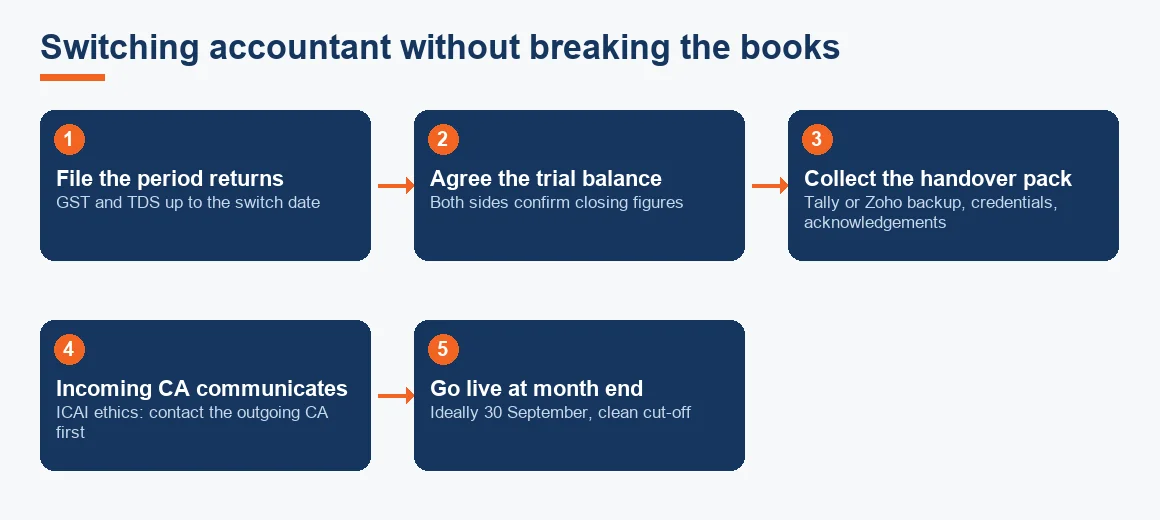
If you already have an accountant and are moving on, the timing and handover matter more than the reason. Switch at a month end, ideally 30 September, once GST returns for the period are filed and the trial balance is agreed. Before the handover, collect the Tally or Zoho backup, all portal credentials, GST and TDS acknowledgements and the last signed financial statements.
One ethics point that catches people out: ICAI rules require the incoming chartered accountant to communicate with the outgoing one before accepting the assignment. This is a professional courtesy, not a sign of a problem, and a firm that skips it is ignoring its own code of conduct.
Key terms
- Trial Balance: a statement listing every ledger balance to check that total debits equal total credits.
- Bank Reconciliation: matching the cash book against the bank statement to explain every difference.
- GSTR-2B Input Tax Credit Matching: comparing supplier-reported invoices against your purchase records to claim only eligible credit.
- Month-End Close Checklist: the fixed set of tasks that turns raw entries into reliable monthly numbers.
- Catch-Up Bookkeeping: clearing a backlog of unrecorded months before a new accountant can report cleanly.
A quick self-check before you decide
If you can use a working template to score two or three candidates side by side, the decision usually makes itself. Weight credentials and the sample-month test highest, price lowest. The cheapest accountant who cannot verify a certificate of practice is not cheap at all.
Key takeaways
- Verify the ICAI membership and certificate of practice number on icai.org before discussing fees.
- Decide in-house versus outsourced on monthly voucher volume and on-desk need, not on gut feel; roughly 300 vouchers is the tipping point.
- Cost an in-house accountant on total cost (salary plus PF, gratuity and workspace), not headline salary.
- Test capability on a real sample month: trial balance, bank reconciliation and GSTR-2B matching.
- Match the accountant to your Pune locality and sector, and switch only at a clean month end with backups and credentials in hand.
Decision guide