
In this guide
If you run a tier-one or tier-two auto-component unit in the Chakan-Pimpri belt, inventory costing is where your accounts either tell the truth or quietly mislead you. Correct costing for auto-component makers in Chakan Pune means valuing raw material, work in progress and finished goods separately at the lower of cost and net realisable value under AS 2, absorbing factory overheads on normal capacity, tracking every batch sent out for job work, and amortising customer tooling over the parts it produces. This explainer walks through each of those, with the local practices that suppliers around the Chakan MIDC estate have settled on. For the commercial engagement, our Manufacturing Accounting Services Pune page sets out scope and pricing; here we stay on the how and why.
Why the Chakan-Pimpri belt accounts differently
Chakan is Pune's largest automobile manufacturing cluster. Plants of Mercedes-Benz, Volkswagen, Bajaj Auto, Mahindra and Tata Motors sit in and around the Chakan MIDC industrial estate, and the belt runs through Talegaon into Pimpri-Chinchwad. Behind those assembly lines are several hundred component suppliers feeding forgings, castings, plastics, wiring harnesses and machined parts on tight just-in-time schedules. That structure, rather than anything unique to Pune tax law, is why the books here specialise in cost records, job work and inventory discipline. Units operating on MIDC plots also carry estate-specific obligations, which we cover under MIDC industrial area compliance.
The commercial pressure is real. An OEM will hold a supplier to a per-part price agreed months earlier, so if your costing understates conversion cost or ignores tooling amortisation, the margin you report is fiction and the shortfall shows up as a cash squeeze. Getting the inventory model right is the difference between quoting profitably and discovering the loss at year end.
How auto-component inventory is valued under AS 2
Under AS 2, issued by the ICAI, inventory is carried at the lower of cost and net realisable value. Cost is not just the invoice price of steel or resin. It covers the purchase price excluding any GST input tax credit you can claim, plus freight inward and non-creditable duties, plus conversion cost, which is the direct labour and the factory overheads incurred to turn material into a finished part. Crucially, fixed factory overheads are absorbed on normal capacity, not on whatever you actually produced that month. If a line runs at half its normal volume, you cannot load the full fixed overhead onto the few parts made; the unabsorbed portion goes straight to the profit and loss account as an expense.
The three inventory pools are valued separately because they sit at different stages of cost accumulation.
| Inventory pool | What it includes | Cost elements absorbed |
|---|---|---|
| Raw material and bought-out parts | Steel, aluminium, resin, fasteners, purchased sub-assemblies | Purchase price (net of ITC), freight inward, duties |
| Work in progress | Parts part-machined, plated or awaiting inspection | Material plus conversion cost to stage reached |
| Finished goods | Parts passed final inspection, ready to dispatch | Full material plus full conversion cost |
Whether you flow cost through on FIFO or weighted average is a policy choice you apply consistently; both are acceptable under AS 2, but LIFO is not. Obsolete or slow-moving components, and here the auto sector is unforgiving once a model is discontinued, must be written down to net realisable value rather than left at cost. A disciplined work-in-progress valuation at each period close is what keeps the finished-goods figure honest.
Job work: goods sent out for machining or plating
Almost no component maker in the belt does every operation in house. Heat treatment, plating, grinding and specialised machining routinely go to a job worker down the road. The accounting rule is simple to state and easy to get wrong: goods sent to a job worker remain your inventory. They do not leave your books on the challan; they are transferred internally to a stock with job worker account, supported by a delivery challan, and they come back into main stock (or move on as a supply) when the job is done.
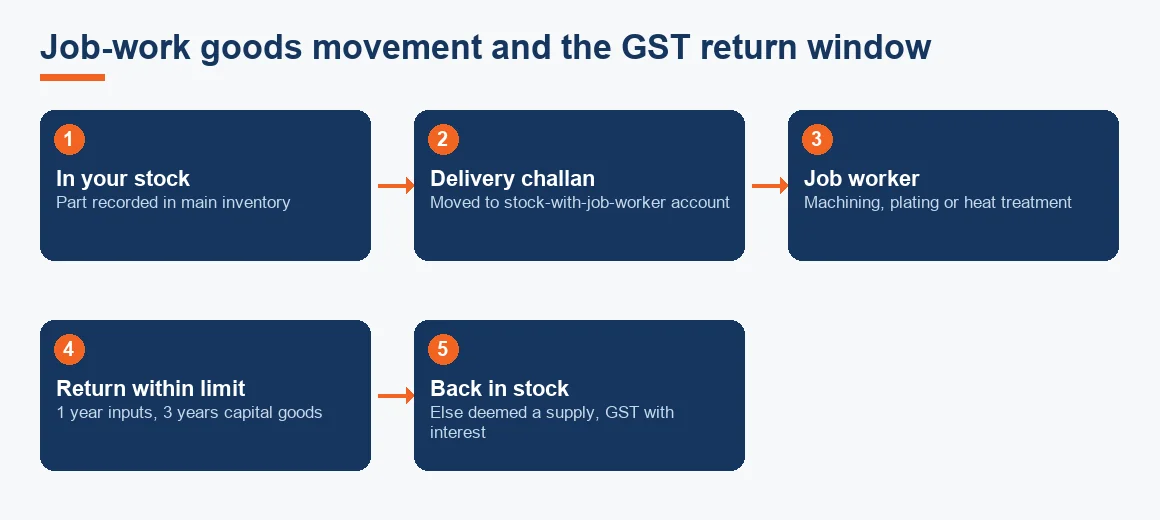
The trap is the return window set by the CBIC under the job-work provisions of GST. Inputs must return within one year of being sent out, and capital goods within three years. If they do not, the original movement is deemed a supply on the date of the challan, and GST becomes payable on that value with interest running from that date. That is a nasty surprise to discover in an audit, because the liability is backdated. You report these movements in Form ITC-04, the return that reconciles what went out against what came back, so keep the challan register clean and reconcile it every quarter.
Tooling and die cost: capitalise or expense?
Dies, moulds and fixtures are expensive and their treatment depends on who owns them. Where the tooling is owned by you, the supplier, it is capitalised as plant and amortised over the expected volume of parts it will produce rather than written off in year one. Take a die costing Rs 12,00,000 expected to produce 6,00,000 pieces: that adds Rs 2 of tooling cost to each part, and that Rs 2 belongs in your per-part cost when you quote. A units-of-production basis matches the cost to the parts it makes; you can model the schedule with our depreciation calculator.
Where the customer funds the tooling and retains ownership, which is common with OEM-supplied dies, the money you receive is not your revenue and the die does not sit on your balance sheet at all. You are merely holding and using the customer's asset. Booking that receipt as income would inflate turnover and distort margin, so keep it off the profit and loss account and disclose the arrangement in the notes.
Worked example: building the cost of one component
To see how the pieces come together, here is a per-unit costing worksheet for a single machined part, a forged steel bracket running on a repeat order. The figures are indicative and Exl GST, but the method is exactly what you apply on your own bill of materials.
| Cost element | Basis | Per component (Rs) |
|---|---|---|
| Direct material | Steel forging blank, net of input tax credit and inclusive of freight inward | 46.00 |
| Direct labour | Machining, deburring and inspection time | 18.50 |
| Fixed factory overhead absorbed | Rs 11,00,000 monthly overhead on normal capacity of 50,000 parts | 22.00 |
| Tooling amortisation | Rs 12,00,000 die over an expected 6,00,000 pieces | 2.00 |
| Cost per component (AS 2 carrying value) | Sum of the above, before margin | 88.50 |
At an OEM price of, say, Rs 99.00 per part (indicative, Exl GST), this leaves a gross margin of Rs 10.50, a little under 11 per cent. Run the line below its normal 50,000-part capacity and the overhead per part climbs, the unabsorbed portion going to the profit and loss account, which is exactly why the absorption discipline in the sections above matters when you quote.
Who needs to worry about this
This applies to any component supplier in the belt that carries meaningful inventory and sends work out: forging and casting units, plastic-moulding shops, machining job workers, wiring-harness assemblers and the tier-two feeders behind them. If you buy material, add labour and overhead, and dispatch a physical part to an OEM or a tier-one, the AS 2 model and the job-work rules are yours to run. Pure traders and service vendors do not carry work in progress and can largely skip the conversion-cost mechanics. New units still setting up their books will find our note on choosing an accountant in Pune useful, and the monthly rhythm is laid out in our bookkeeping and MIS checklist for Pune businesses.
Do you have to maintain cost records?
Machinery and auto components fall in the non-regulated sectors of Table B to the Companies (Cost Records and Audit) Rules 2014, notified by the MCA. Two separate thresholds matter and people conflate them.
| Obligation | Trigger |
|---|---|
| Maintain cost records | Overall turnover crosses Rs 35 crore in the preceding financial year |
| Cost audit | Overall turnover reaches Rs 100 crore and individual product turnover reaches Rs 35 crore |
So a Rs 60 crore component maker must maintain cost records but is not subject to cost audit; a Rs 120 crore unit with a single product line above Rs 35 crore is caught by both. Even below Rs 35 crore, keeping structured cost records is good practice because it is the same data your cost of goods sold and pricing decisions run on. One more local point on payables discipline: the Section 43B(h) MSME clock disallows a deduction if you do not pay a registered micro or small supplier within the agreed window (45 days at most), and the belt is thick with MSME job workers, so settle their bills on time or lose the expense in the year.
The month-end costing close, step by step
A clean close each month keeps the annual accounts from becoming a reconstruction exercise. The sequence below is what most well-run units in the belt follow.
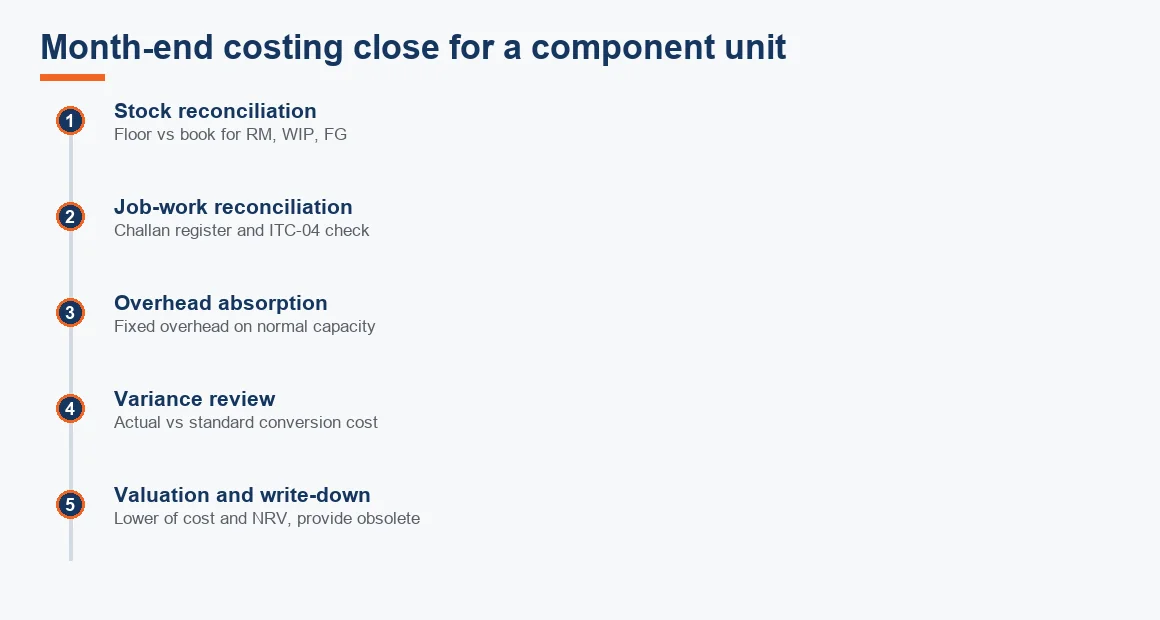
- Physical and book reconciliation: tally floor stock against the system for raw material, work in progress and finished goods, and investigate gaps before they compound.
- Job-work reconciliation: reconcile the stock-with-job-worker account and the challan register, flagging anything approaching the one-year input or three-year capital-goods limit.
- Overhead absorption: apply fixed factory overhead on normal capacity and route any under-absorption to the profit and loss account.
- Variance review: compare actual conversion cost against standard, part by part, and pull the outliers for the pricing conversation.
- Valuation and write-down: value each pool at lower of cost and net realisable value, and provide against obsolete or discontinued-model stock.
Run consistently, this feeds a reliable gross margin and a defensible closing-stock figure. Suppliers weighing whether to keep this in house or outsource can benchmark the effort against our note on the cost of accounting and bookkeeping in Pune; those who also sell spares online through marketplaces will want the companion piece on settlement reconciliation for Pune D2C sellers.
Key terms
- Work-in-Progress (WIP) Valuation: costing partly finished parts at the material and conversion cost incurred to the stage reached.
- Form ITC-04 Job Work Tracking: the GST return that reconciles goods sent to and received back from job workers.
- Direct vs Indirect Factory Overheads: splitting costs that attach to a part from those absorbed on normal capacity.
- Bill of Materials (BOM) Costing: building a part's standard cost from its component list and routing.
- Standard Cost Variance: the gap between standard and actual cost that signals where to reprice.
Key takeaways
- Value raw material, work in progress and finished goods separately at the lower of cost and net realisable value under AS 2.
- Absorb fixed factory overheads on normal capacity; send under-absorption straight to the profit and loss account.
- Goods sent for job work stay in your inventory and must return within one year (inputs) or three years (capital goods), or the movement is deemed a supply with backdated GST.
- Amortise supplier-owned tooling over expected part volume; customer-owned tooling is neither your revenue nor your asset.
- Cost records become compulsory above Rs 35 crore turnover; cost audit needs Rs 100 crore overall and Rs 35 crore per product.
None of this is exotic accounting, but in a just-in-time cluster the volume of movements makes discipline the whole game. If you would rather have this run for you end to end, our Manufacturing Accounting Services team handles cost records, job-work reconciliation and month-end close for units across the Chakan-Pimpri belt, and general bookkeeping support sits under accounting and bookkeeping services in Pune.