- What is FSSAI, and is a food licence the same as FSSAI?
- FSSAI is the Food Safety and Standards Authority of India, the national food safety body under the Ministry of Health and Family Welfare. It sets food standards and oversees food businesses. A "food licence" is the everyday name for an FSSAI registration or licence, the same thing. Small businesses take a basic registration; larger ones a State or Central licence.
- What is FoSCoS?
- FoSCoS (the Food Safety Compliance System) is FSSAI's online portal. Every application for a registration or licence, every change and every return is filed there, so you can apply from anywhere without visiting an office.
- Is FSSAI registration mandatory?
- Yes. No one may start or carry on a food business (making, storing, selling, transporting or importing food) without an FSSAI registration or licence. That includes small businesses, restaurants, cafes, traders, exporters and online sellers; delivery apps and marketplaces also ask for it, and packaged food must show the FSSAI number. The rule is regulation 5(7) of the Food Safety and Standards (Labelling and Display) Regulations, 2020.
- Do I need FSSAI for a home kitchen, tiffin service or cloud kitchen?
- Yes. A home kitchen or tiffin service can register with your home as the premises, and usually needs a basic registration. From 1 April 2026, registration covers turnover up to ₹1.5 crore. A cloud kitchen needs a registration or licence for each kitchen location, chosen by its turnover and kind of business. Some cities also ask for a local health or trade licence.
- Which FSSAI licence do I need: basic, State or Central?
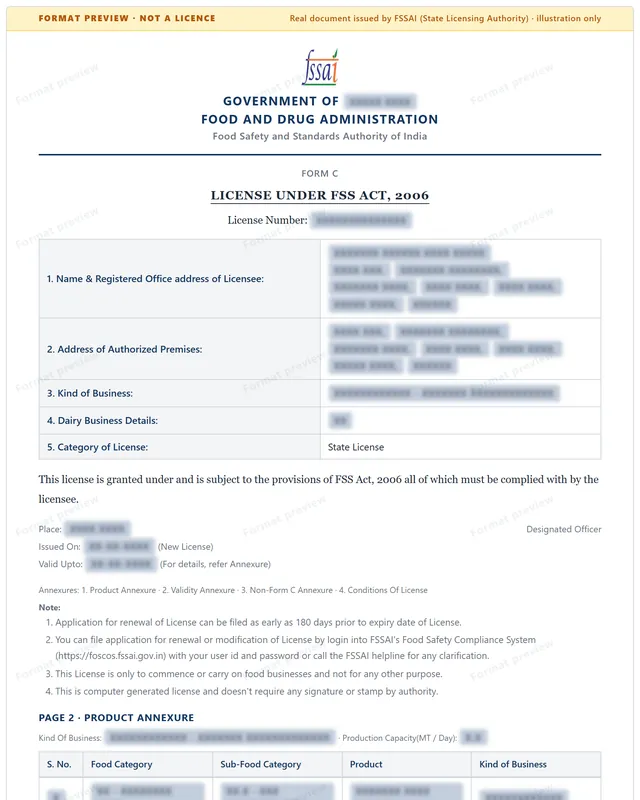
- It depends on your turnover and kind of business. From 1 April 2026, for applications made on or after that date: registration for turnover up to ₹1.5 crore, a State licence above ₹1.5 crore up to ₹50 crore, and a Central licence above ₹50 crore. Importers, businesses in more than one State and some other kinds of business need a Central licence whatever their turnover. A registration uses the shorter form; a licence the fuller form. (Form A for a registration, Form B for a licence: Schedule 2 of the Regulations)
- How much does an FSSAI licence cost?
- ₹100 a year for a basic registration, ₹5,000 a year for a State licence and ₹7,500 a year for a Central licence (FoSCoS fee schedule), paid online on FoSCoS. Hawkers (itinerant or mobile food vendors) and Anganwadi centres pay no registration fee: FoSCoS shows the fee as waived from 28 September 2024 for hawkers and from 12 March 2025 for Anganwadi centres. Registrations and licences no longer run for a fixed term, but the fee is still payable: you can pay for any number of years at once, at any time of the year. Our professional fee is Starting from ₹999 (Exl GST and Govt. Charges).
- What documents are required for an FSSAI licence?
- For a registration: photo identity, a photograph, proof of premises and a list of food products. For a licence, also the business's constitution papers, an authority letter, a layout plan and equipment list for manufacturers, a water test report where water is used, a food safety plan and an IEC for importers. Some States ask for a local health NOC. The Regulations list the documents in Annexure 2 of Schedule 2.
- How do I apply for an FSSAI registration?
- Work out which permission you need, create a login on FoSCoS, fill in the application, upload the documents, pay the fee and submit. The authority checks it (and for a licence may inspect the premises) and then issues the certificate on FoSCoS.
- How long does it take to get an FSSAI licence?
- A registration is quicker than a licence, because a licence may involve an inspection. Section 31(4) of the Act lets the applicant start the business if a licence is neither issued nor refused within two months of the application. We give you a dated plan when we start.
- Does an FSSAI licence expire? Do I need to renew it?
- Under the Food Safety and Standards (Licensing and Registration of Food Businesses) Amendment Regulations, 2026 (notified 10 March 2026), FSSAI licences and registrations stay valid unless suspended, cancelled or surrendered, and need no renewal. Any licence or registration issued on or after 1 April 2026 has this validity. A licence or registration issued before 1 April 2026 carries the expiry date it was issued with (1 to 5 years under the earlier regulation 2.1.7). If your licence shows an expiry date, talk to us before that date.
- How do I download my FSSAI certificate or check a number?
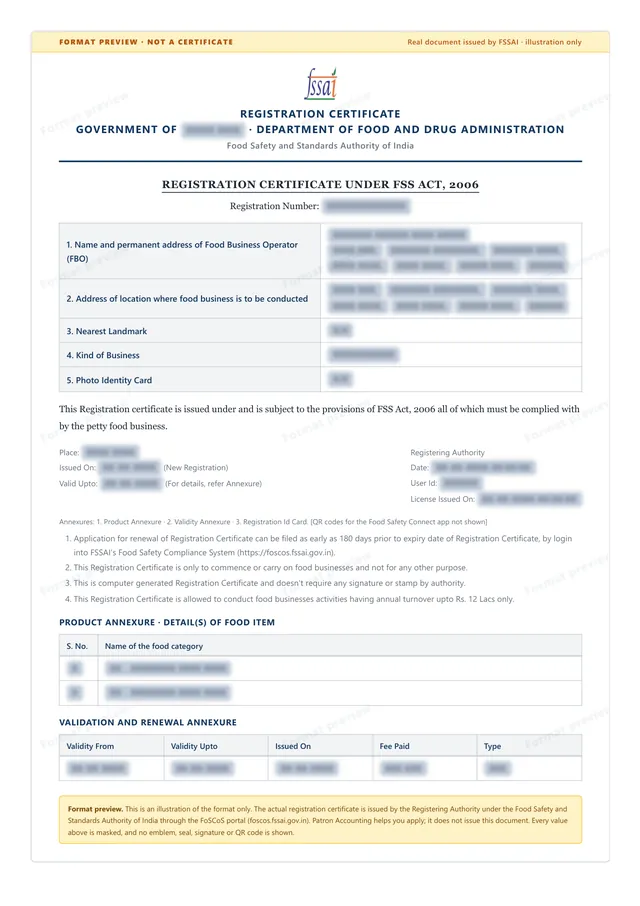
- Sign in to FoSCoS, open your licence or registration and download the certificate. The FSSAI number is printed near the top with the business name and premises. Anyone can check a number with the licence search on FoSCoS. The number has 14 digits; a licence number starts with 1 and a registration number with 2.
- What is the penalty for running a food business without an FSSAI licence?
- You need the registration or licence before you start. Under Section 63 of the Act, a person who must hold a licence and makes, sells, stores, distributes or imports food without one can be punished with imprisonment of up to six months and a fine of up to ₹5 lakh. It is an offence tried by a court (a Judicial Magistrate of the first class or a Metropolitan Magistrate under Section 73) and not a penalty fixed by an officer. Delivery apps and marketplaces will also delist a business without a valid FSSAI number.
- What is the difference between FSSAI and the FDA?
- The US FDA regulates food and drugs in the United States and does not license Indian food businesses. In India, FSSAI sets national food standards and issues Central licences, and each State's food safety department (called the FDA in some States) issues registrations and State licences under the same Act.
- How do I change details or cancel my FSSAI registration?
- Changes (address, products, partners, capacity) are made by applying for a modification on FoSCoS. If you close the business, you surrender the registration or licence on FoSCoS. A change of the mobile number on your login is made through your FoSCoS profile.