
In this guide
A monthly bookkeeping and MIS checklist for a Pune business is a fixed list of tasks that closes the books by a set date and produces a short management pack: the trial balance, the profit and loss, the balance sheet, and a page or two of numbers the owner can actually act on. If your accountant is only handing you a P&L at year end, you are missing the pack that a growing Pune SME, whether a Hinjewadi SaaS firm or a Chakan component maker, should already be receiving every month. This guide sets out what belongs in that pack, the close steps behind it, and the statutory dates that pin the calendar. It is an explainer, not a sales page; if you want the work done for you, that sits with our accounting and bookkeeping services in Pune.
What goes into a monthly bookkeeping and MIS pack
Split the pack in two. The bookkeeping half is the record: every sale, purchase, bank line and journal posted and reconciled, so the trial balance ties and the general ledger is complete. The MIS half is the interpretation: what the recorded numbers say about margin, cash and collections. A Pune owner needs both, because a tidy ledger that nobody reads and a dashboard built on half-posted books are equally useless.
A workable monthly pack contains the three primary statements (P&L, balance sheet, cash position), a receivables and payables ageing, a short variance note against the prior month or budget, and a compliance status line confirming GST, TDS and professional tax are filed and paid. Keep it to a few pages. The point of MIS is that a busy founder reads it in ten minutes, not that it wins an audit prize.
The month-end close: a step-by-step checklist
The close is the routine that turns raw transactions into a signed-off set of books. Run it in the same order every month so nothing is skipped when the team is busy.
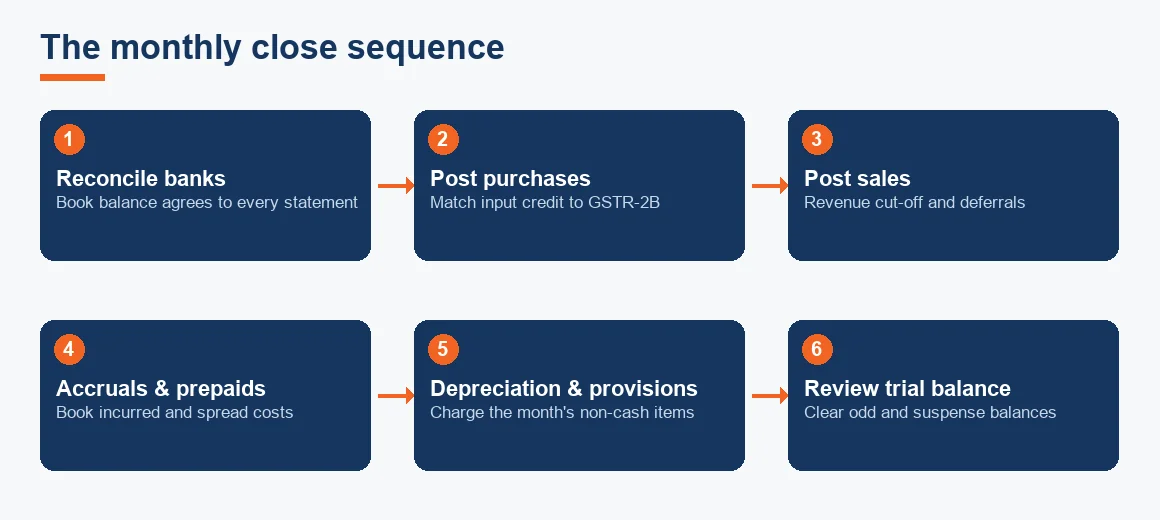
- Reconcile every bank and card account. The book balance must agree to the statement, with timing differences listed. Nothing else is reliable until this is done.
- Post and match purchases. Enter vendor bills, then match input credit against the auto-drafted GSTR-2B so you only claim what actually appears.
- Post sales and revenue cut-off. Recognise revenue in the correct month; for a SaaS or service firm, split advance receipts into earned and deferred.
- Run accruals and prepaids. Book expenses incurred but not billed, and spread prepaid costs such as insurance or annual software.
- Depreciation and provisions. Charge the month's depreciation and any provision for doubtful debts.
- Review the trial balance. Scan for odd balances, suspense entries and negative stock, and clear them before you publish.
- Build the MIS and file compliance. Generate the statements, write the variance note, and confirm statutory returns are paid.
Two related Pune reads sit alongside this: costing discipline for auto-component makers is covered in our note on costing and inventory accounting for Chakan-Pimpri makers, and marketplace sellers should read settlement reconciliation for Pune D2C sellers before closing a month with heavy Amazon or Flipkart flow.
Statutory deadlines a Pune business tracks each month
Three statutory streams drive the monthly calendar in Maharashtra: GST, TDS and professional tax. Miss a date and the cost is interest and, for GST, a hard late fee, so these belong on the checklist as non-negotiable line items rather than as afterthoughts.
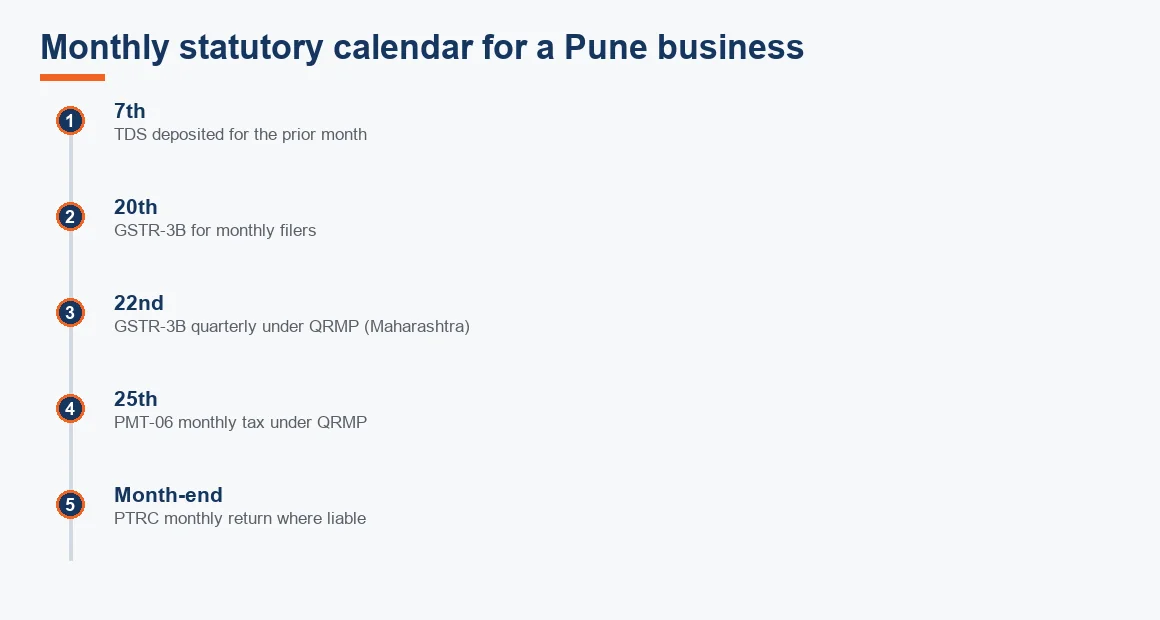
GST is the anchor. A monthly filer lodges GSTR-3B by the 20th of the following month. A Maharashtra business under the QRMP scheme, open to turnover up to Rs 5 crore, files GSTR-3B quarterly by the 22nd of the month after the quarter and still pays tax every month in Form PMT-06 by the 25th. Late payment carries interest at 18 percent a year. The rule and the current dates are set out by the CBIC and returns are lodged on the GST portal.
TDS is the second stream. Tax deducted in a month must be deposited by the 7th of the following month, with the single exception of March, which may be paid up to 30 April. Quarterly TDS statements in Form 24Q and 26Q fall on 31 July, 31 October, 31 January and 31 May. Late deposit of tax you have already deducted attracts interest at 1.5 percent a month; the mechanics are published by the Income Tax Department.
| Obligation | Who it applies to | Monthly due date | Late cost |
|---|---|---|---|
| GSTR-3B (monthly) | Turnover above Rs 5 crore, or opted monthly | 20th of following month | Interest 18% p.a. plus late fee |
| GST PMT-06 (QRMP) | Turnover up to Rs 5 crore, opted QRMP | 25th of following month | Interest 18% p.a. |
| TDS deposit | Any deductor | 7th of following month | Interest 1.5% per month |
| PTRC (monthly) | Prior-year PT liability above Rs 1,00,000 | Last day of following month | Interest and penalty |
Professional tax in Maharashtra: PTEC and PTRC
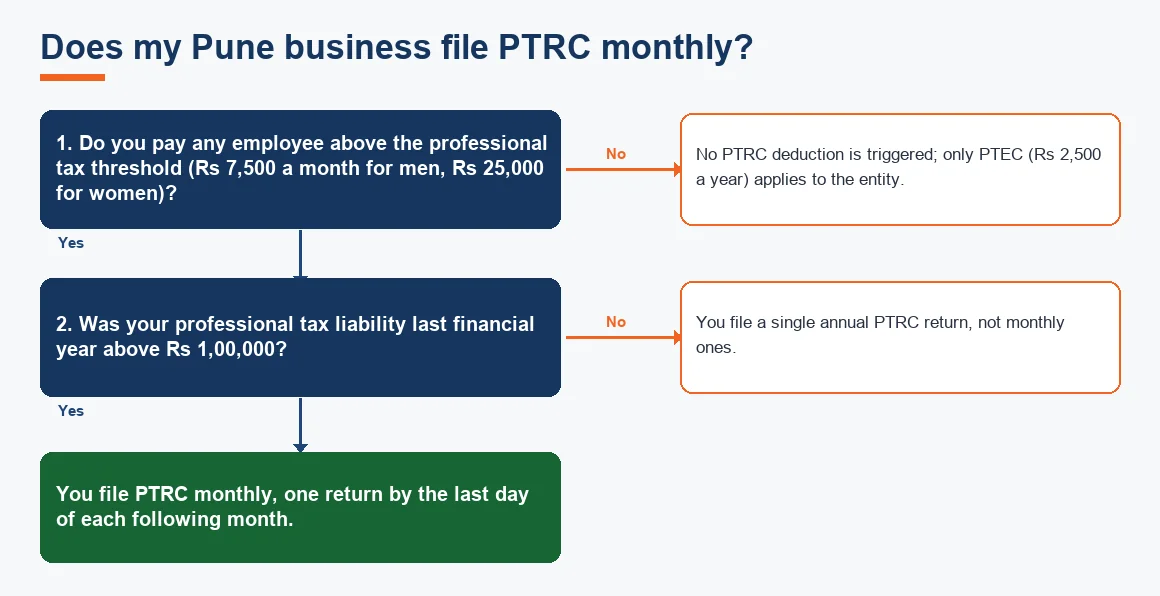
Professional tax is the local angle that trips up owners who have run a business elsewhere. A comparable firm in Delhi or Haryana pays no professional tax at all; a Pune firm pays two kinds. PTEC, the enrolment certificate, covers the entity or proprietor at Rs 2,500 a year, payable by 30 June. PTRC, the registration certificate, covers salaried staff, where deduction starts once monthly salary crosses Rs 7,500 for men, or Rs 25,000 for women.
When PTRC is monthly rather than annual
PTRC returns are monthly where the professional tax liability in the previous financial year exceeded Rs 1,00,000, and annual where it was Rs 1,00,000 or less. So a Pune employer whose prior-year liability was, say, Rs 1,45,000 files twelve returns, one by the last day of each following month, not a single annual one. Getting this frequency wrong is a common source of small, avoidable penalties.
What the MIS should tell a Pune SME owner
A P&L on its own answers one question: did we make a profit. Good MIS answers the ones an owner actually loses sleep over. Add a receivables ageing schedule and a days sales outstanding figure so you can see collection slipping before it becomes a cash crunch. Add a variance note so a jump in cost is explained, not just reported. For a product or SaaS business, a contribution margin view separates the lines that fund overheads from the ones that drain them.
Keep the metric set small and stable. Owners trust a dashboard they see every month with the same definitions; they ignore one that reinvents itself. If you are weighing whether to build this in-house or hand it over, our guide to choosing an accountant in Pune across Hinjewadi, Kharadi and Baner works through the trade-off, and the local price bands are set out in our 2026 Pune cost benchmarks. SaaS founders can see the sector-specific version of this pack on our Pune SaaS accounting page.
Bookkeeper or accountant: does a Pune business need both?
Bookkeeping and accounting are different jobs, and the honest answer for most Pune SMEs is that you need both, though rarely two separate hires early on. A bookkeeper records: they post invoices, reconcile the bank and keep the ledger current. An accountant interprets: they set up the chart of accounts, sign off the close, prepare the MIS, and take the statutory and tax positions. In a small firm one person or one outsourced team does both; as volume grows the recording work is delegated while the interpretation stays senior. What you should not do is buy only the recording half and assume the interpretation happens by itself.
The difference between bookkeeping and accounting, in one line each
Bookkeeping is the disciplined, daily act of recording transactions accurately and reconciling them. Accounting is the wider work of classifying, summarising and interpreting those records into statements and decisions, and carrying the compliance and tax judgement that goes with them. Bookkeeping is the input; accounting is the output plus the thinking. Both rest on the same foundation of double-entry discipline, which is why sloppy books can never be rescued by clever reporting.
Worked example: a Pune SaaS SME's monthly statutory schedule
Take a small Hinjewadi SaaS company for the month of August 2026. It has one senior salary above the PT threshold, deducts TDS on rent and contractor fees, and files GST monthly. The figures below show what the close should confirm as due, and by when. All amounts are illustrative.
| Item | Basis | Amount (Rs) | Due date |
|---|---|---|---|
| GST net payable | Output tax less matched GSTR-2B credit | 84,000 | 20 Sep 2026 (GSTR-3B) |
| TDS on office rent, Sec 194-I | 10% on Rs 60,000 | 6,000 | 7 Sep 2026 |
| TDS on contractor, Sec 194C | 2% on Rs 1,50,000 | 3,000 | 7 Sep 2026 |
| Professional tax, PTRC | Rs 200 for one liable employee | 200 | 30 Sep 2026 |
| Total statutory outflow | 93,200 |
The point of laying it out this way is that the close does not just tell the owner the profit for August; it produces a dated payment schedule of Rs 93,200 that protects them from interest at 18 percent on the GST and 1.5 percent a month on the TDS. That is the difference between books that record the past and a pack that manages the next thirty days.
Key terms
- Month-End Close Checklist: the fixed sequence of tasks that finalises a month's books.
- Bank Reconciliation: matching the book balance to the bank statement and listing timing differences.
- GSTR-2B Input Tax Credit Matching: verifying claimed GST credit against the auto-drafted 2B statement.
- Trial Balance: the list of ledger balances that must agree before statements are drawn.
- Accounts Receivable Ageing Schedule: receivables grouped by how long they have been outstanding.
Key takeaways
- A monthly pack is closed books plus a short, readable MIS, not just a year-end P&L.
- Fix a close date, run the same seven-step sequence, and start with the bank reconciliation.
- Track GST (20th or 22nd), TDS (7th) and Maharashtra professional tax every single month.
- PTEC is Rs 2,500 a year by 30 June; PTRC turns monthly once prior-year liability tops Rs 1,00,000.
- Good MIS reports ageing, DSO, variance and margin, so the owner acts before problems harden.
If interpreting these numbers is not something you want to own in-house, that commercial work sits with the accounting and bookkeeping services in India team and the wider process, software and industry hub. For a couple of the calculations behind the close, our depreciation calculator and deferred tax calculator may save time. Statutory dates in this guide reflect positions published by the CBIC and the Income Tax Department as at July 2026; always confirm current dates before filing.
Decision guide