Tool
GSTR-9 annual return checklist
Work through the year's checks before the return is prepared.

GST Compliance
In short: the GST annual return, GSTR-9, brings together a whole financial year of monthly or quarterly returns in one statement: sales, credit taken, tax paid, and the corrections made during the year. Where aggregate turnover for the year is above ₹5 crore, a self-certified reconciliation statement, GSTR-9C, is filed with it. We reconcile your books with your returns, prepare both forms, and file them before the due date.

The annual return
Through the year, GSTR-1 and GSTR-3B report each period on its own. The annual return asks a different question: do the twelve months, taken together, agree with each other and with your books of account?
It is the last point at which several things can be put right for the year.
Because the annual return is compared with your financial statements and with what your suppliers and customers have reported, it is also where most later notices begin. A careful annual return is the cheapest form of protection against them.
Input tax credit on an invoice or debit note for the year cannot be taken after 30 November following the end of the financial year, or after the date the annual return is filed, whichever is earlier (section 16(4)). Filing GSTR-9 early therefore closes the door on any credit you have not yet claimed.
Turnover that was left out of GSTR-1 or GSTR-3B during the year shows up when the books and returns are compared. Additional tax found in this way is paid, with interest.
Credit on supplies from a supplier who did not file GSTR-3B by 30 September after the year is reversed by 30 November under rule 37A, and re-claimed once the supplier files.
Who it applies to
Filed by regular taxpayers registered under GST for the year.
Exempt up to ₹2 croreBusinesses whose aggregate turnover in a financial year is up to ₹2 crore are exempt from filing the annual return (GSTR-9) for that year, from FY 2024-25 onwards (Notification 15/2025-Central Tax, 17 September 2025, first proviso to section 44(1)).
A self-certified reconciliation statement between the annual return and the audited financial statements.
Above ₹5 croreEvery registered person whose aggregate turnover in the financial year is above ₹5 crore files it together with GSTR-9, by 31 December after the end of the year (rule 80(3)). The statement is certified by the taxpayer itself. Many businesses still have it prepared by a Chartered Accountant, because it is often the first document an officer reads.
Annual return due
31 December following the end of the financial yearUnless the date is extended by notification. GSTR-9C, where required, is filed with GSTR-9 by the same date (rule 80(3)).
How we work
Eight steps, in the order they happen. You see every reconciliation before anything is filed.
We download the year's GSTR-1, GSTR-3B and GSTR-2B from the portal and take your books of account (trial balance, sales and purchase registers, and the audited or provisional financial statements).
Turnover in the books is compared with turnover reported in GSTR-1 and in GSTR-3B, month by month. Differences are explained: credit notes, advances, exempt and non-GST supplies, supplies in the next year's returns, and genuine omissions.
Tax liability on the turnover is compared with tax actually paid through GSTR-3B. Any shortfall is worked out with the interest due, so it can be paid through Form DRC-03 before the return is filed.
Credit taken in GSTR-3B is compared with credit available in GSTR-2B and with the purchase register. We separate credit on inputs, input services and capital goods. We also identify credit that is blocked (section 17(5)), credit that should have been reversed (rule 37A, rules 42 and 43), and credit still unclaimed before the section 16(4) cut-off.
The tables are filled from the reconciled figures, including the amendments made in the next year's returns that relate to this year.
The reconciliation between the audited turnover and tax and the annual return is prepared, with the reasons for each difference and any additional liability.
You see the reconciliations, the differences and any tax to pay before anything is filed.
Any additional tax and interest is paid through DRC-03, and GSTR-9 (and GSTR-9C) is filed with your digital signature or an electronic verification code.
DRC-03A. Payments made through DRC-03 towards a demand can later be linked to that demand order through Form DRC-03A, so they are credited correctly in the liability register (Notification 12/2024-Central Tax).
The form
GSTR-9 is organised in parts. Knowing what each one is for makes the reconciliation easier to follow.
| Part | What it covers | Where the figures come from |
|---|---|---|
| Part I | Basic details: GSTIN, legal and trade name, financial year | Registration |
| Part II | Outward and inward supplies on which tax is payable, declared in the year's returns: taxable, zero-rated, reverse charge, advances, credit and debit notes | GSTR-1 and GSTR-3B, reconciled with the books |
| Part III | Input tax credit availed in the year, split into inputs, input services and capital goods, and credit reversed | GSTR-3B, GSTR-2B and the purchase register |
| Part IV | Tax paid as declared in the returns, in cash and through credit | GSTR-3B and the electronic ledgers |
| Part V | Transactions for this year declared in the next year's returns, up to the cut-off | The next year's GSTR-1 and GSTR-3B |
| Part VI | Other information: demands and refunds, HSN summaries of outward and inward supplies, late fee paid | Orders, refund applications, item-level data |
A credit note issued in May for a sale made in February, or credit on a March invoice taken in the April return, belongs to the earlier year, and has to be reported in Part V so the year's figures agree.
Worked example
An example of how differences between the books and the returns are explained; not client figures.
A trading company's books show sales of ₹6,20,00,000 for the year. Its GSTR-1 filings for the year total ₹6,05,00,000. The difference of ₹15,00,000 is explained line by line:
| Reconciling item | Amount | Treatment |
|---|---|---|
| Sales of exempt goods, recorded in books but correctly not taxed | ₹4,00,000 | Reported in the exempt table, not as taxable |
| March invoices reported in the April GSTR-1 | ₹6,50,000 | Reported in Part V |
| Credit notes for the year issued in the next year | ₹1,50,000 | Reported in Part V |
| Sale of scrap recorded in books, never invoiced or reported | ₹3,00,000 | Taxable supply missed: tax and interest paid through DRC-03 |
| Total explained | ₹15,00,000 | Every line has a reason |
Only one item (the scrap) is a real omission. The other three are timing or classification differences that the annual return is designed to show. Without the line-by-line explanation, all ₹15,00,000 would look like unreported sales to an officer comparing the books with the returns.
The same exercise is done for tax paid and for credit. On the credit side, the common reconciling items are: credit on invoices not in GSTR-2B (to be reversed or explained), blocked credit (to be reversed), credit reversed under rule 37A and re-claimed after the supplier filed, and credit of this year taken in the next year's returns before the section 16(4) cut-off.
Timing
The annual return is due by 31 December after the year. Filing early has one hidden cost: credit for the year cannot be taken after the annual return is filed, if that is earlier than 30 November.
A business that files GSTR-9 in October therefore gives up any credit for the year that it has not already taken by then.
We complete the credit review (including supplier follow-up) before the 30 November cut-off, take any remaining eligible credit in the return for that period, and then file the annual return. That way nothing is lost to the timing of the filing.
Several registrations
An annual return is filed for each GSTIN separately. A business with registrations in several States files one GSTR-9 for each, even though it prepares one set of financial statements. Turnover in the books therefore has to be split by GSTIN before it can be reconciled: by State, by branch, or by whatever division the accounts allow.
The ₹5 crore threshold for GSTR-9C is tested on aggregate turnover, which is worked out across all registrations on the same PAN.
(CGST Rules rule 80(3) tests aggregate turnover during the financial year, and section 2(6) computes it on an all-India basis for persons with the same PAN.)
Stock transfers and shared services
Supplies between your own GSTINs in different States (stock transfers, shared services) are treated as supplies between distinct persons and must appear on both sides. Under Schedule I, paragraph 2 of the CGST Act, a supply between distinct persons or related persons made in the course or furtherance of business is a supply even without consideration. Its value is worked out under CGST Rules rule 28. They are one of the most frequent sources of difference in multi-State reconciliations.
Side by side
| Point | GSTR-9 | GSTR-9C |
|---|---|---|
| What it is | The annual return | A reconciliation statement |
| Who files | Regular taxpayers (exempt where aggregate turnover is up to ₹2 crore, FY 2024-25 onwards) | Aggregate turnover above ₹5 crore |
| Compares | The year's returns with each other and with the books | The annual return with the audited financial statements |
| Certified by | The taxpayer | The taxpayer (self-certified) |
| Due | 31 December after the year | With GSTR-9 |
| Based on | Returns plus books | Audited accounts plus GSTR-9 |
In practice the two are prepared together. The GSTR-9C reconciliation often finds items that change GSTR-9 (a missed supply, a credit to reverse) so we finish both before either is filed. See GSTR-9C reconciliation for the statement itself.
Credit
The year-end view of credit regularly surfaces issues that monthly filing did not.
If a supplier had not filed GSTR-3B for a period by 30 September after the year, credit on their invoices for that period is reversed by 30 November, with interest, and re-claimed once they file (rule 37A). The annual return is where the reversal and any re-claim are reported.
Since 1 April 2025, common input services from third parties used by more than one GSTIN must be distributed through an Input Service Distributor registration (Notification 16/2024-Central Tax). Credit for such services taken directly by one branch is a reconciliation item.
Credit on capital goods is shown separately from inputs and input services, and credit on capital goods used partly for exempt supplies is reversed over their life under rule 43. See ITC on capital goods.
Credit on items in section 17(5) is reversed.
If any eligible credit is still unclaimed, it must be taken before the cut-off.
Composition scheme
A business in the composition scheme does not file GSTR-9. It pays tax every quarter through CMP-08 and files an annual return in GSTR-4. CMP-08 is due by the 18th of the month after each quarter, and GSTR-4 by 30 June after the financial year (from FY 2024-25; 30 April for earlier years) (CGST Rules, rule 62).
A business that crosses the limit during the year leaves the scheme, and from that point files regular returns. In that year it may need both an annual return for the composition period and one for the regular period. See GSTR-4 filing.
Which annual returns are due in the year of the switch depends on the facts of the case.
What goes wrong
The order of work
The annual return is easier, and cheaper, when the work is spread across the months after the year ends. For a financial year ending 31 March, we work to this order:
Section 16(4) sets 30 November following the end of the financial year as the last date for the year's credit, so these dates fall in the year after the financial year.
Businesses that follow this order rarely have a surprise in December. Businesses that start in December usually find that some credit can no longer be taken.
Before you sign
Before you sign or approve GSTR-9, ask for (and look at) five things:
From your financial statements to the turnover in GSTR-9, with a reason for every line
Showing tax payable on that turnover and tax actually paid
From the purchase register and GSTR-2B to the credit in GSTR-9
With the interest, and proof that it has been paid
What belongs to this year but was reported next year
If any of the five is missing, the return is not ready. We give you all five as a pack with every annual return.
Own returns
Several kinds of registration file their own returns and are outside GSTR-9, and therefore also outside GSTR-9C:
A business with a normal registration and, say, a separate ISD registration files GSTR-9 only for the normal registration. Its ISD files GSTR-6 through the year. See GSTR-7 filing and GSTR-8 filing for the deductor and collector returns.
Quiet years
A registration that was active for the year but recorded few or no supplies still has an annual return to consider.
Whether a GSTR-9 is due for such a year depends on any exemption notified for that year (section 44(1), first proviso) and the facts of the case.
Even in a quiet year, three checks are worth doing: that every monthly return was filed (including nil returns), that no credit was taken on purchases for exempt or personal use, and that the electronic cash ledger does not hold an unused balance that could be refunded (a refund of excess cash ledger balance is not subject to the two-year time limit). See refund of excess cash ledger balance.
Where the business has stopped trading altogether, the annual return is one step in closing the registration properly. See GST registration cancellation.
Working with your auditor
Where your accounts are audited, the GST annual return and the audit touch the same figures. Agreeing these points with your auditor early saves rework:
A missed year
An unfiled annual return does not go away. The late fee and the three-year limit set out under 'Due date and late fee' above apply.
For a missed year, we start with the reconciliation in the same way, so the return when filed is complete and correct. We tell you the late fee and any tax and interest before you decide to file.
After filing
The annual return is often the starting point for the department's review of a year. Officers compare it with GSTR-1, GSTR-3B, GSTR-2B and your financial statements, and differences that are not explained in the return can lead to a notice. For tax periods up to FY 2023-24 notices are issued under sections 73 and 74; for later periods under section 74A. A departmental audit, if it comes, is preceded by at least 15 working days' notice.
If a scrutiny notice in Form ASMT-10 does arrive, see ASMT-10 GST Scrutiny Notice Reply and ASMT-11 Filing.
The reconciliation pack we prepare for the return is the document you will need if that happens. It shows every difference and why it arose, so a reply can be prepared from it rather than reconstructed from memory.
What to keep ready
Our checks
Scope
Our internal GST team does this work. How long it takes depends on the scope, so we confirm the timing when we quote. A Chartered Accountant on our team reviews the work before filing.
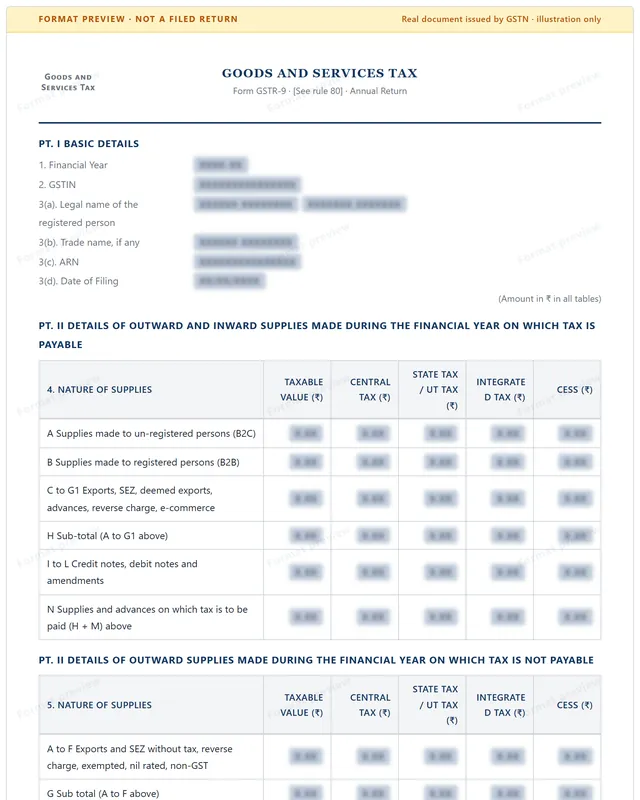
See a sample
GSTR-9 and GSTR-9C filing acknowledgement
The acknowledgement that the GST portal gives once Form GSTR-9 with Form GSTR-9C is filed.
Values hidden for privacy. Names, numbers and dates are covered. Your own document carries your details.
Download GSTR-9 and GSTR-9C filing acknowledgement sample (PDF) View GSTR-9 and GSTR-9C filing acknowledgement sample
What it costs
GST annual return filing
We confirm the fee in writing after seeing the year's data.
The fee depends on turnover, the number of GSTINs, the state of the books and whether GSTR-9C is required.
Forms
| Form | What it is for |
|---|---|
| GSTR-9 | Annual return for regular taxpayers |
| GSTR-9C | Self-certified reconciliation statement, turnover above ₹5 crore |
| GSTR-4 | Annual return for composition taxpayers |
| DRC-03 | Voluntary payment of tax and interest found short |
| DRC-03A | Linking a DRC-03 payment to a demand order |
Ready-to-use reconciliation formats will be published separately in our formats section.
Our review
Before an annual return is filed, a second person reviews the turnover, tax and credit reconciliations, confirms every difference has a stated reason, and checks the figures carried into each table.
Regulatory statements
Regulatory statements on this page are taken from the CGST Act and Rules and CBIC notifications, and are reviewed by CA Sundram Gupta.
Subham Jhunjhunwala, reviewed by CA Sundram Gupta
Get a quote
Send us your turnover and the number of GSTINs, and we will tell you what the year needs.
Leave your details and we will call you back.
By sending this form you agree to our privacy policy.
Sources used on this page