Stock turns over in days
Fresh and fast-moving items may be replenished several times a week, so the system can move a long way from the shelves between counts.

Stock Audit · Dark stores and quick commerce
An independent count of the stock in one dark store or a network of them, checked bin by bin against the inventory system, to show how accurate the system is, where stock is being lost and whose loss it is: the platform's, the operator's or the seller's who owns the goods. A dark store is a small warehouse closed to walk-in customers that serves quick-commerce orders, so its stock turns over in days and its records drift just as fast.

In short
A dark store, also run as a micro-fulfilment centre, holds a few thousand fast-moving items in a small space and ships them within minutes of an order. A stock audit of a dark store counts every bin, or an agreed sample, against the inventory system on one cut-off, and separates genuine loss from picking errors, unrecorded damages and returns, and stock that belongs to someone else.
This page covers what a dark store changes: counting while orders keep coming, bin-level accuracy, short-life goods, mixed ownership between platform, operator and seller, how a seller can check stock held in someone else's store, the records a dark store keeps, what the count usually finds and what moves the fee. What a stock audit is and how one is carried out in general are written once on our India-wide stock audit page.
What changes
A dark store packs a wide range into a small space and turns it over very fast. Six things follow from that.
Fresh and fast-moving items may be replenished several times a week, so the system can move a long way from the shelves between counts.
Many dark stores pick orders through most of the day and night, so the count is planned around picking, replenishment and returns rather than a closed store.
Pickers go to the bin the system shows. An item in the wrong bin causes a missed or substituted order even when the store's total is right.
Dairy, bakery, fruit and vegetables and other short-life goods expire or get damaged quickly, and must leave the system the day they leave the shelf.
Depending on the business model, the goods may belong to the platform, to a separate operator or to sellers, so the count has to be clear whose stock it is counting.
A network can run dozens of dark stores in one city. Results are compared store by store, so the stores with unusual losses are looked at first.
A lender's stock audit covers one asset class, is commissioned by a lender rather than required by the Companies Act, reports to that lender and gives no opinion on the accounts. Who can sign, and RBI's position, are under when a stock audit is needed on our India-wide stock audit page.
Scope
Each store is checked bin by bin, with short-life goods and ownership recorded as the count goes. The standard parts of a bank stock audit report are under what the stock audit report contains on our India-wide stock audit page.
| Area | What is checked |
|---|---|
| Quantity | Counted quantity against the system, item by item |
| Bin accuracy | Whether each item is in the bin the system shows |
| Short-life goods | Expired and near-expiry stock, chiller and freezer storage, and removal records |
| Damages and write-offs | Damaged goods awaiting disposal and how write-offs are recorded |
| Inward stock and returns | Deliveries not yet put away, customer returns and rejected deliveries |
| Ownership | Platform, operator and seller stock identified separately |
| Seller settlement (where in scope) | The sales and stock reports used to settle with sellers |
| Bank terms (where the stock is security) | Declared stores, insurance cover and drawing power |
Under AS 2 and Ind AS 2, inventory is carried at the lower of cost and net realisable value, so expired and damaged goods still on the shelf are written down rather than carried at cost.
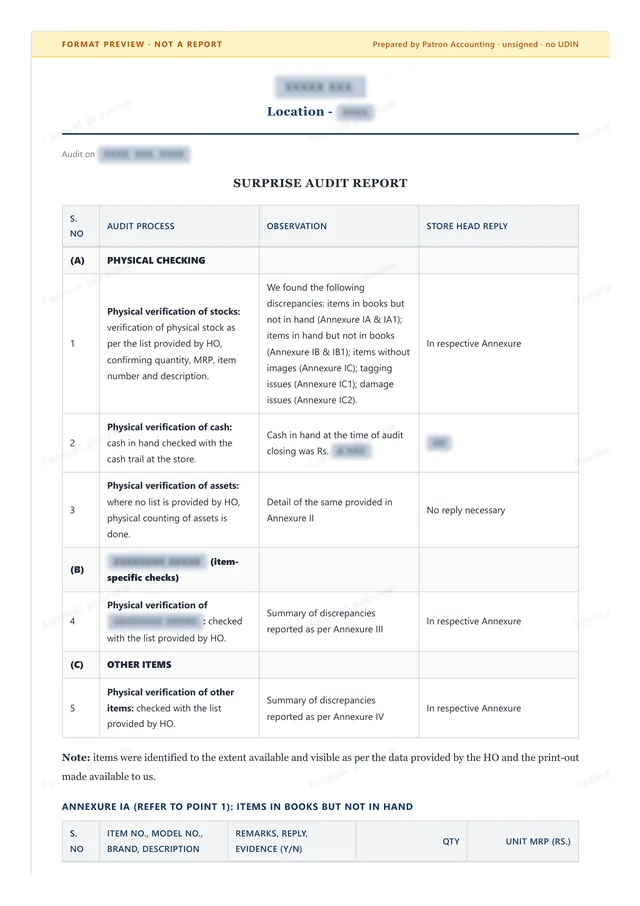
See a sample
Stock audit report
A summary of a stock audit report to the bank, with the stock and book-debt reconciliation and the drawing power.
Values hidden for privacy. Names, numbers and dates are covered. Your own document carries your details.
Download stock audit report sample (PDF) View stock audit report sample
Process
The method depends on the engagement scope: the number of stores, whether picking pauses during the count, and whether every bin or a sample is counted. Timing, such as counting in low-order hours or in a short planned pause, is agreed for each engagement. These are the steps a dark store adds to the general stock audit procedure.
Agree how orders, replenishment and returns during the count will be recorded, and hold inward put-away for the counting window where the scope allows.
You and the auditorUse the bin master to give every rack, chiller and freezer to one counter, so no area is missed and none is counted twice.
Auditor and shift leadRecord the item, quantity, condition and, for short-life goods, the expiry date, and note whose stock it is where several companies' goods share the store.
Field teamWhere inventory is material, SA 501 expects the auditor to attend the physical count, evaluate management's procedures, inspect the inventory and perform test counts. Sample size and test checks are designed using the principles of SA 530 (Audit Sampling), from the system to the bin and from the bin to the system.
AuditorRecount the differences, then trace each to an unrecorded pick, damage, return or put-away before calling it a loss.
Field team and shift leadAdjust for orders picked during the count, reconcile to the system and report by store, category and cause. How long the report takes depends on the scope and the team needed, and is confirmed with your quote.
Patron, to you or the bankThe dark store task
Dark store records lose accuracy faster than most warehouses, for reasons that repeat from one operator to the next. Each is small on its own; at high order volumes they add up within days, and the audit tests for each one.
A picker takes a similar item from the next bin: one order is wrong and two bins are now wrong. The count compares bins side by side, and the report shows pick accuracy problems as pairs of matching shortages and excesses.
Inward stock goes where there is space rather than where the system expects it, and cancelled or substituted items go back to any free slot. The count reports bin accuracy apart from quantity accuracy for exactly this reason.
Short-life goods leave the shelf but not the system. Food products are also subject to the Food Safety and Standards Act 2006, so storage conditions and remaining shelf life are recorded, and expired stock is listed apart from saleable stock.
Stock the system shows but the shelf does not have is offered to customers and then cannot be picked. A falling order fill rate is often the first sign; the count finds which items and bins are behind it.
Deliveries received in full in the system although some units were short or damaged create a shortage on day one that no picker caused. The count tests recent inward receipts against delivery documents so the loss is placed with the right party.
Under section 17(5)(h) of the CGST Act, input tax credit must be reversed on goods lost, stolen, destroyed, written off, or given as gifts or free samples. Losses the audit confirms should be written off with that effect in mind.
For brands and sellers
Brands and sellers who place stock with a quick-commerce platform usually see only the platform's reports. A count gives them their own evidence. These are the points to agree with the platform before it starts.
Which stores can be visited, when, and who from the platform will be present during the count.
Seller and platformThe item codes, lots or labels that identify the seller's goods, including returns waiting to be collected.
Seller and platformThe platform's stock report for the seller at the cut-off, so the count can be reconciled to it line by line.
PlatformThe seller's dispatches to the platform and the platform's damage, expiry and return reports for the period, so the count starts from figures both sides recognise.
Seller and platformHow damages, expiries and missing units are charged to the seller, so the count can test those charges and not only the quantities.
Seller and auditorHow differences found in the count will be settled, and by when, so the result leads to an adjustment rather than a dispute.
Seller and platformQuick-commerce platforms that collect payment for sellers also collect tax at source under section 52 of the CGST Act on the net value of those sellers' supplies. A seller who reconciles platform settlements and tax credits with its own stock records benefits from a count that shows exactly what stock the platform held.
What to keep ready
These are the records a dark store keeps that a general stock audit does not ask for. The general list, sanction letter to insurance policy, is under records to keep ready on our India-wide stock audit page.
What the count finds
The differences that come up most often in dark stores, the usual reason, and what to change before the next count.
| Finding | Usual cause | What to do |
|---|---|---|
| In the system but not in its bin | Mis-pick, wrong put-away or unrecorded damage | Scan the bin and the item at put-away and at picking; record damages at once |
| On the shelf but not in the system | Short-receipt or return not processed | Receive inward stock and returns by scan, line by line |
| Expired stock still saleable in the system | Expiry not checked daily | Walk the short-life categories for expiry every day |
| Large differences in one category | Look-alike items in adjacent bins | Separate look-alike items and review the bin labels |
| Seller stock mixed with platform stock | Weak ownership tagging | Track ownership by item and lot |
Daily cycle counts of a rotating set of bins, with fast-moving and short-life items counted most often, recording damages, expiries and returns as they happen, and a weekly look at negative stock and large manual adjustments keep the system close to the shelves. Where the stock secures a limit, note that many banks exclude obsolete, expired or slow-moving stock from drawing power, using ageing cut-offs set in their own policy and sanction letter.
Fees
A written quote once the stores, the bins and the picking arrangements are known. The general cost drivers of a stock audit are under what a stock audit costs on our India-wide stock audit page.
Professional fee
Get a quote Exl GST and Govt. Charges · final fee after scopingThe quote rises with the number of stores and bins and with how the count fits around picking. travel quoted per location Work usually starts within 3 to 5 working days of confirmation.
Fees exclude GST and government charges. All fees listed are indicative only and do not constitute a binding offer; the final amount is confirmed after a scoping review and depends on the volume of work and the complexity involved.
For a quote, send the number of dark stores, the approximate number of items and whether picking can pause, and you will receive the fee and the records list in writing.
How it is delivered
Patron Accounting runs stock audits across India through local field teams coordinated by Patron. Engagement planning, scope and quality review stay with Patron, and the report is reviewed and signed off by a Chartered Accountant.
Statements about audit frequency and ageing exclusions describe common bank practice; your own sanction letter decides how they apply to you.
Get a quote
Share the number of dark stores, the approximate number of items and whether picking can pause, and you will receive a quote and a list of records to prepare.
We reply on working days.
Not a dark store count, or a different service? Say so in the message and the right team calls instead. By sending this form you agree to our privacy policy. No spam, no sharing of your details.
Message us on WhatsApp with the number of dark stores and their cities, and the stock audit team replies.
Chat on WhatsAppA CA confirms the stores, whose stock is in scope and how picking will be handled, and sends the scope, the fee and the records list in writing before any count is planned.