


Talk to an Expert
Talk to an Expert ✆ +91 945 945 6700
Trusted by 10,000+ Businesses

SaaS Accounting Services in India

Reviewed by CA and CS Team, Patron Accounting LLP ICAI & ICSI Registered| 15+ Years Experience| Last Updated: July 2026 Verify Credentials →

Revenue earned across the term: The revenue in any month is what your contracts actually earned in it. A quarter then reads the same whichever renewals land inside.

A deferred balance that ties: Your opening unearned income, billings and revenue recognised roll forward to a closing deferred balance agreed against your billing system export.

Gross margin you can read: We keep hosting, support and customer success costs apart from engineering, research and sales spend. Your profit and loss then shows a real gross.

An export position that holds: We test every overseas subscription invoice against the zero rating conditions and carry the correct LUT reference.

15+ YearsIndustry Experience
CA & CSCertified Experts
4.9
Based on real Google reviews

Get Free Consultation

Talk to a CA/CS expert today

🇮🇳 +91

Our team will get back to you shortly. No spam.

Real Stories from Real People

Verified Google reviews from founders and businesses Patron works with across India.

Join 3,000+ Founders and Businesses on Patron

Rated 4.9 on Google - trusted for startup accounting since 2019.

Talk to an Expert
10,000+Businesses ServedGST compliance and litigation support across India.
15+Years ExperienceDeep expertise in IP registration, GST & business compliance.
50,000+Documents FiledReturns, appeals, and filings handled accurately.
4.9★Client RatingTrusted by entrepreneurs, startups, and growing businesses.
ISO CertifiedProfessional standards and documented processes.
SSL SecureYour financial and business data is fully protected.

What SaaS Accounting Covers — Scope, Deliverables and Who It Suits

📌 TL;DR - SaaS Accounting Services at a Glance

SaaS accounting services handle what subscription revenue breaks: deferred revenue schedules, MRR and ARR tracking, and recognition under Ind AS 115 rather than on invoice date. Board MIS carries ARR, churn and burn every month in one format. Patron maintains the revenue waterfall, export documentation and LUT position that investor diligence tests. Typically chosen by Indian SaaS companies from seed stage to Series C.

Once the billing exports, the bank feeds and the signed contract file reach Patron, what returns is a posted ledger, an amortisation schedule for each contract and the working papers behind every figure. Contracts are read once at signature and then spread across their term, with renewals, upgrades and mid-term downgrades re-cut in the month they occur. The same SaaS accounting work is walked through in our Mumbai SEEPZ revenue write-up for product teams.

A yearly invoice recognised in a single month inflates that period and invites a restatement later, while a lapsed undertaking turns zero-rated exports into taxable supply with interest attached. The load in saas accounting rises with contract count, the currencies you bill in and each additional registration kept live at the GST portal for returns. Secretarial filings and valuation work sit outside scope.

What Are SaaS Accounting Services?

SaaS accounting is often confused with the revenue a billing tool displays, but a subscription invoiced today is not revenue earned today. SaaS accounting services exist to draw that line: recognising subscription income across the period it is actually delivered, not on the date it is billed.

A deferred revenue schedule is maintained for every contract, with annual and multi-month plans spread across their term and re-cut when a customer upgrades or downgrades mid-cycle. It tracks recurring revenue and the export documentation that zero-rated software sales rely on. This engagement turns signed contracts and raw billing exports into a ledger, an amortisation schedule and working papers that hold up under investor scrutiny. Contract count, the currencies billed and the number of live registrations drive the workload. The filing of returns and the rates that apply belong to the GST specialists, and secretarial and valuation work sit outside this engagement entirely.

Key Terms for SaaS Accounting:

What Are SaaS Accounting Services. SaaS accounting is often confused with the revenue a billing tool displays, but a

Who Needs SaaS Accounting Services in India?

SaaS accounting services suit companies that sell software on a subscription, not by the project. Revenue arrives before it is earned, often in another currency. Until each contract is spread across its term, the monthly numbers overstate what the business actually kept.

  • B2B software firms billing a year upfront, where the cash is not yet earned revenue.
  • Product companies on monthly recurring plans, tracking new sign-ups against churn each period.
  • SaaS teams invoicing overseas customers in dollars, needing each remittance tied to its FIRC.
  • Firms mixing monthly and annual plans, where upgrades and downgrades re-cut revenue mid-term.
  • Founders opening a funding round, whose recurring revenue quality gets tested in diligence.
  • Usage-billed products carrying unbilled hours, where work done outruns what is invoiced.
  • Companies paying foreign cloud and licence vendors, needing cost of revenue split cleanly.
  • Multi-entity SaaS billing from more than one GST registration, each return drawing on the same ledger.

Our SaaS Accounting Services

ServiceWhat We Do
Revenue recognition and deferred revenueSubscription contracts mapped to earned revenue and a deferred revenue recognition schedule rolled forward each month, tying to your billing system export Monthly
MRR and ARR reportingMonthly recurring revenue, ARR, churn and net revenue retention reported from the billing data and reconciled back to the ledger Monthly
Multi-currency accountingForeign receipts booked at the real rate, EEFC balances tracked and exchange differences posted, so INR and foreign accounts stay reconciled Monthly
Export invoicing and LUT trackingZero-rated export invoices checked against the LUT, with FIRC and eBRC matched so your outward remittances close cleanly each period Monthly
ESOP charge accountingShare-based payment expense computed over the vesting period under Ind AS 102, with the option register kept current and audit-ready Monthly
Monthly close and founder MISFull close covering cost of revenue, gross margin and cloud licence spend, delivered as founder-ready MIS within our SaaS accounting services Monthly
Our Process

How SaaS Accounting Services Work — Our Process

How Patron delivers saas accounting, step by step from onboarding to a clean monthly close.

Step 1

Contract to revenue mapping

Each MSA, order form and SOW is read for term, billing frequency, renewal date and any ramp or usage tier. From that we set what is recognised each month, so the revenue schedule is built from the contract and not from the invoice date.

Illustration for Contract to revenue mapping: Each MSA, order form and SOW is read for term, billing frequency, renewal date
Step 2

Deferred revenue roll forward

Opening unearned income, plus amounts billed in the month, less amounts recognised, must equal the closing balance, and that closing balance is agreed line by line to the billing system export. Annual and multi-year prepayments are the usual break.

Illustration for Deferred revenue roll forward: Opening unearned income, plus amounts billed in the month, less amounts
Step 3

Recognised revenue versus GST outward

Revenue recognised over the term will not equal the GST outward register, because GST attaches at the time of supply on the invoice. We keep a standing bridge between the two so the difference is explained rather than discovered at assessment.

Illustration for Recognised revenue versus GST outward: Revenue recognised over the term will not equal the GST outward
Step 4

Export invoice and LUT check

Every overseas subscription invoice is tested against the zero-rating conditions and carries the correct LUT reference, so the supply is exported without payment of tax. Invoices raised outside the LUT validity are separated and dealt with on their own footing.

Illustration for Export invoice and LUT check: Every overseas subscription invoice is tested against the zero-rating
Step 5

Remittance and exchange difference posting

Foreign receipts are matched to the invoices they settle, the rate actually applied by the bank is used, and the resulting gain or loss is posted separately from revenue. Balances left in the EEFC account are restated rather than ignored.

Illustration for Remittance and exchange difference posting: Foreign receipts are matched to the invoices they settle, the
Step 6

Cloud and licence cost treatment

Recurring hosting, infrastructure and third-party licence bills are examined once for their character, then applied consistently. We settle whether withholding arises on the payment, whether reverse charge applies on the import of service, and whether Form 15CA or 15CB is required.

Illustration for Cloud and licence cost treatment: Recurring hosting, infrastructure and third-party licence bills are
Step 7

Cost of revenue split

Hosting, support and customer-success costs are separated from research, engineering and sales spend, so gross margin means something. Without that split the profit and loss shows one undifferentiated cost block and no margin can be read from it.

Illustration for Cost of revenue split: Hosting, support and customer-success costs are separated from research, engineering

Documents Required for SaaS Accounting Services

Subscription revenue is earned across the term rather than on the invoice date, so the contract and the deferred revenue schedule sit at the top.

  • Customer contracts, MSAs, SOWs and subscription/order forms with the term, billing frequency and renewal dates
  • Deferred revenue / unearned income schedule and the billing system export (subscription, MRR and churn report)
  • Export invoices with the LUT (Letter of Undertaking) reference, or the IGST-paid export invoices
  • FIRC / eBRC and bank inward remittance advices with the FIRS reference
  • Foreign currency receipts detail with the exchange rate applied, and the EEFC account statement if held
  • Foreign vendor invoices (cloud hosting, overseas contractors, software licences) with Form 15CA/15CB where filed
  • Bank statements for all INR and foreign currency accounts
  • Domestic sales invoices and the GST outward supply register
  • Payroll register including contractors, with PF, ESI, PT and TDS challans and returns
Client Portal

How You Work With Patron

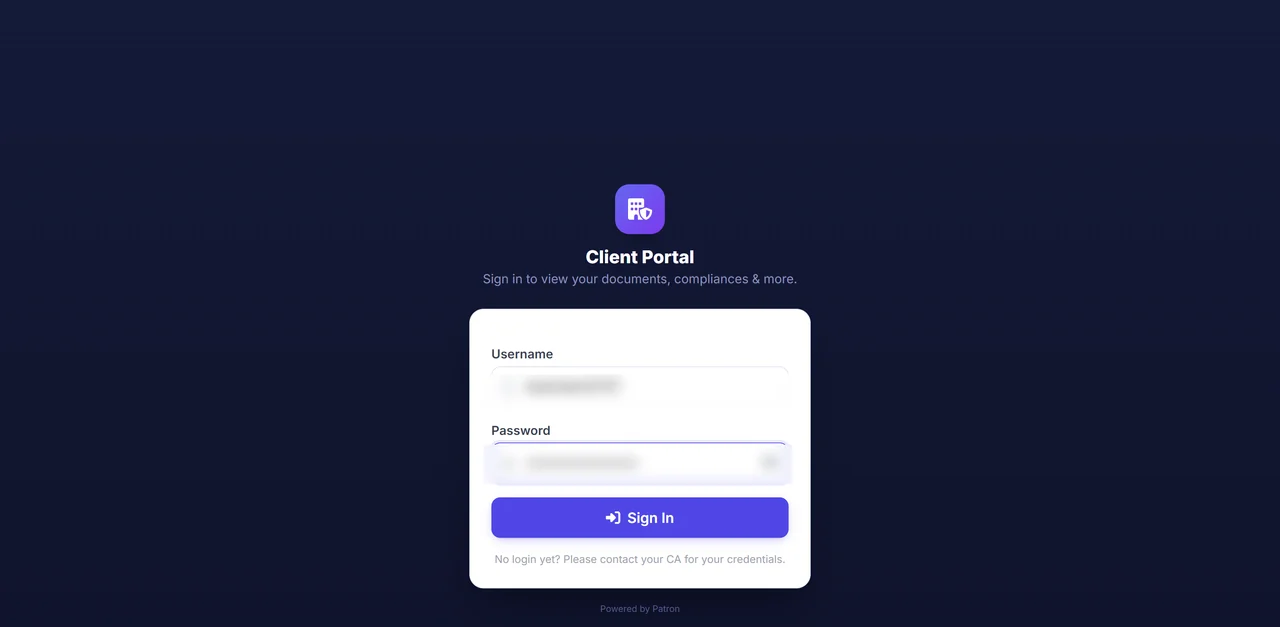
Everything happens in one secure login. You can see your active services, the Patron team on your account, and anything still pending. Once you raise a request, it moves through the same clear steps every time, so you always know exactly where your work stands.

Secure client portal login screen
1

Sign in securely

Your books, documents and requests all sit behind one private, password protected login. The team handling your account is shown on screen, so nothing sensitive ever needs to travel over email or WhatsApp.

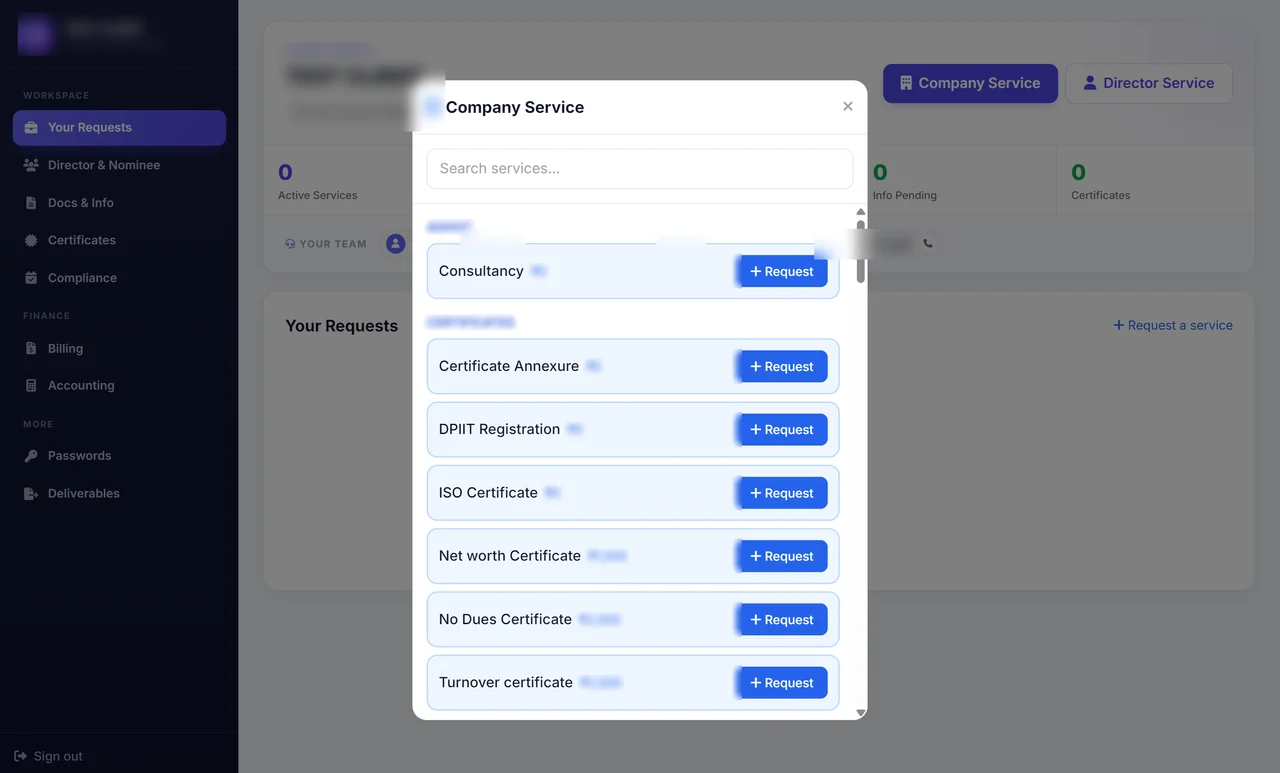
Service catalogue inside the client portal
2

Raise your request

Choose the service you need from the menu inside the portal, where the price is shown before you go ahead. Your request is logged the moment you send it, with no phone calls or reminder emails to wait on.

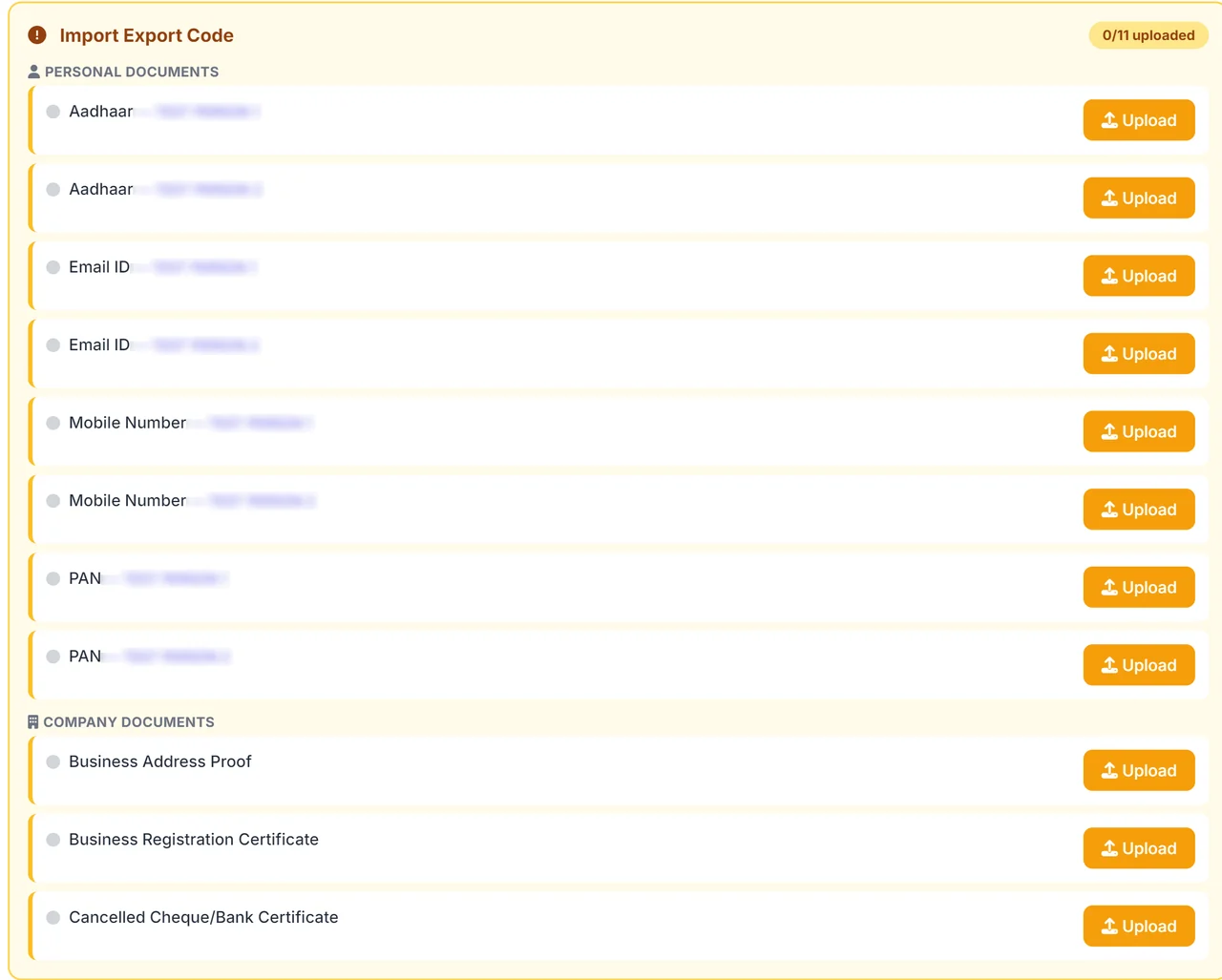
Import Export Code document checklist in the client portal, with an upload button beside each item
3

Share what the service asks for

For every service, the portal shows the exact documents it needs, each with its own upload button. The list shown here is the Import Export Code checklist. When a service needs nothing from you, it simply asks for nothing.

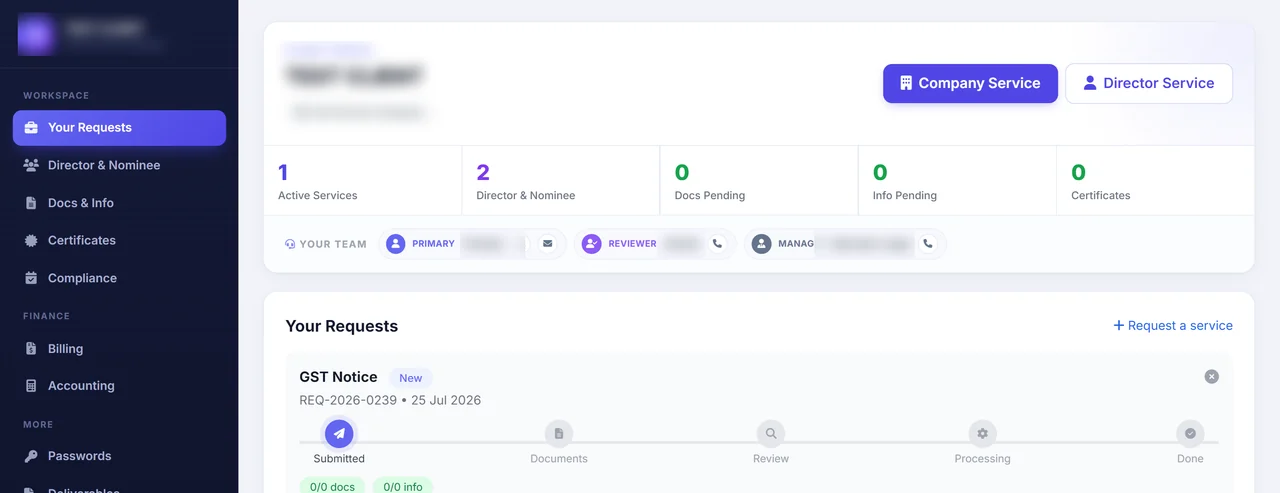
Live request tracker inside the client portal
4

We review, prepare and file

Once your documents are in, your team checks them, prepares the work and files it for you. A live tracker shows each stage as it happens, from review to processing to done, so you never have to ask where things stand.

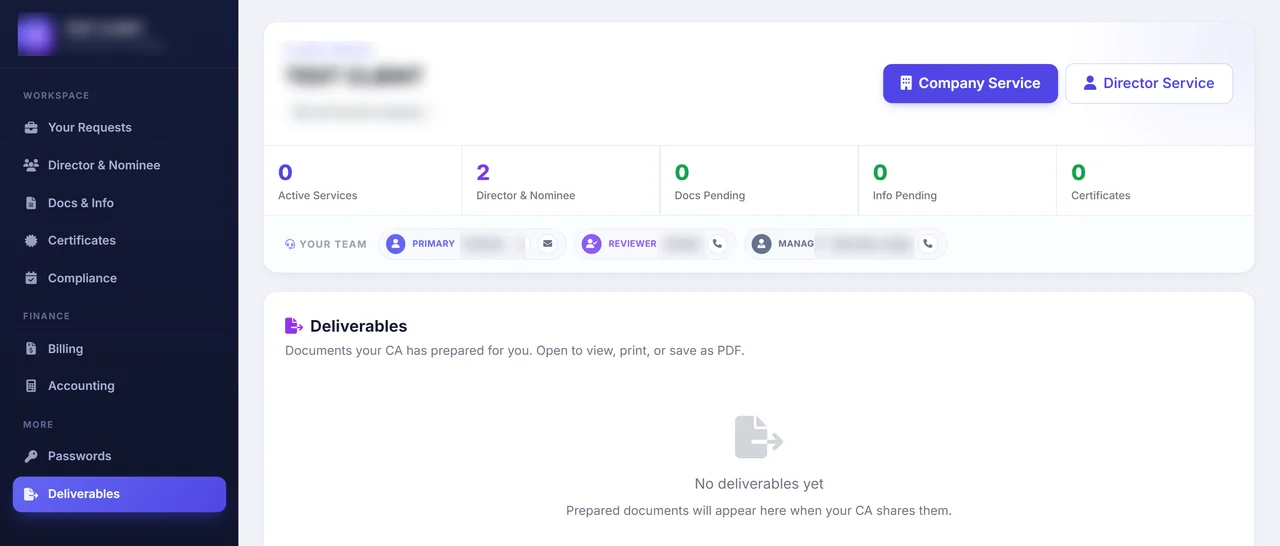
Deliverables area of the client portal
5

Collect your finished work

Every completed return, computation and certificate is placed in your Deliverables area. You can open, print or download any of them as a PDF whenever you need a copy.

Common SaaS Accounting Challenges and How We Solve Them

ChallengeImpactHow Patron Accounting Solves It
Setup, subscription and support bundled on one invoice, booked togetherRevenue recognised too early on components delivered over different periods, overstating the current quarterWe allocate each performance obligation its own value, so a bundled contract recognises on its true delivery pattern.
Sales commissions expensed upfront rather than over the contract lifeProfit dips the month a deal closes and overstates in every month afterContract acquisition costs capitalised and amortised across the customer term, following Ind AS 115 revenue recognition.
Gateway payouts arrive net of fees, refunds and FX, never matching invoicesCash and revenue drift apart, and merchant fees vanish into the settlement figurePatron reconciles Stripe and Razorpay settlement files line by line, booking fees, refunds and chargebacks to their own accounts.
Overseas subscription revenue left at the invoice-date exchange rateReceivables and revenue misstate as the rupee moves before the customer paysOur team restates foreign-currency invoices under AS 11 at each close, posting exchange differences to the right period.
Annual prepaid plans and mid-term upgrades tracked on spreadsheetsProration errors compound, and the deferred balance no longer ties to signed contractsPatron posts upgrades, downgrades and proration to a contract-level revenue register that reconciles to billings each month.

SaaS Accounting Fees

Fee ComponentAmount
Starter — one SaaS entity with a single subscription plan setINR 2,999 per month
Excl. GST & Government Charges
Growth — more subscription lines, deferred revenue schedules and rising MRROn quote
Managed — multi-entity books with custom revenue recognition and monthly reportingOn quote

At INR 2,999 per month, the entry plan keeps one SaaS entity's books current, covering billing, expenses and basic deferred revenue. Fees rise with more subscription lines and a longer deferred-revenue recognition schedule as MRR grows. Schedule a pricing consultation on +91 94594 56700.

Fees exclude GST and government charges. Final quote confirmed after a scoping review.

All fees and charges listed are indicative only and do not constitute a binding offer. Final amounts may vary depending on the volume of work and the complexity involved.

Professional accounting and compliance charges are scoped to your number of entities, funding stage and monthly transaction volume, and are separate from statutory and government charges. Contact us for a detailed, fixed quote.

Get a free SaaS Accounting consultation - Call +91 945 945 6700 or WhatsApp us. No-obligation assessment.

SaaS Accounting Compliance Calendar 2026

ComplianceDue DateApplies To
TDS / TCS deposit (Challan ITNS-281)7th of every month (30 April for March)Every business that deducts tax at source on salaries, rent, contractor or professional fees
GSTR-1 (outward supplies)11th of every month for monthly filersGST-registered businesses filing monthly returns
GSTR-3B (summary return and tax payment)20th of every month for monthly filersGST-registered businesses filing monthly; QRMP filers pay via PMT-06
Form 15CA / 15CB on foreign remittancesBefore each outward foreign remittanceBusinesses remitting payments to non-residents
SOFTEX / EDF declaration on software and service exportsSOFTEX within 30 days of invoice until 30 September 2026; single monthly EDF from 1 October 2026Software and IT/ITeS exporters realising foreign receipts
Letter of Undertaking renewal (Form RFD-11)31 March 2026 for the new financial yearExporters of services or goods supplying without payment of IGST
Income-tax return, audit cases31 October 2026Companies and audit-liable firms
Transfer pricing report (Form 3CEB)31 October 2026Businesses with international or specified domestic related-party transactions
Annual GST return GSTR-9 and reconciliation GSTR-9C31 December 2026GST-registered businesses above the annual-return and audit thresholds

For SaaS exporters the date to watch is the SOFTEX to EDF switch on 1 October 2026, alongside the LUT renewal by 31 March that keeps zero-rated invoicing valid. Foreign receipts then need Form 15CA or 15CB before remittance. Our SaaS accounting team files these on time so export benefits are never lost. Book a compliance review with a Patron CA on +91 94594 56700.

Key Benefits

Why Professional SaaS Accounting Matters

Revenue earned across the term

The revenue in any month is what your contracts actually earned in it. A quarter then reads the same whichever renewals land inside.

  • Revenue mapped from MSAs, SOWs and subscription order forms
  • Recognised across the contract term, not by invoice date
  • Without it billing cycles inflate the growth curve you show investors

A deferred balance that ties

Your opening unearned income, billings and revenue recognised roll forward to a closing deferred balance agreed against your billing system export.

  • Reconciled line by line to the billing system export
  • Held in a deferred revenue schedule that rolls forward
  • Without it prepayments drift and diligence cannot trace the balance

Gross margin you can read

We keep hosting, support and customer success costs apart from engineering, research and sales spend. Your profit and loss then shows a real gross margin.

  • Cost of revenue split from engineering, research and sales spend
  • Reads margin by customer segment and infrastructure load
  • Without it you cannot tell which segment pays for itself

An export position that holds

We test every overseas subscription invoice against the zero rating conditions and carry the correct LUT reference.

  • Invoices outside LUT validity kept separate and handled on their own footing
  • Backed by export invoices with LUT reference, FIRC and eBRC
  • Otherwise zero rated supplies can be reassessed as taxable, and tax hits margin

A standing revenue to GST bridge

A permanent working explains why revenue recognised over the term differs from your GST outward register. That register attaches at the time of supply.

  • Bridges recognised revenue to the GST outward supply register
  • Kept as a standing reconciliation, updated each period
  • Without it you reconstruct years of contracts at assessment

Foreign receipts at the real rate

We match inward remittances to the invoices they settle, at the rate your bank applied. The resulting gain or loss posts away from revenue.

  • Matched using FIRC, eBRC and the EEFC account statement
  • Exchange gain or loss posted outside the revenue line
  • Without it currency movement inflates revenue and EEFC balances go unrestated

Why Businesses Choose Patron Accounting for SaaS Accounting Services (IT & SaaS)

Five things a founder can check before handing over the books. Each is a claim with the proof behind it.

Deferred revenue and MRR schedules that survive diligence

We build deferred revenue and MRR schedules that hold up when an investor runs diligence. Our 15+ years across 3,000+ businesses served make subscription books routine for the team.

Ind AS 115, LUT-backed exports and SOFTEX filings

We recognise revenue under Ind AS 115, file LUTs for zero-rated software exports and lodge SOFTEX on time. This routine sits inside the 25,000+ filings we have completed.

Zoho Books and Xero wired to Stripe and Razorpay

Working across Zoho Books and Xero, we wire your billing to Stripe and Razorpay with multi-currency feeds where supported. We work in Tally Prime or Odoo when you run those.

Board-ready MIS with ARR, churn and burn monthly

Each month you get a board-ready MIS carrying ARR, churn and burn, ready for your next investor update. The monthly discipline shows in our 4.9 star Google rating.

SaaS companies among the 3,000+ businesses we serve

SaaS product companies from seed to Series C sit among the 3,000+ businesses we have served since 2019. Our in-house team of CAs and CS brings 15+ years of experience.

Figures reflect Patron Accounting LLP engagements since 2019. Scope and turnaround are confirmed in your engagement letter.

SaaS Accounting In-House vs Specialist Outsourced

CriterionSaaS Accounting In-HouseSpecialist Outsourced
Monthly costFull salary, software and training carried every month whether transaction volume is high or low.Variable fee scaled to volume, with lower fixed overhead and no idle-capacity cost.
Revenue recognition depthRelies on one hire understanding deferred revenue and Ind AS 115 recurring schedules.Specialists apply deferred revenue and recurring-billing schedules across many similar clients routinely.
Compliance riskOne person handling filings raises the chance of a missed return or wrong ledger.A reviewer layer and standard checklists catch slips before returns are filed.
ContinuityAbsence or attrition stalls the books, and process knowledge walks out the door.Built-in cover keeps the monthly close on schedule through absences and handovers.
ScalabilityAdding subscriptions, plans and currencies strains a lean finance team quickly.Capacity grows as recurring revenue, invoice count and entities rise.
Software and controlsYou buy, configure and maintain the accounting stack and bank feeds yourself.Cloud stack, multi-currency bank feeds and access controls come included.
VerdictMost growing SaaS firms are better served by specialist outsourced SaaS accounting services, gaining review depth and continuity. In-house suits only large-scale firms with steady headcount and an in-team revenue expert. See MRR, ARR and churn metrics.

Legal and Regulatory Framework for SaaS Accounting

An annual SaaS subscription invoiced in April is cash today but not revenue today, and that gap between the accounting treatment and the plain fact of a payment is where the framework begins. Ind AS 115 spreads the fee across the contract term for the books, while GST and FEMA decide how the same invoice is taxed and how its foreign currency is realised.

For an Indian SaaS company selling abroad, three regimes meet on one invoice. The income is recognised over time, the export is zero-rated under a Letter of Undertaking, and the receipt is tracked through SOFTEX until the money lands. That is why Deferred Revenue (Unearned Revenue) sits as a liability on the balance sheet while Ind AS 115 Revenue Recognition governs its release. SaaS accounting services keep these regimes aligned against the provisions below.

  • Ind AS 115 / AS 9Subscription and licence income is recognised as the service is delivered over the contract term, so unearned revenue sits as a liability until earned.
  • Section 16, IGST Act 2017 with an LUT under Rule 96AExport of software services is a zero-rated supply made without payment of tax under a Letter of Undertaking, rather than paying and reclaiming a refund.
  • FEMA 1999 with the SOFTEX/EDF filing route (RBI/STPI)Software export invoices are reported through SOFTEX so realisation of foreign exchange can be tracked against each one.
  • Sections 92 to 92F, Income-tax Act 1961Transactions with an overseas parent or group company must be at arm's length and reported in an accountant's report in Form 3CEB.
  • Section 128, Companies Act 2013The books stay on accrual and double entry at the registered office and are retained for eight years.
  • Rule 3(1), Companies (Accounts) Rules 2014The audit trail is enabled, so a revenue-schedule revision leaves a record. The broader IT-sector position is covered on the IT accounting page.

Official sources: Ministry of Corporate Affairs · Income Tax Department · GST Portal · Startup India (DPIIT)

What is SaaS in accounting?

In accounting, SaaS refers to software sold as a subscription rather than a one time licence, which changes how revenue and costs are recorded. Subscription fees are recognised across the service period and not on invoicing, so amounts billed ahead sit as deferred revenue. For a SaaS company this makes deferred revenue, recurring revenue and customer acquisition cost the numbers that matter most.

How is deferred revenue handled for annual subscriptions billed upfront?

Annual subscriptions billed upfront are recorded as deferred revenue on the balance sheet and released to income evenly over the twelve month service period, so a Rs 12,00,000 contract adds Rs 1,00,000 of revenue each month. GST is payable on invoicing rather than on recognition, which is why GST turnover and profit and loss revenue will not agree in any given month.

Is GST charged on SaaS subscriptions sold to overseas customers?

Exports of SaaS can qualify as a zero rated supply where the recipient is outside India and payment is received in convertible foreign exchange, so no GST is charged, provided a letter of undertaking is filed for that financial year. Without a valid letter of undertaking, IGST must be paid on the invoice and then claimed back as a refund.

How should sales commissions and customer acquisition costs be accounted for?

Under Ind AS 115 the incremental cost of winning a contract, such as a sales commission, is capitalised and amortised over the period the customer benefits, so a Rs 5,00,000 commission on a three year deal is spread across three years. Immediate expensing applies only where that period is one year or less. Companies still on AS expense these costs as incurred.

Is SaaS capitalized or expensed?

SaaS subscription fees paid by a customer are expensed as incurred, because a cloud service gives access to software rather than control of an asset, so no intangible asset is recognised under AS 26 or Ind AS 38. Implementation and configuration spend is normally expensed as well. A SaaS vendor building its own product can capitalise development cost only once the recognition tests in those standards are met.

What is the rule of 40 for SaaS companies?

The rule of 40 says a SaaS company's annual revenue growth rate plus its profit margin should add up to at least 40 percent, so 25 percent growth with a 15 percent margin passes. Investors use it to test whether growth is being bought with an unsustainable burn. It only holds on clean accrual books, since revenue billed upfront but not yet earned otherwise flatters both numbers.

What accounting do investors expect before a SaaS seed or Series A round?

Investors expect at least two years of clean accrual books, a deferred revenue schedule tied to signed contracts, a cap table reconciled to MCA filings, ESOP cost recognised under Ind AS 102 where a pool exists, and GST and TDS returns filed with no open notices. Diligence most often stalls on revenue recognition and related party transactions, so both are documented in advance.

What is the P&L of a SaaS company?

A SaaS profit and loss statement starts with recognised subscription revenue, deducts cost of revenue such as cloud hosting, support and payment gateway charges to give gross margin, then shows sales and marketing, research and development and general administration separately to reach operating profit. Amounts billed in advance sit in deferred revenue on the balance sheet, which is why billings and revenue for a month rarely match.

What do you charge to run the books for a SaaS company each month?

SaaS accounting typically costs Rs 15,000 to Rs 45,000 a month depending on recurring revenue, the number of billing systems, the entity structure and whether a foreign holding company has to be consolidated. Companies below roughly Rs 2 crore of annual recurring revenue usually sit at the lower end. Deferred revenue schedules and investor MIS are inside the retainer, not billed separately.

What accounting software stack do you set up for a SaaS company?

We run Zoho Books or Xero as the ledger, connected to the billing platform and bank feeds, with a deferred revenue schedule maintained alongside and posted every month. QuickBooks is not an option in India because Intuit withdrew the product for Indian users in 2023, so companies still using it are migrated to Zoho Books with two years of history carried across.

Quick Answers

Once the billing exports, the bank feeds and the signed contract file reach Patron, what returns is a posted ledger, an amortisation schedule for each contract and the working papers behind every figure. Contracts are read once at signature and then spread across their term, with renewals, upgrades and mid-term.

SaaS Accounting Deadlines You Cannot Afford to Miss

TDS / TCS deposit (Challan ITNS-281) is due 7th of every month (30 April for March). GSTR-1 (outward supplies) is due 11th of every month for monthly filers. GSTR-3B (summary return and tax payment) is due 20th of every month for monthly filers. Patron tracks each against your books so nothing is reconstructed after the fact. Call +91 94594 56700 to set up a filing-reminder schedule.

Start Your SaaS Accounting Services with Patron Accounting

Billing exports pass for accounts in a lot of SaaS companies until someone senior asks what last quarter actually earned. The finance lead then rebuilds it from gateway reports and a spreadsheet of contracts, and those days come out of work that would have moved the company forward. Nobody ever books that time anywhere.

SaaS accounting makes ARR mean one thing across the board deck, the ledger and the filing. You get a renewal rate you can quote without a caveat, and a deferred balance that agrees to the contracts behind it. Investors get a monthly number they can compare with the last one they saw.

Your contract file is where this starts: how many subscriptions are live, and whether annual and monthly plans sit in one system. Export billing is the other half. How a mid-term cancellation lands in your books matters too, as it does across our wider IT sector work.

Book a Free Consultation - No Obligation.

SaaS Accounting Near You

Local teams for saas accounting in these cities.

Reviewed by the CA & CS Team, Patron Accounting LLP
ICAI & ICSI registered  ·  15+ years in Indian accounting & compliance  ·  Last reviewed 23 July 2026  ·  Next review 23 October 2026