Talk to an expert

Tell us what you need and we will call you back.

🇮🇳 +91

    Licences & Permits

    FSSAI State License Registration in India

    Medium-sized food businesses (restaurants, bakeries, food makers, dairy and storage units working within one state) need a state licence from the state food safety authority. We confirm the right licence level, prepare the application and documents on FoSCoS, and support you through scrutiny and inspection to the licence.
    FSSAI State Licence: Food business growing beyond basic registration?
    State licence, at a glance The middle level
    Our fee Starting from ₹2,499 (Exl GST and Govt. Charges)
    • Issued by The state licensing authority of the state where the premises are, through FoSCoS
    • By turnover Above ₹1.5 crore and up to ₹50 crore, for applications from 1 April 2026
    • Validity Valid unless suspended, cancelled or surrendered, if issued on or after 1 April 2026
    Each premises generally needs its own licence or registration.

    The short answer

    FSSAI state licence at a glance

    Law
    Food Safety and Standards Act, 2006 and the Food Safety and Standards (Licensing and Registration) Regulations (Section 31 of the Act; regulations 2.1.2 and 2.1.3)
    Issued by
    The state licensing authority of the state where the premises are, through FoSCoS (foscos.fssai.gov.in)
    Who needs it: by turnover
    Above ₹1.5 crore and up to ₹50 crore, for applications from 1 April 2026
    Who needs it: by activity
    By turnover for most kinds of business; a caterer takes a State licence at any turnover up to ₹50 crore, and grain, cereal and pulse milling units stay with the State authority even above ₹50 crore (FoSCoS eligibility criteria, updated 1 April 2026)
    Government fee
    ₹5,000 a year
    Validity
    Valid unless suspended, cancelled or surrendered, with no renewal, for any licence or registration issued on or after 1 April 2026; the fee can be paid for any number of years at once (a licence or registration issued before 1 April 2026 carries the expiry date it was issued with (1 to 5 years under the earlier regulation 2.1.7) so check its status on FoSCoS)
    Our fee
    Starting from ₹2,499 (Exl GST and Govt. Charges)

    Definition

    What is an FSSAI state licence?

    FSSAI stands for the Food Safety and Standards Authority of India, set up under the Food Safety and Standards Act, 2006. Every food business needs FSSAI registration or a licence before it operates. There are three levels: basic registration, the state licence and the central licence.

    The state licence is the middle level. It is granted by the food safety department of the state where your premises are, not by FSSAI's central office. Once granted, the licence carries a licence number that must be printed on food labels and displayed at the premises. The number has 14 digits; a licence number starts with 1 and a registration number with 2.

    The State licensing authority is the Designated Officer appointed by the State's Commissioner of Food Safety under Section 36 of the Act.

    See a sample
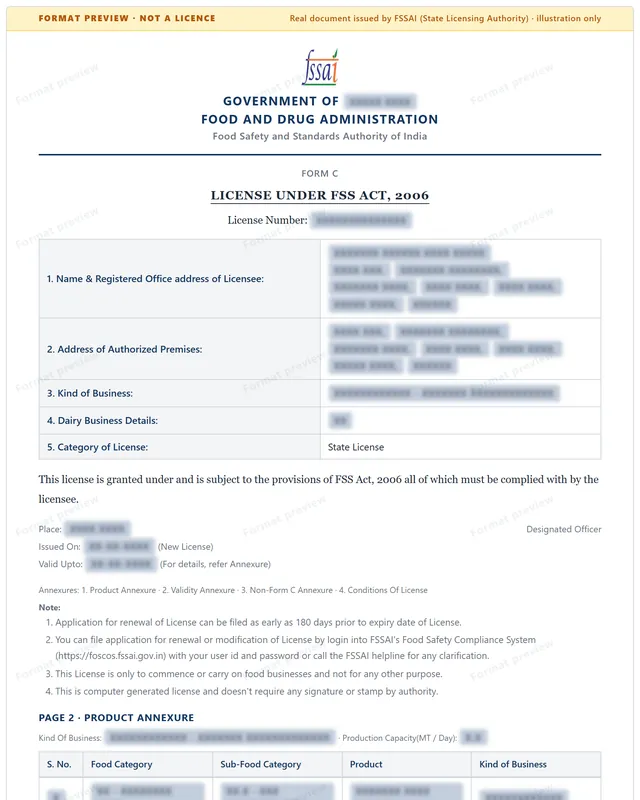
    Sample with values hidden Sample FSSAI state licence with all values hidden

    FSSAI state licence

    The food licence issued by the State Licensing Authority.

    Issued by
    FSSAI (State Licensing Authority)
    When you get it
    Once the licence application is approved.

    Values hidden for privacy. Names, numbers and dates are covered. Your own document carries your details.

    Download FSSAI state licence sample (PDF) View FSSAI state licence sample
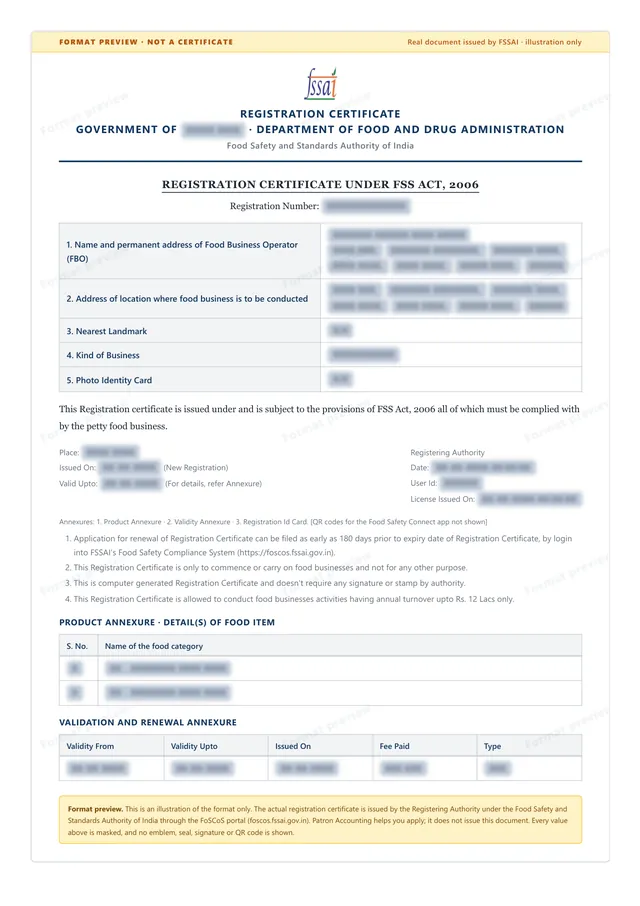
    Sample with values hidden Sample FSSAI basic registration certificate with all values hidden

    FSSAI basic registration certificate

    The certificate issued for FSSAI basic registration.

    Issued by
    FSSAI (Registering Authority)
    When you get it
    Once the application is approved.

    Values hidden for privacy. Names, numbers and dates are covered. Your own document carries your details.

    Download FSSAI basic registration certificate sample (PDF) View FSSAI basic registration certificate sample

    Which level

    Basic registration, state licence or central licence?

    Level

    Basic registration

    Usually for
    Small food businesses (turnover up to ₹1.5 crore)
    Granted by
    State food safety department
    Government fee
    ₹100 a year

    Level

    State licence

    Usually for
    Medium businesses in one state (above ₹1.5 crore up to ₹50 crore)
    Granted by
    State licensing authority
    Government fee
    ₹5,000 a year

    Level

    Central licence

    Usually for
    Large businesses, importers, multi-state operators (above ₹50 crore)
    Granted by
    Central licensing authority
    Government fee
    ₹7,500 a year

    Turnover is not the only test. A business below the state band may still need a state licence because of its kind of business (for example, a caterer takes a State licence at any turnover up to ₹50 crore, FoSCoS eligibility criteria, updated 1 April 2026). Some businesses need the central licence whatever their size, importers, for example. If you are smaller, see FSSAI Registration (Basic); if you are larger or import food, see FSSAI Central License.

    Common cases

    Who needs a state licence?

    Businesses that commonly need a state licence include:

    • restaurants, hotels, cafes and cloud kitchens above the basic band;
    • food manufacturers and processors bakeries, sweet makers, snack units, spice and flour mills, oil units (turnover above ₹1.5 crore and up to ₹50 crore);
    • dairy units milk chilling, processing and products (turnover above ₹1.5 crore and up to ₹50 crore);
    • meat and poultry processing (turnover above ₹1.5 crore and up to ₹50 crore);
    • storage, cold storage, wholesale and distribution businesses in one state;
    • caterers and canteens State licence up to ₹50 crore of turnover; Central licence above it

    From 1 April 2026 a State licence covers turnover above ₹1.5 crore up to ₹50 crore.

    Dairy farms.

    A farmer selling raw milk is treated differently from a dairy unit that chills, processes or packs milk. Which level a dairy activity needs depends on what it does and how much it handles. FoSCoS applies the same turnover bands to dairy units, with registration for a petty milkman or milk vendor.

    Several premises.

    Each premises generally needs its own licence or registration at the level its own activity requires. Section 31(6) and (7) of the Act: one licence can cover premises in the same area, and premises in different areas need separate licences.

    Six steps

    How to apply for an FSSAI state licence: step by step

    1. Confirm the level

      We check turnover, products and premises and confirm that the state licence is right for each premises. FoSCoS publishes the test for each kind of business in its eligibility criteria, updated on 1 April 2026.

    2. Create the FoSCoS login

      The application is made on FoSCoS with the business's mobile number and email.

    3. Fill the application

      Kind of business, food categories and products, capacity or turnover, the authorised person, the layout plan and the equipment list. (Form B of Schedule 2)

    4. Upload documents and pay the fee

      Documents are uploaded and the licence fee is paid online. (₹100 a year for a registration, ₹5,000 for a State licence and ₹7,500 for a Central licence)

    5. Scrutiny and inspection

      The state authority scrutinises the application and may inspect the premises. Queries are answered within the time given. On FoSCoS, a status such as "processing to be initiated" usually means the application has been submitted and is waiting for the officer to start scrutiny.

    6. Licence granted

      The licence is issued on FoSCoS. Display it at the premises and print the number on your labels.

    Checklist

    Documents required

    Identity proof of the owner, partners or directors
    PAN, Aadhaar, passport or voter ID
    Proof of premises
    Ownership papers, or rent agreement with the owner's no-objection
    Business registration
    Certificate of incorporation, partnership deed, GST, or shop registration
    Layout plan of the unit
    Showing processing, storage and cleaning areas
    List of equipment
    For manufacturing and processing units
    Food categories and products
    What you make, store or sell
    Water test report
    For manufacturing units, from an accredited laboratory (FSSAI's FAQs: where a municipal corporation supplies the water, its water bills can go in place of the report)
    Local body no-objection
    For manufacturers and restaurants where the state or city asks for it
    Food safety management plan
    For manufacturers

    Many restaurants and shops also need a Shop and Establishment Registration from the state, which is a separate registration.

    What we do

    Our FSSAI state licence services

    Level check
    Basic, state or central, premises by premises
    Restaurants and cloud kitchens
    Layout plan, equipment list and food categories
    Manufacturing units
    Water tests, food safety plan and capacity details
    Inspection readiness
    A checklist for hygiene, storage, pest control and records before the visit
    Several premises
    One application plan so each unit gets the right licence
    After the licence
    Modifications, yearly returns; see FSSAI Returns: and renewal questions (see) FSSAI Renewal

    What it costs

    FSSAI state licence fees

    Patron professional fee: Starting from ₹2,499 (Exl GST and Govt. Charges)

    CostPaid toAmount
    State licence feeState authority, on FoSCoS₹5,000 a year, payable for any number of years at once, at any time of the year
    Water test, layout drawingLaboratory, draughtsmanCharged by them, if needed
    Professional feePatron AccountingStarting from ₹2,499 (Exl GST and Govt. Charges)

    Our fee depends on the number of premises and products and how much documentation is ready. We confirm the full amount in writing before you pay. Fees shown are indicative and not a binding offer.

    The 2026 rule

    Validity, renewal and changes

    Under the Food Safety and Standards (Licensing and Registration of Food Businesses) Amendment Regulations, 2026 (notified 10 March 2026), FSSAI licences and registrations stay valid unless suspended, cancelled or surrendered, and need no renewal. Any licence or registration issued on or after 1 April 2026 has this validity. The fee is still payable: you can pay for any number of years at once, at any time of the year. A licence or registration issued before 1 April 2026 carries the expiry date it was issued with (1 to 5 years under the earlier regulation 2.1.7). Check your licence status on FoSCoS before relying on an old expiry date.

    • Changes. New products, a change of premises layout, capacity, or partners and directors are filed as a modification on FoSCoS. Under regulation 2.1.9, a change that alters what the licence certificate shows needs approval or endorsement before business starts with the change.
    • Moving up a level. When turnover or activity grows past the state band, or you start importing or working across states, you move to the central licence.
    • Surrender. A licence you no longer need can be surrendered on FoSCoS.

    Where applications go wrong

    Common problems and how we handle them

    Problem

    Wrong level chosen

    What it causes
    Rejection or the wrong licence
    How we handle it
    We test turnover, kind of business and geography together

    Problem

    Wrong kind of business selected

    What it causes
    Queries or rejection
    How we handle it
    We map your business to the right kind and categories

    Problem

    Premises not inspection-ready

    What it causes
    Adverse observations
    How we handle it
    A gap check before the visit

    Problem

    Several units in one application

    What it causes
    Units without cover
    How we handle it
    One plan per premises

    Four reasons

    Why the licence matters

    • Legal to operate. The Act does not allow a food business to run without the right licence or registration.
    • Selling online. Food delivery apps and marketplaces ask sellers for a valid FSSAI number before listing.
    • Buyers and lenders. Distributors, institutional buyers and banks usually ask for the licence.
    • Growth. A clean licence record makes the move to a central licence simpler.

    How we check this page

    The turnover bands, fees and validity on this page come from FSSAI's order of 13 March 2026, the FoSCoS fee schedule and the 2026 amendment regulations.

    Written by · reviewed by Subham Jhunjhunwala

    • FSSAI's order of 13 March 2026 on turnover bands
    • FoSCoS fee schedule (foscos.fssai.gov.in)
    • Food Safety and Standards (Licensing and Registration of Food Businesses) Amendment Regulations, 2026
    • Food Safety and Standards Act, 2006

    Questions

    Frequently asked questions

    What is an FSSAI state licence?
    It is the middle level of FSSAI food licensing, granted by the state licensing authority to medium food businesses in that state. FSSAI is the Food Safety and Standards Authority of India. The licence number must be printed on labels and shown at the premises.
    What is the difference between basic, state and central FSSAI?
    There are three levels: basic registration for small businesses, the state licence for medium businesses in one state, and the central licence for large businesses, importers and multi-state operators. From 1 April 2026 the turnover bands are: up to ₹1.5 crore for registration, above ₹1.5 crore up to ₹50 crore for a State licence, and above ₹50 crore for a Central licence.
    What are the criteria for a state licence?
    Turnover in the state band (above ₹1.5 crore up to ₹50 crore from 1 April 2026), with premises in one state. Some kinds of business are placed by activity instead, for example a caterer takes a State licence at any turnover up to ₹50 crore, while an importer always needs a Central licence.
    How do I apply for a state licence online?
    Create a FoSCoS login, fill the application with business, product and premises details, upload the documents, pay the fee and answer any query; the state authority may inspect before granting. (Form B of Schedule 2) (₹100 a year for a registration, ₹5,000 for a State licence and ₹7,500 for a Central licence)
    How long does a State FSSAI licence take?
    It depends on how complete the application is and on scrutiny and any inspection. Section 31(4) of the Act lets the applicant start the business if a licence is neither issued nor refused within two months of the application.
    What does "processing to be initiated" mean?
    It usually means the application has been submitted and is waiting for the officer to begin scrutiny. Keep an eye on FoSCoS for queries.
    Can I make changes in an FSSAI licence?
    Yes. Changes in products, premises, capacity or business details are filed as a modification on FoSCoS with supporting documents.
    Do I need to renew a state licence?
    Under the Food Safety and Standards (Licensing and Registration of Food Businesses) Amendment Regulations, 2026 (notified 10 March 2026), FSSAI licences and registrations stay valid unless suspended, cancelled or surrendered, and need no renewal. Any licence or registration issued on or after 1 April 2026 has this validity. A licence or registration issued before 1 April 2026 carries the expiry date it was issued with (1 to 5 years under the earlier regulation 2.1.7).
    Is a licence needed for a dairy farm, and who files the annual return?
    It depends on what the dairy activity does and how much it handles. FoSCoS applies the turnover bands to dairy units, with registration for a petty milkman or milk vendor. A milk producer who is a registered member of a dairy co-operative society and sells all the milk to it is exempt from registration (regulation 2.1.1). Annual returns are filed by licence holders who make, import, export, label or repack food. (the annual return is Form D1, filed on FoSCoS by 31 May by licensed manufacturers, including repackers and relabellers, and importers)

    Get a quote

    Get your FSSAI state licence with us

    Tell us what you make or sell, your turnover, your premises and the state you operate in. We will confirm the licence level, the documents, the government fee and our fee, and file the application.

    Patron professional fee: Starting from ₹2,499 (Exl GST and Govt. Charges)

    Get a quote

    Leave your details and we will call you back.

    🇮🇳 +91

      By sending this form you agree to our privacy policy.

      Call or message us

      What to tell us

      1. What you make or sell
      2. Your turnover and premises
      3. The state you operate in

      Get a quote

      Leave your details and we will call you back.

      🇮🇳 +91

        By sending this form you agree to our privacy policy.
