


Talk to an Expert
Talk to an Expert ✆ +91 945 945 6700
Trusted by 10,000+ Businesses

Monthly MIS Reporting Services

Reviewed by CA and CS Team, Patron Accounting LLP ICAI & ICSI Registered| 15+ Years Experience| Last Updated: July 2026 Verify Credentials →

Metrics that stop moving: We define revenue, gross margin and headcount in writing once, then measure them the same way every month.

Variance explained by its driver: We give each significant gap against budget commentary naming price, volume, mix or timing as the cause.

Seasonal patterns read correctly: We load your budget with the monthly phasing that was approved, rather than spreading it evenly across the year.

Limit utilisation seen early: We put working capital beside profit, showing ageing, days outstanding, inventory cover and how much of your sanctioned limit is drawn.

15+ YearsIndustry Experience
CA & CSCertified Experts
4.9
Based on real Google reviews

Get Free Consultation

Talk to a CA/CS expert today

🇮🇳 +91

Our team will get back to you shortly. No spam.

Real Stories from Real People

Verified Google reviews from founders and businesses Patron works with across India.

Join 3,000+ Founders and Businesses on Patron

Rated 4.9 on Google - trusted for startup accounting since 2019.

Talk to an Expert
10,000+Businesses ServedGST compliance and litigation support across India.
15+Years ExperienceDeep expertise in IP registration, GST & business compliance.
50,000+Documents FiledReturns, appeals, and filings handled accurately.
4.9★Client RatingTrusted by entrepreneurs, startups, and growing businesses.
ISO CertifiedProfessional standards and documented processes.
SSL SecureYour financial and business data is fully protected.

What MIS Reporting Covers — Scope, Deliverables and Who It Suits

📌 TL;DR - MIS Reporting Services at a Glance

A monthly MIS report is a management pack covering revenue, margin, cash, receivables and burn, issued on a fixed date each month. It is built by Patron in one consistent format, tied back to the statutory books so there is a single version of the truth. Variance against budget and the prior period is explained within 5 working days of close. Frequently used by founders, boards and lenders needing recurring reporting.

The obligation here is written by your board and your lenders rather than by statute, and it binds just as tightly. Patron draws the trial balance once the books are closed for the month, maps it onto the reporting structure agreed at the outset, then builds the pack: revenue and margin by line, cash movement, debtor ageing, creditor position and spend against plan. Reading a management pack properly explains the layout most readers expect.

Complexity in MIS report preparation depends on the entities being consolidated, the depth of cost-centre splits you want, each additional revenue line tracked and whether budgets exist to measure against. Commentary and the variance walk are included. Rebuilding books that were never closed, and any filing through the government GST portal, sit outside this scope.


What Is MIS Reporting?

A board can only act on numbers it has in the room, in a form it trusts. MIS reporting is the engagement responsible for exactly that: a management pack that reaches the board on a fixed date every month. A monthly MIS report gathers revenue, margin, cash, receivables and burn into a single consistent format. Every figure ties back to the closed statutory books, so management reads one version of the numbers rather than several.

Mapping the trial balance onto an agreed reporting structure comes first, then each revenue line, the gross and net margin, working capital and cash movement are reported. It measures actual performance against budget and against the prior period, and explains each variance in plain commentary. Cash runway and the working-capital position are shown, so the board can see how long funds last. Management reporting services of this kind arrive within a few working days of close, while the numbers can still inform a decision. A monthly MIS report interprets the books; it does not file anything with the tax authorities.

Key Terms for MIS Reporting:

  • Gross ProfitSales less the direct cost of producing the goods or services.
  • Net ProfitWhat remains after every cost, tax and expense is taken from revenue.
  • Working CapitalCurrent assets minus current liabilities, the cash a business runs on daily.
  • EBITDAEarnings before interest, tax, depreciation and amortisation are deducted.
  • Variance AnalysisComparing actual figures against budget or standard to explain the differences.
  • Contribution Margin DashboardA view of sales left over after variable costs, product by product.
  • Operating Cash RunwayHow many months current cash lasts at the present spending rate.
  • Current AssetsCash and items expected to convert to cash within one year.
What Is MIS Reporting. A board can only act on numbers it has in the room, in a form it trusts. MIS reporting is the

Who Needs MIS Reporting in India?

A monthly MIS report is for organisations that answer to someone every month: a board, a lender, an investor. It fits businesses where decisions wait on numbers, and the people who need those numbers cannot read them out of the statutory books alone.

  • Founders answering to a board each month who cannot wait for year-end to see margin.
  • Companies with bank loans and cash-credit limits whose lender tests covenants on a schedule.
  • Investor-backed businesses that must report burn and runway to their board every month.
  • Multi-entity groups needing one pack in a fixed format, not five spreadsheets in five styles.
  • Owners wanting margin split by product, customer and region before they reprice anything.
  • Management teams whose numbers land after the meeting that needed them.
  • Businesses that cannot yet tell a management pack from their statutory accounts.
  • Boards asking for the same figures monthly and getting a different working each time.

Our MIS Reporting Services

ServiceWhat We Do
Reporting pack designWe agree the report pack, its metrics and their definitions upfront, so every number keeps the same meaning from one period to the next One-time (setup)
Monthly close and reportingOur mis report preparation starts only after a proper close, so your monthly MIS report is tied to reconciled books, not draft numbers Monthly
Budget versus actualWe load your budget with monthly phasing and report actuals against it, following ideas in this monthly MIS report format template Monthly
Dimensional reportingWe report by cost centre, product, customer and region, so seasonal patterns and segment performance read correctly instead of hiding in totals Monthly
Variance analysisWe explain each material variance by its driver, not just its amount, so your management reporting shows why the number moved Monthly
Cash and working capital viewWe show cash, receivables, payables and limit utilisation each period, so tightening working capital and funding gaps are seen early Monthly
Our Process

How MIS Reporting Works — Our Process

How Patron delivers mis reporting, step by step from onboarding to a clean monthly close.

Step 1

Agree the pack and definitions

We start by asking what decisions the pack has to support, then fix the metric definitions in writing: what counts as revenue, what sits in gross margin, and how a headcount is counted. Defined once, the numbers stop moving between months for no reason.

Illustration for Agree the pack and definitions: We start by asking what decisions the pack has to support, then fix the
Step 2

Close before you report

Reporting from a ledger that has not been closed produces confident-looking noise. The trial balance is closed, banks are reconciled, receivables and payables are agreed and known accruals are posted before a single number leaves for the management pack.

Illustration for Close before you report: Reporting from a ledger that has not been closed produces confident-looking noise.
Step 3

Load the budget with phasing

The approved budget is loaded with its monthly phasing rather than divided evenly across twelve months. For any seasonal business, even phasing manufactures variances that do not exist and hides the ones that do, which then discredits the whole report.

Illustration for Load the budget with phasing: The approved budget is loaded with its monthly phasing rather than divided
Step 4

Report by dimension

Results are cut by cost centre, department, location, product and project using the dimensions already in the chart of accounts. Shared costs are allocated on a basis that is stated and then left alone, because a changing allocation basis makes every comparison meaningless.

Illustration for Report by dimension: Results are cut by cost centre, department, location, product and project using the
Step 5

Explain the variances

Budget against actual is reported with commentary above an agreed threshold, and the commentary explains the driver: price, volume, mix or timing, not the arithmetic. A variance restated as a percentage is not an explanation and does not help anyone decide anything.

Illustration for Explain the variances: Budget against actual is reported with commentary above an agreed threshold, and the
Step 6

Show the cash and working capital

The pack carries the working capital view alongside profit: receivable and payable ageing, days outstanding, inventory cover, and utilisation of overdraft and cash credit limits against what is sanctioned. Profitable businesses fail on cash, not on the profit and loss account.

Illustration for Show the cash and working capital: The pack carries the working capital view alongside profit: receivable
Step 7

Review and carry actions forward

The pack is walked through with management, decisions and actions are recorded, and the following month opens by revisiting them. Where a prior month has to be restated, it is restated with a visible note rather than silently corrected in the comparative column.

Illustration for Review and carry actions forward: The pack is walked through with management, decisions and actions are

Documents Required for MIS Reporting

Reporting compares actual against plan, so the budget and the dimensions you want to report on matter more than transaction paperwork.

  • Approved annual budget or forecast with monthly phasing
  • Chart of accounts with the cost centre, department, location and project dimensions in use
  • Revenue data broken down by product, service line, customer and region
  • Order book, sales pipeline and the billing or milestone schedule
  • Accounts receivable and accounts payable ageing as at the reporting date
  • Bank and cash balances plus loan, overdraft and cash-credit utilisation against sanctioned limits
  • Inventory and work-in-progress position with consumption data for the period
  • Current-period trial balance and general ledger, closed and reconciled
Client Portal

How You Work With Patron

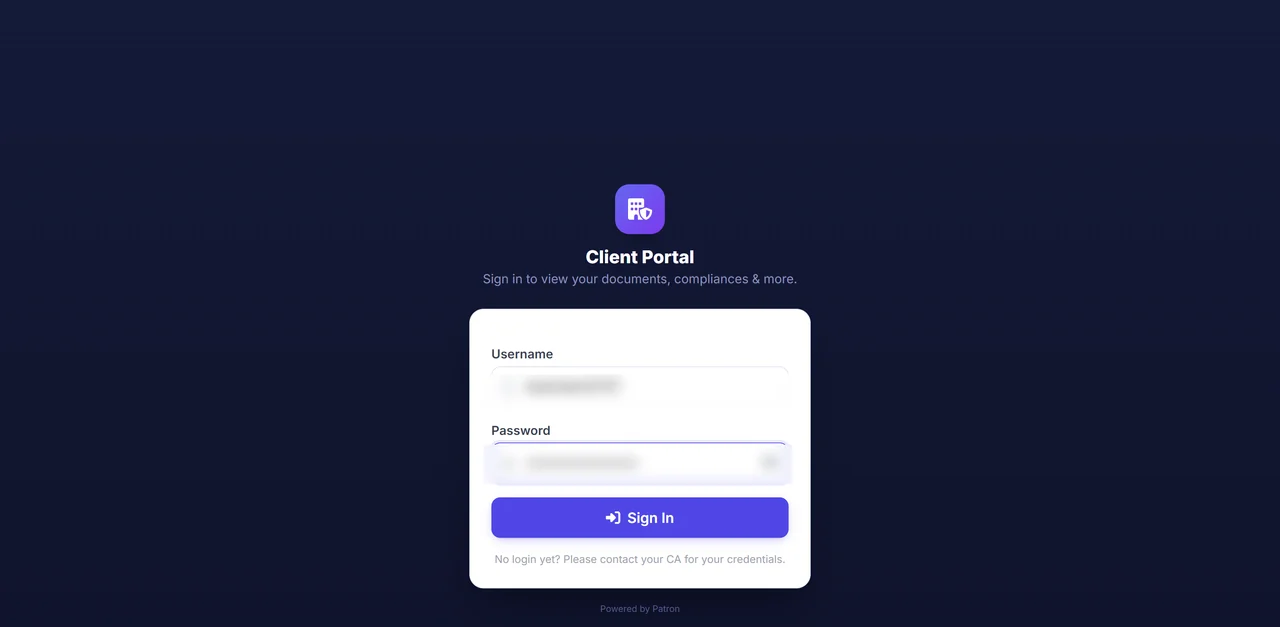
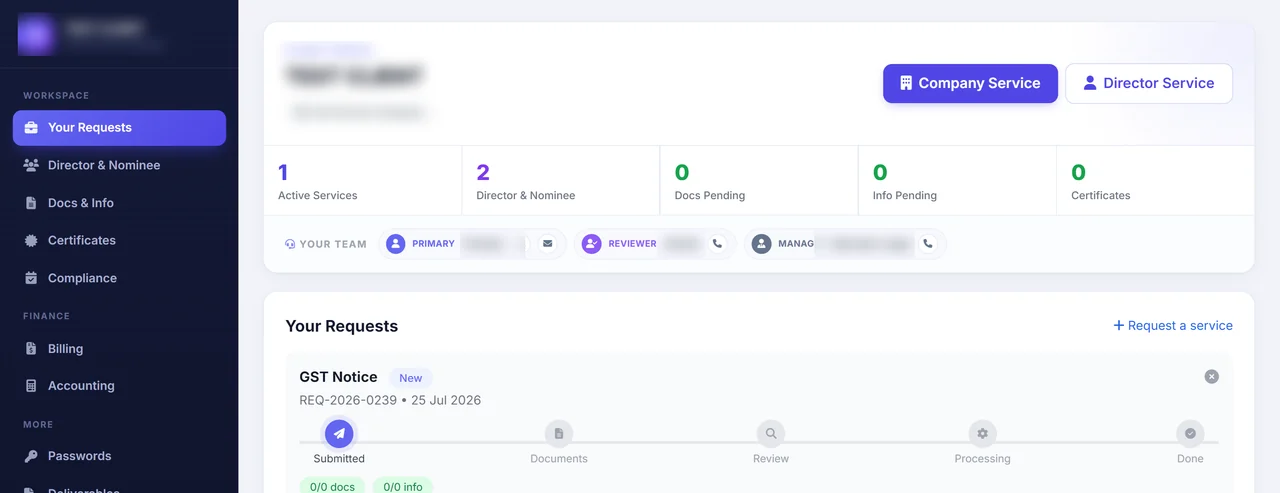
Everything happens in one secure login. You can see your active services, the Patron team on your account, and anything still pending. Once you raise a request, it moves through the same clear steps every time, so you always know exactly where your work stands.

Secure client portal login screen
1

Sign in securely

Your books, documents and requests all sit behind one private, password protected login. The team handling your account is shown on screen, so nothing sensitive ever needs to travel over email or WhatsApp.

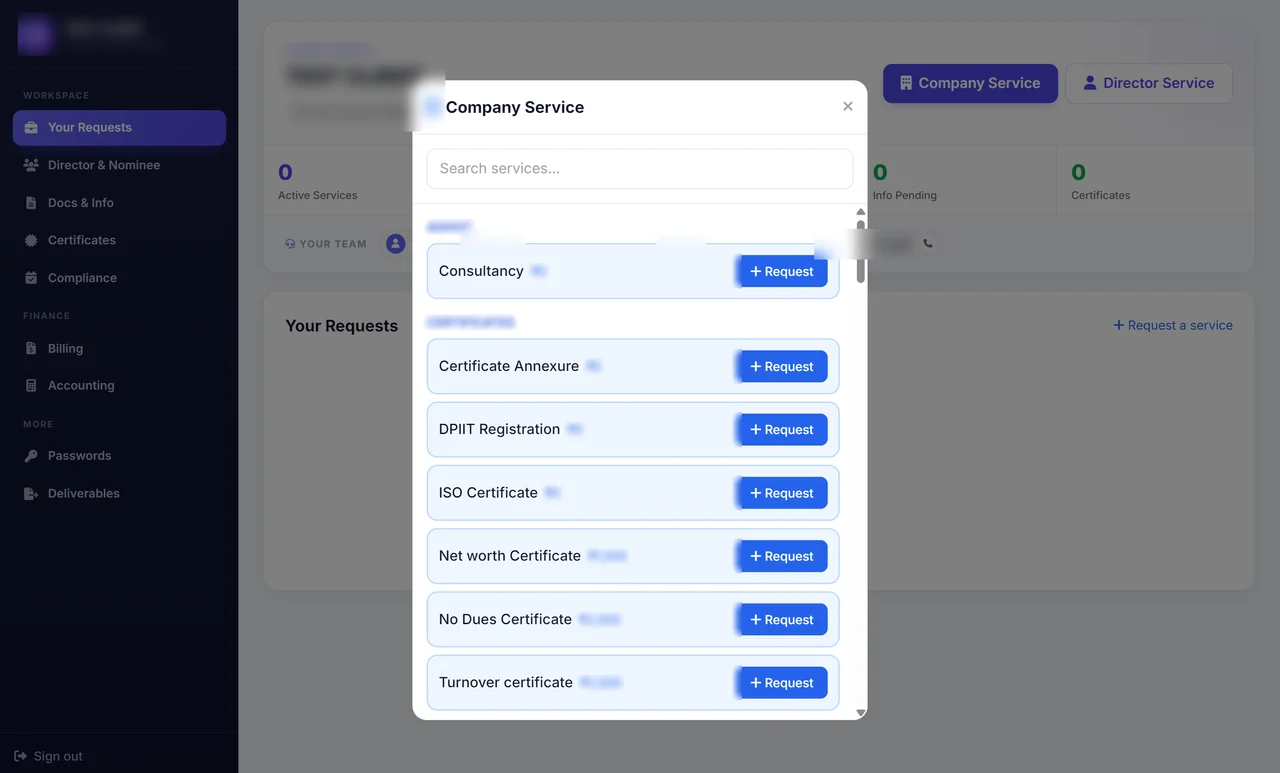
Service catalogue inside the client portal
2

Raise your request

Choose the service you need from the menu inside the portal, where the price is shown before you go ahead. Your request is logged the moment you send it, with no phone calls or reminder emails to wait on.

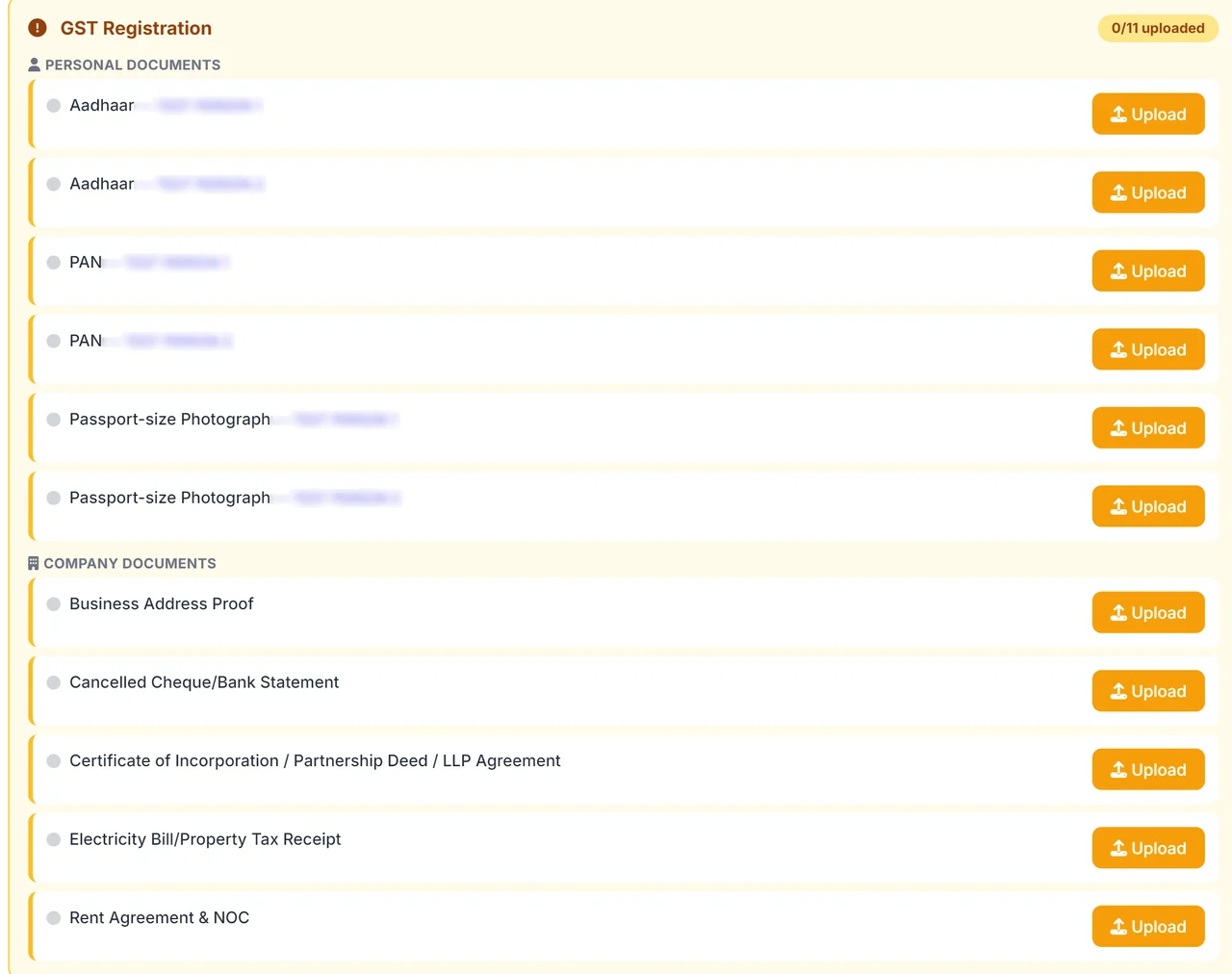
GST registration document checklist in the client portal, with an upload button beside each item
3

Share what the service asks for

For every service, the portal lists the exact documents it needs, each with its own upload button. The example shown here is the GST registration checklist. When a service needs nothing from you, it simply asks for nothing.

Live request tracker inside the client portal
4

We review, prepare and file

Once your documents are in, your team checks them, prepares the work and files it for you. A live tracker shows each stage as it happens, from review to processing to done, so you never have to ask where things stand.

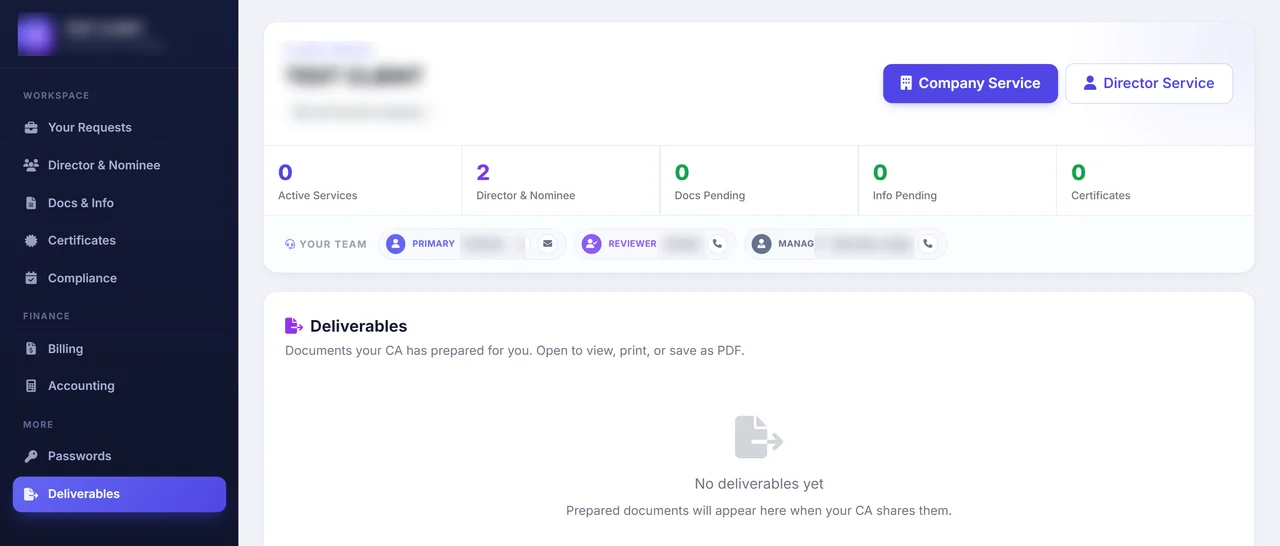
Deliverables area of the client portal
5

Collect your finished work

Every completed return, computation and certificate is placed in your Deliverables area. You can open, print or download any of them as a PDF whenever you need a copy.

Common MIS Reporting Challenges and How We Solve Them

ChallengeImpactHow Patron Accounting Solves It
MIS built from spreadsheets disconnected from the ledgerNumbers shift between versions, so management debates the data instead of the decisionDraw every figure from the trial balance, so the pack reconciles to the books line by line
KPI definitions differ across departments and monthsGross margin or CAC means something different each pack, so trends turn meaninglessFix a definitions library from standard MIS report formats and examples, so each metric is computed the same way
Reports show totals with no drill-down to transactionsA variance query stalls while someone re-derives the number from raw ledgersBuild the pack over tagged ledgers, so any line traces back to its postings
Accruals and prepayments skipped in interim monthsMonthly profit swings on timing, and the year-end audit restates the storyPass standard month-end accruals and prepayment releases, so interim margin holds up against audit
Cash-flow forecast never compared against what actually landedRunway estimates drift, and a funding gap surfaces with little warningRun a rolling forecast against actual receipts and burn, explaining each variance at close

MIS Reporting Fees

Fee ComponentAmount
Starter — a standard monthly MIS pack for one entityINR 4,999 per month
Excl. GST & Government Charges
Growth — more reports, added dashboards or higher reporting frequencyOn quote
Managed — multi-entity dashboards with bespoke KPIs and board packsOn quote

Pricing for a standard monthly MIS report pack covering one entity opens at INR 4,999 per month. The number of reports, the dashboards built and how often you need them refreshed is what shifts the fee. Request a customised estimate on +91 94594 56700.

Fees exclude GST and government charges. Final quote confirmed after a scoping review.

All fees and charges listed are indicative only and do not constitute a binding offer. Final amounts may vary depending on the volume of work and the complexity involved.

Professional accounting and compliance charges are scoped to your number of entities, funding stage and monthly transaction volume, and are separate from statutory and government charges. Contact us for a detailed, fixed quote.

Get a free MIS Reporting consultation - Call +91 945 945 6700 or WhatsApp us. No-obligation assessment.

MIS Reporting Compliance Calendar 2026

ComplianceDue DateApplies To
GSTR-3B (summary return and tax payment)20th of every month for monthly filersGST-registered businesses filing monthly; QRMP filers pay via PMT-06
Advance tax final instalment (100%)15 March 2026Companies, firms and individuals liable to advance tax
Advance tax first instalment (15%)15 June 2026Companies, firms and individuals with a tax liability of Rs 10,000 or more
Advance tax second instalment (45% cumulative)15 September 2026Companies, firms and individuals liable to advance tax
Tax audit report (Form 3CA/3CB-3CD)30 September 2026Businesses crossing the Section 44AB turnover threshold
Advance tax third instalment (75% cumulative)15 December 2026Companies, firms and individuals liable to advance tax
Annual GST return GSTR-9 and reconciliation GSTR-9C31 December 2026GST-registered businesses above the annual-return and audit thresholds

Good MIS is what makes the four advance-tax dates, 15 June, 15 September, 15 December and 15 March, predictable rather than a scramble. Patron's monthly MIS gives a running profit view so each instalment is estimated from real numbers, not a year-end guess. Download the 2026 calendar or talk to a CA on +91 94594 56700.

Key Benefits

Why Professional MIS Reporting Matters

Metrics that stop moving

We define revenue, gross margin and headcount in writing once, then measure them the same way every month.

  • Definitions agreed with the pack, then held steady
  • The same basis every month, so figures reconcile
  • Without it, two people bring different numbers to one meeting

Variance explained by its driver

We give each significant gap against budget commentary naming price, volume, mix or timing as the cause.

  • Commentary names price, volume, mix or timing behind each gap
  • Written against every significant variance from budget
  • Without it, the same question returns a month later

Seasonal patterns read correctly

We load your budget with the monthly phasing that was approved, rather than spreading it evenly across the year.

  • Approved monthly phasing loaded into the budget
  • Even spreading invents shortfalls in quiet months, hides peak ones
  • Without it, the whole pack loses credibility with the board

Limit utilisation seen early

We put working capital beside profit, showing ageing, days outstanding, inventory cover and how much of your sanctioned limit is drawn.

  • Loan and cash-credit utilisation shown against sanctioned limits
  • Debtor and creditor ageing and inventory cover sit beside profit
  • Without it, borrowing headroom is gone before anyone notices

A pack tied to the books

We trace every figure in the management pack back to a closed and reconciled trial balance.

  • Built from a closed and reconciled trial balance
  • So the management pack agrees with the signed accounts
  • Without it, lender reporting contradicts the signed accounts

Decisions carried into next month

We record the actions agreed at each review and reopen them at the start of the following month's pack.

  • Agreed actions reopened in the next month's pack
  • Any prior period restatement shown with a note
  • Without it, the same issue is discussed with no record kept

Why Businesses Choose Patron Accounting for MIS Reporting Services

Five things a founder can check before handing over the books. Each is a claim with the proof behind it.

The three numbers your board actually asks for

We build the report around the few numbers your board acts on, not a forty-tab dump nobody reads. Knowing which KPIs matter comes from 15+ years of experience across 3,000+ businesses.

Reporting tied to the statutory books

Your MIS reconciles to the same ledger that files your GST and income tax returns, so the board and the tax office see one set of numbers. This ties to the 25,000+ filings we have completed.

Dashboards live off the ledger, no manual export

We build inside the platform already running your books, whether Zoho Books, Xero, Tally Prime or Odoo. Dashboards read straight from the ledger and refresh without a monthly export and rekey.

Board pack in the same format every month

Every month you get the same board pack in the same layout, so trends read cleanly period on period. Founders rate this monthly MIS report 4.9 on Google.

MIS engagements among 3,000+ businesses served

MIS work spans startup dashboards to group consolidations, all among the 3,000+ businesses we have served since 2019. Our in-house team of CAs and CS brings 15+ years of experience and a 4.9 star rating.

Figures reflect Patron Accounting LLP engagements since 2019. Scope and turnaround are confirmed in your engagement letter.

Excel MIS vs Automated MIS Reporting

CriterionExcel MISAutomated MIS Reporting
TimelinessManual data pulls delay the pack, often days after month-endFigures refresh from the ledger soon after the close
Error riskBroken formulas and stale links can distort reported numbersData flows from source, cutting manual keying errors
Cost and effortCheap to start but heavy analyst time each monthTool cost offset by far less repeat preparation work
ScalabilityMultiple entities and cost centres make workbooks unwieldyAdded entities and dimensions handled without rebuilding sheets
Data integrityNumbers can drift from the books once copied outEvery figure traces back to the underlying ledger
FlexibilityFully customisable for one-off or unusual analysisStandard views are quick, bespoke cuts need configuration
VerdictFor small teams, a well-built Excel workbook still serves. Once entities multiply, an automated monthly MIS report gives faster, more reliable numbers, as these financial KPIs for dashboards illustrate.

Legal and Regulatory Framework for MIS Reporting

An MIS pack is only as reliable as the ledger beneath it, and Section 128 requires that ledger to be true and fair on accrual and double entry. A management report built on unclosed books is a forecast dressed up as a fact.

So the framework matters even though the report itself is unregulated. The figures a board reads - margin, working capital, cash - have to reconcile to the statutory books beneath them, measured under the same standards that will later be audited. That is why Gross Profit, EBITDA and Working Capital in a monthly MIS report are drawn from the ledger, not estimated alongside it. The provisions below are what the underlying numbers answer to.

  • Section 128, Companies Act 2013The books the MIS draws on are kept true and fair on accrual and double entry, so a management figure ties back to a statutory one.
  • Companies (Accounting Standards) Rules 2021 and Companies (Indian Accounting Standards) Rules 2015The same measurement standards apply to the MIS numbers as to the audited accounts, so the two never diverge - the basis of a reliable Net Profit line.
  • Section 128 and Section 44AA, Income-tax Act 1961The double-entry obligation behind the report applies whether the entity is a company or a non-corporate, so the pack is built on real books.
  • Section 44AA, Income-tax Act 1961A non-corporate business maintains its books once the limits are crossed, giving the MIS a compliant source to summarise.
  • Rule 3(1), Companies (Accounts) Rules 2014The audit trail stays enabled, so any adjustment that changes an MIS figure is itself traceable. A months-behind ledger is closed first via catch-up bookkeeping.

Official sources: Ministry of Corporate Affairs · Income Tax Department · GST Portal · Startup India (DPIIT)

What is a monthly MIS report?

A monthly MIS report is a management information pack issued after each month end showing profit and loss against budget, cash flow, debtor and creditor ageing, inventory position and the operating KPIs a management team acts on. Unlike statutory financials it is prepared for internal decisions, so it can be split by product, branch or customer and is issued within days of close.

How do you prepare a monthly MIS report in Excel?

A monthly MIS in Excel is built by exporting the trial balance from Tally or Zoho Books, mapping every ledger to a reporting head through a lookup table, then driving the profit and loss, ageing and KPI sheets from that single mapped data tab. Keeping data, mapping and presentation on separate sheets is what stops the file breaking when new ledgers appear.

Which data sources are used to prepare an MIS report?

An MIS report is prepared from the trial balance and general ledger, sales and purchase registers, bank statements, debtor and creditor ageing, inventory records, payroll data and the approved budget, plus operational inputs such as order book, headcount and production volumes. Data quality matters more than format, so bank and GST reconciliation is completed before any number enters the pack.

By what date each month is the MIS pack delivered?

Standard delivery is by the 10th of the following month, and by the 7th where bank feeds and the accounting software are already current. A draft pack goes out first for management comments and is finalised within two working days. Where a board or lender deadline is fixed, we agree an entry cut off with your team so the date holds every month.

What reports and KPIs are included in a standard MIS pack?

A standard pack carries the profit and loss with month, year to date and budget comparison, balance sheet, cash flow with a 13 week forecast, debtor and creditor ageing, inventory and gross margin analysis, and a one page dashboard of agreed KPIs. A short commentary explains the three or four variances that actually moved the result instead of listing every line.

Can the MIS be prepared branch wise or product wise?

Yes. Branch, product, project or channel reporting is set up by adding cost centres or tracking categories in Tally or Zoho Books and enforcing them at the point of data entry, so every transaction carries a dimension. Once that structure exists, the MIS shows gross margin per store, per SKU or per client with no manual reallocation at month end.

How much do monthly MIS reporting services cost?

Monthly MIS reporting typically costs Rs 10,000 to Rs 30,000 a month where we also maintain the books, and Rs 15,000 to Rs 40,000 where the books stay in house and we build the pack from your data. Price depends on the number of entities, branches and reporting dimensions, and whether a rolling cash forecast and budget variance analysis are included.

What are the types of management reporting?

Management reporting falls into five types: financial reports such as profit and loss against budget and the balance sheet, cash reports including a rolling 13 week forecast, operational reports covering ageing, inventory and productivity, compliance reports on GST, TDS and payroll status, and external formats for lenders and investors such as stock and debtor statements, covenant computations, burn and runway. All are built from one reconciled ledger.

Can you work with existing accounting software and an in-house accountant?

Yes. We work inside your existing Tally Prime, Zoho Books, Xero or ERP with read only or limited access, so your accountant continues daily entry while we take the closing, reconciliation and reporting layer. Where the ledger structure is not reporting ready, we redesign the chart of accounts once and then leave the routine running with your own team.

What does management reporting do?

Management reporting turns raw ledger data into the monthly numbers a management team acts on, covering performance against budget, cash position, receivable and payable ageing and the KPIs behind each result. Unlike statutory accounts prepared once a year for filing, it is issued within days of month end and split by branch, product or customer, so a loss making line is visible while it can still be fixed.

Quick Answers

The obligation here is written by your board and your lenders rather than by statute, and it binds just as tightly. Patron draws the trial balance once the books are closed for the month, maps it onto the reporting structure agreed at the outset, then builds the pack: revenue and margin by line, cash movement, debtor.

MIS Reporting Deadlines You Cannot Afford to Miss

GSTR-3B (summary return and tax payment) is due 20th of every month for monthly filers. Advance tax final instalment (100%) is due 15 March 2026. Advance tax first instalment (15%) is due 15 June 2026. Patron tracks each against your books so nothing is reconstructed after the fact. Call +91 94594 56700 to set up a filing-reminder schedule.

Start Your MIS Reporting with Patron Accounting

Numbers requested at a board meeting and produced only after it has ended are numbers the board cannot act on in the room. The discussion moves to the next item, decisions wait a month, and the finance team spends that month building a monthly MIS report for a question that has already gone stale.

Pricing is the decision this unlocks. Once margin is visible by product line and by customer, management reporting services let the loss-making account be repriced or let go on evidence rather than instinct. The discount that was protecting volume can be measured against the gross profit it consumed.

Your list of readers shapes everything that follows: what the board asks each month, which covenants your lender tests, and which questions your existing reporting cannot answer without a manual working. Reliable packs need current books, so restoring an incomplete ledger comes earlier.

Book a Free Consultation - No Obligation.

Explore Our Accounting Services

Related services our CA-led team delivers for businesses across India.

Reviewed by the CA & CS Team, Patron Accounting LLP
ICAI & ICSI registered  ·  15+ years in Indian accounting & compliance  ·  Last reviewed 23 July 2026  ·  Next review 23 October 2026