In this guide
Monthly bookkeeping in Pune costs about Rs 5,000 to Rs 15,000 for a small proprietor or early-stage firm, and roughly Rs 15,000 to Rs 35,000 for a private limited company that needs GST returns, TDS and payroll handled together. The number moves with how many transactions you post, how many registrations you carry and how quickly you want reports back, not with the hours an accountant spends. This guide sets out the 2026 fee bands for Pune, the local IT-corridor premium, and how GST and TDS change the real figure you pay. For a scoped quotation on your own books, the accounting and bookkeeping page for Pune is the right place to start; this article stays on how the pricing is built.
How much does monthly bookkeeping cost in Pune?
There is no single rate card because a Pune quotation is a bundle of scope, volume and turnaround. The bands below are indicative and Exl GST. They reflect what SMEs across Shivajinagar, Hadapsar, Baner and the Hinjewadi belt actually pay for a monthly retainer in 2026.
| Business profile | Typical monthly transactions | Indicative monthly fee (Exl GST) | Usually included |
|---|---|---|---|
| Freelancer or proprietor (section 44ADA) | Up to 100 | Rs 4,000 to Rs 8,000 | Books, GST if registered, one annual ITR |
| Small trader or early-stage startup | 100 to 300 | Rs 8,000 to Rs 15,000 | Books, GSTR-1 and GSTR-3B, TDS, monthly MIS |
| Growing private limited (services) | 300 to 800 | Rs 15,000 to Rs 25,000 | Above plus light payroll and ROC support |
| IT, SaaS or D2C in Hinjewadi or Kharadi | 800 and above | Rs 25,000 to Rs 35,000 and up | Above plus foreign receipts, ESOP and multi-GSTIN work |
Treat these as starting points. A firm with only 60 invoices a month but three GST registrations across states will sit higher than the transaction count alone suggests, because each registration adds its own return cycle.
What drives the price of accounting services in Pune
A monthly fee is built up from a handful of cost drivers rather than pulled from thin air. Understanding the build-up lets you see why two Pune firms quote differently for what looks like the same work.
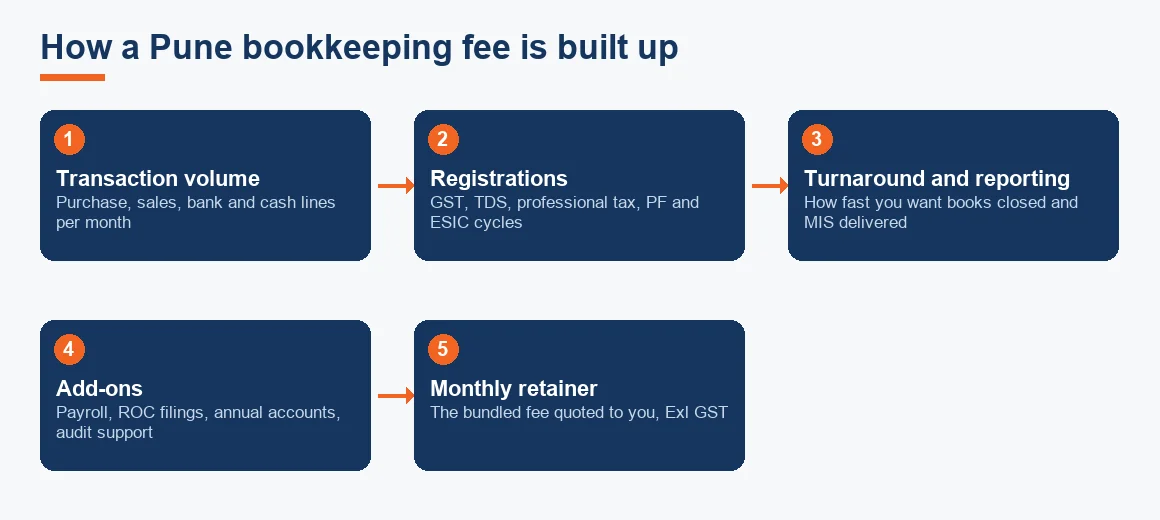
The main drivers are transaction volume (purchase, sales, bank and cash lines), the number of statutory registrations you hold (GST, TDS, professional tax, PF and ESIC), the reporting turnaround you expect, and any add-ons such as payroll, ROC filings or annual accounts. A business that wants its general ledger closed and an MIS pack by the fifth of every month will pay more than one that accepts a leisurely month-end. Complexity also matters: inventory, multi-currency receipts and job-work tracking each raise the base.
The Hinjewadi and Kharadi IT-corridor premium
Pune has two pricing worlds. A trader in Market Yard and a funded SaaS startup in Hinjewadi Phase 2 are quoted very differently even at similar turnover. The corridor premium is real, and it is not only about location rent. IT and services exporters in Hinjewadi, Kharadi and Baner usually carry foreign-currency receivables, SOFTEX or STPI filings, ESOP accounting and sometimes more than one GSTIN. Each of those pushes the work from routine bookkeeping into specialist territory, which is why IT and SaaS accounting in Pune and startup accounting in Pune sit at the top of the bands above. If your operation is a straightforward domestic trade or a professional practice, you should not be paying a corridor rate, and it is fair to say so during negotiation.
What a monthly bookkeeping retainer usually includes
Before you compare two figures, confirm you are comparing the same scope. A standard Pune retainer covers purchase and sales entry, bank and cash posting, bank reconciliation, preparation and filing of GSTR-1 and GSTR-3B, TDS computation, and a monthly MIS pack. What is almost always priced separately: payroll processing, annual financial statements, statutory audit support, ROC filings and income tax returns.
Two habits protect you here. First, insist that input tax credit is reconciled against GSTR-2B input tax credit matching every month, not once a year, or credit quietly leaks. Second, agree a month-end close checklist so both sides know what "books done" means. Our monthly bookkeeping and MIS checklist for Pune businesses sets out a workable version you can hand to any firm.
GST and TDS on accounting fees: the real cost
The headline fee is not the amount that leaves your account, and it is not always the amount that stays gone. Accounting, bookkeeping and audit services attract GST at 18 per cent under SAC 998222, as classified in the CBIC service rate schedule (cbic-gst.gov.in). If you are a registered business, that 18 per cent is claimable as input tax credit, so it is a cash-flow item rather than a true cost. An unregistered proprietor cannot claim it and genuinely bears the extra 18 per cent.
Separately, professional fees paid to a chartered accountant attract TDS at 10 per cent under section 194J of the Income-tax Act once your payments to that one firm cross Rs 50,000 in a financial year (incometax.gov.in). You deduct the TDS, pay the firm the balance and deposit the tax with the government. Individuals and HUFs not subject to tax audit fall outside section 194J and need not deduct.
Worked example: the true monthly cost of a Rs 15,000 retainer
Take a registered Pune private limited company on a Rs 15,000 a month retainer (indicative, Exl GST). Here is what changes hands and what the engagement actually costs once GST and section 194J are applied. TDS is deducted on the fee, not on the GST shown separately.
| Line | Amount (Rs) |
|---|---|
| Professional fee (SAC 998222) | 15,000 |
| Add: GST at 18% | 2,700 |
| Invoice value | 17,700 |
| Less: TDS at 10% under section 194J (on fee) | (1,500) |
| Net paid to the firm | 16,200 |
| Add: TDS deposited with the government | 1,500 |
| Less: input tax credit on GST (registered) | (2,700) |
| Effective monthly cost | 15,000 |
Across a year that is Rs 1,80,000 of effective cost, with Rs 32,400 of GST recovered as credit and Rs 18,000 routed to the exchequer as the firm's advance tax. An unregistered proprietor on the same retainer cannot recover the GST, so their effective annual cost is Rs 2,12,400. That single difference often decides whether GST registration is worth taking voluntarily.
Outsourced retainer versus an in-house accountant in Pune
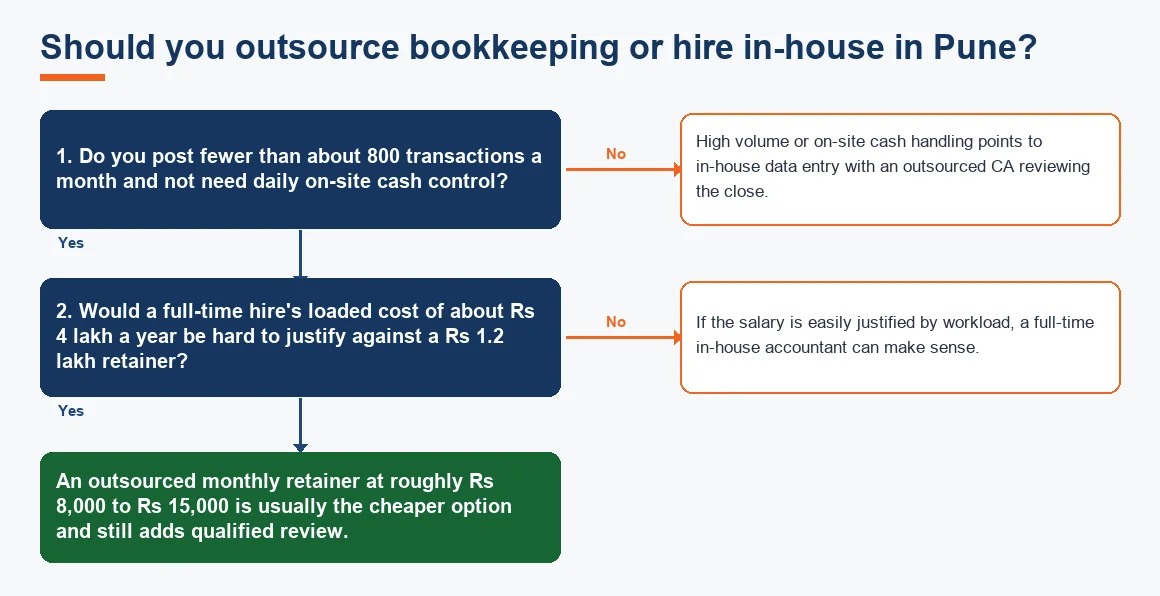
The most common question behind a fee search is whether to hire instead. An in-house accountant in Pune costs roughly Rs 25,000 to Rs 40,000 a month in salary, and once you add provident fund, professional tax, gratuity accrual and leave cover the loaded figure is close to Rs 4 lakh a year. An outsourced retainer at Rs 10,000 a month is Rs 1.2 lakh a year and comes with review by a qualified accountant rather than a single junior. For most small and mid-sized firms the retainer wins on both cost and control quality until transaction volume genuinely needs a full-time person on site.
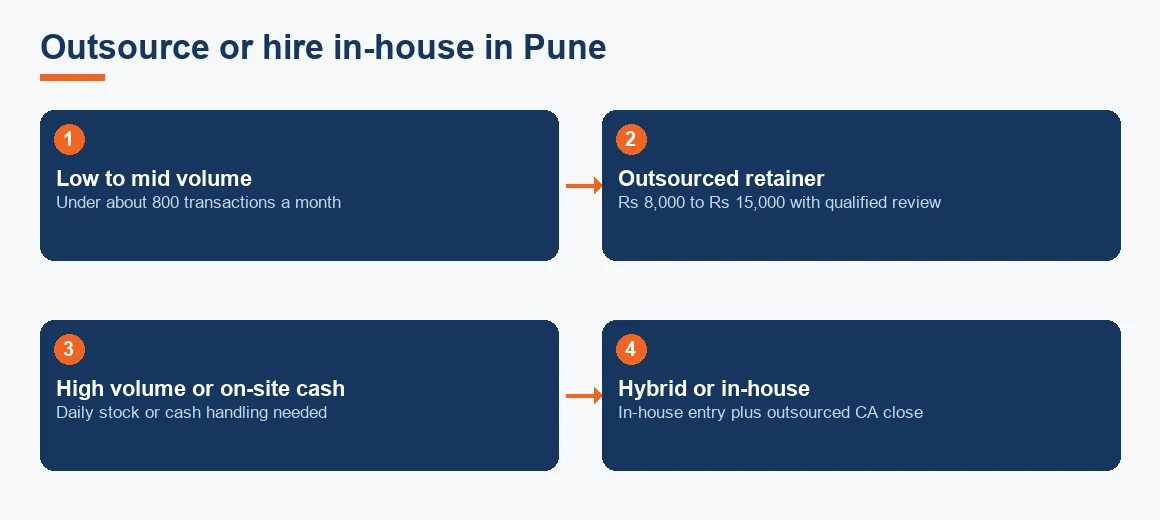
Where books are inventory-heavy or need daily on-site cash handling, the maths shifts. A Chakan or Pimpri auto-component maker running shop-floor stock, as covered in our note on costing and inventory accounting for Pune auto-component makers, may need in-house data entry with an outsourced CA reviewing the close. A D2C seller reconciling marketplace payouts, discussed in settlement reconciliation for Pune D2C sellers, is usually better served by a specialist retainer than a generalist hire. The right answer follows your days sales outstanding and volume, not a rule of thumb.
How to compare two Pune quotations without overpaying
Fee shopping only works when you hold scope constant. Work through these steps before you sign.
- Write down your monthly transaction count and your live registrations (GST, TDS, PT, PF). This sets the band you belong in.
- List the deliverables you actually need, separating the monthly retainer from annual work such as accounts, audit support and ITR.
- Ask each firm to quote against that exact list, and to name what is excluded.
- Convert each quote to an effective cost using the GST and 194J treatment above, so a registered and unregistered comparison is fair.
- Check who signs off the work. A slightly higher fee with qualified review can be cheaper than a cheap quote that a statutory auditor later has to unpick.
If you want a structured way to weigh firms on more than price, our guide on how to choose an accountant in Pune covers the Hinjewadi, Kharadi and Baner market in detail. When you are ready to move from comparing to commissioning, the accounting and bookkeeping services hub and the national accounting and bookkeeping services page set out how engagements are scoped.
Key terms
- Bank Reconciliation: matching your books against the bank statement to catch missing or duplicated entries.
- General Ledger: the master record where every posted transaction lands by account.
- GSTR-2B Input Tax Credit Matching: reconciling claimed credit against the auto-drafted GSTR-2B so no eligible credit is lost.
- Days Sales Outstanding (DSO): the average time customers take to pay, a signal of how much collection work your books carry.
- Month-End Close Checklist: the agreed list of tasks that defines when a month's books are genuinely complete.
Key takeaways
- Pune monthly bookkeeping runs about Rs 5,000 to Rs 15,000 for small firms and Rs 15,000 to Rs 35,000 for GST-registered companies, all indicative and Exl GST.
- Price follows volume, registrations and turnaround, so match scope before comparing two quotes.
- 18 per cent GST (SAC 998222) is recoverable for registered businesses; section 194J TDS at 10 per cent applies past Rs 50,000 a year to one firm.
- The Hinjewadi and Kharadi premium reflects foreign receipts, ESOP and multi-GSTIN work, not just address.
- For most small firms an outsourced retainer beats a Rs 4 lakh-a-year in-house hire on cost and review quality.
Decision guide