A textile manufacturer in Surat with a Rs 8 crore CC limit had been submitting monthly stock statements showing stock valued at Rs 12 crore. When the bank commissioned its half-yearly stock audit in December 2025, the CA's physical verification found actual stock of only Rs 7.2 crore - a shortfall of Rs 4.8 crore (40%). Of this, Rs 1.5 crore was genuinely obsolete fabric, Rs 2 crore was dispatched but not billed (timing), and Rs 1.3 crore could not be explained.
The bank recalculated drawing power at Rs 4.86 crore. The borrower's CC outstanding of Rs 7.5 crore now exceeded drawing power by Rs 2.64 crore. The bank issued a regularisation notice - repay the excess within 30 days or face NPA classification.
This is the reality of bank stock audit. It is the mechanism through which the bank verifies its collateral, recomputes drawing power, and decides whether the borrower's account is healthy or stressed. Understanding when it is mandatory, what the auditor checks, and how to prepare is essential for every CC/OD borrower.
What Is a Bank Stock Audit?
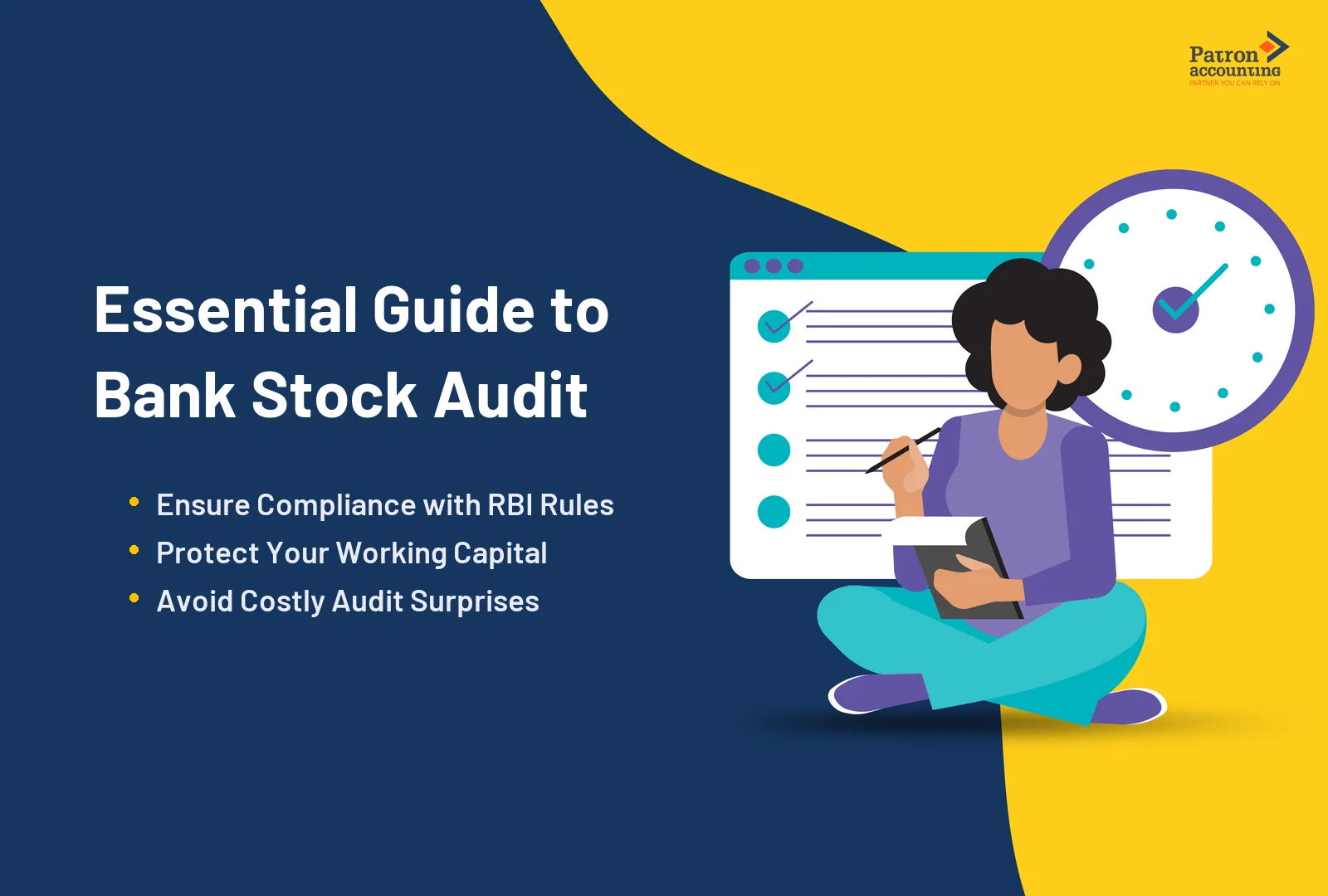
A bank stock audit is an independent physical verification, reconciliation, and valuation of a borrower's inventory and receivables conducted by a Chartered Accountant appointed by the bank. It verifies that the stock reported in the borrower's monthly bank stock statement actually exists, is correctly valued, and is eligible as collateral for the working capital facility.
The audit produces a report with: physical vs book stock reconciliation, eligible vs ineligible stock classification, Ind AS 2/AS 2 valuation review, drawing power computation, stock statement verification, insurance adequacy check, and observations on internal controls. The report is submitted to the bank's credit department.
For a broader understanding of stock audit beyond banking, see our complete stock audit guide. For professional CA-led stock audit services covering physical verification, DP computation, and bank report preparation, explore our service page.
Key Terms You Should Know
- Cash Credit (CC): Working capital facility where the bank extends credit against security of stock and receivables. The borrower draws up to the limit subject to drawing power. CC is the most common trigger for mandatory stock audit.
- Drawing Power (DP): Maximum drawable amount = eligible stock value x (100% minus stock margin) + eligible debtor value x (100% minus debtor margin). Stock audit determines the stock component of DP.
- Bank Stock Statement: Monthly declaration submitted by the borrower showing stock and debtor values. The bank computes monthly DP from this. Stock audit verifies these statements - discrepancies trigger excess drawing classification.
- Hypothecation Agreement: Legal document creating a charge on borrower's movable assets (inventory) in favour of the bank. Stock audit verifies stock exists at locations mentioned in this agreement.
- Out-of-Order Account: CC/OD where outstanding exceeds sanctioned limit or drawing power continuously for 90 days, or interest is not serviced. Under RBI IRACPD 2025, this is NPA.
- SARFAESI Act 2002: Allows banks to take possession of hypothecated assets without court intervention when the borrower defaults. Adverse stock audit findings can trigger SARFAESI proceedings.
Who Needs a Bank Stock Audit? Mandatory Thresholds
| Borrower Category | Typical Threshold | Frequency | Notes |
|---|---|---|---|
| CC/OD borrowers - commercial banks | Credit exposure > Rs 5 crore (varies by bank) | Quarterly or half-yearly | Threshold set by individual bank credit policy; some banks mandate at Rs 2 crore |
| CC/OD borrowers - large exposure | Credit exposure > Rs 25 crore | Quarterly | Higher-frequency audit for larger exposures; some banks require concurrent stock audit |
| CC/OD borrowers - cooperative banks | As per RBI Master Direction for UCBs | Half-yearly or annually | UCB-specific thresholds differ from commercial banks |
| Consortium/Multiple banking borrowers | As per lead bank's credit policy | As per lead bank | Lead bank coordinates the stock audit for all consortium members |
| Borrowers with deteriorating accounts | Ad-hoc (bank-initiated) | As required | Bank can mandate additional audit if account shows stress signals |
| Borrowers under restructuring or OTS | As per restructuring terms | Quarterly or more frequent | Restructured accounts require closer monitoring |
Borrowers in Pune's manufacturing belt can access on-site stock audit in Pune with drawing power computation, bank stock statement reconciliation, and report preparation in the bank's prescribed format.
RBI Regulatory Framework for Bank Stock Audit
| RBI Direction/Circular | Key Provision | Effective Date |
|---|---|---|
| RBI Master Direction - Credit Facilities Directions 2025 | Banks must obtain periodic stock audit for WC borrowers above prescribed thresholds; report reviewed by credit department | November 28, 2025 |
| RBI Credit Facilities Amendment Directions 2026 | Revised current account framework - CC/OD of borrowers with Rs 10 crore+ exposure must be with banks holding 10%+ exposure | April 1, 2026 |
| RBI IRACPD 2025 (NPA classification) | CC/OD is NPA when outstanding exceeds sanctioned limit or DP continuously for 90 days | November 28, 2025 |
| ICAI Technical Guide on Stock & Receivable Audit | Prescribes scope, procedures, format, and reporting for bank-commissioned stock audits | Current edition |
| Bank-specific credit policies | Each bank sets its own stock audit thresholds, frequency, and report format - can be stricter than RBI minimum | Bank-specific |
2026 Update: The RBI Credit Facilities Amendment Directions 2026 (effective April 2026) tighten the current account and CC/OD framework for borrowers with Rs 10 crore+ exposure. Only banks with 10%+ exposure share can operate full CC/OD accounts - increasing the primary bank's oversight and making stock audit findings even more consequential.
What the Stock Auditor Checks: Step-by-Step
1. Physical stock existence and condition. Physical count of all stock at every location in the hypothecation agreement - factory, warehouse, third-party locations, job workers. Verification of condition - damaged, expired, obsolete, slow-moving.
2. Book vs physical reconciliation. Comparison of physical count against stock register, ERP/Tally, and latest bank stock statement. Identification of shortages and excesses. Investigation of discrepancy reasons.
3. Eligible vs ineligible stock classification. Total stock classified into eligible (for DP) and ineligible (excluded). Ineligible typically includes: obsolete/expired, stock older than bank's ageing limit (90-180 days), uninsured, at unapproved locations, disputed, damaged.
4. Valuation review under Ind AS 2 / AS 2. Verification of lower-of-cost-or-NRV valuation. Review of cost method (FIFO/weighted average). Assessment of write-down requirements. WIP valuation including proportionate overhead.
5. Drawing power computation. DP = eligible stock x (100% minus stock margin) + eligible debtors x (100% minus debtor margin). Comparison with bank's records and borrower's stock statement-implied DP. Identification of excess drawing.
6. Bank stock statement verification. Cross-verification of monthly statements for the audit period against physical stock, book records, and invoices. Identification of inflation, timing differences, or reporting errors.
7. Insurance and hypothecation compliance. Sum insured covers stock value; all locations covered; policies current; bank named as loss payee. Stock confirmed at hypothecation agreement locations.
Documents Borrowers Must Keep Ready
- Bank sanction letter and hypothecation agreement
- Monthly bank stock statements for the audit period (6-12 months)
- Updated stock ledger / ERP inventory data
- Purchase invoices, GRNs, and supplier records
- Sales invoices, delivery challans, and e-way bills
- Stock transfer records - inter-branch, job worker, consignment
- Ageing analysis of inventory (item-wise age report)
- Insurance policies - sum insured, locations, exclusions, loss payee
- Scrap register and disposal records
- GST returns (GSTR-3B, GSTR-1) for cross-verification
- Previous stock audit reports
- Drawing power register / DP computation worksheet
Drawing Power Computation: Worked Example
Borrower with Rs 10 crore CC limit - how stock audit computes drawing power:
| Component | Amount (Rs) | Explanation |
|---|---|---|
| A. Total physical stock verified | 14,50,00,000 | Verified across factory + warehouse + job worker |
| Less: Ineligible stock | ||
| - Obsolete/expired | (45,00,000) | Identified during physical count |
| - Stock older than 180 days | (1,20,00,000) | Bank policy excludes >180 day stock |
| - Uninsured stock | (35,00,000) | Insurance does not cover job worker location |
| - Stock at unapproved location | (28,00,000) | Not in hypothecation agreement |
| - Disputed/rejected stock | (18,00,000) | Pending quality assessment |
| Total ineligible | (2,46,00,000) | 17% of total stock ineligible |
| B. Eligible stock | 12,04,00,000 | |
| C. Bank margin on stock (25%) | (3,01,00,000) | As per sanction letter |
| D. DP from stock | 9,03,00,000 | |
| E. DP from debtors (separate) | 2,10,00,000 | Eligible debtors x 60% |
| F. Total drawing power | 11,13,00,000 | Stock DP + Debtor DP |
| G. CC limit | 10,00,00,000 | As per sanction |
| H. Maximum drawable | 10,00,00,000 | Lower of DP and CC limit |
| I. CC outstanding | 9,25,00,000 | As on audit date |
| J. Available headroom | 75,00,000 | Borrower within limits - no excess |
Key Insight: If the borrower's stock statement had shown Rs 16 crore (vs Rs 14.5 crore actual), the bank was computing DP on inflated figures. The Rs 1.5 crore stock audit correction reduces DP and reveals the true headroom. In extreme cases, correction turns headroom into excess drawing - triggering regularisation demands or NPA classification.
What Happens When Stock Audit Reveals Problems?
| Finding | Bank Action | Borrower Consequence |
|---|---|---|
| Stock shortfall (physical < reported) | Recalculate DP; issue excess drawing notice | Must repay excess within 30-90 days or face NPA |
| Significant obsolete/expired stock | Exclude from eligible stock; reduce DP | Lower credit availability; may need additional collateral |
| Stock at unapproved locations | Exclude from DP until location approved | Must amend hypothecation agreement or move stock |
| Insurance inadequacy | Exclude uninsured stock from DP | Must increase insurance and provide updated policy |
| Stock statement inflation | Adverse report; may require concurrent audit | Loss of bank trust; account downgrade risk |
| Suspected fraud in statements | Report to fraud monitoring cell; Section 406/409 IPC | Criminal prosecution; SARFAESI; fraud classification |
| Minor discrepancies within tolerance | Noted in report; no immediate action | Must address in next audit; controls improvement |
GST implications: excess stock may indicate unrecorded purchases (ITC issues), shortage may indicate unrecorded sales. Borrowers filing GST return filing must ensure stock movements reconcile with GSTR-3B and GSTR-1 - discrepancies flagged in bank audit can trigger parallel GST inquiry.
Common Mistakes Borrowers Make Before Stock Audit
Mistake 1: Submitting inflated monthly stock statements. Many borrowers overstate stock values to maintain higher DP - adding stock-in-transit as "in warehouse," including obsolete items at full cost, or rounding up quantities. The stock audit exposes every inflation. The gap between reported and actual stock is documented and reported to the bank.
Mistake 2: Not updating stock register before audit. If the stock register is weeks behind actual transactions, the reconciliation will show discrepancies that are actually timing differences - but the auditor must report them. Keep the stock register current in real-time.
Mistake 3: Not informing the auditor about stock at third-party locations. Stock at job workers, consignment agents, or third-party warehouses is valid stock - but only if it is in the hypothecation agreement, verifiable by the auditor, and insured. Undisclosed stock at third parties creates questions about completeness and control.
Mistake 4: Insurance not aligned with current stock levels and locations. Insurance policies are often taken at the time of sanction and not updated as stock levels or locations change. If stock has grown 50% but insurance has not, the excess is uninsured and excluded from eligible stock.
Mistake 5: Not conducting internal reconciliation before the bank's audit. The first time the borrower discovers discrepancies should not be during the bank stock audit. Conduct monthly internal reconciliation - identify and resolve discrepancies before the external auditor arrives.
How Bank Stock Audit Connects with Other Compliance
Bank stock audit findings feed directly into the statutory audit under CARO 2020. If the bank audit finds material discrepancies, the statutory auditor must consider these when reporting on inventory controls. Income tax assessment can reference the bank audit report to verify closing stock.
The April 2026 current account changes mean the primary bank now has greater oversight of the borrower's fund flows. Stock audit + current account monitoring + DP computation creates comprehensive credit surveillance - making accurate stock records essential at all times, not just during audit periods.
For consortium borrowers, the lead bank's stock audit serves all member banks. The auditor's report is shared with all consortium banks and forms the basis for each bank's individual DP computation. Discrepancies affect the borrower's relationship with every bank in the consortium - not just one.
Bank Stock Audit vs Internal Audit vs Statutory Audit
| Feature | Bank Stock Audit | Internal Stock Audit | Statutory Audit (CARO 2020) |
|---|---|---|---|
| Mandated by | Bank / RBI | Management / Audit Committee | Companies Act 2013 |
| Purpose | Verify collateral; compute DP | Control improvement; loss prevention | Report on physical verification adequacy |
| Auditor appointed by | Bank (independent CA) | Company management | Company shareholders (via AGM) |
| Frequency | Quarterly / half-yearly | Ad-hoc or per audit plan | Annually (year-end) |
| DP computation | Yes - primary deliverable | No | No |
| Stock statement verification | Yes | No | No |
| Report to | Bank credit department | Management / audit committee | Filed with ROC |
| Adverse finding consequence | DP reduction; NPA; SARFAESI | Process improvement | Qualified audit report |
Key Takeaways
Bank stock audit is mandated by RBI and individual bank policies for all CC/OD borrowers with credit exposure above the prescribed threshold - typically Rs 5 crore. The audit is conducted by an independent CA appointed by the bank and determines whether the borrower's reported stock actually exists and is eligible collateral.
The audit computes drawing power by classifying stock into eligible and ineligible categories and applying the bank's prescribed margin. If CC outstanding exceeds the computed DP for 90+ days, the account is classified as NPA under RBI IRACPD 2025 - with consequences including loan recall and SARFAESI proceedings.
Monthly bank stock statements are verified during the audit. Any inflation - from measurement errors, timing differences, or deliberate misreporting - is documented. Persistent inflation can trigger fraud investigation under Section 406/409 IPC and account classification as fraud.
The April 2026 RBI framework changes strengthen bank oversight of borrower fund flows and stock collateral. Only banks with 10%+ exposure can operate the borrower's CC/OD - making stock audit findings more consequential for the borrower-bank relationship.
Borrowers should prepare by maintaining real-time stock records, conducting monthly internal reconciliation, ensuring insurance covers all stock locations, keeping the hypothecation agreement updated, and addressing obsolete/slow-moving stock proactively before the auditor discovers it.
Need a Professional Bank Stock Audit?
Whether your bank has mandated a quarterly stock audit, you need to prepare for an upcoming verification, or you want to proactively identify and fix stock discrepancies before the bank's auditor arrives - professional stock audit services provide the accuracy, credibility, and bank-compliant reporting that borrowers need.
Explore our stock audit services - CA-led on-site physical verification, Ind AS 2 valuation, drawing power computation, bank stock statement reconciliation, insurance review, and detailed reporting in the bank's prescribed format. Available across India with dedicated teams in Pune, Mumbai, Delhi, Bengaluru, and Chennai.
For queries, reach out at +91 945 945 6700 or WhatsApp us directly.