


Talk to an Expert
Talk to an Expert ✆ +91 945 945 6700
Trusted by 10,000+ Businesses

Preparation of Financial Statements in India

Reviewed by CA and CS Team, Patron Accounting LLP ICAI & ICSI Registered| 15+ Years Experience| Last Updated: July 2026 Verify Credentials →

Every figure with its working: You can trace any figure the day it is questioned, because each Schedule III note carries the working behind it.

Comparatives that stay comparable: Where a ledger's grouping changes, we regroup last year's figures and disclose the regrouping. Your prior year column then means what it appears to.

Ratios you can explain: The prescribed ratios come with the reason each one moved, written while the ledger is still open in front of you.

One set that cross-ties: Balance sheet, profit and loss and cash flow agree with one another. Every note casts to the face and rounding holds across the set.

15+ YearsIndustry Experience
CA & CSCertified Experts
4.9
Based on real Google reviews

Get Free Consultation

Talk to a CA/CS expert today

🇮🇳 +91

Our team will get back to you shortly. No spam.

Real Stories from Real People

Verified Google reviews from founders and businesses Patron works with across India.

Join 3,000+ Founders and Businesses on Patron

Rated 4.9 on Google - trusted for startup accounting since 2019.

Talk to an Expert
10,000+Businesses ServedGST compliance and litigation support across India.
15+Years ExperienceDeep expertise in IP registration, GST & business compliance.
50,000+Documents FiledReturns, appeals, and filings handled accurately.
4.9★Client RatingTrusted by entrepreneurs, startups, and growing businesses.
ISO CertifiedProfessional standards and documented processes.
SSL SecureYour financial and business data is fully protected.

What Financial Statement Preparation Covers — Scope, Deliverables and Who It Suits

📌 TL;DR - Financial Statement Preparation Services at a Glance

Preparation of financial statements means drafting the balance sheet, profit and loss, cash flow and notes in Schedule III format. Patron applies the correct AS or Ind AS basis, so the accounts give the true and fair view Section 129 requires. Your auditor signs without a rework list, and related-party and segment disclosures come from the ledger. Typically chosen by companies, LLPs and groups facing statutory audit.

The trial balance rarely agrees with the schedules that support it. Fixed asset registers, loan confirmations, statutory dues and inter-company balances must all reconcile to the ledger before anything is drafted. Patron runs that agreement first, clears the differences with your team, then builds the statements and notes from the reconciled ledger rather than from last year's file. A breakdown of the four statements sets out what each one carries.

Errors here are expensive after the fact: an audit reopened, comparatives restated, a filing revised at the registry. Financial statement preparation services are scoped by how many entities report, the volume of related-party dealings and whether a consolidation is needed. Bookkeeping corrections for prior periods and any restatement driven by the standards issued by ICAI fall outside the recurring retainer.

What Is Financial Statement Preparation?

A finalised ledger, with every balance agreed to its supporting schedule, is the raw material here. Preparation of financial statements is the service that turns it into a reported set of accounts. It drafts the balance sheet, the profit and loss, the cash flow statement and the accompanying notes, each laid out in the Schedule III format the Companies Act prescribes.

Applying the correct Accounting Standards or Ind AS basis is what lets the accounts present the true and fair position the law requires. It classifies assets and liabilities between current and non-current, records depreciation on the fixed assets, and builds the related-party and segment notes from the ledger itself. Comparative figures for the prior year are restated onto the same basis where a policy has changed. Financial reporting services of this kind hand over a set an auditor can sign without a rework list. Preparation of financial statements ends at the drafted accounts; the statutory audit opinion on them belongs to a separate firm.

Key Terms for Financial Statement Preparation:

  • DepreciationThe systematic writing down of a fixed asset's value over its useful life.
  • Fixed AssetsLong-term resources like plant, buildings and equipment a business uses to operate.
  • Current AssetsCash and items expected to convert to cash within one year.
  • Current LiabilitiesDebts and dues a business must settle within the next twelve months.
  • Balance SheetA statement of what a business owns and owes on a given date.
  • Profit & Loss StatementA statement showing income, expenses and the resulting profit over a period.
  • Cash Flow StatementA statement tracing cash moving through operating, investing and financing activities.
  • Schedule III Balance SheetThe Companies Act format prescribing how Indian company accounts must be presented.
What Is Financial Statement Preparation. A finalised ledger, with every balance agreed to its supporting schedule, is

Who Needs Financial Statement Preparation in India?

Preparation of financial statements suits entities that must present a formal Schedule III set, not just maintain a ledger. The organisations below each face a reader, an auditor or a registry that the raw trial balance cannot satisfy on its own.

  • Private companies heading into statutory audit that must hand the auditor a drafted set.
  • LLPs crossing the turnover limit where accounts must be filed at the registry.
  • Groups with subsidiaries that need a consolidation rather than standalone figures.
  • Companies with related-party dealings whose transactions and balances need full disclosure.
  • Businesses seeking a lender renewal where the schedules must agree across every statement.
  • Entities restating comparatives that must stay comparable to last year's signed accounts.
  • Companies mapping every ledger to Schedule III heads for the first time.
  • Businesses whose fixed asset and depreciation working must reconcile before drafting begins.

Our Financial Statement Preparation Services

ServiceWhat We Do
Trial balance take-onWe take on your final adjusted trial balance, agree opening balances to last year's signed accounts, and confirm the reporting framework Annually
Schedule III mappingFor the preparation of financial statements we map every ledger to the correct Schedule III grouping, keeping comparatives on the same basis Annually
Mandated schedules buildOur financial statement preparation services build the ageing, inventory, loan and related-party schedules that support each figure on the face of the accounts Annually
Notes and disclosures draftingWe draft the notes to accounts and disclosures, cross-referencing them to the schedules, following the format in this Schedule III format explainer Annually
Ratios and comparativesWe compute the disclosed ratios with their workings and check comparatives stay comparable, so you can explain every movement to reviewers Annually
Final cross-check and handoverWe cross-tie the whole set so balance sheet, profit and loss and cash flow agree, then return a review-ready balance sheet to management Annually
Our Process

How Financial Statement Preparation Works — Our Process

How Patron delivers financial statement preparation, step by step from onboarding to a clean monthly close.

Step 1

Agree framework and engagement

We first settle which framework applies: Division I with Accounting Standards, Division II with Ind AS, or a non-corporate format. We also confirm in writing that this is a compilation. We assist management in preparing the statements; no audit is performed and no assurance is expressed.

Illustration for Agree framework and engagement: We first settle which framework applies: Division I with Accounting
Step 2

Take on the trial balance

The starting point is a trial balance that agrees to the general ledger, with every sub-ledger tied to its control account and no balance parked in suspense. Where it does not agree, that is resolved before a single line of the statements is drafted.

Illustration for Take on the trial balance: The starting point is a trial balance that agrees to the general ledger, with
Step 3

Map every ledger to Schedule III

Each ledger is mapped to a Schedule III line item and to the note that supports it, rather than grouped out of habit. Where the mapping has changed, prior year figures are regrouped and the regrouping is disclosed, so the comparative column is genuinely comparable.

Illustration for Map every ledger to Schedule III: Each ledger is mapped to a Schedule III line item and to the note that
Step 4

Build the mandated schedules

Schedule III requires ageing of trade receivables and trade payables split undisputed and disputed, with payables also split between micro and small enterprises and others. We also build the fixed asset movement under Schedule II, borrowings with current maturities, and the bank stock-statement comparison.

Illustration for Build the mandated schedules: Schedule III requires ageing of trade receivables and trade payables split
Step 5

Draft the notes and disclosures

Notes are drafted rather than rolled forward: accounting policies as actually applied, related party transactions and closing balances, and contingent liabilities. They also carry the additional regulatory information Schedule III now requires, including the prescribed ratios with an explanation wherever the movement is significant.

Illustration for Draft the notes and disclosures: Notes are drafted rather than rolled forward: accounting policies as
Step 6

Cross-check the whole set

The balance sheet is agreed to the profit and loss account and to the cash flow statement. Every note is cast and agreed to the face of the statements, and comparatives are agreed to last year's signed accounts. Rounding is applied consistently across the entire set.

Illustration for Cross-check the whole set: The balance sheet is agreed to the profit and loss account and to the cash flow
Step 7

Return the set to management

The completed statements go back to management, whose responsibility they are, together with our compilation report. That report expresses no opinion on truth and fairness. Where an audit is required, that opinion remains the work of the appointed auditor.

Illustration for Return the set to management: The completed statements go back to management, whose responsibility they

Documents Required for Financial Statement Preparation

Schedule III asks for splits your ledger does not hold, such as ageing buckets and disputed against undisputed, so those schedules are collected separately.

  • Trade receivables and trade payables ageing schedules, split undisputed/disputed and MSME/others
  • Closing inventory valuation statement with the basis of valuation stated
  • Bank balance confirmation certificates as at the reporting date
  • Loan confirmations, sanction letters, charge/CHG filings and the current-maturities split
  • Quarterly stock and book-debt statements filed with banks against working capital limits
  • Related party list and the year's related-party transactions with balances outstanding
  • Final adjusted trial balance with every ledger balance and its grouping
  • Previous year's signed financial statements with the full notes to accounts
  • Fixed asset register with additions, disposals, revaluations and the Schedule II depreciation working
Client Portal

How You Work With Patron

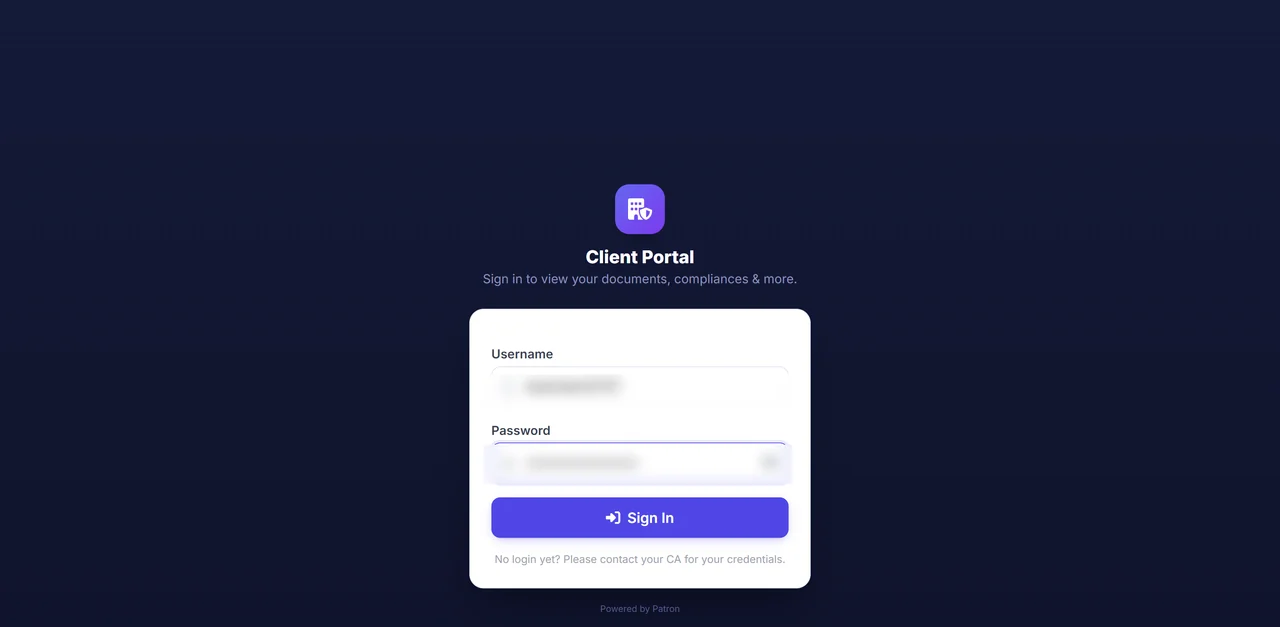
Everything happens in one secure login. You can see your active services, the Patron team on your account, and anything still pending. Once you raise a request, it moves through the same clear steps every time, so you always know exactly where your work stands.

Secure client portal login screen
1

Sign in securely

Your books, documents and requests all sit behind one private, password protected login. The team handling your account is shown on screen, so nothing sensitive ever needs to travel over email or WhatsApp.

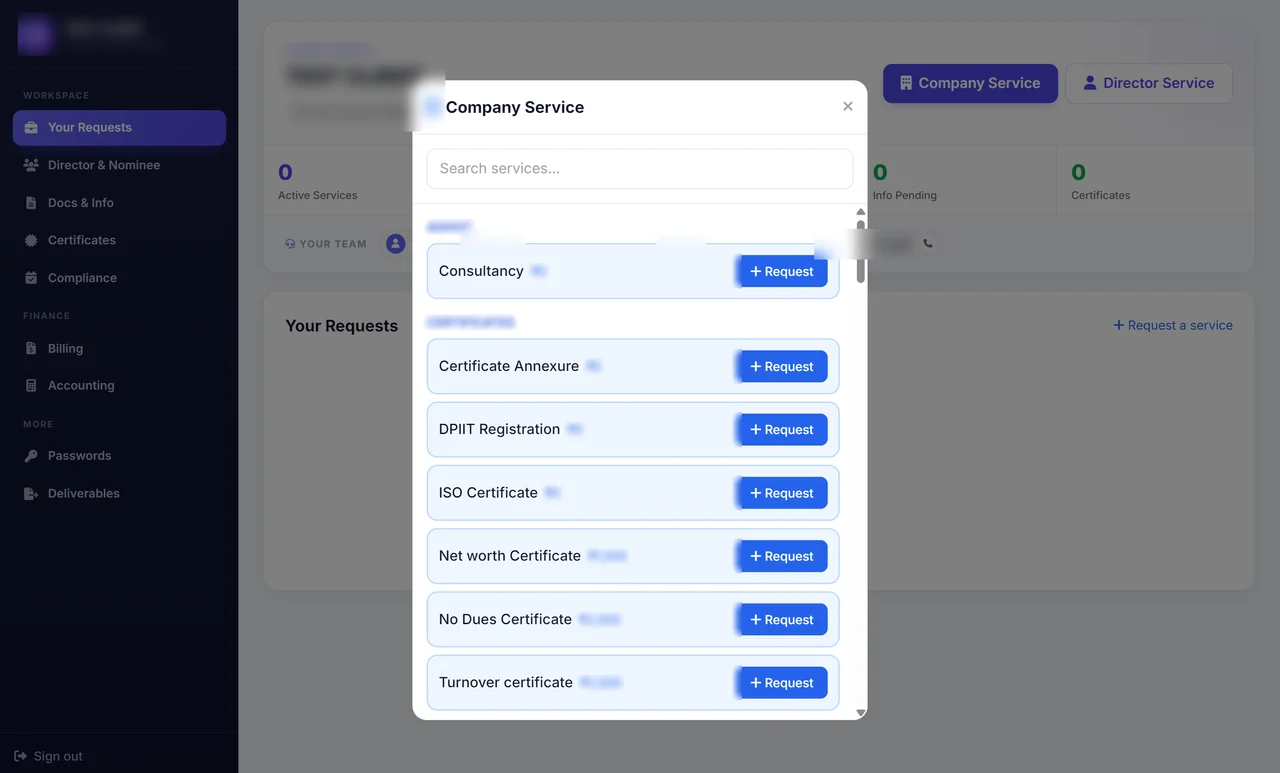
Service catalogue inside the client portal
2

Raise your request

Choose the service you need from the menu inside the portal, where the price is shown before you go ahead. Your request is logged the moment you send it, with no phone calls or reminder emails to wait on.

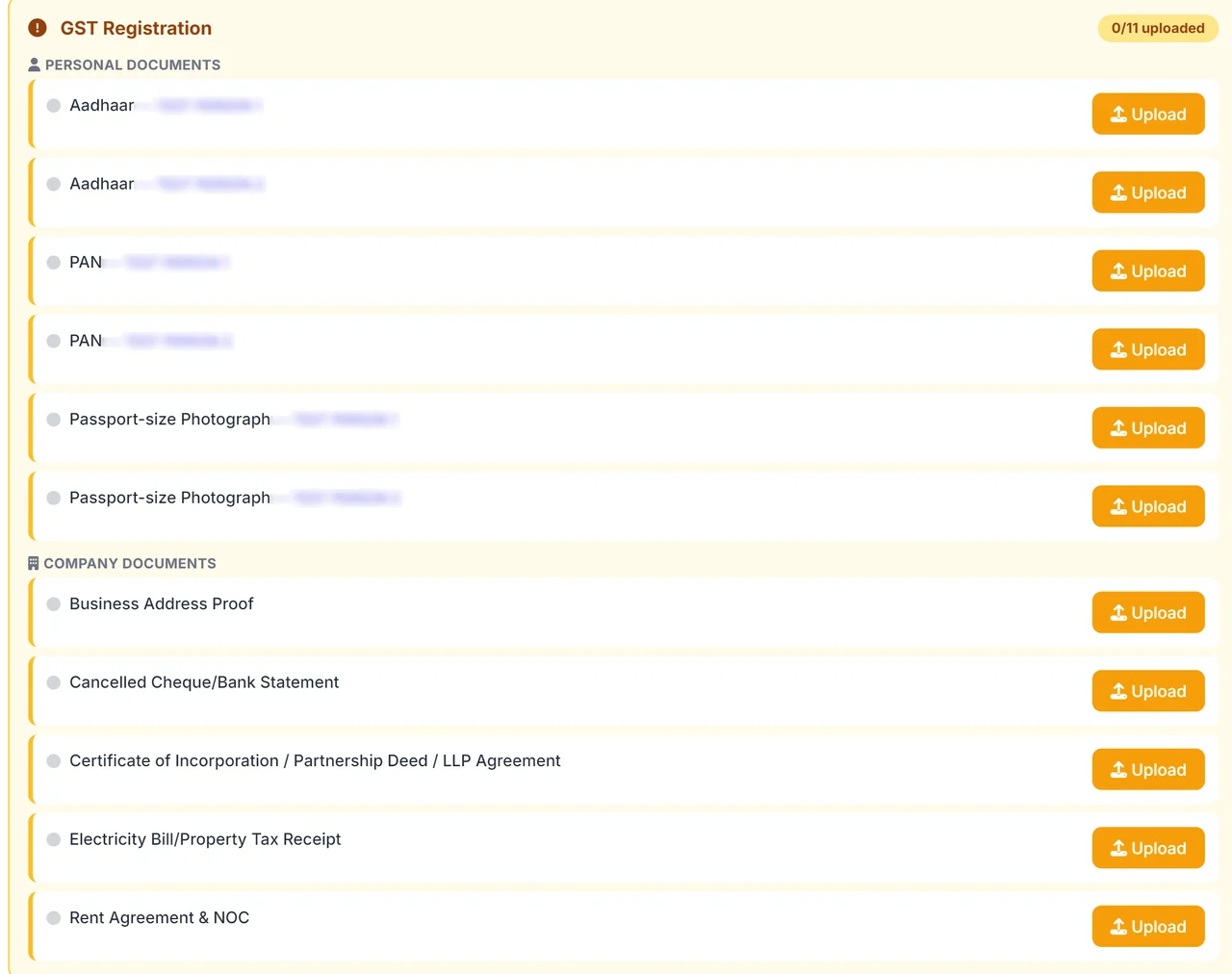
GST registration document checklist in the client portal, with an upload button beside each item
3

Share what the service asks for

For every service, the portal lists the exact documents it needs, each with its own upload button. The example shown here is the GST registration checklist. When a service needs nothing from you, it simply asks for nothing.

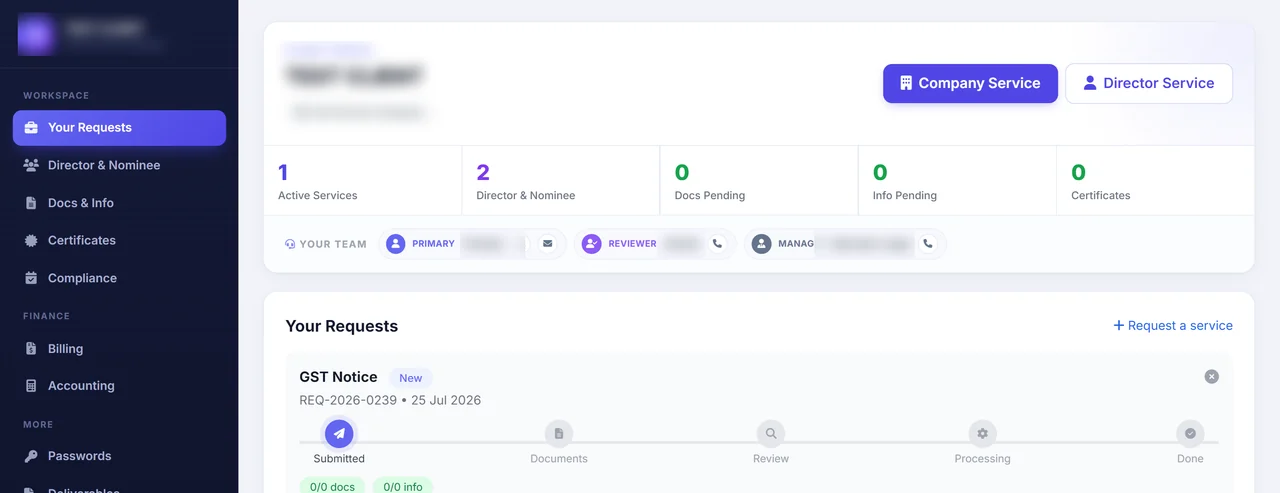
Live request tracker inside the client portal
4

We review, prepare and file

Once your documents are in, your team checks them, prepares the work and files it for you. A live tracker shows each stage as it happens, from review to processing to done, so you never have to ask where things stand.

Deliverables area of the client portal
5

Collect your finished work

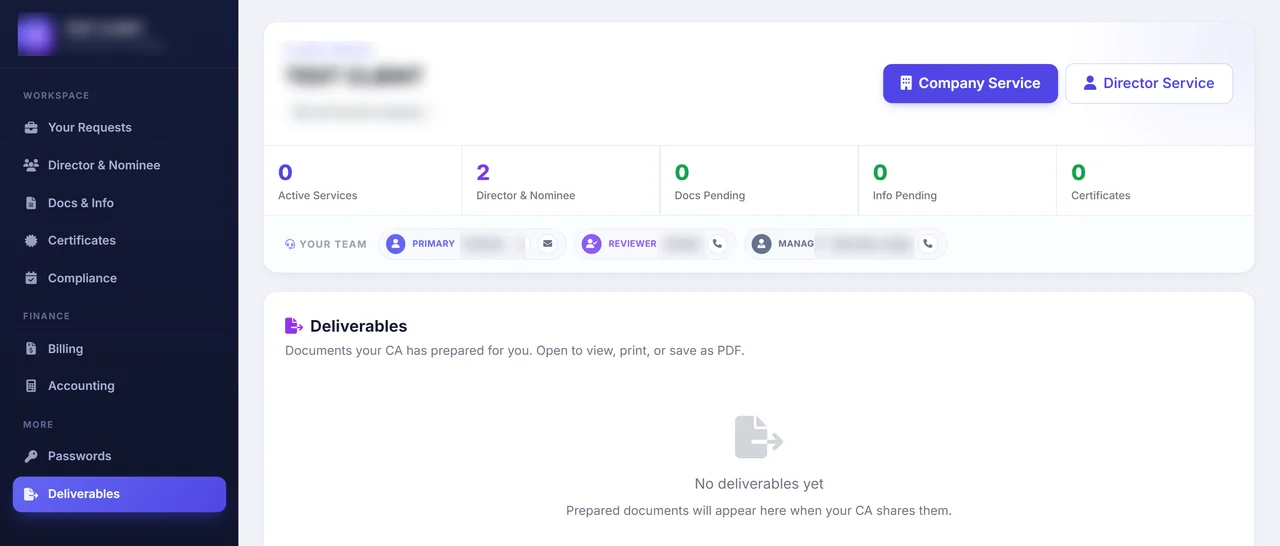
Every completed return, computation and certificate is placed in your Deliverables area. You can open, print or download any of them as a PDF whenever you need a copy.

Common Financial Statement Preparation Challenges and How We Solve Them

ChallengeImpactHow Patron Accounting Solves It
Current versus non-current split of loans and assets not maintainedThe balance sheet misclassifies liabilities, so ratios and Schedule III disclosures come out wrong.Tag maturity on every borrowing and asset; derive the twelve-month split automatically at close.
Contingent liabilities and capital commitments never captured in notesMaterial disclosures go missing, risking an auditor qualification or a later restatement.Keep a running register of guarantees, disputes and commitments feeding the Schedule III notes.
Deferred tax on timing differences not computedProfit after tax is misstated and the accounts breach AS 22.Build a deferred-tax working from depreciation and disallowance differences at each close for the balance sheet.
Cash flow prepared by plugging, not from actual movementsThe cash flow does not tie to the balance sheet, drawing review comments.Derive cash flow from real asset, working-capital and financing movements, reconciled to bank, in the correct order to prepare statements.
Prior-year figures and regroupings carried inconsistentlyComparatives break and the auditor asks for a reconciliation of every restated line.Lock the prior-year mapping, disclose regroupings, and keep a reconciliation for each restated figure.

Financial Statement Preparation Fees

Fee ComponentAmount
Single-entity set — one unaudited statement set for a single entityINR 9,999 per set
Excl. GST & Government Charges
Group or consolidated set — multiple entities or a consolidated set with supporting schedulesOn quote

The preparation of financial statements starts at INR 9,999 per set for one entity, covering an unaudited balance sheet, profit and loss and notes. Cost climbs when several entities are involved or a consolidated set with supporting schedules is required. Ask for a fixed quote on +91 94594 56700.

Fees exclude GST and government charges. Final quote confirmed after a scoping review.

All fees and charges listed are indicative only and do not constitute a binding offer. Final amounts may vary depending on the volume of work and the complexity involved.

Professional accounting and compliance charges are scoped to your number of entities, funding stage and monthly transaction volume, and are separate from statutory and government charges. Contact us for a detailed, fixed quote.

Get a free Financial Statement Preparation consultation - Call +91 945 945 6700 or WhatsApp us. No-obligation assessment.

Financial Statement Preparation Compliance Calendar 2026

ComplianceDue DateApplies To
Advance tax final instalment (100%)15 March 2026Companies, firms and individuals liable to advance tax
Return of deposits (Form DPT-3)30 June 2026Companies reporting loans and deposits outstanding as on 31 March
Tax audit report (Form 3CA/3CB-3CD)30 September 2026Businesses crossing the Section 44AB turnover threshold
Income-tax return, audit cases31 October 2026Companies and audit-liable firms
Financial statements filing (Form AOC-4)Within 30 days of the AGM (by 29 October 2026 for a 30 September AGM)Companies filing audited financials with the ROC
Annual return (Form MGT-7 / MGT-7A)Within 60 days of the AGM (by 28 November 2026 for a 30 September AGM)Companies filing the annual return with the ROC
Annual GST return GSTR-9 and reconciliation GSTR-9C31 December 2026GST-registered businesses above the annual-return and audit thresholds

Finalised statements feed the ROC dates: AOC-4 by 29 October and MGT-7 by 28 November, after the tax audit on 30 September. DPT-3 reports deposits by 30 June. Patron prepares financial statements early so each filing runs off signed, reconciled numbers. Book a compliance review with a Patron CA on +91 94594 56700.

Key Benefits

Why Professional Financial Statement Preparation Matters

Every figure with its working

You can trace any figure the day it is questioned, because each Schedule III note carries the working behind it.

  • Ageing split into undisputed and disputed
  • Payables split between micro and small enterprises and others; fixed asset movement shown
  • Without the workings, each query is reconstructed and the close runs late

Comparatives that stay comparable

Where a ledger's grouping changes, we regroup last year's figures and disclose the regrouping. Your prior year column then means what it appears to.

  • Every ledger mapped to Schedule III
  • Last year's figures regrouped and the regrouping disclosed
  • Without it, a reclassification reads as a real performance movement

Ratios you can explain

The prescribed ratios come with the reason each one moved, written while the ledger is still open in front of you.

  • Prescribed ratios carry the reason each one moved
  • Part of the additional regulatory information Schedule III requires
  • Without it, an unexplained ratio is raised at the board or credit review

One set that cross-ties

Balance sheet, profit and loss and cash flow agree with one another. Every note casts to the face and rounding holds across the set.

  • Three statements agree and every note casts to the face
  • Rounding holds across the whole set
  • Without it, one note that does not cast puts the whole file in doubt

Stock statements that match books

We compare the quarterly stock and book-debt statements filed against your working capital limits with the final book figures. This is done before signing.

  • Quarterly stock and book-debt statements compared to final book figures
  • Reconciled against your working capital limits
  • Without it, a difference surfacing later at renewal is hard to explain

The right reporting framework

You know at the outset which presentation your accounts must follow, agreed in writing with whoever will audit them.

  • Reporting framework agreed in writing at the outset
  • Engagement scope fixed before drafting begins
  • Without it, drafting restarts from the trial balance on a different basis

Why Businesses Choose Patron Accounting for Financial Statement Preparation

Five things a founder can check before handing over the books. Each is a claim with the proof behind it.

Schedule III presentation your auditor signs without a rework list

We present accounts in Schedule III format the way auditors expect, so the draft goes through without a rework list. That comes from 15+ years preparing statutory financials.

AS or Ind AS applied on the correct basis

We judge whether AS or Ind AS applies, then apply it on the right basis with the note disclosures to match. Framework calls like this run through 25,000+ filings completed.

Statements generated from the ledger, not rebuilt in a spreadsheet

We generate the statements straight from the accounting ledger, whether Zoho Books, Xero, Tally Prime or Odoo, not rekeyed into a spreadsheet. We work across Zoho Books and Xero.

Draft financials once the trial balance is frozen

Once the trial balance is frozen, you receive a full draft set of financials prepared in the right order. Delivery this reliable sits behind our 4.9 star Google rating.

Statutory financials prepared, including group consolidations

We prepare statutory financials, standalone and consolidated, for companies among the 3,000+ businesses served since 2019. Our in-house team of CAs and CS, ISO Certified and MCA Registered, does the work.

Figures reflect Patron Accounting LLP engagements since 2019. Scope and turnaround are confirmed in your engagement letter.

Schedule III Format vs Management Accounts

CriterionSchedule III FormatManagement Accounts
PurposeSchedule III: statutory statements filed with MCA for external users.Management accounts: internal reports for owners and their decisions.
FormatSchedule III: prescribed heads, disclosures and comparatives are fixed.Management accounts: flexible layout, segment and KPI views chosen.
FrequencySchedule III: prepared annually alongside the statutory audit.Management accounts: monthly or weekly as management needs.
Standards appliedSchedule III: AS or Ind AS plus Companies Act rules.Management accounts: no mandatory framework, tailored to the use.
AudienceSchedule III: registrar, lenders, tax authorities and shareholders.Management accounts: directors, investors and internal budget owners.
AssuranceSchedule III: subject to a formal statutory audit.Management accounts: usually unaudited, faster but less formal.
VerdictThese are not rivals; Schedule III statements are mandatory for MCA filing, while management accounts drive month-to-month decisions. Sound preparation of financial statements delivers both, using the Schedule III of the Companies Act format for the filed set.

Legal and Regulatory Framework for Financial Statement Preparation

An incorporated entity triggers a chain of filings that a proprietorship never sees, and financial statement preparation sits at the head of it. Section 129 requires the accounts to be drawn in the Schedule III format and adopted by the members, and everything downstream - the ROC return, the tax audit - depends on that set being right first.

So the framework treats the statements as the pivot between the closed ledger and the filings that consume it. The balance sheet and profit and loss are built to a prescribed shape, then flow into two different forms with two different deadlines. That is why the grouping of Fixed Assets, Current Assets and Current Liabilities is dictated by statute rather than preference. Preparation of financial statements answers to the provisions below.

  • Section 129 with Schedule III, Companies Act 2013The year-end balance sheet and profit and loss are drawn in the Schedule III format and adopted at the AGM within the Companies Act timeline. ICAI's Guidance Note on Schedule III governs how each line is presented.
  • Sections 137 and 92, Companies Act 2013The adopted accounts are filed with the ROC in AOC-4, and the annual return in MGT-7, once the year is closed.
  • Section 44AB, Income-tax Act 1961Where the turnover thresholds are met, the finalised accounts feed the tax audit report before the filing date.
  • Companies (Accounting Standards) Rules 2021 and Companies (Indian Accounting Standards) Rules 2015The numbers are measured under the applicable AS or Ind AS, including the Depreciation charge that the statements must reflect.
  • Section 128, Companies Act 2013The underlying books must be complete and true and fair before a statement can be drawn from them, and are retained for eight years.
  • Rule 3(1), Companies (Accounts) Rules 2014Any adjustment posted during finalisation is captured by the audit trail, so the reported figures are traceable to the ledger. A backlog is closed first via catch-up bookkeeping.

Official sources: Ministry of Corporate Affairs · Income Tax Department · GST Portal · Startup India (DPIIT)

What are the 4 basic financial reports?

The four basic financial reports are the balance sheet, the statement of profit and loss, the cash flow statement and the statement of changes in equity, presented together with the notes to accounts. Indian companies prepare this set in the Schedule III format under the Companies Act 2013. One person companies and small companies are exempt from preparing the cash flow statement, and comparative figures are mandatory.

Do financial statements have to follow AS or Ind AS?

Ind AS applies to listed companies and to unlisted companies whose net worth is Rs 250 crore or more, together with their holding, subsidiary, associate and joint venture entities. Everyone else continues under the notified Accounting Standards. We test net worth at each year end, because crossing the threshold once makes Ind AS permanent for that company.

How long does it take you to prepare financial statements?

For a company with clean books, a full Schedule III set takes 7 to 10 working days from receipt of the final trial balance. Where ledgers need scrutiny, provisions are missing or intercompany balances are unmatched, allow 3 to 4 weeks instead. Statements needed for a bank sanction or investor pack are delivered against a committed date.

Can financial statements be prepared when the books exist only in Excel?

Yes. We rebuild a trial balance from your Excel workings, bank statements, GST returns and TDS statements, then produce the statutory format from that base. Most Excel-only businesses also receive a proper chart of accounts and migration to Tally or Zoho Books, so next year needs no rebuild. The rebuild itself is quoted separately.

What is the deadline for filing financial statements with the MCA?

Form AOC-4 carrying the financial statements is filed within 30 days of the annual general meeting, and the annual return in Form MGT-7 within 60 days of that meeting. The AGM itself is generally due by 30 September for a company on an April to March year. Late filing attracts an additional fee for each day.

What does financial statement preparation cost?

A standalone Schedule III set for a private limited company with clean books is typically Rs 15,000 to Rs 40,000, rising with consolidation, Ind AS or multiple reportable segments. LLP and partnership statements sit lower. Where we already maintain your books monthly, preparation is covered inside the annual scope instead of being billed as a separate job.

Do you prepare consolidated financial statements for a group?

Yes. Consolidation covers subsidiaries, associates and joint ventures, with intercompany transactions and unrealised profits eliminated and non-controlling interest presented separately. A company having one or more subsidiaries must prepare consolidated statements in addition to its standalone set. Foreign subsidiaries are translated using the method the applicable standard prescribes for that class of operation.

Is coordination with the statutory auditor included?

Yes. We prepare the statements and the full audit schedule pack, answer auditor queries and pass agreed adjustments, while the auditor stays independent and signs the report. Preparation and audit are deliberately kept as separate engagements, since an auditor cannot audit statements they prepared themselves. Audits usually close faster when schedules arrive alongside the draft.

Can these statements be used for a bank loan or a government tender?

Yes. Banks and tender authorities normally want three years of audited statements with the auditor's report, plus a certified computation and net worth statement. We prepare the set in the format the lender specifies, including provisional statements for the current part-year where a sanction needs them. Provisional statements are always labelled clearly as provisional.

What happens if last year's numbers turn out to be wrong?

Prior period errors are corrected in the current year statements with the effect disclosed in the notes, rather than by quietly changing opening balances. Where the error also affects tax already filed, we tell you whether a revised or updated return remains available for that year before you decide. Material misstatements are escalated to the board.

Quick Answers

The trial balance rarely agrees with the schedules that support it. Fixed asset registers, loan confirmations, statutory dues and inter-company balances must all reconcile to the ledger before anything is drafted. Patron runs that agreement first, clears the differences with your team, then builds the statements and.

Financial Statement Preparation Deadlines You Cannot Afford to Miss

Advance tax final instalment (100%) is due 15 March 2026. Return of deposits (Form DPT-3) is due 30 June 2026. Tax audit report (Form 3CA/3CB-3CD) is due 30 September 2026. Patron tracks each against your books so nothing is reconstructed after the fact. Call +91 94594 56700 to set up a filing-reminder schedule.

Start Your Financial Statement Preparation with Patron Accounting

Whether the accounts get drafted is rarely in doubt; who carries the drafting risk when the auditor's queries arrive is the real question. Handing preparation of financial statements to a team that will also defend every schedule behind them changes what happens when a query lands, because the answer already exists in the file.

Lenders reading a renewal proposal test three things: whether the numbers agree across the statements, whether the notes explain the movements, and whether last year's figures moved without explanation. Financial reporting services that answer all three in the file itself turn a query list into a short call.

Last year's auditor query list comes out early and is worked through line by line, because the schedules that caused trouble then are the ones built differently this time. Where entries are still missing, clearing a period of arrears has to come before any drafting begins.

Book a Free Consultation - No Obligation.

Explore Our Accounting Services

Related services our CA-led team delivers for businesses across India.

Reviewed by the CA & CS Team, Patron Accounting LLP
ICAI & ICSI registered  ·  15+ years in Indian accounting & compliance  ·  Last reviewed 23 July 2026  ·  Next review 23 October 2026