In this guide
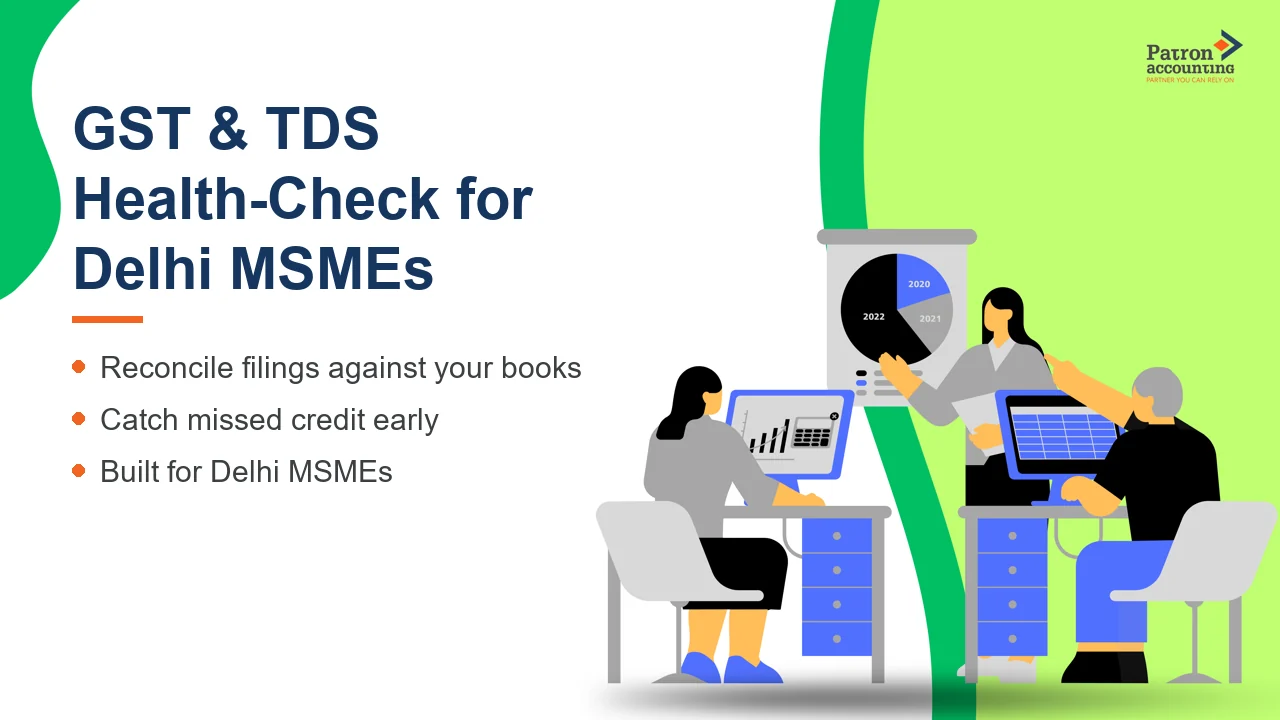
A practical GST and TDS compliance checklist for Delhi MSMEs is not a long audit; it is a short health-check that compares your filed returns with your books and flags the filings you have already got wrong. For a small business in Nehru Place, Rohini or Okhla, the recurring problems are predictable: input tax credit claimed but not appearing in GSTR-2B, tax deducted on the wrong amount, and reverse charge quietly left unpaid. This guide sets out what to check, the rule behind each item, and how to read the result, so you can run the same diagnostic every quarter rather than discovering the gap at year end. It stays informational; if you would rather the reconciliation was done for you, that sits with our Accounting & Bookkeeping Services in India team and the Delhi accounting desk.
What a GST and TDS health-check actually is
A health-check is a reconciliation exercise, not an audit. You line up each filed return against the record it is supposed to reflect and look for the gaps. On the GST side that means comparing GSTR-1 against the sales register, GSTR-3B against GSTR-2B for input tax credit, e-way bills against outward supplies, and, once a year, GSTR-9 against the annual accounts. On the TDS side it means confirming tax was deducted on the right value, deposited by the 7th, and reported in the correct quarterly return. The point is diagnostic: you find errors while they are still cheap to fix.
Who needs this health-check
Any Delhi MSME or independent professional filing GST and deducting TDS benefits from it, but a few situations make it close to essential. If you buy from vendors across state lines (which most Delhi and wider NCR businesses do), if you pay rent, professional fees or contractor bills above the TDS thresholds, or if your turnover has crossed the point where Section 194Q TDS on goods starts to apply, the number of moving parts is already past what memory can track. Professionals billing under presumptive schemes still deduct TDS on the rent and salaries they pay, so the TDS half applies to them too. If you are weighing whether to keep this in-house at all, our guide on choosing an accountant in Delhi covers that decision separately.
The GST side: five reconciliations that catch missed filings
Most GST errors are not dramatic. They are small mismatches that compound: a credit taken that GSTR-2B never showed, an invoice reported in GSTR-1 but left out of GSTR-3B, reverse charge that was never paid. Work through the five checks below in order and the majority surface on their own.
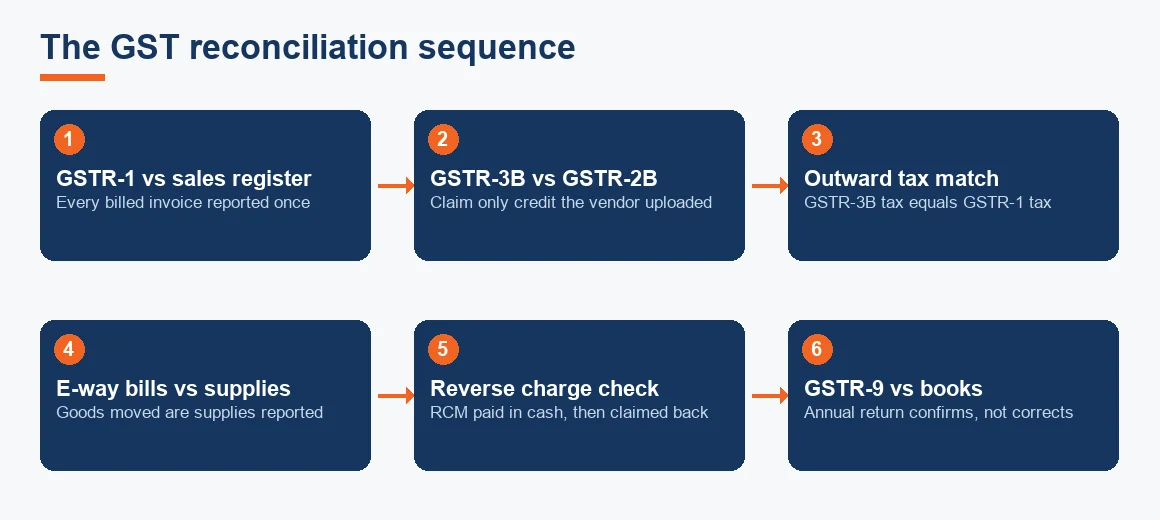
| Reconcile | Against | What it catches |
|---|---|---|
| GSTR-1 | Sales register | Invoices billed but not reported, or reported twice |
| GSTR-3B input credit | GSTR-2B | Credit claimed that the vendor never uploaded |
| GSTR-3B outward tax | GSTR-1 | Tax reported to customers but not paid to the exchequer |
| E-way bills | Outward supplies | Goods moved but the supply left off the return |
| GSTR-9 | Annual accounts | Reverse charge left unpaid; blocked credit under Section 17(5) |
The two that hurt Delhi MSMEs most are the GSTR-2B mismatch and unpaid reverse charge. Credit that your books claim but GSTR-2B does not carry is not yours to take under the matching rule the GST portal enforces; take it anyway and it reverses with interest. Reverse charge on goods transport, legal fees or director sitting fees is easy to forget because no vendor invoice reminds you. A health-check catches both before the annual return does.
Worked example: a GSTR-3B versus GSTR-2B ITC reconciliation
To see how the credit match plays out in practice, here is a short worked reconciliation for one month. Figures are indicative and every taxable value is shown Exl GST, with GST taken at the standard 18% rate. You may claim input tax credit only where the invoice appears in GSTR-2B, so an invoice missing there is deferred, not lost, and an entry extra in 2B is traced back to a purchase bill you have not yet recorded.
| Invoice | Taxable value (Rs) | GST in books (18%) | GST in GSTR-2B | Status | ITC claimable now (Rs) |
|---|---|---|---|---|---|
| INV-101 | 1,00,000 | 18,000 | 18,000 | Matched | 18,000 |
| INV-102 | 50,000 | 9,000 | 9,000 | Matched | 9,000 |
| INV-103 | 2,00,000 | 36,000 | 0 | Missing in 2B: defer | 0 |
| INV-201 | Not in books | 0 | 5,000 | Extra in 2B: investigate | 0 |
| Eligible ITC total | 3,50,000 | 63,000 | 32,000 | Matched only | 27,000 |
Only the two matched invoices give credit this month, so the eligible ITC total is Rs 27,000. The Rs 36,000 on INV-103 is deferred until the vendor uploads it and it appears in a later GSTR-2B; claim it early and it reverses with interest. The Rs 5,000 sitting in 2B against INV-201 points to a purchase bill missing from your books, which the reconciliation should trace before you accept the credit.
The TDS side: where Delhi MSMEs slip
TDS errors are usually one of three kinds: deducting on the wrong value, deducting at the wrong rate, or depositing late. The value error is the most common and the most avoidable. Where GST is shown separately on a bill, income-tax TDS is deducted on the taxable value only, not on the GST, following the position the Income Tax Department set out in CBDT Circular 23 of 2017. On a professional bill of Rs 5,00,000 plus Rs 90,000 GST, TDS under Section 194J at 10% is Rs 50,000, not Rs 59,000. Deduct on the gross and you have over-deducted; the vendor chases you, and the reconciliation flags it.
Rate and threshold errors come next. Rent under Section 194-I, contractor payments under Section 194C, and professional fees under Section 194J each carry their own rate and threshold, and they change often enough that last year's memory is not safe. High-turnover buyers also fall into Section 194Q on purchases of goods above Rs 50,00,000 in the year, deducting 0.1% on the excess, which many first-time crossers miss entirely. Late deposit is the third: TDS deducted must reach the government by the 7th of the following month, and deducting on the wrong section can invite disallowance of the expense, so the base value and the section both have to be right.
GST TDS and income-tax TDS are not the same thing
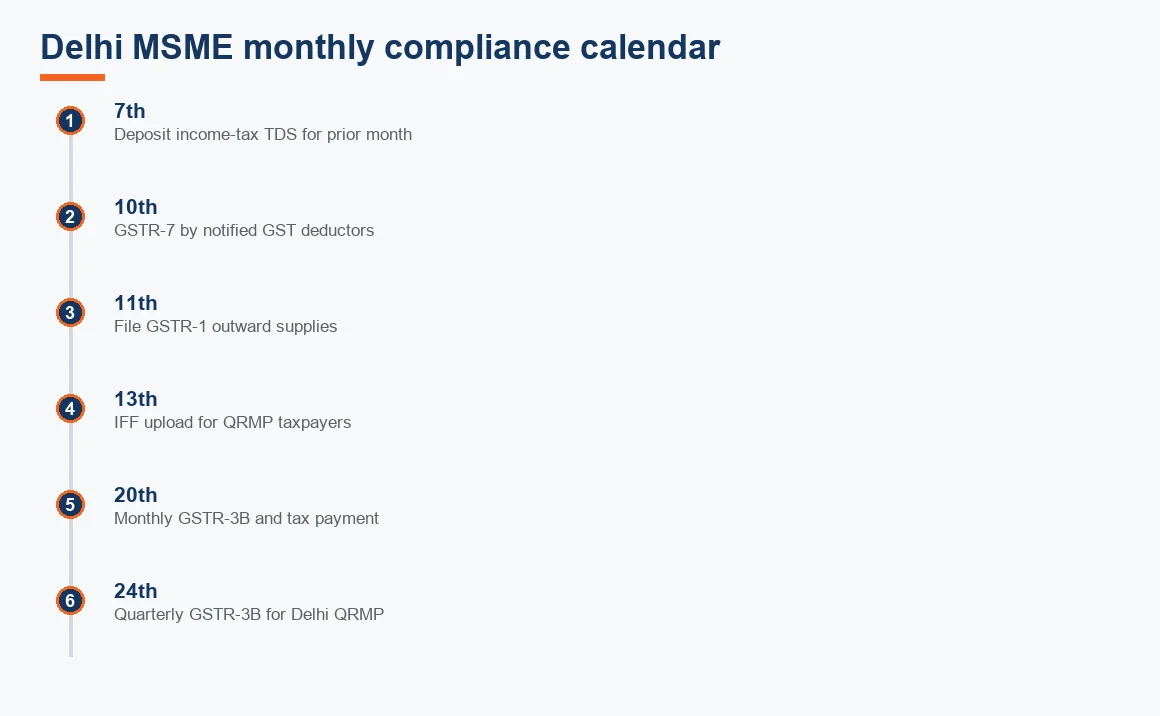
This confuses more Delhi owners than any other point, so it is worth separating cleanly. Income-tax TDS is what your business deducts when it pays rent, fees or contractors, under the Income Tax Act. GST TDS is a different animal: it is the 2% deduction under Section 51 of the CGST Act (1% CGST plus 1% SGST) that only notified deductors, government departments, local authorities and public sector undertakings make, and only when a single contract exceeds Rs 2,50,000. An ordinary Delhi MSME does not deduct GST TDS; it may, however, have GST TDS deducted from its own receipts if it supplies to a government body. That amount lands under TDS and TCS Credit Received on the portal, and you have to accept it for the credit to move into your electronic cash ledger. Left unaccepted, it becomes a working-capital loss. The deductor files GSTR-7 by the 10th and the certificate is Form GSTR-7A, per CBIC.
Delhi-specific points worth knowing
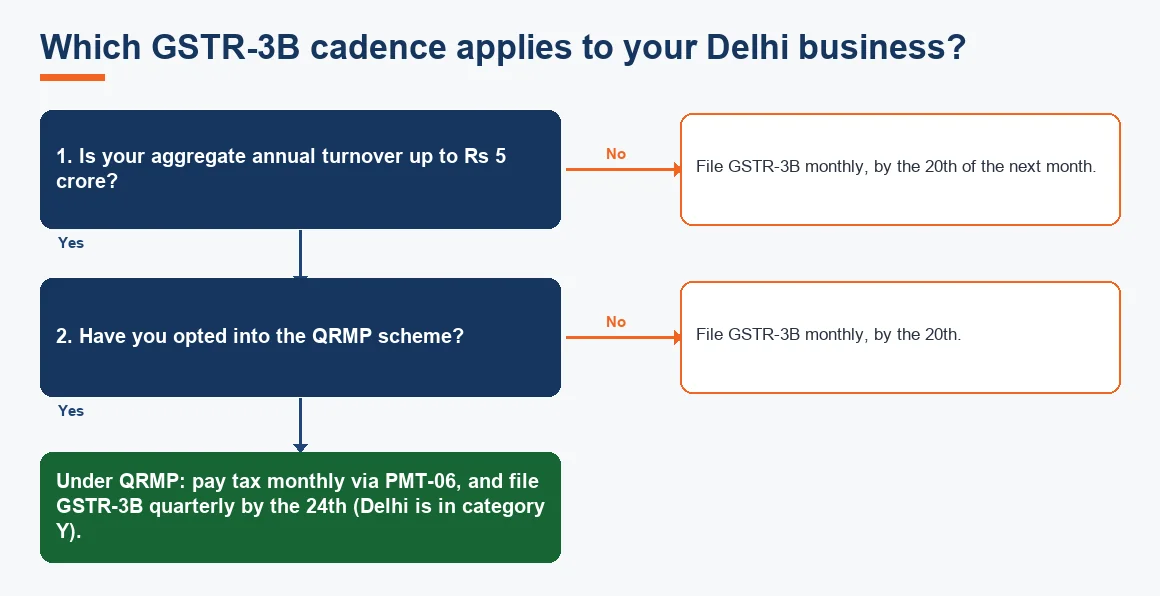
A few things are genuinely local. Delhi levies no professional tax, so unlike Maharashtra or Karnataka there is no monthly PT return for your payroll to reconcile; the Delhi nil professional tax regime removes a line item other cities have to track, and the interaction with Shops & Establishment registration is covered in our note on Delhi Shops & Establishment and GST/TDS compliance for employers. On GST due dates, monthly GSTR-3B is due on the 20th, but if you are on the QRMP scheme your quarterly GSTR-3B falls on the 24th because Delhi sits in the later state category. And because Delhi trade flows straight into Gurugram, Faridabad and Noida, inter-state credit matching is a routine part of the health-check here in a way it is not for a single-state business elsewhere.
Step by step: running your own quarterly health-check
- Freeze the period. Close the quarter's books and pull GSTR-1, GSTR-3B, GSTR-2B, the sales and purchase registers, and the TDS challan summary into one place.
- Match sales. Tie GSTR-1 to the sales register invoice by invoice, then confirm the outward tax in GSTR-3B equals GSTR-1. Any gap is either an unbilled supply or unpaid output tax.
- Match credit. Compare input credit claimed in GSTR-3B against GSTR-2B. Park anything not appearing in 2B; do not claim it until the vendor files.
- Test reverse charge. Scan for goods transport, legal, and director payments and confirm the reverse charge was paid in cash and then claimed back.
- Verify TDS value and rate. For every deduction, confirm it was on the taxable value, at the right section and rate, and deposited by the 7th.
- Reconcile to 26AS. Match challans to TRACES and to vendor 26AS entries so nothing is stranded.
Run this six-step pass every quarter and the annual GSTR-9 and the income-tax return become confirmations rather than clean-up jobs. Businesses that skip it usually pay for it in the reconciliation once, either in reversed credit or in interest, and often in both.
The compliance calendar to reconcile against
A health-check is only as good as the calendar behind it, because a filing that was correct but late still carries interest and a fee. The Delhi monthly cycle below is what your reconciliation should assume, subject to any extension the portal announces.
One further deadline sits outside GST and TDS but interacts with both: Section 43B(h) disallows the expense if you pay a registered micro or small vendor beyond the agreed period, capped at 45 days. The Section 43B(h) MSME clock means a late payment does not just annoy the supplier; it can push your own taxable profit up. A health-check that reconciles the payables ageing against this window catches it before the year closes. If your books are behind and the ageing is not even reliable yet, that is a bookkeeping gap first, and our accounting and bookkeeping hub covers how to get current.
Key terms
- GSTR-2B ITC Matching: the static monthly statement your input credit must appear in before you can claim it.
- Section 194Q TDS on Goods: 0.1% deduction by high-turnover buyers on goods purchases above Rs 50,00,000 a year.
- GST TDS/TCS Credit: amounts withheld by notified deductors that you accept to release into your cash ledger.
- Section 43B(h) MSME Clock: the 45-day payment window that governs when an MSME expense is deductible.
Key takeaways
- A health-check reconciles filed returns against your books; it finds errors, it does not re-file for you.
- Income-tax TDS is deducted on the taxable value excluding GST when tax is shown separately.
- GST TDS is a separate 2% deduction only notified government-linked deductors make, not ordinary MSMEs.
- Delhi has no professional tax, and QRMP GSTR-3B falls on the 24th, not the 22nd.
- Inter-state credit matching and Section 43B(h) payment timing are the two Delhi-specific traps worth a quarterly look.
- Run the six-step pass every quarter so GSTR-9 and the ITR become confirmations, not clean-ups.
None of this is unique to Delhi in principle, but the mix of inter-state trade, nil professional tax and the QRMP date pattern gives the local version its own shape. If you would rather not run it yourself, the same reconciliation is standard work for a Delhi accounting team, and manufacturers in Bawana or Okhla with heavier input credit and job-work flows can see the sector view in our note on accounting for Delhi manufacturers and the dedicated Delhi manufacturing desk. What a health-check costs against what it saves is set out in our 2026 Delhi price guide, and early-stage founders can start with the Delhi startup accounting option.
Decision guide