In this guide
NGO accounting in Gurugram means keeping the books of a trust, society or section 8 company so that each source of money, whether a domestic donation, a corporate CSR grant or a foreign contribution, can be traced separately from receipt to spend. Gurugram sits at the centre of the National Capital Region's corporate belt, so many local foundations are funded by companies headquartered in Cyber City and DLF Cyber Hub, and a good number also receive money from abroad. That mix is exactly why fund-based accounting, FCRA segregation and clean 12A, 80G and CSR records matter more here than for a small charity elsewhere. This guide explains the local informational picture; when you want the work done, our NGO & Non-Profit Accounting team and the NGO & Non-Profit Accounting Gurugram page cover the service side.
Why Gurugram non-profits carry a heavier compliance load
A charity that lives on a handful of individual donations can almost get by with a cash book. A Gurugram foundation rarely can. The corporates along Golf Course Road and NH-48 want CSR reporting they can drop straight into their own board papers, foreign donors expect FCRA-compliant statements, and the same organisation often runs several projects at once. Each of those pulls the books in a different direction, and the only way to keep them straight is to account by fund rather than by a single profit and loss line.
Haryana adds one small mercy: the state levies no professional tax, so payroll for your programme staff is simpler than in Maharashtra or Karnataka. If you employ people, the wider state rules still apply, and we set those out in our note on Haryana compliance for employers. Everything else on this page is about the money that flows through the organisation, not the people running it.
Fund-based accounting is the discipline everything else rests on
In an ordinary business, income is income and you report a single surplus. A non-profit cannot do that, because most of its money arrives with strings attached. Restricted grants are recognised as income only to the extent you actually spend on the sanctioned purpose during the year; the unspent balance is carried as a liability, described as an unutilised grant, and never dressed up as surplus. Unrestricted donations, by contrast, are yours to apply across objects. Keeping the two apart, project by project, is the whole game.
Underneath that sits plain double-entry discipline. Every project needs its own set of ledger accounts so that a utilisation certificate can be tied straight back to the books, and interest earned on grant funds usually belongs to the grant, not to the general pool. This is where a proper project-wise general ledger structure earns its keep. The income-tax side then layers on the 85% application rule: a registered trust must apply at least 85% of its income towards its objects in the year, or formally set the shortfall aside, to keep its exemption intact, a point the Income Tax Department tests at assessment.
Foreign money must live in its own account
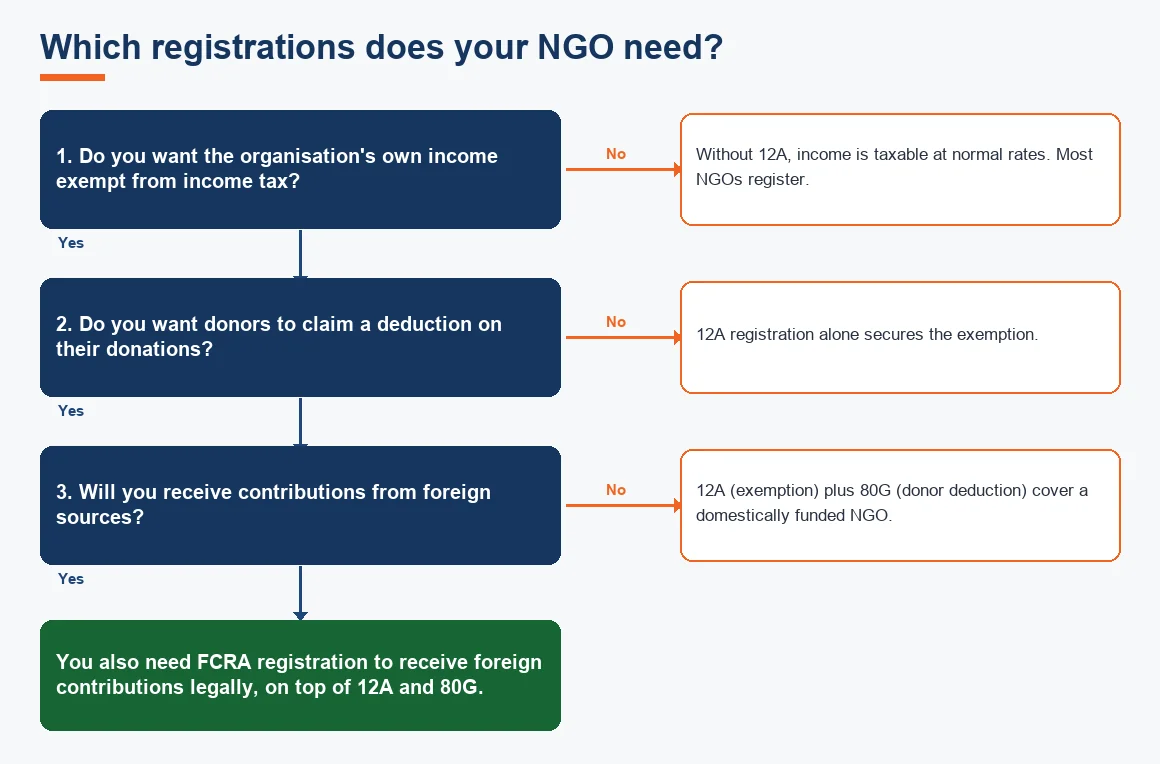
If your organisation is registered under the Foreign Contribution (Regulation) Act, every foreign contribution has to be received into the single FCRA designated bank account (the SBI New Delhi Main Branch account) and then, if you wish, moved to a utilisation account. It cannot be mixed with domestic funds at any point. The books must show foreign contribution receipts, the interest they earn and the expenditure against them as a wholly separate stream, because that stream is reported on its own.
The annual return is Form FC-4, filed online with the Ministry of Home Affairs by 31 December for the financial year that ended on the previous 31 March, together with the audited receipt and payment account, income and expenditure account and balance sheet certified by a chartered accountant. A nil return is compulsory even in a year when no foreign money came in, and the audited FC accounts must also be disclosed on your own website. The rules and the portal sit with the FCRA online portal.
CSR funds: no CSR-1, no money
Since 1 April 2021 a company may route its CSR spending only to an implementing agency that has filed Form CSR-1 with the Registrar of Companies and holds a CSR Registration Number. The agency must also hold registration under section 12A and approval under section 80G, or be a section 8 company set up by the funding company itself. For a Gurugram foundation hoping to receive CSR money from an NCR corporate, this is not optional paperwork; without the CSR-1 number the donor's own auditors will not release the funds. The framework sits with the MCA.
Once the money arrives it is a restricted grant like any other, and it flows through the books the same way.
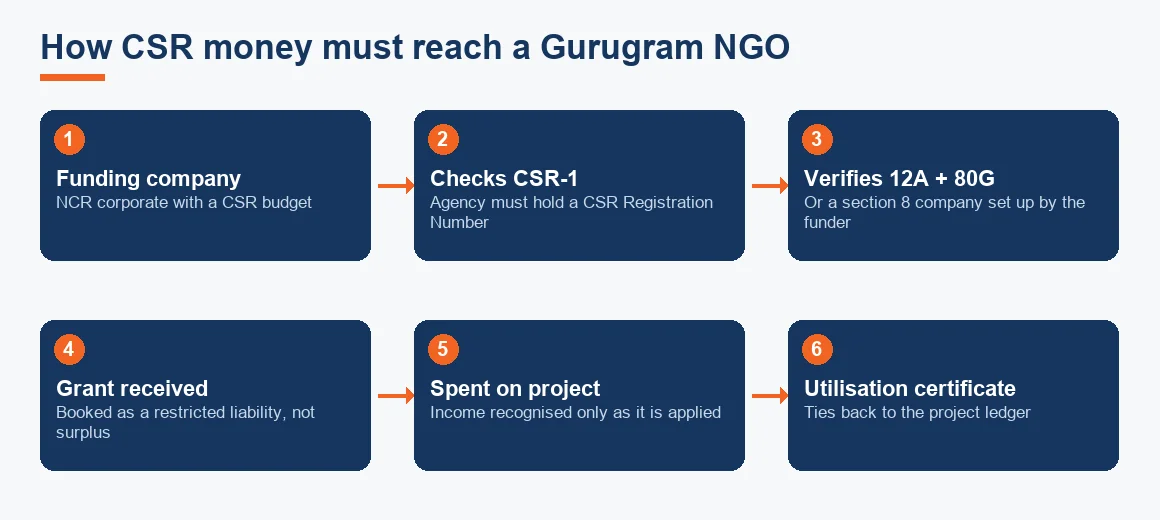
Getting this chain right is often the deciding factor when a Gurugram start-up's founders set up a giving arm alongside the business; if that describes you, the virtual CFO checklist for Gurugram start-ups covers the corporate side, and dedicated start-up accounting keeps the two entities cleanly apart.
A worked CSR grant utilisation example
To see how a restricted CSR grant moves through the books, take a Gurugram foundation that receives a single sanctioned grant of Rs 50,00,000 from an NCR corporate. The figures below are illustrative, but they follow the current rules: administrative overheads may not exceed 5% of total CSR expenditure for the year, and only the amount actually applied to the project is recognised as income, with the balance carried forward as an unspent amount to report.
| Line item | Amount (Rs) | Notes |
|---|---|---|
| Opening CSR grant received | 50,00,000 | Booked as a restricted liability, not surplus |
| Direct project expenditure | 40,00,000 | Recognised as income only as spent on the sanctioned purpose |
| Administrative overhead | 2,00,000 | 4.76% of the grant applied, within the 5% statutory cap |
| Total grant applied in the year | 42,00,000 | Project spend plus admin overhead |
| Closing unspent balance | 8,00,000 | Transferred to the Unspent CSR Account and reported |
The unspent Rs 8,00,000 does not become surplus: it stays a liability, and the utilisation certificate issued to the donor reconciles exactly to the Rs 42,00,000 applied. Reporting this cleanly is far easier when the grant sits in its own project ledger from day one.
Keeping 12A and 80G alive
Registration under section 12AB is what makes a trust's income exempt, and approval under section 80G is what lets your donors claim a deduction. Neither is permanent any more. A 12AB registration is granted for five years and must be renewed by filing Form 10AB at least six months before it expires, while a provisional registration runs for only three years. The same clock applies to 80G. Miss the window and you are forced into a fresh application, with exemption lost for the intervening period, so the renewal dates belong in your compliance calendar the day the certificate is issued.
These four registrations govern different things and renew on different cycles, which is why a single tracking sheet is worth building.
| Registration | What it enables | Renewal cycle |
|---|---|---|
| Section 12AB | Income-tax exemption for the trust | Five years; Form 10AB six months before expiry (provisional: three years) |
| Section 80G | Deduction for your donors | Same five-year cycle as 12AB |
| Form CSR-1 | Eligibility to receive corporate CSR funds | One-time filing; update on any change in particulars |
| FCRA registration | Eligibility to receive foreign contribution | Five years; renew via Form FC-3C before expiry |
Which audit form applies, 10B or 10BB
Charitable trusts and institutions have a tax audit of their own, and choosing the correct form matters because filing the wrong one has been treated as a defect. Form 10B applies where the total income before exemption exceeds Rs 5 crore, or the trust received any foreign contribution during the year, or applied any income outside India. Every other trust files the shorter Form 10BB. In either case the audit report must reach the department at least one month before the income-tax return due date. A Gurugram NGO with even a single foreign donation is pushed into Form 10B regardless of its size, which is another reason the FCRA stream has to be visible in the books from the start.
The NGO compliance year at a glance
Most of the friction in non-profit accounting comes not from difficulty but from sequence: the donation statement feeds the audit, the audit feeds the return, and the FCRA return trails months behind. Laid out in order, the year looks like this.
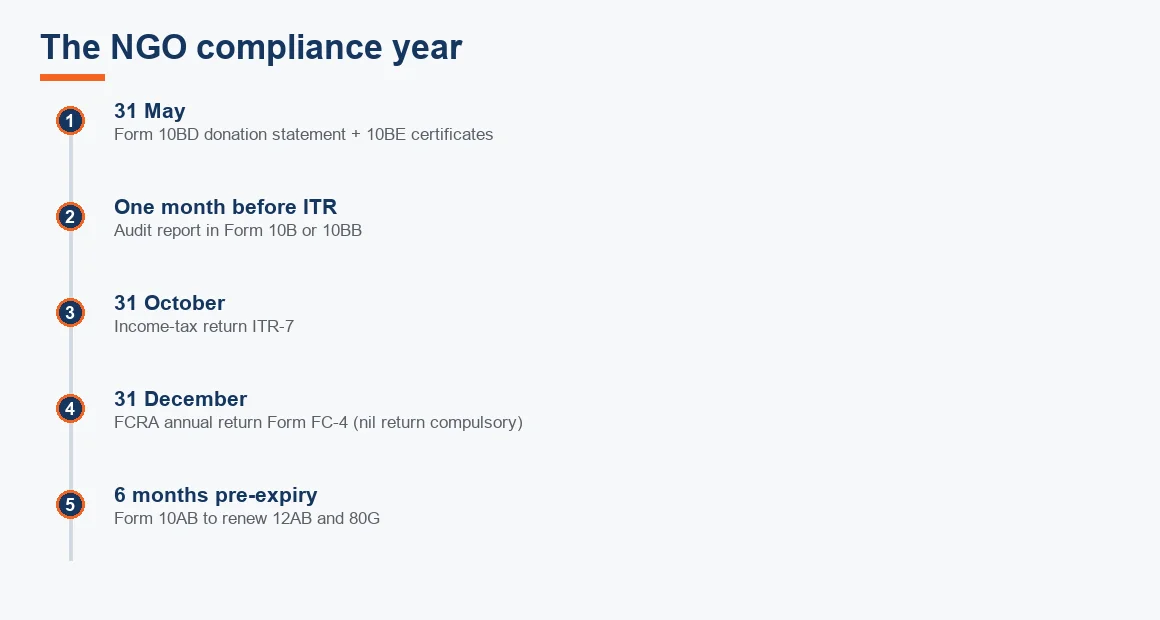
The statement of donations in Form 10BD, due by 31 May, is the one most new organisations forget, and it matters because your donors' 80G deductions are only reflected once you file it and issue the Form 10BE certificate. Everything after it depends on the books being closed cleanly, which is where a steady monthly close, rather than a March scramble, pays for itself.
Who needs this, and how the books get set up
If you run a registered trust, a society or a section 8 company in or around Gurugram, and you receive CSR money, foreign contributions or grants earmarked for specific projects, this is your accounting model. A purely self-funded neighbourhood charity can run lighter books; the moment restricted money enters, fund accounting becomes non-negotiable. Setting it up is a short, ordered exercise:
- Map your funds. List every active grant, CSR commitment and foreign donor, and give each its own ledger group and, where relevant, its own bank account.
- Ring-fence the FCRA stream. Route all foreign money through the designated account only, and never let it touch domestic funds.
- Book restricted grants as liabilities. Recognise income only as you spend, and carry the balance as unutilised grant.
- Diarise the deadlines. Put Form 10BD (31 May), the audit report, ITR-7 and Form FC-4 (31 December), plus the 12AB, 80G and FCRA renewal dates, into one calendar.
- Reconcile monthly. Match each project ledger to its bank movement so every utilisation certificate ties to the books without a year-end reconstruction.
What that costs to run in this market is a separate question; we break the local numbers down in the guide to the cost of outsourced accounting and virtual CFO in Gurugram, and if you are still deciding who should keep the books, our note on choosing an accountant in Gurugram is a useful next read. For general bookkeeping outside the non-profit angle, the accounting and bookkeeping services in Gurugram page covers the everyday work.
Key terms
- Fund-Based Accounting: tracking money by the purpose it was given for, rather than in a single pooled account.
- FCRA Designated Bank Account: the single mandated account through which all foreign contribution must first be received.
- Restricted Corpus Donations: donations tied to the corpus or a specific object and not freely spendable.
- 85% Income Application Rule: the requirement to apply at least 85% of income towards objects to retain exemption.
- Section 12A / 80G Annual Upkeep: the ongoing renewals and filings that keep exemption and donor-deduction status live.
Key takeaways
- Account by fund, not by a single surplus; restricted grants are liabilities until spent on their sanctioned purpose.
- Foreign money lives only in the FCRA designated account and is reported separately through Form FC-4 by 31 December, nil return included.
- No CSR-1 number, no corporate CSR money; the agency also needs live 12A and 80G.
- 12AB and 80G run for five years and renew on Form 10AB six months before expiry; diarise the dates immediately.
- Any foreign contribution pushes the trust into Form 10B rather than the shorter Form 10BB.
- A steady monthly close is what makes the audit, the return and every utilisation certificate line up at year end.
This article is an informational explainer for Gurugram non-profits and is not a substitute for advice on your specific facts. For the exemption tests referenced here, the section 10(23C) exemption rules glossary entry adds context on the alternative regime some institutions fall under.
Decision guide