
In this guide
If you run a software product or services business from Ahmedabad, the accounting rules that apply to you depend heavily on where the entity actually sits. A unit registered inside the GIFT City International Financial Services Centre near Gandhinagar is treated as outside India for exchange control and enjoys a distinct tax and currency regime; a firm on SG Highway, in Prahlad Nagar or near Ashram Road operates in the ordinary domestic tariff area. This is an explainer on how those two worlds differ in day-to-day bookkeeping. It is not a services pitch, and if you want the commercial engagement side, our SaaS Accounting Services (IT & SaaS) Ahmedabad page covers that.
What GIFT City and the IFSC actually mean for a tech firm
GIFT City is Gujarat International Finance Tec-City, and inside it sits India's first International Financial Services Centre. The IFSC zone is regulated by the International Financial Services Centres Authority, and for foreign exchange purposes a unit there is treated as a person resident outside India. In plain terms, an IFSC unit keeps its books in foreign currency, usually US dollars, and receives its export proceeds without the usual domestic banking friction. Banking, fund management, insurance and a growing set of technology and data units operate from it. For an accountant, the immediate consequence is that a multi-currency bank feed and clean foreign-currency ledgers are not optional extras; they are the foundation of the whole file.
The contrast matters. An SG Highway SaaS company billing overseas customers is exporting from within India and follows the standard export-of-services route under GST, with rupee books and foreign-currency receivables converted at the applicable rate. A GIFT City unit does not convert into rupees for its core operations at all. Getting this base assumption wrong is where most reconstructed books go astray.
Who needs to read this
This is written for founders and finance managers of three kinds of Ahmedabad business: a company that has set up, or is weighing up, a unit inside the GIFT City IFSC; a software or SaaS firm on SG Highway that exports and wants to understand its obligations rather than its concessions; and an accountant inheriting either kind of file mid-year. If you are earlier in the journey and simply setting up books, our Startup Accounting Services India and IT & Software Company Accounting Services pages are the better starting points. If your revenue is marketplace-led rather than subscription-led, E-Commerce Accounting Services is the closer fit.
The Section 80LA tax holiday: the rule, the threshold and what it means in practice
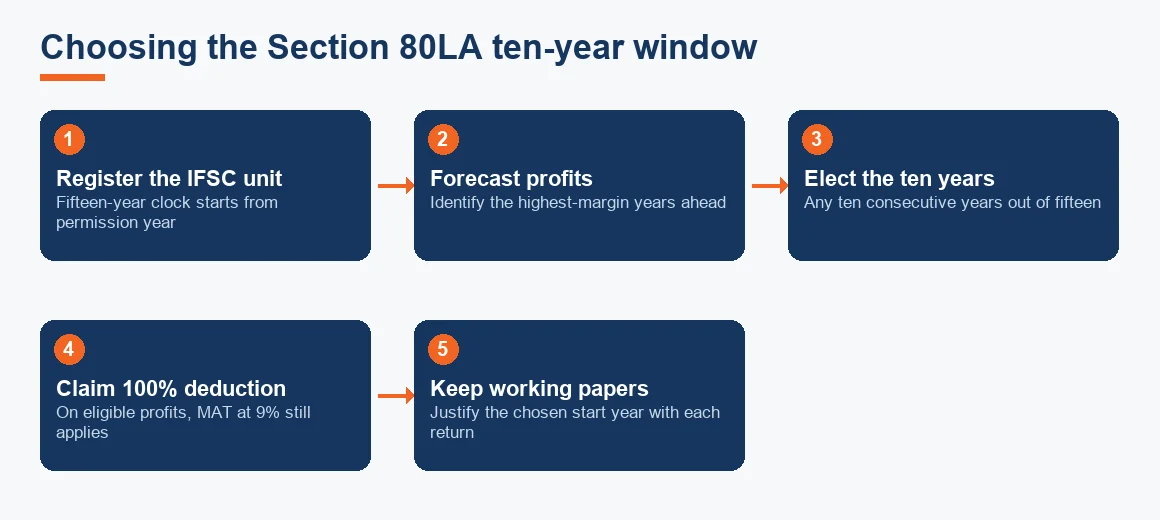
The headline concession for an IFSC unit is a hundred per cent deduction of business profits under Section 80LA of the Income Tax Act, as administered by the Income Tax Department. The important detail, and the one most summaries skip, is the shape of it: the deduction is available for any ten consecutive years chosen by the unit out of a fifteen-year window beginning from the year it obtains its registration or permission. The unit picks its ten years, which lets a firm defer the holiday until it is actually profitable rather than burning relief during loss-making early years. The GIFT City IFSC tax holiday is therefore a planning decision, not an automatic switch.
It is also not a blanket exemption. Minimum alternate tax continues to apply at nine per cent for a company that has not moved to the concessional tax regime, and every other obligation, GST, TDS, withholding and annual filing, runs throughout the holiday. The relief covers income tax on eligible profits; it does not silence the rest of the compliance calendar.
| Point | GIFT City IFSC unit | SG Highway / DTA firm |
|---|---|---|
| Functional currency | Foreign currency (usually USD) | Indian rupee |
| Exchange-control status | Treated as outside India | Resident in India |
| Profit-linked deduction | Section 80LA, 10 of 15 years | Not available on this basis |
| Minimum alternate tax | 9% where applicable | Standard MAT rules |
| GST registration | Separate GSTIN, treated as SEZ unit | Ordinary GSTIN |
GST when you sit inside an IFSC or SEZ
A common misconception is that an IFSC unit escapes GST. It does not. An IFSC unit is treated as a special economic zone unit, so it registers separately in Gujarat and files returns like any other GSTIN, with the CBIC rules applying in full. What changes is the treatment of supplies to it. A domestic supplier billing the unit makes a zero-rated supply, handled either through a letter of undertaking without payment of tax, or by paying IGST and claiming a refund. Services the unit supplies outside India are exports and follow the usual export-of-services conditions. Monthly GSTR-3B and the outward-supply return still fall due, and the Gujarat state administration handles assessments through the Gujarat GST Bhavan assessment machinery like any other registrant.
For an SG Highway software exporter with no IFSC status, the mechanics are the more familiar ones: export of services against a letter of undertaking, careful input-tax-credit matching, and refunds where credit accumulates. If your books are behind and the credit position is unclear, that reconstruction work is its own exercise, and our books cleanup and GST reconciliation guide for Ahmedabad SMEs walks through it rather than repeating it here.
Software exports, SOFTEX and getting paid in foreign currency
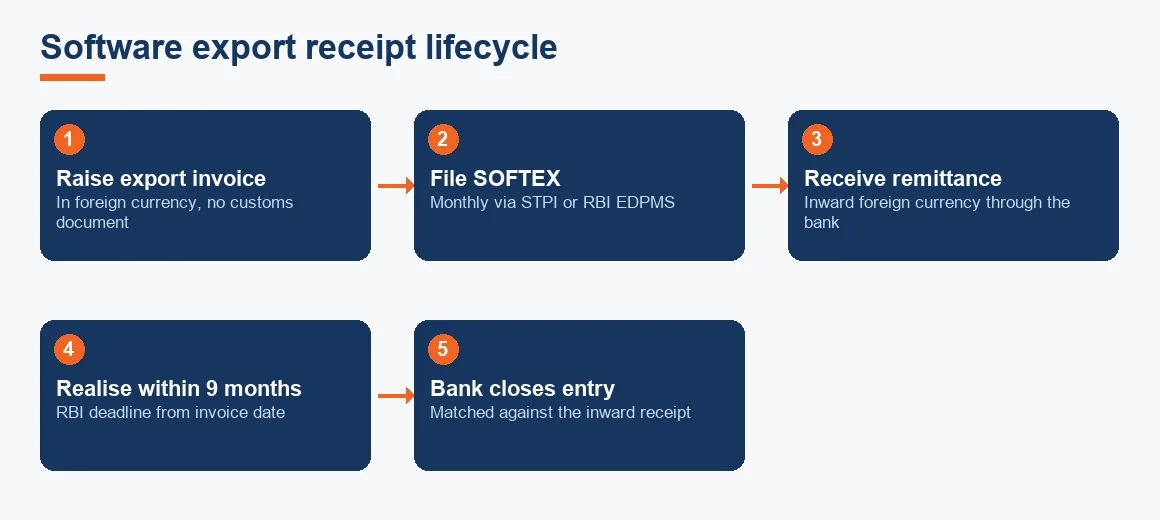
Whether you are inside GIFT City or on SG Highway, if you export software without customs documentation you still deal with SOFTEX. The form is filed through STPI or generated on the RBI export data processing system, and registered exporters file monthly. The STPI / SOFTEX export filing exists so that the banking system can match your invoices against inward remittance. Export proceeds must be realised within nine months of the invoice date under RBI rules, and any unrealised entry stays open in the system until the bank closes it against a receipt. Keeping your foreign currency receivables ledger aligned with what the bank sees is the single most useful control an exporter can run. Where the unit qualifies as an SEZ software exporter, the related software export revenue under Section 10AA treatment is a separate deduction path to keep documented.
One forward-looking note: the SOFTEX route is being folded into a monthly Export Declaration Form process, with the change taking effect from 1 October 2026, after which authorised dealer banks certify on a par with STPI. For now, through the current year, the SOFTEX filing remains the operative one, so do not switch your process early.
Recognising SaaS revenue correctly
Subscription revenue is where SaaS books most often drift from the tax position. Money received up front for an annual plan is not revenue on the day it lands; it is deferred revenue that unwinds over the contract term. Under Ind AS 115 revenue recognition, you identify the performance obligation and recognise revenue as the customer consumes the service, month by month. This is what keeps your reported monthly recurring revenue honest and stops a single large annual invoice from distorting a quarter. For a GIFT City unit claiming the 80LA holiday, clean revenue recognition also matters because the deduction attaches to correctly measured eligible profits, not to cash collected.
Multi-element contracts, setup fees, usage overages and mid-term upgrades each need a defined treatment written into the chart of accounts, so that the same event is booked the same way every month. Where a firm bills for services rather than a pure subscription, unbilled work and milestone billing come into play, and those sit closer to the service-sector model than the SaaS one.
A worked deferred-revenue schedule for an annual SaaS plan
To see how deferred revenue actually unwinds, take a single annual subscription billed up front at ₹12,00,000 (indicative, Exl GST). GST at 18 per cent is charged and collected separately, so it never touches the revenue schedule. The performance obligation is satisfied evenly across twelve months, so under Ind AS 115 you recognise ₹1,00,000 each month and release the same amount from the deferred balance. The first four months run as follows.
| Month | Opening deferred revenue | Revenue recognised in month | Closing deferred revenue |
|---|---|---|---|
| Month 1 | ₹12,00,000 | ₹1,00,000 | ₹11,00,000 |
| Month 2 | ₹11,00,000 | ₹1,00,000 | ₹10,00,000 |
| Month 3 | ₹10,00,000 | ₹1,00,000 | ₹9,00,000 |
| Month 4 | ₹9,00,000 | ₹1,00,000 | ₹8,00,000 |
By the end of month four, ₹4,00,000 has reached the profit and loss account and ₹8,00,000 stays on the balance sheet as a liability, to be released over the remaining eight months. That monthly release is also the figure that keeps reported monthly recurring revenue honest, rather than the ₹12,00,000 that landed in the bank on day one.
Paying foreign vendors: withholding, GST and the levy that went away
Ahmedabad tech firms spend heavily with overseas platforms, on cloud hosting, advertising and software subscriptions, so the treatment of outbound payments is a live issue. The six per cent equalisation levy on online advertisement payments to non-resident platforms was withdrawn with effect from 1 April 2025, and the two per cent levy on e-commerce supply of services had already gone from 1 August 2024. Payments to foreign vendors now turn on three questions instead: whether a tax treaty gives India the right to tax the income, GST under reverse charge on the import of service, and Section 195 withholding where the income is taxable in India. For cross-border intra-group billing, transfer pricing for IT services adds a documentation layer that a captive development centre cannot ignore.
The month-end and compliance rhythm
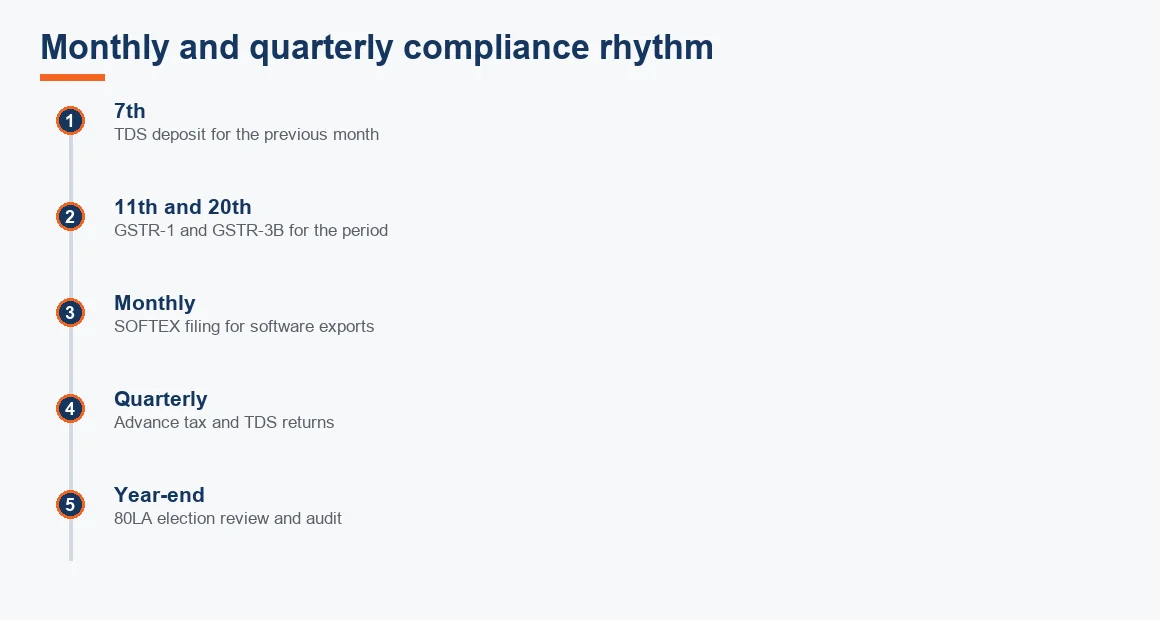
None of the above works without a steady close. Whether you are an IFSC unit or an SG Highway exporter, the same monthly and quarterly beats recur, and a firm that treats them as a checklist rather than a scramble spends far less at year-end. If you are still deciding who should own that rhythm, our guide on choosing an accountant in Ahmedabad and the local cost of accounting and bookkeeping in Ahmedabad benchmarks are the practical companions to this piece. Employers should also keep the Gujarat professional tax and Shops Act obligations on the same calendar, because payroll compliance does not pause for a tax holiday.
If you also run local operations that need routine bookkeeping alongside the export file, our Accounting and Bookkeeping Services in Ahmedabad page and, for Tally-based back offices, Tally Prime Accounting Services in Ahmedabad cover that ground. The parent service for this whole area is our SaaS Accounting Services (IT & SaaS) offering.
Key terms
- GIFT City IFSC Tax Holiday: the Section 80LA hundred per cent profit deduction available for ten of fifteen years to an IFSC unit.
- STPI / SOFTEX Export Filing: the monthly declaration matching software-export invoices against inward remittance.
- Software Export Revenue (Section 10AA SEZ): export income earned by an SEZ unit and the deduction that can attach to it.
- Deferred Revenue: subscription cash received before the service is delivered, released to revenue over the term.
- Foreign Currency Receivables: amounts owed by overseas customers, tracked against realisation deadlines.
Key takeaways
- Where the entity sits, inside the GIFT City IFSC or in Ahmedabad's domestic tariff area, decides its currency, GST and tax treatment before anything else.
- The Section 80LA holiday is ten consecutive years chosen out of fifteen, so time the election for your profitable years and keep the working papers.
- An IFSC unit is a deemed SEZ unit: it still registers for GST, files returns and receives zero-rated domestic supplies.
- SOFTEX filing and the nine-month realisation rule apply to software exports; keep receivables aligned with what the bank has closed.
- Recognise SaaS subscriptions as deferred revenue over the term under Ind AS 115, not as day-one income.
- Equalisation levy is withdrawn; the live cross-border risks are reverse-charge GST and Section 195 withholding.