Tax Audit India
If your accounts need an audit, the audit report is filed first and the return follows. See the tax audit service for what the audit covers and what it costs.

Income Tax & ITR
File your business return with a CA: the right form for your type of business, presumptive or full-books profit worked out correctly, tax audit checked, and the return filed by your due date.

In short
If you run a shop, a trading or manufacturing unit, a service business or a family firm, your profit is taxed as income from "business or profession". How it is worked out, which form you file and when it is due all depend on what kind of business you are and how big it is.
This service is for businesses that are not companies.
Company returns are a separate service.
Which law applies. FY 2025-26 returns (filed in 2026) are under the Income-tax Act, 1961. The Income-tax Act, 2025 applies from tax year 2026-27 (returns filed in 2027). Where a figure differs between the two years, both are shown.
See a sample
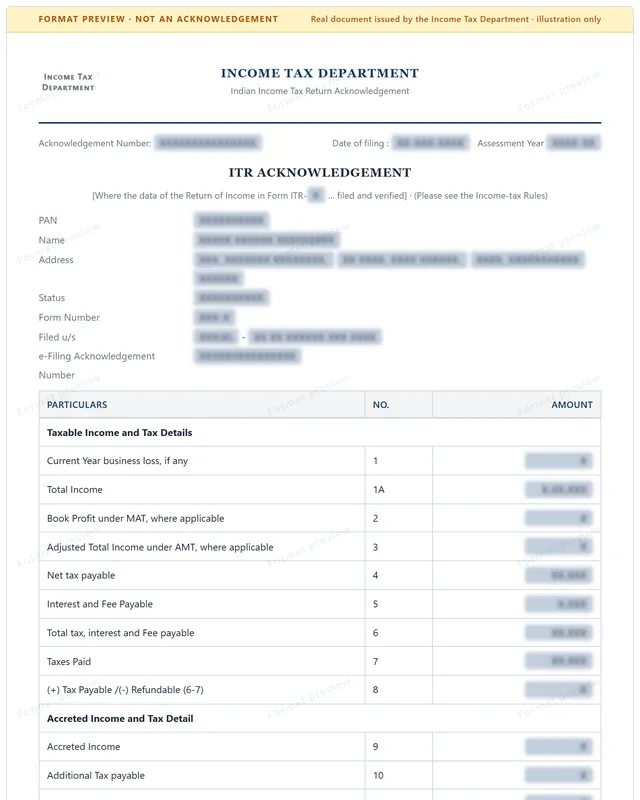
ITR acknowledgement
The acknowledgement that an income-tax return was filed.
Values hidden for privacy. Names, numbers and dates are covered. Your own document carries your details.
Download ITR acknowledgement sample (PDF) View ITR acknowledgement sample
The form
The form follows your type of business and whether the profit is declared on a presumptive basis or taken from your books.
| Type of business | Usual form |
|---|---|
| Sole proprietor or HUF, presumptive profit, total income up to ₹50 lakh | ITR-4 (Sugam), if eligible |
| Sole proprietor or HUF, profit from books, or not eligible for ITR-4 | ITR-3 |
| Partnership firm, presumptive profit, total income up to ₹50 lakh (not an LLP) | ITR-4, if eligible |
| Partnership firm, LLP, AOP or BOI | ITR-5 |
FY 2025-26: Income-tax Rules, 1962, rule 12. Tax year 2026-27: Income-tax Rules, 2026, rule 164. An LLP files ITR-5 in both years and cannot use ITR-4.
Residents only (not "not ordinarily resident"). Among others, ITR-4 cannot be used by:
Using ITR-4 is optional. Where it is closed to you, the return goes on ITR-3.
Rule of thumb
A sole proprietor never uses ITR-1 or ITR-2Neither form has a place for business income, so even a small amount of business income takes you out of them.
Income-tax Rules, 1962, rule 12 (FY 2025-26) · Income-tax Rules, 2026, rule 164 (tax year 2026-27)
For the full proprietor's return, see ITR for proprietorships; for firms and LLPs, see ITR for LLPs and partnership firms.
Presumptive profit
A small business can declare a fixed share of its turnover as profit instead of working it out from books. The share depends on how the money was received.
| Rule | FY 2025-26 (1961 Act s.44AD) and tax year 2026-27 (the corresponding provision of the 2025 Act) |
|---|---|
| If your actual profit is higher | Declare the higher figure |
| Turnover limit | ₹2 crore |
| Higher limit | ₹3 crore, if cash receipts are not more than 5% of turnover |
| Who can use it | Resident individual, HUF or partnership firm, not an LLP |
| Who cannot | Professionals, commission or brokerage income, agency business; goods-carriage owners use their own scheme |
| Advance tax | The whole amount by 15 March |
| Tax audit | Not needed when you declare the presumptive profit |
The live page said cash payments were also tested for this limit; that test belongs to the tax audit limit below, not to presumptive profit.
If you use the scheme for a year and then, in any of the next five years, declare profit on another basis, you cannot use it again for the following five years. If your income is then above the basic exemption limit, books and a tax audit are needed.
Same for both years.
For FY 2025-26 (1961 Act), books and a tax audit are needed only where the five-year rule applies and total income is above the basic exemption limit (section 44AD(4) and (5)). For tax year 2026-27 (2025 Act), they are needed whenever you claim a profit below the deemed 6% or 8% and total income is above the basic exemption limit, whether or not the five-year rule applies (section 58(3)).
Owners of up to ten goods carriages have their own scheme: ₹1,000 per ton of gross vehicle weight per month for a heavy goods vehicle, ₹7,500 per month for any other, or actual profit if higher (same for both years).
1961 Act s.44AE; the corresponding provision of the 2025 Act, Table Sl. 2.
Tax audit
The same tests apply for FY 2025-26 (1961 Act s.44AB) and tax year 2026-27 (the corresponding provision of the 2025 Act).
A professional needs an audit when gross receipts exceed ₹50 lakh in both years (1961 s.44AB(b); the corresponding provision of the 2025 Act), unless profit is declared under the presumptive scheme. For FY 2025-26, a presumptive business needs an audit only if it left the section 44AD scheme within five years and its income is above the basic exemption limit (s.44AB(e)). A professional who declares less than 50% under section 44ADA with income above that limit needs one (s.44ADA(4)). So does a goods-carriage owner claiming less than the deemed profit (s.44AE(7)). For tax year 2026-27, a business or professional on the presumptive scheme who declares less than the scheme's rate, with total income above the basic exemption limit, needs books and an audit (the corresponding provision of the 2025 Act, the corresponding provision).
If your accounts need an audit, the audit report is filed first and the return follows. See the tax audit service for what the audit covers and what it costs.
How we work
Seven steps, in the order they happen.
Proprietor, firm, LLP, HUF, AOP or BOI; this decides the form and how the income is taxed.
Turnover, cash share of receipts and the five-year history decide whether presumptive profit is open to you.
Profit and loss account, balance sheet and depreciation for book-based returns; sales matched with GST returns, bank statements and your AIS.
If an audit applies, the audit report is filed first, a month before the return.
For a proprietor or HUF, the old and new regimes are compared. The new regime is the default for individuals, HUFs, AOPs and BOIs. A person with business income who wants the old regime must choose it by the due date; for tax year 2026-27 the choice is made in the return itself (no Form 10-IEA). Once you leave the new regime with business income, you can come back only once.
For FY 2025-26, the choice is made by filing Form 10-IEA on or before the due date (1961 Act section 115BAC(6)); it carries on to later years and can be withdrawn only once.
For a firm or LLP: the firm pays 30% on its total income in both FY 2025-26 and tax year 2026-27, except income taxed at special rates (for example certain capital gains), which is taxed at those rates. Remuneration to working partners is deductible only up to ₹3,00,000 or 90% of book profit, whichever is more, on the first ₹6,00,000 of book profit (or a loss), and 60% of the balance (1961 Act section 40(b); the corresponding provision of the 2025 Act). Interest to partners is deductible up to 12% simple a year. A firm with income above ₹1 crore pays a 12% surcharge, and a 4% cess applies on tax plus surcharge.
Advance tax and TDS are taken off, any balance is paid, and the return is filed and e-verified.
A business loss can be carried forward for up to 8 years and set off only against business income, but only if the return is filed by the due date. A speculation loss can be set off only against speculation income and carried forward for 4 years.
What to keep ready
What we ask for depends on whether the profit is presumptive or from books. The full list for a book-based return:
Taking ₹2 lakh or more in cash from one person in a day, for one transaction or for one event is not allowed, and the penalty equals the amount received (1961 s.269ST; the corresponding provision of the 2025 Act).
Under the 2025 Act an individual or HUF business must keep books once income from it exceeds ₹2,50,000 or turnover exceeds ₹25 lakh in any one of the three preceding years (the corresponding provision of the 2025 Act).
For FY 2025-26 (1961 Act s.44AA), the limits are income above ₹1,20,000 or turnover above ₹10 lakh in any one of the three preceding years, raised to ₹2,50,000 and ₹25 lakh for an individual or HUF. Specified professions must always keep books.
Dates
The due date depends on whether your accounts need a tax audit. The Finance Act, 2026 moved the non-audit business date from 31 July to 31 August.
| Your situation | FY 2025-26 (1961 Act) | Tax year 2026-27 (2025 Act) |
|---|---|---|
| Business, no tax audit | 31 August 2026 | 31 August 2027 |
| Business with a tax audit | 31 October 2026 | 31 October 2027 |
| With a transfer-pricing report | 30 November 2026 | 30 November 2027 |
| Tax audit report | 30 September 2026 | 30 September 2027 |
Advance tax
Each instalment is a running total of the year's tax.
Presumptive cases pay all of it by 15 March.
The late filing fee is ₹5,000, or ₹1,000 if total income is up to ₹5 lakh (1961 s.234F; the corresponding provision of the 2025 Act). A late return loses the right to carry forward business, speculation and capital losses (house-property loss and unabsorbed depreciation are not affected).
An updated return can be filed up to 48 months later, with extra tax of 25%, 50%, 60% or 70% of the tax and interest, depending on how late it is.
What it costs
The fee depends on the type of business, whether the profit is presumptive or from books, whether a tax audit is needed, and the number of partners or members.
Professional fee
Exl GST and Govt. Charges
Tell us what kind of business you run, your turnover and whether you keep books, and we will tell you what the filing will cost.
Questions
The question business owners ask most before they send us a return.
No. ITR-1 and ITR-2 have no part for income from business or profession, so even a small amount of business income takes you out of them. An individual or HUF files ITR-4 if the profit is declared on a presumptive basis and the other conditions are met, and ITR-3 otherwise. Firms, AOPs and BOIs file ITR-5.
Get a quote
Tell us what kind of business you run, your turnover for the year and whether you keep books. We will tell you which form you need, whether an audit applies and what the filing will cost.
Leave your details and we will call you back.
By sending this form you agree to our privacy policy.
Sources