
In this guide
Project billing is a way of raising invoices against a defined scope of work rather than a flat monthly charge, using milestones, percentage of completion, time and material rates or retainers. For a Mumbai consultancy or media agency, the practical difficulty is not the invoice itself but the gap between work delivered and invoices raised: revenue is recognised as each obligation is satisfied, which is often before the bill goes out. This explainer walks through how that gap is recorded, how the common billing methods differ, and the two tax points (advance retainers and pass-through media) that most often trip up service firms. It stays on the accounting mechanics; if you want a firm to run these books for you, that sits with our Service Sector Accounting (Project Billing) service and its Mumbai city page.
What is project billing, and why does the invoice date not match the revenue date?
In project billing you open a job for a defined engagement, agree how it will be invoiced, and then bill against progress or an agreed schedule. Revenue, however, follows a different clock. Under Ind AS 115 (or AS 9 for firms not on Ind AS) you recognise revenue as each performance obligation is satisfied, measured by the stage of completion. A retainer creative brief signed off in one month may not be invoiced until the next; a consulting phase may be 60% delivered on 31 March with no invoice raised at all. The difference between what you have earned and what you have billed is unbilled revenue, and it is a real asset on the balance sheet that has to be measured every month.
This is the core discipline. Cash accounting tells you what has come in; project accounting tells you what you have actually earned across every open job. For a Mumbai firm juggling ten or fifteen live engagements, the only reliable way to keep the two apart is a job or cost centre code for each one.
Why Mumbai consultants and media agencies carry so much unbilled work-in-progress
Mumbai is where a large share of India's advertising, media buying, PR and management consulting sits, clustered around Bandra Kurla Complex, Lower Parel, Nariman Point and Fort. These engagements share three features that inflate unbilled work-in-progress: they run for months, they are billed on milestones or retainers rather than on delivery, and they carry heavy out-of-pocket costs (media, production, freelancer fees) that are incurred long before the client is invoiced. A pitch won in April can involve two months of work before the first milestone invoice is due in June.
The local angle also brings a payroll-linked compliance point. Maharashtra levies Professional Tax on employers and salaried staff, which most Mumbai agencies deduct and remit monthly; the mechanics of PTRC and PTEC registration are set out in our note on Maharashtra Professional Tax and Shops Act compliance. It is a small line, but it is one of the few statutory items that is genuinely state-specific for a service firm, so it belongs in every Mumbai project cost build-up alongside salaries.
Time and material, fixed fee and retainer: how the billing methods differ
Three methods cover almost all service-firm work, and each recognises revenue differently. Time and material billing converts approved hours at agreed rates, so revenue equals hours times rate and the overrun risk sits with the client. Fixed fee work recognises revenue by percentage of completion, so the invoice schedule and the recognised figure can diverge sharply. A retainer is a recurring fee for availability or an agreed monthly scope, frequently billed in advance, which brings the GST timing point covered further down.
| Feature | Time and material | Fixed fee (milestone) | Retainer |
|---|---|---|---|
| Revenue basis | Approved hours times rate | Stage of completion of the whole scope | Period earned (usually straight-line) |
| Who carries overrun risk | Client | The firm | The firm, within the retained scope |
| Typical unbilled position | Hours worked, not yet invoiced | Work done ahead of the next milestone | Usually billed ahead, so deferred not unbilled |
| Loss provision needed? | Rarely | Yes, when estimated cost exceeds the fee | Only if the scope becomes loss-making |
| Common Mumbai use | Consulting projects, developer time | Campaign builds, brand projects | PR, social, ongoing agency-of-record work |
The one asymmetry worth memorising: a fixed fee engagement needs a loss provision as soon as the estimated total cost is expected to exceed the fee, even if the job is only half done. You do not wait for the loss to arrive.
How is project billing managed in the accounts, step by step?
The structure is the same across Tally cost centres, Zoho Books projects and Xero tracking categories. The tool matters less than the discipline of coding everything consistently to the job.
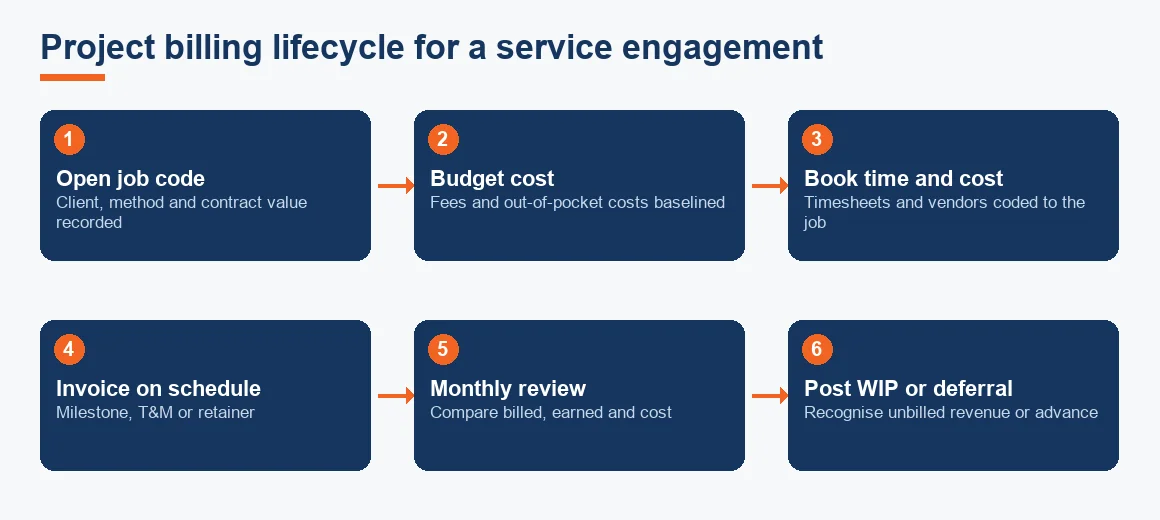
- Open a job code for every signed engagement, with the client, billing method and contract value recorded against it.
- Budget fees and out-of-pocket costs to that code so you have a baseline to measure against.
- Book timesheets and vendor costs to the code as they occur, using cost centres so nothing lands in a general overhead bucket by accident.
- Raise invoices from an approved billing schedule, whether milestone, T&M or retainer, rather than ad hoc.
- Run a monthly project review comparing billed value, recognised revenue and cost to date for each job, and post the unbilled or deferred adjustment.
That monthly review is where unbilled revenue and any loss provision are recognised. It is also where slow-paying clients surface: watching days sales outstanding by project tells you which engagements are quietly funding themselves out of your working capital. If your books are months behind, the audit-readiness and book-cleanup checklist for Mumbai businesses is the faster way to get current before layering project discipline on top.
How is a retainer received in advance treated for GST?
This is the point service firms most often get wrong. GST on a service falls due when the advance is received, not when the work is done. The supplier must issue a receipt voucher under Section 31(3)(d) of the CGST Act, and the tax goes into that month's GSTR-3B. The exemption notified in November 2017 that pushed advance-stage GST to the invoice date applies to goods only; it never covered services. So a retainer collected in April is an April tax liability, full stop.
The receipt voucher and the eventual tax invoice are two different documents. When you deliver the work and raise the tax invoice, you adjust the advance already taxed so you are not charging GST twice on the same value. You can confirm the receipt-voucher and time-of-supply rules directly on the CBIC GST portal.
How is media spend passed on to a client shown in agency revenue?
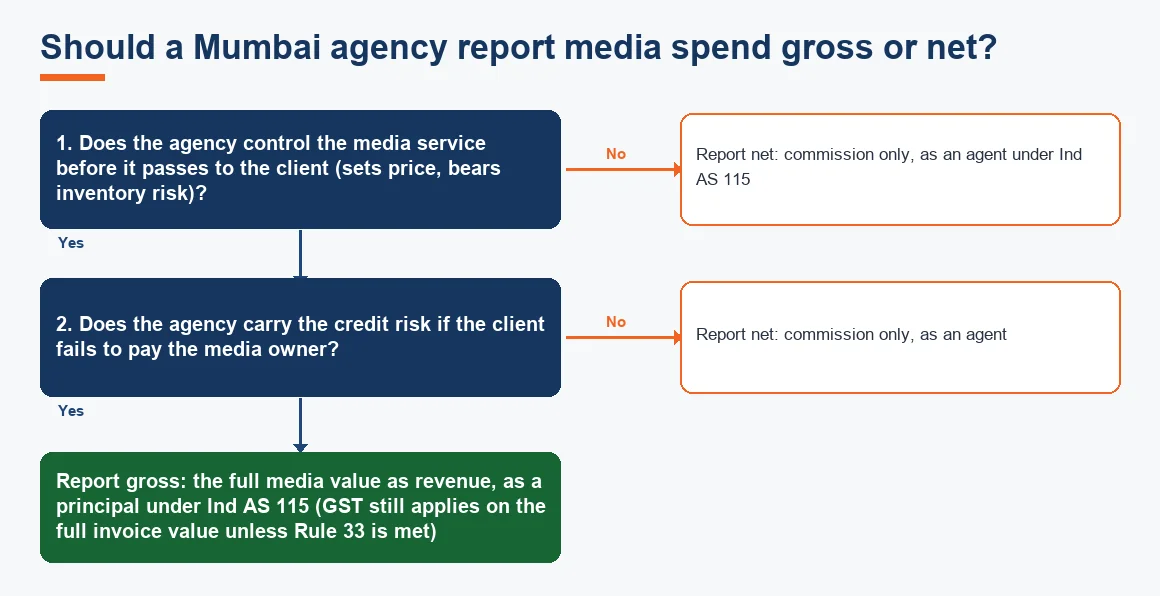
A media agency that buys airtime or digital inventory for a client faces a presentation question: is the media the agency's own revenue, or a pass-through it merely arranges? Under Ind AS 115 the answer turns on control. Where the agency acts as an agent, arranging the buy without controlling the service before it passes to the client, it reports net, that is, commission only. Where it controls the service before transfer and carries the credit risk, it reports gross, the full media value as revenue.
An agency placing Rs 1,00,00,000 of media at a 10% commission usually reports Rs 10,00,000 of revenue, not Rs 1,10,00,000. GST, however, follows a separate logic: it is charged on the full invoice value unless the strict Rule 33 pure agent conditions are met, so the accounting presentation and the tax base can legitimately differ. This principal-versus-agent question is the same one SaaS and IT resellers wrestle with; if that is your model, our SaaS accounting services and IT and software company accounting pages cover the reseller and marketplace angle, and early-stage agencies may find the startup accounting guidance a better fit.
Worked example: recognising a fixed fee campaign at month-end
Take a Rs 20,00,000 fixed fee brand campaign for a BKC client, budgeted to cost Rs 12,00,000. By 31 May the agency has incurred Rs 4,80,000 of cost and invoiced one milestone of Rs 5,00,000. Using cost-based percentage of completion, the worksheet below shows the recognised revenue and the unbilled position. All figures are illustrative and Exl GST.
| Line | Working | Amount (Rs) |
|---|---|---|
| Contract value (fixed fee) | Agreed scope | 20,00,000 |
| Budgeted total cost | Baseline | 12,00,000 |
| Cost incurred to 31 May | Timesheets + vendors | 4,80,000 |
| Percentage of completion | 4,80,000 / 12,00,000 | 40% |
| Revenue recognised to date | 40% x 20,00,000 | 8,00,000 |
| Invoiced to date | Milestone 1 | 5,00,000 |
| Unbilled revenue (WIP asset) | 8,00,000 - 5,00,000 | 3,00,000 |
The Rs 3,00,000 is earned but not yet billed, so it sits as an unbilled revenue asset until the next milestone invoice absorbs it. Had the budgeted cost instead been revised up to, say, Rs 21,00,000 (above the Rs 20,00,000 fee), the agency would recognise the full expected loss immediately as a provision, not spread it over the remaining stages.
Key terms
- Unbilled Revenue (WIP Hours): work earned and recognised but not yet invoiced, held as an asset.
- Milestone vs Retainer Billing: billing tied to deliverables versus a fixed recurring fee for ongoing scope.
- Percentage of Completion Method (POCM): recognising revenue by stage of completion, usually measured by cost.
- Deferred Revenue (Unearned Revenue): a retainer or advance billed before the work is earned, held as a liability.
- Project-Wise Profitability Margin: revenue less cost measured per job code, not just at firm level.
Bringing it together for a Mumbai service firm
Project accounting is not a bigger version of monthly bookkeeping; it is a discipline of measuring earned work, billed work and cost separately for every open job, then reconciling the three each month. Get the job codes, the advance-retainer GST and the principal-or-agent media call right, and the unbilled figure stops being a surprise. The Ind AS applicability checker is a quick way to confirm which revenue standard binds your firm before you fix the policy. For firm-level bookkeeping rather than project mechanics, the Mumbai accounting and bookkeeping page and, for tech-led agencies, the SaaS accounting Mumbai page are the right starting points, and if you are still selecting a firm, our guide to choosing an accountant in Mumbai and the 2026 price benchmarks for outsourced accounting in Mumbai set realistic expectations.
Key takeaways
- Revenue follows completion, not the invoice date; the gap is unbilled work-in-progress and must be measured monthly.
- Fixed fee work needs a loss provision the moment estimated cost is expected to exceed the fee.
- GST on an advance retainer is due when the money is received, with a receipt voucher under Section 31(3)(d), and the November 2017 advance relief is for goods only.
- Media placed for a client is usually reported net as commission, while GST applies to the full invoice value unless Rule 33 pure agent conditions are met.
- One job code per engagement, coded consistently, is what keeps billed, earned and cost figures honest.
Decision guide