
In this guide
An audit readiness checklist for Mumbai businesses is the short list of reconciliations, schedules and supporting documents that let an auditor begin testing on day one rather than waiting weeks for information. For a city with a heavy concentration of listed companies, financial-services firms and their group entities, readiness is less about the audit itself and more about the state of the books in the eleven months before it. This guide sets out what to have ready, what applies to your entity and what does not, and the single number that decides whether a tax audit is even triggered.
What audit readiness actually means (and what it is not)
Readiness is a condition of the books, not a folder created the week the auditor emails. In practice it means bank balances reconciled to statements, input credit in the books matched to GSTR-2B, TDS agreed to Form 26AS, vendor and customer balances confirmed, a physically counted stock statement, and fixed asset and loan schedules that tie to the ledger. It is not a fresh set of adjustments passed in a hurry to make a broken trial balance agree. If you keep clean books through the year, the audit becomes a review; if you do not, it becomes a reconstruction, and reconstruction is where deadlines slip. This is also the line that separates statutory from internal audit: the statutory auditor tests what already exists, and readiness decides how much of the year they can rely on without further work.
Which audit applies to your Mumbai business, and the number that decides it
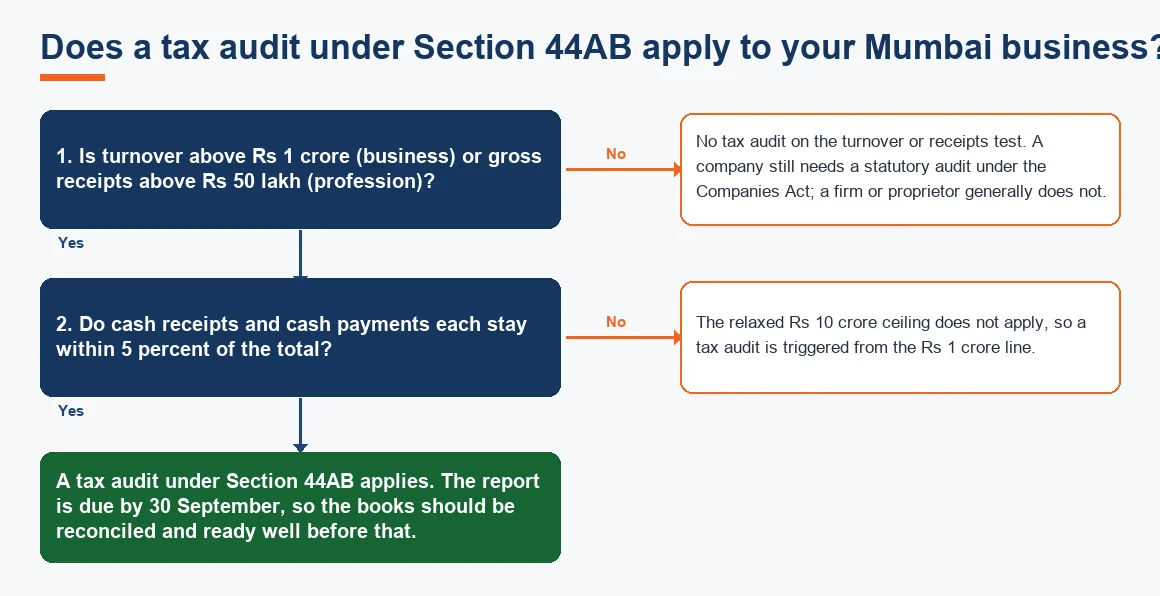
Every company incorporated under the Companies Act needs a statutory audit regardless of turnover, so a private limited company in BKC or Fort is audited even in a loss-making year. A tax audit under Section 44AB is separate and turnover-driven: it applies once business turnover crosses Rs 1 crore, with the ceiling relaxed to Rs 10 crore where both cash receipts and cash payments each stay within 5 percent of the total. For professionals the line is gross receipts above Rs 50 lakh. Mumbai's listed and financial-services entities also carry additional layers, from SEBI reporting timelines to sector regulators, but the core readiness work underneath is identical. For anything commercial (choosing a firm, scoping the engagement) speak to a provider through our Accounting and Bookkeeping Services in India page or the process-and-software accounting hub; this article stays on the readiness question.
The book-cleanup checklist: reconciliations first
Cleanup follows a fixed order, because later schedules depend on earlier ones being right. Work through these before anything else:
- Bank and cash: every account reconciled to the closing statement, with bank reconciliation items explained, not just netted off.
- GST: input credit in the books matched to GSTR-2B, and outward supplies agreed to GSTR-1 and GSTR-3B.
- TDS: deductions and credits agreed to Form 26AS so nothing is claimed that the department cannot see.
- Receivables and payables: an ageing schedule that ties to the ledger, plus vendor balance confirmations for material suppliers.
- Fixed assets and loans: schedules with additions, disposals, depreciation and interest that reconcile to the balance sheet. A depreciation calculator aligned to Schedule II settles most queries here.
- Stock: a counted, valued closing stock statement, not a plug figure.
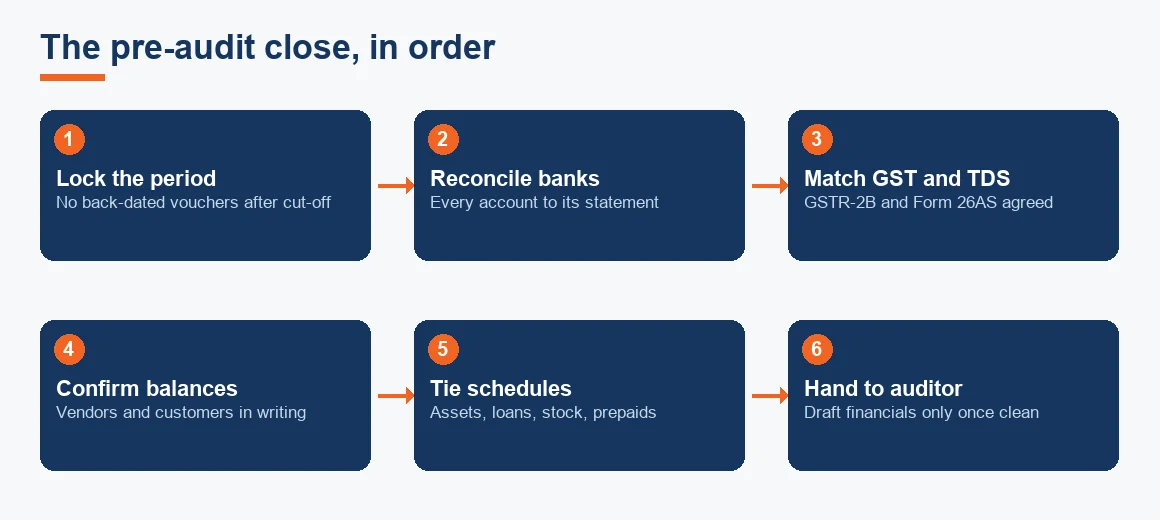
A six-step pre-audit close
When the year has ended and you are preparing the file, run these steps in sequence:
- Lock the period so no back-dated vouchers can be posted after cut-off.
- Reconcile every bank and wallet account to its statement.
- Match GST input credit to GSTR-2B and resolve or provide for the gaps.
- Agree TDS to Form 26AS and 27D, both deducted and received.
- Confirm material vendor and customer balances in writing.
- Tie fixed asset, loan, stock and prepaid schedules to the ledger, then freeze the close checklist.
Only once these six agree should the draft financials go to the auditor. Sending an unreconciled file simply moves your cleanup into audit time, where it costs more and delays sign-off.
Worked example: reconciling input credit to GSTR-2B
The most common readiness gap in Mumbai books is input credit claimed in the ledger that does not appear in GSTR-2B, usually because a vendor has not uploaded the invoice. Suppose a trading firm has claimed the following across the year. The difference must be explained or provided for before the auditor tests it.
| Particulars | Amount (Rs) |
|---|---|
| Input tax credit claimed in books (Apr to Mar) | 8,40,000 |
| Input tax credit reflected in GSTR-2B | 8,10,000 |
| Unmatched (not appearing in 2B) | 30,000 |
| Traced to two vendors yet to file GSTR-1 | 22,000 |
| Ineligible credit to be reversed | 8,000 |
Of the Rs 30,000 gap, Rs 22,000 is timing (recoverable once the vendors file, so it is followed up, not written off) and Rs 8,000 is genuinely ineligible and reversed with interest. Presenting the reconciliation this way, with the split shown, is what readiness looks like: the auditor sees the gap has been analysed rather than ignored.
How long a Mumbai company must preserve records
Section 128(5) of the Companies Act requires books of account and the relevant vouchers to be kept in good order for at least eight financial years immediately preceding the current year. Where the Central Government has ordered an investigation, it may direct a longer period. Electronic records must remain accessible and legible in India for the same eight years, which matters for firms that migrated software mid-history. The Income Tax Act works to a shorter window in most cases, but the Companies Act eight-year rule is the safe planning number for any incorporated entity. You can read the provision on the Ministry of Corporate Affairs portal.
The audit trail question every auditor now asks
Since the audit trail rules took effect, accounting software must maintain an edit log under Rule 3(1) of the Companies (Accounts) Rules, and the auditor separately reports under Rule 11(g) of the Companies (Audit and Auditors) Rules 2014 whether the software used an audit trail throughout the year, whether it operated for all transactions, whether it was tampered with, and whether the logs were preserved. This is a reporting clause in the audit report, not a CARO paragraph, but it has a practical readiness consequence: the trail must have been switched on and left on from day one of the year. It cannot be enabled in March. Confirm the feature is active in your software and that no user has the rights to disable it silently.
Deadlines and what missing them costs
The penalties for late audit and filing are mechanical, so the calendar below is worth pinning up. The tax audit penalty in particular is a percentage of turnover, which makes it painful for a Mumbai business of any scale.
| Requirement | Due date | Late consequence |
|---|---|---|
| Annual general meeting | By 30 September | Company and officers liable to penalty under the Companies Act |
| Tax audit report (Form 3CA/3CB-3CD) | 30 September | Section 271B penalty: 0.5 percent of turnover, capped at Rs 1,50,000 |
| AOC-4 (financial statements) | Within 30 days of AGM | Additional fee of Rs 100 per day, no upper limit until filed |
| MGT-7A (annual return) | Within 60 days of AGM | Additional fee of Rs 100 per day, no upper limit until filed |
| GSTR-9 annual return | 31 December | Late fee per day plus interest on any short payment |
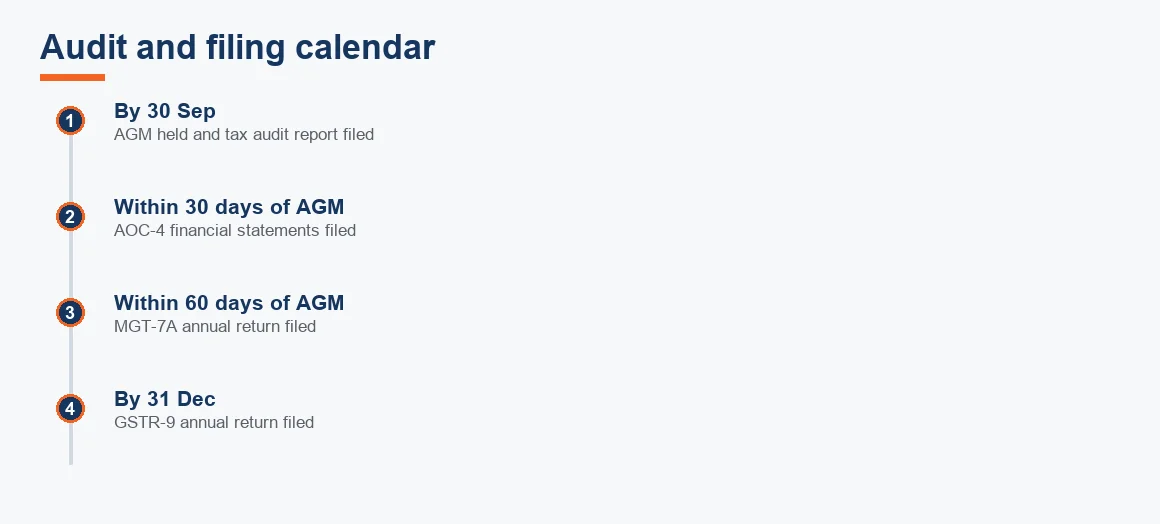
The dates confirmed against the Income Tax Department and CBIC portals should always be checked for any year-specific extension before you rely on them.
Readiness for Mumbai's listed and financial-services firms
Group entities, listed companies and NBFCs headquartered around BKC and Nariman Point carry the same base checklist plus a few local overlays: SEBI reporting timelines that run ahead of the statutory calendar, inter-company balances that must be confirmed both ways, and consolidation schedules that only tie if each subsidiary closed cleanly first. If your entity sits in one of these groups, the readiness gain from a disciplined monthly close is larger, because a single unreconciled subsidiary can hold up the whole consolidation. For sector-specific queries our Mumbai city pages, including Accounting and Bookkeeping Services in Mumbai and SaaS and IT accounting in Mumbai, cover the commercial side. On costs and choosing a firm, see our Mumbai guides on 2026 price benchmarks and how to choose an accountant across Fort, BKC and Nariman Point. Employers should also keep Maharashtra Professional Tax and Shops Act records current, and MIDC and Andheri manufacturers should tie in their costing and e-invoicing before the auditor arrives.
Key terms
- Bank Reconciliation: matching the ledger bank balance to the bank statement and explaining every timing difference.
- GSTR-2B Input Tax Credit Matching: agreeing input credit in the books to the auto-drafted GSTR-2B statement.
- Month-End Close Checklist: the fixed monthly routine that keeps books audit-ready all year.
- Statutory vs Internal Audit: the external legal audit versus management's own controls review.
- Notes to Accounts: the disclosures that accompany the financial statements and support the numbers.
Key takeaways
- Readiness is a state of the books, built by monthly reconciliation, not a March folder.
- Statutory audit applies to every company; tax audit under Section 44AB turns on the Rs 1 crore (or relaxed Rs 10 crore) turnover line.
- Preserve books and vouchers for eight financial years under Section 128(5).
- The audit trail must be on from day one of the year, because Rule 11(g) makes the auditor report on it.
- Late tax audit costs 0.5 percent of turnover up to Rs 1,50,000; AOC-4 and MGT-7A run Rs 100 a day with no cap.
Use the Ind AS applicability checker if you are unsure which reporting framework governs your financials, as that decision shapes several of the schedules above. Everything on this page is general guidance and indicative; confirm entity-specific thresholds and any year-specific extensions before you act.
Decision guide