
In this guide
Professional tax registration for a Maharashtra employer means obtaining two separate numbers under the Maharashtra State Tax on Professions, Trades, Callings and Employments Act 1975: a Professional Tax Registration Certificate (PTRC) that lets you deduct tax from your employees' salaries and pay it to the state, and a Professional Tax Enrolment Certificate (PTEC) that covers the tax the business itself owes each year. Both are applied for online through the Maharashtra GST Department portal at mahagst.gov.in, and for a Mumbai business the two usually sit alongside a Shops and Establishment registration. This guide explains the slabs, the filing calendar and the practical points that trip employers up. For the commercial side of setting up or outsourcing your books, see our accounting and bookkeeping services in Mumbai.
PTRC and PTEC: what a Mumbai employer actually holds
The two certificates answer two different questions. PTEC is the tax on the entity or the individual carrying on a profession or trade: a company, LLP, proprietor or partnership pays a flat Rs 2,500 a year on its own account, regardless of staff. PTRC is the deduction mechanism: once you have employees, you withhold professional tax from their monthly salary and remit it, much like TDS. A one-person consultancy with no staff may need only a PTEC; the moment it hires, it also needs a PTRC.
| Feature | PTEC (Enrolment) | PTRC (Registration) |
|---|---|---|
| Who it covers | The business or professional itself | Employees on the payroll |
| Amount | Rs 2,500 flat per year | Varies by each employee's salary slab |
| Payment basis | Single annual payment | Monthly or annual, per return frequency |
| Return | No separate return; pay the challan | Form III-B on mahagst.gov.in |
| Due date | 30 June each year | Last day of the following month, or 31 March annually |
Professional tax slabs in Maharashtra for 2026
The employee deduction follows a short salary table. No professional tax is deducted where monthly salary is up to Rs 7,500 for men or up to Rs 25,000 for women. Men earning Rs 7,501 to Rs 10,000 pay Rs 175 a month. Anyone earning above Rs 10,000 pays Rs 200 a month, rising to Rs 300 in February. The annual maximum any individual can be charged is Rs 2,500, a ceiling fixed by Article 276 of the Constitution and recorded on the Maharashtra GST Department site.
- Up to Rs 7,500 (men) / up to Rs 25,000 (women)
- Nil
- Rs 7,501 to Rs 10,000 (men)
- Rs 175 per month
- Above Rs 10,000
- Rs 200 per month, and Rs 300 in February
The higher women's threshold of Rs 25,000 was introduced to reduce the deduction burden on lower and middle salaries and remains in force. Gender here follows the employee's records; the slab is applied to gross monthly salary as defined for the purpose, not to net pay.
How to register for PTRC and PTEC: step by step
Registration is entirely online and, for a standard private limited company or LLP, is usually granted within a few working days.
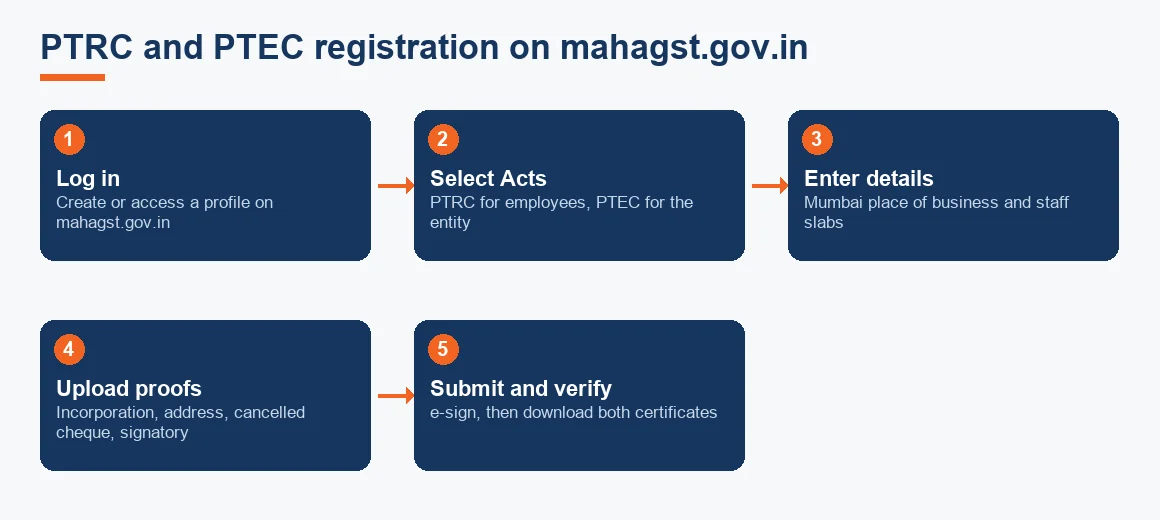
- Create or log in to a profile on mahagst.gov.in and select the professional tax e-registration option.
- Choose the Act: the Registration Certificate (PTRC) for employees and the Enrolment Certificate (PTEC) for the entity. You can apply for both.
- Fill in the entity details, principal place of business in Mumbai, and the number of employees against each slab.
- Upload the constitution document (certificate of incorporation, partnership deed or proprietor's PAN), address proof, a cancelled cheque and the authorised signatory's details.
- Submit with the digital signature or e-verification, then download the PTRC and PTEC certificates once approved.
If you also employ ten or more workers you will register under the Shops Act at the same stage, so keep the establishment details ready. Businesses that outsource this typically hand the whole set to their accountant; our note on choosing an accountant in Mumbai covers what to check before you do.
The PTRC filing calendar and how to pay
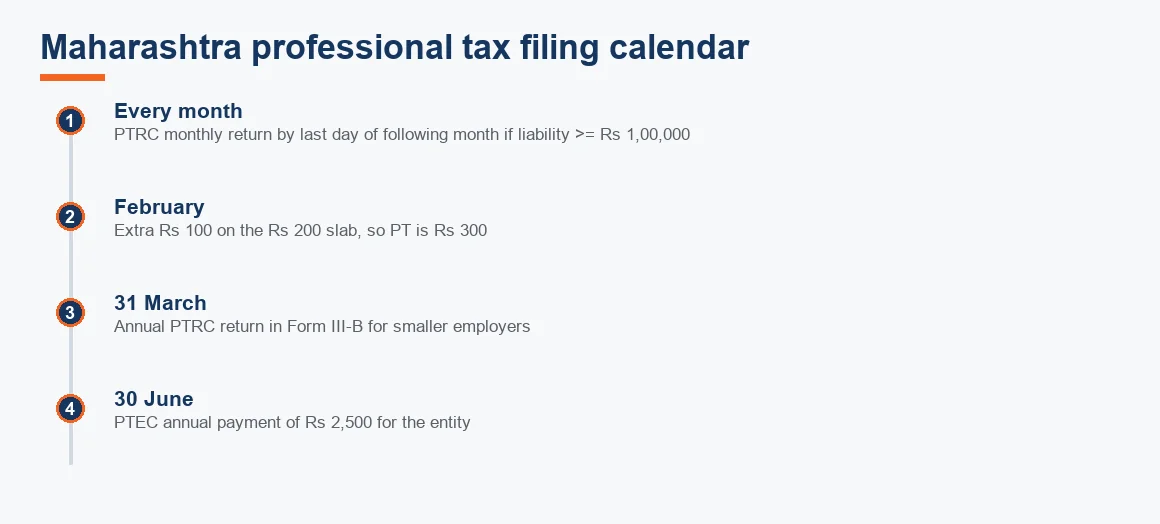
PTRC returns are filed in Form III-B on mahagst.gov.in as a validated template upload. The frequency depends on last year's tax: employers whose professional tax liability in the previous year was Rs 1,00,000 or more file monthly, by the last day of the following month, while everyone else files a single annual return by 31 March. Payment must be made before or along with the return, and the challan generated is the MTR-6.
PTEC is simpler: a single annual payment of Rs 2,500 with no separate return, due by 30 June each year. Log in with the PTEC or PTRC number, choose e-payment, select the Act, period and form, generate the MTR-6 challan and pay by net banking.
Because professional tax is a payroll liability, it belongs in the same month-end discipline as salaries, TDS and provident fund. Recording it correctly as an accrued liability and reconciling it against the challan is part of a clean month-end close; our audit-readiness checklist for Mumbai businesses sets out the wider payroll reconciliation.
Why professional tax is Rs 300 in February
The Rs 300 February figure surprises many first-time payroll teams, but it is arithmetic, not a penalty. The annual ceiling is Rs 2,500. Deducting Rs 200 for each of twelve months would give only Rs 2,400, so the state collects the remaining Rs 100 in the final month of the financial year. That is why February's deduction is Rs 300 (Rs 200 plus Rs 100) rather than Rs 200. It is an adjustment to reach the yearly maximum, and it applies only to employees in the Rs 200 slab.
The Maharashtra Shops and Establishment Act 2017 and Form F
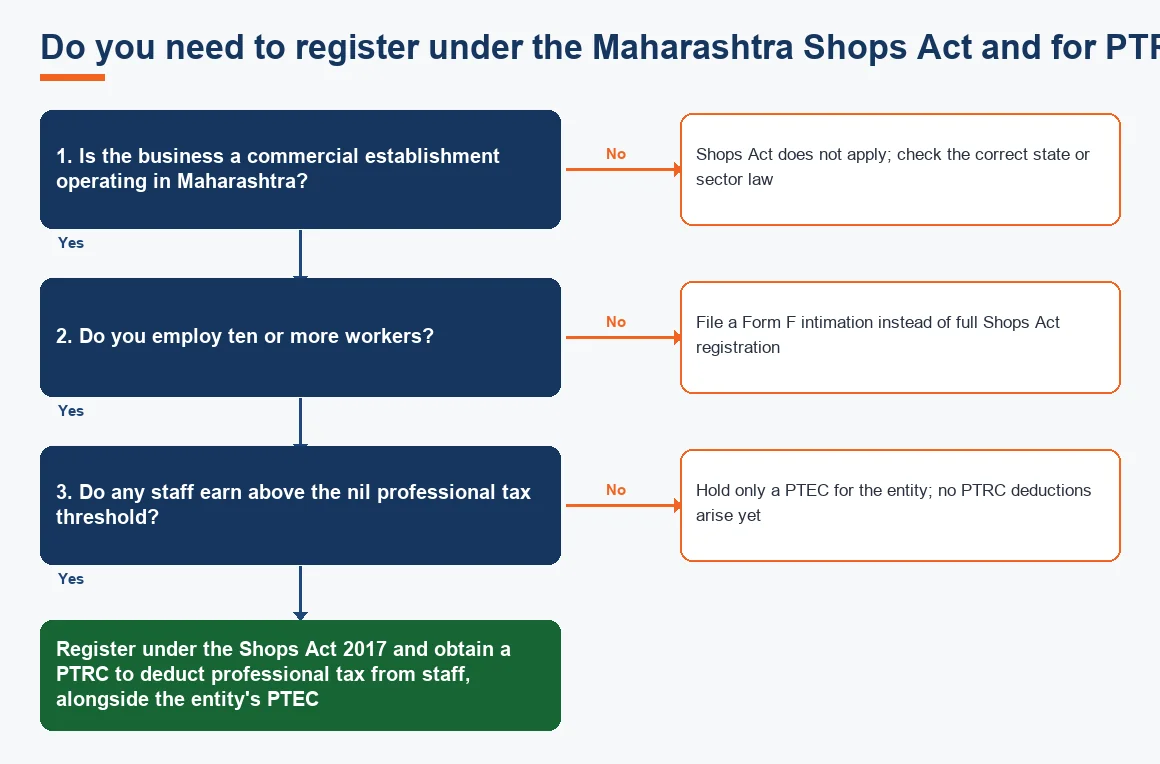
The Shops and Establishment Act is a separate state law governing working hours, weekly holidays, leave, wages, employment of women and young persons, and record keeping in shops, offices and commercial establishments. Every state runs its own version, so thresholds and forms differ. Maharashtra's 2017 Act requires registration where ten or more workers are employed, while smaller establishments simply file an intimation in Form F rather than a full registration.
For a Mumbai office this means a genuine head-count test on the date you start. Ten or more workers puts you into registration with the local authority; fewer than ten keeps you on the lighter Form F intimation, which still records your existence but carries a lower compliance load. The Act sits alongside, and is independent of, your professional tax obligations, though the two are commonly set up together. Manufacturers in the suburbs should also weigh MIDC industrial area compliance and the Maharashtra Stamp Act provisions on their leases, points our note on accounting for MIDC and Andheri manufacturers takes further.
Worked example: professional tax across a small Mumbai payroll
Take a four-person office in Fort for the month of February, when the Rs 200 slab carries the extra Rs 100. The table below shows the deduction against each employee's monthly salary. All figures are in Indian rupees.
| Employee | Monthly salary | Slab applied | February PT |
|---|---|---|---|
| A (male) | 6,800 | Up to 7,500: Nil | 0 |
| B (male) | 9,200 | 7,501 to 10,000 | 175 |
| C (female) | 22,000 | Up to 25,000: Nil | 0 |
| D (male) | 45,000 | Above 10,000 (Feb) | 300 |
| Total remitted | 475 |
In an ordinary month the same payroll would remit Rs 375 (Rs 175 for B and Rs 200 for D, with A and C nil). Employee D's annual total works out to Rs 2,500, eleven months at Rs 200 plus Rs 300 in February, exactly the ceiling. The Rs 2,500 PTEC for the business itself is separate and paid once by 30 June.
Key terms
- Accrued Liabilities: amounts owed but not yet paid, such as professional tax deducted and pending remittance.
- Journal Entry: the paired debit and credit that records the PT deduction and the liability to the state.
- General Ledger: the master record where the professional tax payable account is tracked and reconciled.
- Delhi Nil Professional Tax Regime: a contrast point, as Delhi levies no professional tax at all, unlike Maharashtra.
Key takeaways
- Hold both a PTEC (Rs 2,500 flat, due 30 June) and a PTRC (employee deductions) as a Maharashtra employer.
- Nil PT up to Rs 7,500 for men and Rs 25,000 for women; Rs 175 or Rs 200 a month above that, with Rs 300 in February.
- File PTRC in Form III-B monthly if last year's liability was Rs 1,00,000 or more, otherwise annually by 31 March.
- Register under the Shops and Establishment Act 2017 at ten or more workers; use Form F below that.
- Book professional tax as a payroll accrual and reconcile it to the MTR-6 challan each month.
Professional tax and the Shops Act are procedural once set up correctly, but the head-count tests, the February adjustment and the PTEC payment date all reward getting the mechanics right at the start. If you would rather have the registration, monthly returns and payroll accruals handled end to end, see our accounting and bookkeeping services and the wider accounting and bookkeeping hub, or benchmark local costs in our guide to the cost of outsourced accounting in Mumbai. Statutory calculators for related payroll and asset matters sit in our depreciation calculator and companion tools.
Decision guide