In this guide
Choosing an accountant in Mumbai comes down to three checks done in the right order: confirm the person or firm is genuinely qualified for the work you need, match their profile to your business stage and location, and make sure any handover from a previous accountant is complete. Get those right and the rest, fees, software, personality, is negotiable; get them wrong and you discover the gap at assessment, when it is expensive to fix. This guide is a vetting checklist for owners across Fort, BKC, Nariman Point and the wider city. If you are ready to appoint, the commercial detail sits on our Accounting & Bookkeeping Services in Mumbai page and the national Accounting & Bookkeeping Services in India hub.
First, match the appointment to your statutory stage
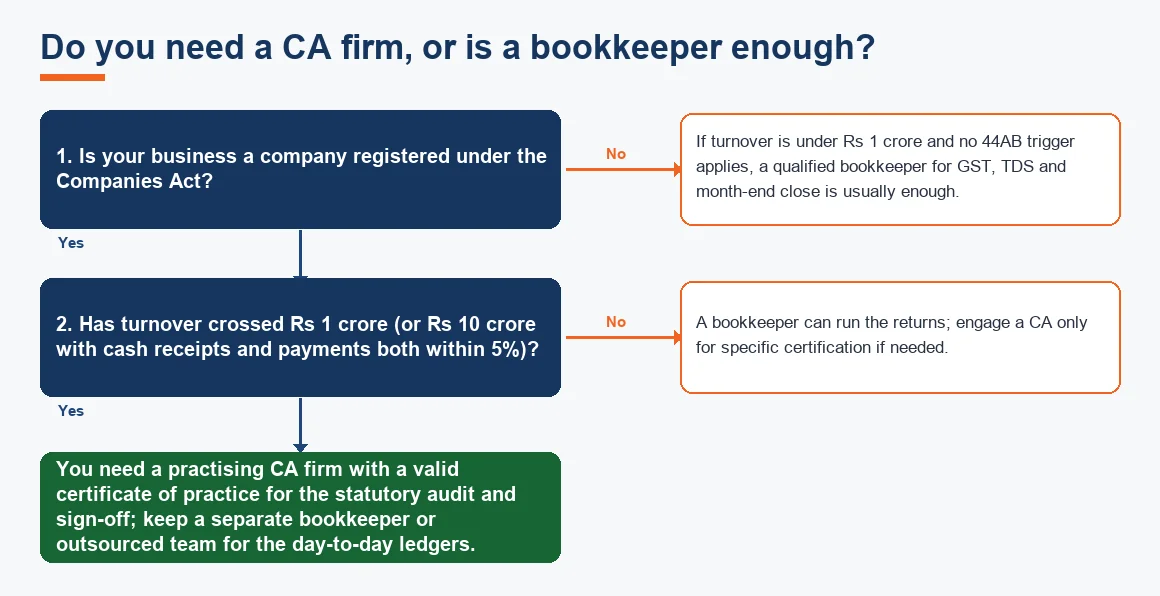
The single most common mistake is hiring the wrong tier: a full CA firm for a business that only needs clean bookkeeping, or a solo bookkeeper for a company that legally requires a statutory audit. The deciding factor is not turnover alone, it is whether someone has to sign off on your accounts.
A company incorporated under the Companies Act needs a statutory auditor under Section 139 from its first year, regardless of size. A tax audit under Section 44AB applies once turnover crosses Rs 1 crore, extended to Rs 10 crore where both cash receipts and cash payments stay within 5% of the totals. Below those triggers, a qualified bookkeeper handling GSTR-1, GSTR-3B, TDS challans and a monthly close is usually enough. The table below sets out who can do what.
| Provider | Typical work | Can sign a tax audit (44AB)? | Can sign a company audit (139)? |
|---|---|---|---|
| In-house or freelance bookkeeper | Vouchers, bank entries, GST returns, TDS challans, payroll | No | No |
| Accountant or accounting firm (non-CA) | Above plus MIS, month-end close, provisional financials | No | No |
| Practising CA firm (with COP) | Above plus statutory sign-off, audit, certification, representation | Yes | Yes |
Verify the firm's ICAI registration before you appoint
Anyone can print "tax consultant" on a visiting card. Only a member of the Institute of Chartered Accountants of India holding a valid certificate of practice can sign the statutory work. Every practising firm holds a Firm Registration Number and every member a membership number, both searchable through the member and firm search on the ICAI website. This takes two minutes and should happen before, not after, you share your books.
Ask three things: the FRN, the certificate of practice, and confirmation of who will actually sign, because a large firm may pitch with a partner and staff the file with an article assistant. None of this is rude to request; a genuine practice expects it.
Red flags when hiring an accountant
Some warning signs show up in the first meeting if you know to look for them. Treat these as reasons to pause and ask more:
- Reluctance to share the FRN or certificate of practice, or vague answers about who signs.
- A promise to "manage" your tax liability aggressively, or to backdate entries, rather than to report it correctly.
- No written engagement scope, so nobody can say later whether the audit, ROC filings or TDS returns were in or out of the fee.
- Books kept only on the accountant's own laptop, with no client-owned Tally or Zoho file and no shared portal credentials.
- For a switch, an incoming firm that has not communicated with your retiring auditor. That communication is mandatory under the ICAI Code of Ethics, and skipping it is professional misconduct.
The last point matters more than owners expect: a firm that ignores the ethics on the way in is telling you how it will behave once it holds your file.
How do I choose a tax professional: questions that separate them
Beyond the credentials, the fit is about how a firm works, not just what it charges. A useful shortlist of questions:
- Who is my point of contact, and who signs the return? Are they the same person?
- Do I own the accounting file? Insist on a client-held Tally or Zoho Books data file, not a monthly PDF.
- What is your month-end close and reconciliation routine, and by which date each month?
- What is included in the annual fee: GST, TDS, ROC filings, the audit, notices? Get it in writing.
- How do you handle a departmental notice or assessment, and is representation billed separately?
Notice that these are the same disciplines a good outsourced team documents anyway: a defined month-end close checklist, proper bank reconciliation, and clear segregation of duties so the person recording a payment is not the only person approving it.
Fort, BKC and Nariman Point: what the office cluster tells you
Location in Mumbai is a rough signal of a firm's client mix, and matching it to your own business saves time. It is a starting filter, not a rule.
Fort and Nariman Point
The older commercial core around Fort and Nariman Point is dense with long-established practices serving trading houses, brokerages, professional firms and family businesses. If you run a trading or services firm with straightforward GST and TDS, a practice here is often well matched, and physically close for the paperwork that still moves on foot in south Mumbai.
Bandra Kurla Complex (BKC)
BKC skews corporate: firms geared to larger companies, regulated entities and groups reporting under Ind AS, with the fee levels that follow. A private limited company heading towards consolidation or investor reporting will value that depth; a single-GSTIN trader may be over-buying. The read on outsourced accounting price benchmarks in Mumbai puts numbers to that spread.
Suburban and industrial belts
For manufacturers around Andheri and the MIDC belts, proximity to a firm that understands costing, e-invoicing and job-work is more useful than a south Mumbai address; our note on accounting for MIDC and Andheri manufacturers covers that ground. Whatever the cluster, confirm the firm knows Maharashtra-specific obligations such as Professional Tax and Shops Act registration (PTRC/PTEC), which trip up businesses that appoint an out-of-state accountant.
A step-by-step vetting process
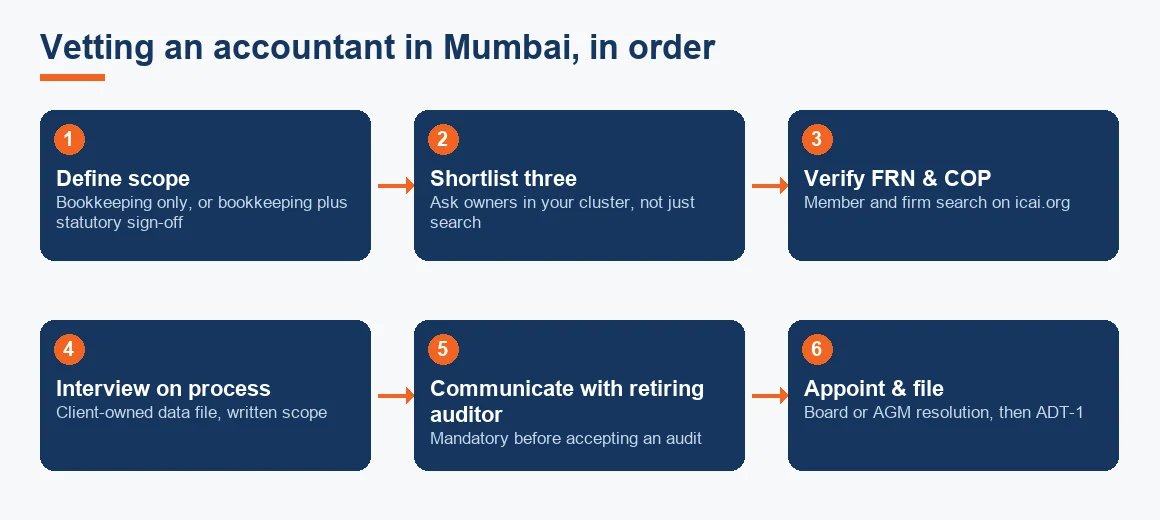
Run the same sequence for every candidate so you are comparing like with like:
- Define the scope. Decide whether you need bookkeeping only, or bookkeeping plus statutory sign-off, before you take a single quote.
- Shortlist three. Ask existing owners in your cluster rather than relying on search rankings alone.
- Verify credentials. Check the FRN and membership number on icai.org and ask for the certificate of practice.
- Interview on process. Use the questions above; insist on a client-owned data file and a written scope.
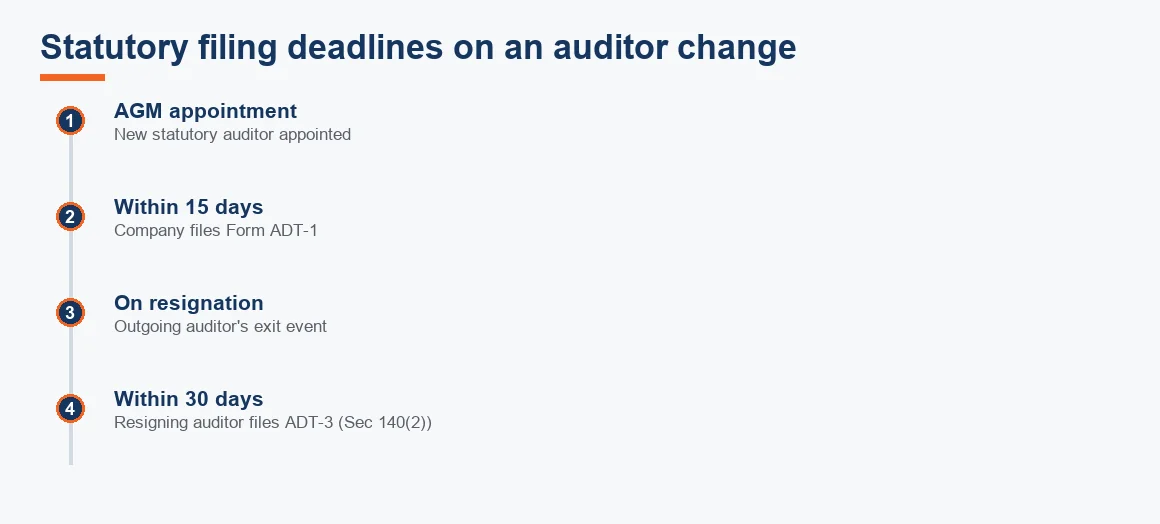
- Communicate with the retiring auditor. If you are switching, confirm the incoming firm has written to and heard back from the outgoing one.
- Appoint and file. For a company, pass the board or AGM resolution and file Form ADT-1 within the deadline.
Worked example: does your Mumbai firm actually need a CA-signed tax audit?
Take a Fort-based trading firm, Turnover Rs 3.2 crore for FY 2025-26. It is above the Rs 1 crore line, so the question is whether it qualifies for the Rs 10 crore relaxation, which needs both cash receipts and cash payments at 5% or less of the respective totals. The arithmetic decides it.
| Test | Amount (Rs) | Threshold (5%) | Within limit? |
|---|---|---|---|
| Total receipts | 3,20,00,000 | 16,00,000 | Reference |
| Cash receipts | 9,60,000 | 16,00,000 | Yes (3.0%) |
| Total payments | 3,05,00,000 | 15,25,000 | Reference |
| Cash payments | 21,00,000 | 15,25,000 | No (6.9%) |
Cash receipts pass at 3.0%, but cash payments are 6.9%, above the 5% ceiling. Because both tests must pass, the relaxation does not apply and the firm needs a Section 44AB audit for the year. Had the owner routed those cash payments through the bank, the same business would have stayed audit-exempt to Rs 10 crore. That is the kind of forward call a good accountant flags in April, not the following September.
The handover checklist when you switch accountants
A clean switch is mostly about collecting the right things before the outgoing accountant loses interest. Gather, at minimum:
- The Tally or Zoho Books data file with the full year of vouchers, not a summary export.
- GST and income tax portal credentials, TDS challans and the latest Form 26AS.
- Three years of signed financial statements and the fixed asset register.
- The auditor's working papers reference and any open notices or assessments.
Section 128(5) of the Companies Act requires books to be preserved for eight financial years, so an incomplete handover is not just inconvenient, it leaves the business exposed if an earlier year is reopened. If the previous books are patchy, budget for a round of catch-up bookkeeping and work through an audit-readiness and book-cleanup checklist before the new firm can rely on the opening balances. This diligence is the same whether you engage a local firm or an outsourced accounting and bookkeeping team.
Tools and terms worth knowing before you sit down
You do not need to speak like an accountant to vet one, but a few terms make the conversation faster. It also helps to know the sort of workings a competent firm should produce on request, such as an AS vs Ind AS comparison if you are moving into Ind AS reporting, or a clean depreciation schedule under Schedule II. If a firm cannot show you these, that tells you something.
Key terms
- Statutory vs Internal Audit: a statutory audit is legally required and signed by a CA; an internal audit is a management check, not a filing.
- Financial Internal Controls: the routines that stop errors and fraud, the thing a good accountant builds, not just reports on.
- Standard Operating Procedure (SOP): the documented way a task is done, so the work survives a change of staff.
- Trial Balance: the summary of all ledger balances your accountant should be able to hand you at any month-end.
Key takeaways
- Decide bookkeeper versus CA firm by statutory sign-off, not turnover alone; only a practising CA with a COP can sign a 44AB or 139 audit.
- Verify the FRN and membership number on icai.org before sharing any books.
- Match the Mumbai cluster, Fort, BKC or a suburban belt, to your own business rather than the postcode.
- On a switch, collect the data file, credentials, 26AS and three years of financials, and confirm the retiring auditor was communicated with.
- File ADT-1 within 15 days of appointment; the numbers on the audit threshold reward keeping cash payments under 5% of the total.
For the commercial engagement, fees, turnaround and a scoped proposal, start at Accounting Services in Mumbai. If your business sits in a specific sector, the startup and manufacturing city pages carry the sector-specific detail this general guide deliberately leaves out.
Decision guide