

In this guide
If you are asking how much accounting services cost in Mumbai, the honest answer is a range rather than a single figure. In 2026, most Mumbai businesses pay somewhere between Rs 8,000 and Rs 30,000 a month for outsourced bookkeeping and compliance, plus 18 percent GST, with the exact number set by your turnover, transaction volume and how many statutory filings you carry. Mumbai fees sit slightly above the national average, and this guide explains why, what a quote should contain, and how the bands look for South Mumbai trading houses and BKC corporates. It is a pricing explainer; for a scoped quote you can speak to our Accounting & Bookkeeping Services in India team directly.
How much do accounting services cost in Mumbai in 2026?
Think in three layers. The first is a recurring monthly retainer that keeps your books current. The second is annual work such as statutory audit and income tax filing, quoted per engagement. The third is GST at 18 percent, which sits on top of everything. The table below shows indicative monthly retainers seen across Mumbai in 2026. Treat them as starting bands, not fixed prices, because volume and complexity move the number quickly.
| Business profile | Indicative monthly retainer (Exl GST) | Usually included | Common add-ons |
|---|---|---|---|
| Proprietorship / freelancer, single GST | Rs 8,000 to Rs 12,000 | Voucher entry, bank reconciliation, GSTR-1 and GSTR-3B | Payroll, professional tax returns |
| LLP / small Pvt Ltd, single state | Rs 12,000 to Rs 18,000 | Above plus TDS returns and a monthly trial balance | MIS reporting, ROC support |
| Private limited, payroll and inventory | Rs 18,000 to Rs 30,000 | Full bookkeeping, multi-state GST, payroll, TDS | Costing, consolidation, cash-flow packs |
| South Mumbai trading house / BKC corporate | Rs 30,000 and above | High-volume ledgers, foreign remittances, board reporting | Transfer pricing support, audit coordination |
Why are accounting fees higher in Mumbai?
Two forces push Mumbai above the national band. The first is cost of delivery. Office rent and qualified staff salaries in Mumbai run materially above most Indian metros, and a firm has to recover that through professional fees. The second is compliance load. A Maharashtra employer carries profession tax through PTRC and PTEC, and under the QRMP scheme a taxpayer up to Rs 5 crore turnover files a quarterly GSTR-3B due on the 22nd, as notified by the CBIC. That extra filing cadence is real work, and it is billed. Our companion guide on Maharashtra professional tax and Shops Act compliance covers PTRC and PTEC in full.
Location within the city matters too. Firms clustered around BKC, Nariman Point and Fort tend to serve listed companies, foreign-parent subsidiaries and large trading houses, so their base rates reflect that client mix. If you are a smaller business, you are not obliged to buy at that price point; you simply need to match your firm to your profile. Our note on choosing an accountant in Mumbai walks through the Fort, BKC and Nariman Point options.
What a monthly accounting fee actually covers
A standard Mumbai monthly scope keeps your books closed and your GST current. It normally includes voucher entry on a double-entry basis, monthly bank reconciliation, GSTR-1 and GSTR-3B filing, TDS payment and quarterly TDS returns, and a monthly trial balance with a profit and loss summary. Good firms also run your GSTR-2B input tax credit matching so you do not lose credit on mismatched invoices.
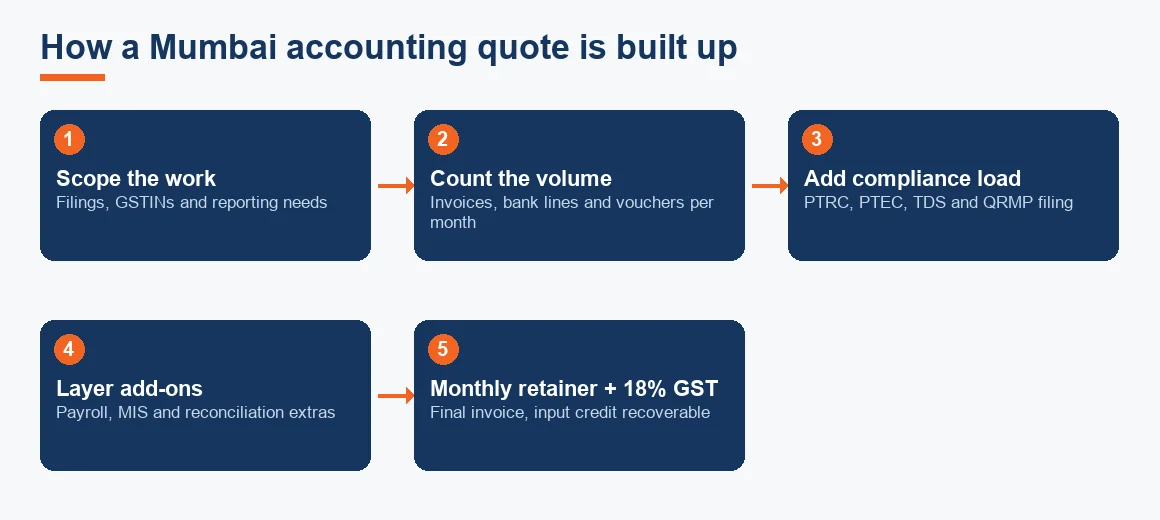
Some items are almost always add-ons: payroll processing, professional tax returns, management reporting and a receivables aging schedule for chasing overdue customers. Ask which side of the line each item falls on before you sign. The diagram below shows how a Mumbai quote is built up from scope to final invoice.
Worked example: building a monthly fee up by business size
To show how the bands above are reached, here is an indicative build-up that starts from the bookkeeping base and adds each GST, payroll and compliance component in turn. Every figure is indicative and quoted Exl GST, and your own quote will move with actual transaction volume, the number of GST registrations and payroll headcount.
| Business size (monthly transactions, GST registrations, payroll headcount) | Bookkeeping base | GST filing | Payroll | TDS and other compliance | Indicative monthly total (Exl GST) |
|---|---|---|---|---|---|
| Micro proprietorship: around 100 transactions, 1 GSTIN, no payroll | Rs 5,000 to Rs 7,000 | Rs 2,000 to Rs 3,000 | Rs 0 | Rs 1,000 to Rs 2,000 | Rs 8,000 to Rs 12,000 |
| Small LLP or Pvt Ltd: around 300 transactions, 1 GSTIN, 5 on payroll | Rs 7,000 to Rs 9,000 | Rs 2,000 to Rs 3,000 | Rs 2,000 to Rs 3,000 | Rs 1,000 to Rs 3,000 | Rs 12,000 to Rs 18,000 |
| Growing Pvt Ltd: around 800 transactions, 2 GSTINs (multi-state), 15 on payroll | Rs 9,000 to Rs 13,000 | Rs 4,000 to Rs 6,000 | Rs 3,000 to Rs 6,000 | Rs 2,000 to Rs 5,000 | Rs 18,000 to Rs 30,000 |
| Trading house or BKC corporate: 2,000 plus transactions, 3 plus GSTINs, 30 plus on payroll | Rs 14,000 plus | Rs 7,000 plus | Rs 6,000 plus | Rs 3,000 plus | Rs 30,000 and above |
Read across any row and the components sum to the indicative total, then add 18 percent GST to reach the invoice value, which a registered business recovers as input tax credit.
Annual and one-off work is priced separately
Your monthly retainer does not include the big annual items. A company statutory audit for a small Mumbai private limited company usually starts near Rs 35,000 and rises with turnover, branch count and inventory volume. A company income tax return commonly starts near Rs 15,000, and ROC annual filing is quoted on its own. These are separate engagements for a reason.
Statutory audit in particular cannot be done by the firm that writes your books. Section 144 of the Companies Act, administered by the MCA, bars an auditor from providing accounting services to the same company, so audit is always a distinct appointment. If you want to understand the difference in scope, our glossary entry on statutory versus internal audit sets it out, and the audit-readiness checklist for Mumbai businesses shows how clean books reduce audit hours and therefore audit cost.
Is GST charged on top of accounting fees?
Yes. The GST portal treats accounting, bookkeeping and audit as taxable services at 18 percent. A Rs 15,000 monthly retainer therefore invoices at Rs 17,700, of which Rs 2,700 splits into CGST and SGST for a supply within Maharashtra. The important point for most businesses is input tax credit: a GST-registered client claims that Rs 2,700 back, so the effective cost of the service stays Rs 15,000. If you are not registered, or your output is exempt, the GST is a real cost and you should budget the gross figure.
Who needs to think hardest about this
Not every business feels fees the same way. A single-GSTIN service firm with a few hundred transactions a month sits comfortably in the lower bands. The businesses that need to plan carefully are the ones with volume or complexity:
- Trading houses in South Mumbai with high invoice counts and import documentation, where transaction volume alone lifts the retainer.
- Manufacturers around MIDC and Andheri carrying inventory, costing and e-invoicing, covered in our guide to accounting for MIDC and Andheri manufacturers.
- Funded startups that need investor-grade reporting from day one; the startup accounting service for Mumbai is scoped for that.
- BKC corporates and foreign-parent subsidiaries with board packs, consolidation and transfer-pricing support.
Match the firm to the profile and you avoid both overpaying for capability you do not use and underbuying for compliance you cannot skip.
How to read and compare a Mumbai quote
Follow the same steps every time and quotes become easy to compare on a like-for-like basis.
- List your monthly filings. GSTINs, TDS, profession tax. This sets the compliance load.
- Estimate transaction volume. Invoices, bank lines and vouchers per month drive data-entry hours.
- Separate monthly from annual. Keep audit, ROC and income tax out of the monthly comparison.
- Confirm what is included versus add-on. Payroll, MIS and reconciliation should be named explicitly.
- Add GST at 18 percent to reach the true cash outflow, then net off input tax credit if you are registered.
The timeline below shows what a well-run monthly retainer actually delivers across a typical month, so you can see the work you are paying for.

Can you negotiate accountant fees in Mumbai?
Within reason, yes, but negotiate on scope rather than rate. Firms have limited room to cut a fair hourly rate, yet plenty of room to adjust what sits inside the retainer. If your books are clean and your invoices arrive digitally, you reduce the firm's hours and a lower quote follows naturally. If you hand over shoeboxes of receipts and reconcile nothing yourself, expect the number to rise. The cheapest way to lower a Mumbai fee is to give the firm tidy, timely data, not to argue the rate down.
Key terms
- Double-Entry Bookkeeping: the method where every transaction posts to two accounts, keeping the books self-balancing.
- Trial Balance: a monthly list of all ledger balances used to check the books tally before reports are drawn.
- Bank Reconciliation: matching your ledger cash to the bank statement so no entry is missed or duplicated.
- Statutory vs Internal Audit: statutory audit is a legal requirement under the Companies Act; internal audit is a voluntary control review.
Key takeaways
- Mumbai monthly accounting typically runs Rs 8,000 to Rs 30,000 plus 18 percent GST, set by turnover and volume.
- Fees sit above the national band because of higher rent, salaries and Maharashtra-specific compliance (PTRC, PTEC, QRMP).
- Statutory audit, ROC filing and income tax returns are separate annual engagements, not part of the monthly fee.
- Section 144 of the Companies Act means your bookkeeping firm cannot also be your statutory auditor.
- GST-registered clients recover the 18 percent as input tax credit, so the effective cost equals the base retainer.
- Compare quotes on scope, and lower your fee by supplying clean, timely data rather than haggling the rate.
For fixed, scoped pricing rather than these indicative bands, review the Mumbai accounting and bookkeeping service, or explore the process, software and industry options on the Accounting & Bookkeeping hub. The commercial quote lives there; this guide simply helps you read it.