In this guide
Ind AS 102 is the Indian Accounting Standard that tells a company how to record share-based payment, which in practice means Employee Stock Option Plans (ESOPs), restricted stock units and stock appreciation rights. Its central rule is short: a company measures the award at its fair value on the grant date and recognises that value as an expense over the period the employee has to work to earn it. This explainer sets out the standard with the working shown, not just the rule, so a founder or finance lead can see how the number actually reaches the profit and loss account. For the commercial side of setting up and running a plan, see our ESOP Accounting (Ind AS 102) service page.
What is Ind AS 102?
Ind AS 102 is one of the 40 Indian Accounting Standards notified by the Ministry of Corporate Affairs under the Companies (Indian Accounting Standards) Rules. It deals with every transaction where a company receives goods or services and pays for them in shares, share options, or an amount that is linked to its share price. Employee stock plans are the most common example, but the standard also reaches payments to consultants or vendors settled in equity.
The reason the standard exists is that a stock option has a real cost even though no cash leaves the company. Before fair-value accounting became mandatory, that cost was often invisible in the accounts. Ind AS 102 removes the choice: the fair value of the award is an expense, full stop. The Institute of Chartered Accountants of India publishes the full text of the notified standard on its website, and the notification itself sits with the Ministry of Corporate Affairs.
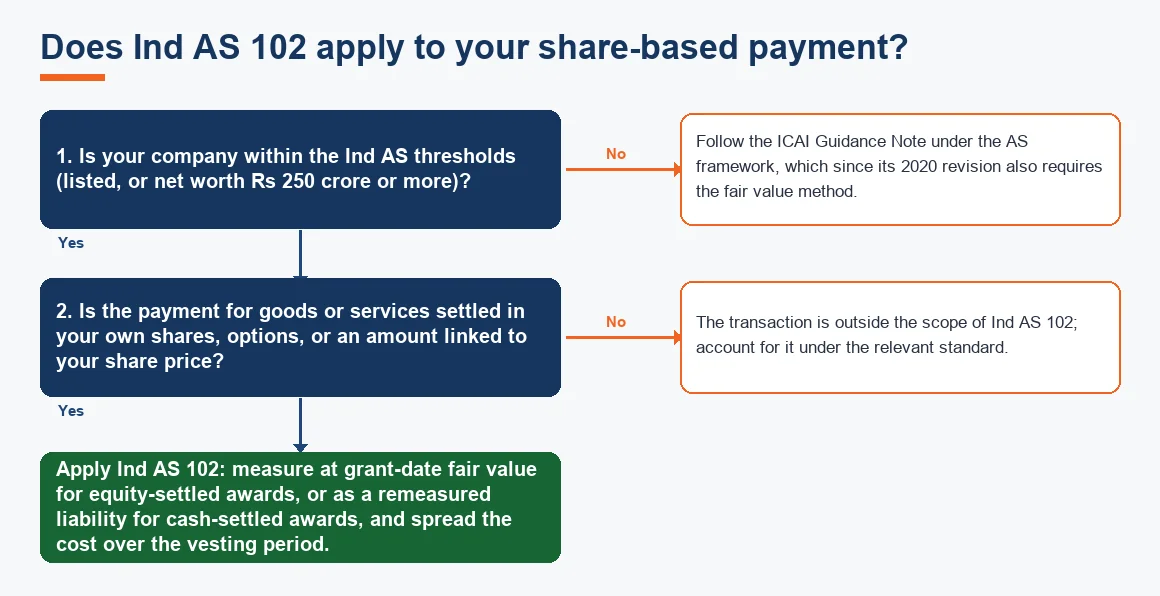
Ind AS 102 became relevant once a company crossed the Ind AS thresholds, broadly listed companies and unlisted companies with net worth of Rs 250 crore or more. If you are unsure whether the standard binds your entity at all, our Ind AS Applicability Checker works through the phased net-worth rules in a couple of minutes.
Ind AS 102 share based payment: the three categories
The standard splits every arrangement into one of three buckets, and the bucket decides how you measure it. This is the single most important classification to get right, because the measurement rule and the balance-sheet entry differ.
- Equity-settled: the employee receives shares or options. Cost is fixed at grant-date fair value and never revised for later share-price movement. It is charged to the profit and loss account with the credit going to a reserve within equity.
- Cash-settled: the employee receives cash based on the share price, the classic case being stock appreciation rights. This creates a liability that is remeasured to fair value at every reporting date.
- Choice of settlement: either party can choose cash or equity, and the accounting follows the substance of that choice.
The contrast between the first two is where most errors happen, so it is worth laying side by side. Our related explainer on cash-settled vs equity-settled share-based payments goes deeper, but the summary below covers the mechanics.
| Feature | Equity-settled ESOP | Cash-settled (SAR) |
|---|---|---|
| What the employee gets | Shares or options | Cash linked to share price |
| Measurement date | Grant date only | Every reporting date until settlement |
| Remeasured for share price? | No | Yes, at each reporting date and at settlement |
| Revised for number vesting? | Yes, for expected forfeitures | Yes |
| Credit side of entry | Reserve within equity | Liability |
| P&L volatility | Low, cost is fixed | High, moves with share price |
What is the accounting treatment for ESOP under Ind AS 102?
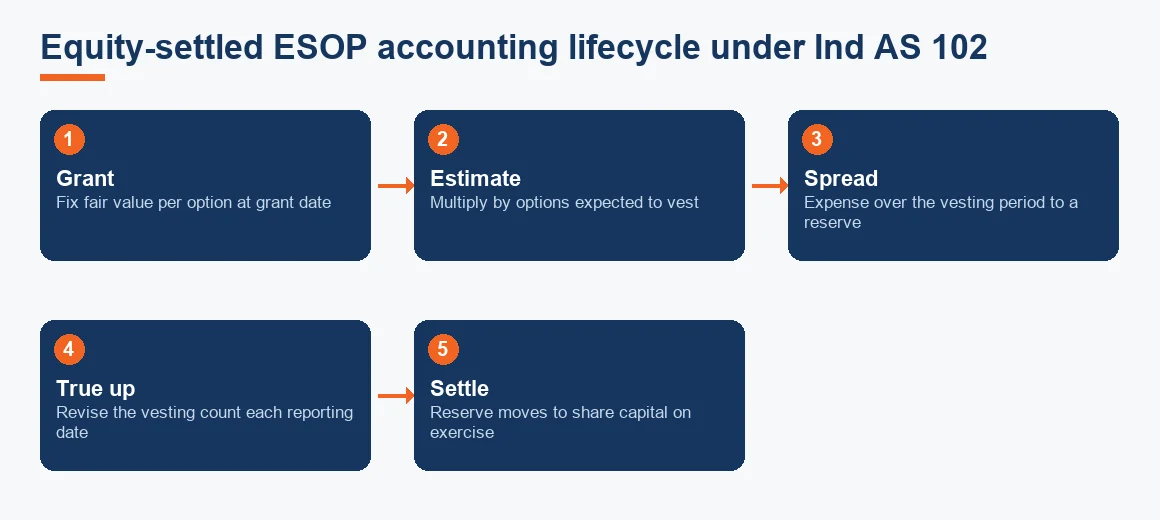
For a standard equity-settled ESOP, the treatment follows a fixed sequence. Getting the steps in order keeps the expense arithmetic clean and the disclosures defensible.
- Measure grant-date fair value. Value each option using an option-pricing model, commonly Black-Scholes or a binomial model, on the date the grant is agreed. This per-option figure is locked in.
- Estimate how many will vest. Multiply by the number of options you expect to actually vest, after allowing for employees you expect to leave before the vesting date.
- Spread over the vesting period. Recognise the total as an employee-benefit expense across the years of service, with the credit to a share-options-outstanding reserve.
- True up the count each year. Revise the forfeiture estimate at every reporting date so the cumulative expense reflects options now expected to vest. You revise the number, never the grant-date fair value.
- Deal with exercise or lapse. On exercise, the reserve moves to share capital and securities premium. If vested options lapse unexercised, the reserve can be transferred within equity, not reversed through profit and loss.
The journal entry each year is a debit to employee compensation expense and a credit to the reserve. Our companion blog on how to account for ESOP expense over the vesting period walks through the reserve movements at exercise in more detail.
What is graded vesting in Ind AS 102?
Graded vesting, sometimes called the graded vesting method, is where an award vests in instalments rather than all on one date. A grant of 900 options vesting one-third at the end of each of three years is graded. A grant that vests fully at the end of year three is cliff vesting.
Under Ind AS 102, graded vesting is not treated as one award spread evenly. Each tranche is accounted for as a separate award with its own vesting period. The tranche that vests in one year is expensed over one year, the tranche that vests in two years over two years, and so on. Because the early tranches are recognised over shorter periods, more of the total cost lands in the first year. This front-loading, known as accelerated recognition, surprises many founders who expected a straight-line charge. The vesting period graded amortisation concept is worth understanding before you model dilution, and our cap table dilution note explains the downstream effect on ownership.
Worked example: graded vesting ESOP expense schedule
Take a company that grants an employee 900 options with a grant-date fair value of Rs 30 per option, vesting one-third at the end of years 1, 2 and 3. Assume the employee is expected to stay, so no forfeiture adjustment is needed. Each tranche of 300 options carries a cost of Rs 9,000 (300 x Rs 30). The schedule below shows how graded vesting front-loads the charge.
| Tranche | Options | Total cost (Rs) | Vesting years | Year 1 (Rs) | Year 2 (Rs) | Year 3 (Rs) |
|---|---|---|---|---|---|---|
| Tranche 1 | 300 | 9,000 | 1 | 9,000 | 0 | 0 |
| Tranche 2 | 300 | 9,000 | 2 | 4,500 | 4,500 | 0 |
| Tranche 3 | 300 | 9,000 | 3 | 3,000 | 3,000 | 3,000 |
| Total | 900 | 27,000 | 16,500 | 7,500 | 3,000 |
The total cost of Rs 27,000 is the same as it would be under any method, but graded vesting pushes Rs 16,500 (61 per cent) into year one against roughly Rs 9,000 under a naive straight-line split. That difference matters for a loss-making startup watching its reported burn. This value is indicative; the actual per-option fair value must come from a proper valuation.
Ind AS 102 vs IFRS 2 and ASC 718
Ind AS 102 is a near word-for-word convergence with IFRS 2, the international standard for share-based payment issued by the IASB. The measurement principles, the split between equity-settled and cash-settled, and the graded vesting treatment are the same. The differences are the usual Indian carve-outs: terminology aligned to the Companies Act, references to Indian regulators, and formatting for Schedule III presentation. For most preparers the two produce the same expense.
US GAAP handles the same ground through ASC 718. The headline difference between IFRS 2 (and therefore Ind AS 102) and ASC 718 is graded vesting: ASC 718 permits a policy choice between accelerated recognition and straight-line, whereas Ind AS 102 mandates the accelerated, tranche-by-tranche approach. A group consolidating an Indian subsidiary into a US parent will often see the two figures diverge for exactly this reason.
Which accounting standard deals with ESOP if Ind AS does not apply?
A company below the Ind AS thresholds does not use Ind AS 102 at all. It follows the ICAI Guidance Note on Accounting for Share-based Payments, which sits under the older AS framework. The important practical point is method: the Guidance Note, since its 2020 revision, also requires the fair value method and no longer permits the intrinsic value method that its older 2005 version allowed, bringing it into line with Ind AS 102.
This change closed a real gap. Intrinsic value is the excess of the share's value over the exercise price at grant. An option granted at the current market price has an intrinsic value of nil, so under the old method no cost appeared in the accounts even though a genuine benefit had been handed over. Our detailed comparison of fair value vs intrinsic value for ESOP under Ind AS 102 shows how far apart the two numbers can be. If you are weighing which framework binds you, the AS vs Ind AS comparison matrix maps the treatment side by side.
Whichever framework applies, the ESOP charge is a book expense only. The tax outcome runs on a separate track: the employee is taxed on a perquisite at exercise, as set out in our note on ESOP perquisite tax for employees, and the company's deduction follows its own rules. Keeping the two schedules reconciled is part of a clean close, which is where structured backlog bookkeeping and catch-up work often surfaces missed grants. Teams that also outsource their accounts payable and accounts receivable tend to catch these reserve movements earlier because the month-end discipline is already in place.
Key terms
- Ind AS 102 Share-based Payment: the Indian standard requiring fair-value expensing of ESOPs and similar awards.
- Vesting Period Graded Amortization: spreading each vesting tranche over its own service period, which front-loads cost.
- ESOP Intrinsic Value Method: the older approach measuring only the excess of share value over exercise price.
- Cap Table Dilution: the reduction in existing shareholders' ownership as options vest and convert.
Ind AS 102 summary
In one line, Ind AS 102 says that a share-based payment is a real expense measured at grant-date fair value and recognised over the period the recipient earns it. Equity-settled awards fix that value at grant and credit a reserve; cash-settled awards create a liability remeasured to fair value each period. Graded vesting front-loads the charge. Companies outside the Ind AS net fall back on the ICAI Guidance Note, which since 2020 also requires fair value, closing the intrinsic value method's old blind spot. The standard is a valuation-and-timing exercise, and it belongs alongside standards like Ind AS 115 revenue recognition in any Ind AS transition.
Key takeaways
- Ind AS 102 is India's IFRS 2, covering all share-based payment including ESOPs and stock appreciation rights.
- Equity-settled awards are measured once at grant-date fair value and never remeasured for share price, only for the number expected to vest.
- Cash-settled awards are a liability remeasured to fair value at every reporting date and at settlement.
- Graded vesting treats each tranche as a separate award and accelerates the expense into early years.
- Below the Ind AS thresholds, the ICAI Guidance Note applies and, since its 2020 revision, it too mandates fair value, retiring the intrinsic value method that once left the cost invisible.
Decision guide