In this guide
ESOP accounting over the vesting period means taking the fair value of the options measured on the grant date and charging it to the profit and loss account in slices, one slice for each year the employee has to keep serving before the options can be exercised. It is a non-cash charge: nothing leaves the bank, but the cost of rewarding staff with equity is recognised while the service that earns it is being received. This guide walks through the standard that applies, the journal entries, a worked schedule, and what happens when someone resigns early. For the commercial side of setting up and running a scheme, see our ESOP Accounting (Ind AS 102) service page.
Which accounting standard covers ESOP?
For companies that report under Indian Accounting Standards, the answer is Ind AS 102 Share-based Payment. It treats employee stock options as an equity-settled share-based payment and requires the grant-date fair value to be expensed across the vesting period. Companies still on the older framework, and most unlisted private companies, follow the ICAI Guidance Note on Accounting for Employee Share-based Payments, which reaches the same result and now also mandates the fair value method. Both are notified through the Ministry of Corporate Affairs, and the standards text sits with the ICAI and in the rules under the Companies Act on the MCA portal. For a plain-language walk-through of the standard itself, our note on What Is Ind AS 102 covers the scope in detail.
The number that decides everything is the grant-date fair value, usually computed with an option pricing model. If you are weighing that against the older approach, read Fair Value vs Intrinsic Value for ESOP before you settle on a method.
Is ESOP an expense, and is it non-cash?
Yes on both counts. Options granted to employees are a cost of employment, so the fair value is charged to the profit and loss account as an employee benefits expense. It is non-cash because the matching credit does not go to a bank or a payable; it goes to an equity reserve called the Share Options Outstanding Account. Cash only appears later, and it flows in, not out, when the employee pays the exercise price. So the charge reduces reported profit without touching liquidity, which is why founders often see a healthy bank balance sitting next to a lower net profit in an ESOP-heavy year.
How ESOP accounting is done over the vesting period
The mechanics follow a short, repeatable loop. The diagram below traces the full lifecycle from grant to allotment.
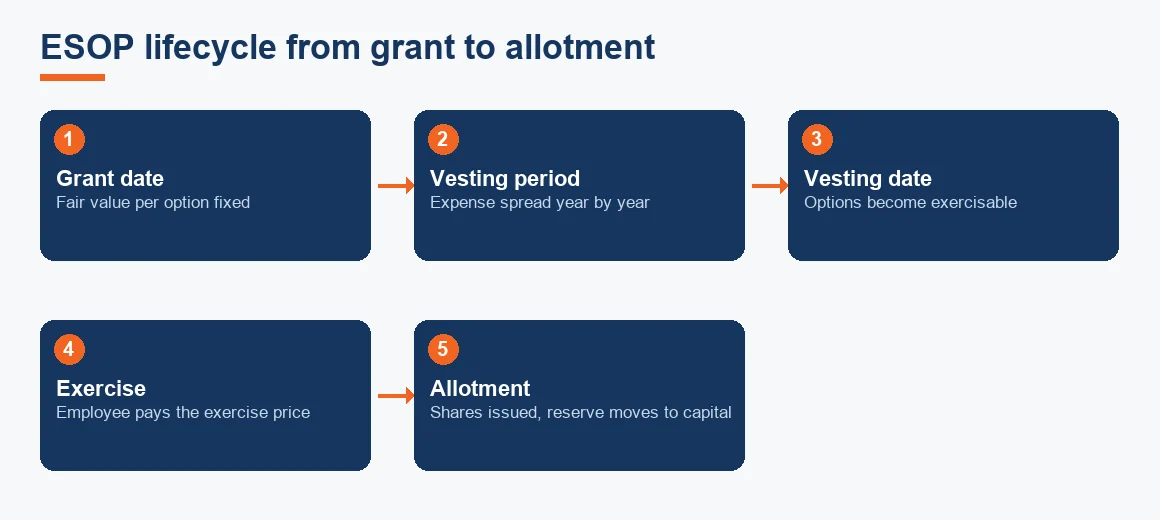
- Measure at grant. Compute the total fair value: number of options expected to vest multiplied by the fair value per option.
- Spread across vesting. Recognise that total over the vesting period. Straight-line for a single tranche, or graded amortisation where options vest in instalments (see vesting period graded amortisation).
- True up each year. Revise the number expected to vest for actual and expected leavers, and adjust the cumulative expense so far.
- Account for exercise. When the employee pays the exercise price, move the accumulated reserve into share capital and securities premium.
- Deal with lapse. If vested options are never exercised, the reserve is moved within equity, with no charge back through profit and loss.
The ESOP journal entry, step by step
Three moments need entries: each year of vesting, the exercise, and any forfeiture. The core annual journal entry rests on ordinary double-entry bookkeeping, one debit to the P&L and one credit to equity.
Each year of the vesting period:
- Debit
- Employee Benefits Expense (the year's slice of fair value)
- Credit
- Share Options Outstanding Account (an equity reserve)
On exercise, when the employee pays and shares are allotted:
- Debit
- Bank, with the exercise price collected
- Debit
- Share Options Outstanding Account, with the accumulated balance for those options
- Credit
- Share Capital, with the face value of the shares issued
- Credit
- Securities Premium, with the balancing figure
Note that the exercise entry issues fresh shares, which is where cap table dilution shows up for existing shareholders. The mechanics of debits and credits here are identical to any other issue of shares, only the source of the premium differs.
Worked example: spreading ESOP expense across a three-year vesting period
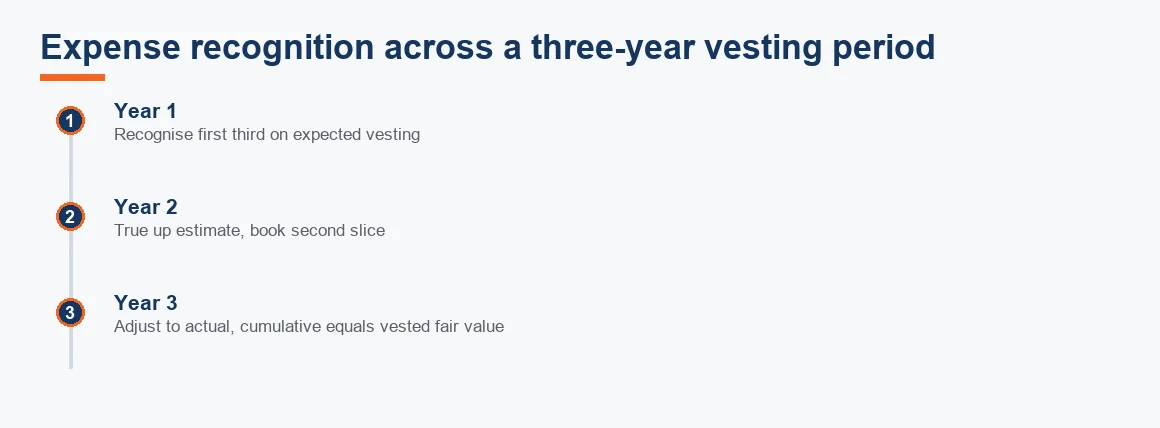
Assume a company grants 5,000 options with a grant-date fair value of ₹60 per option, vesting after three years of continuous service. Each year it revises how many options it expects to vest and trues up the cumulative charge. The schedule below shows the arithmetic.
| Year | Options expected to vest | Total fair value (₹) | Cumulative % earned | Cumulative expense (₹) | Expense for the year (₹) |
|---|---|---|---|---|---|
| 1 | 4,500 (90%) | 2,70,000 | 1/3 | 90,000 | 90,000 |
| 2 | 4,250 (85%) | 2,55,000 | 2/3 | 1,70,000 | 80,000 |
| 3 | 4,200 (actual) | 2,52,000 | 3/3 | 2,52,000 | 82,000 |
The three annual charges (₹90,000 + ₹80,000 + ₹82,000) add up to ₹2,52,000, the fair value of the options that actually vested. Notice that year two's charge fell because the vesting estimate was cut, and year three corrected back up when fewer people left than feared. The grant-date fair value of ₹60 never moved; only the count did.
What happens when an employee resigns before vesting
This is where the treatment splits by the type of condition attached to the option.
Service and non-market performance conditions
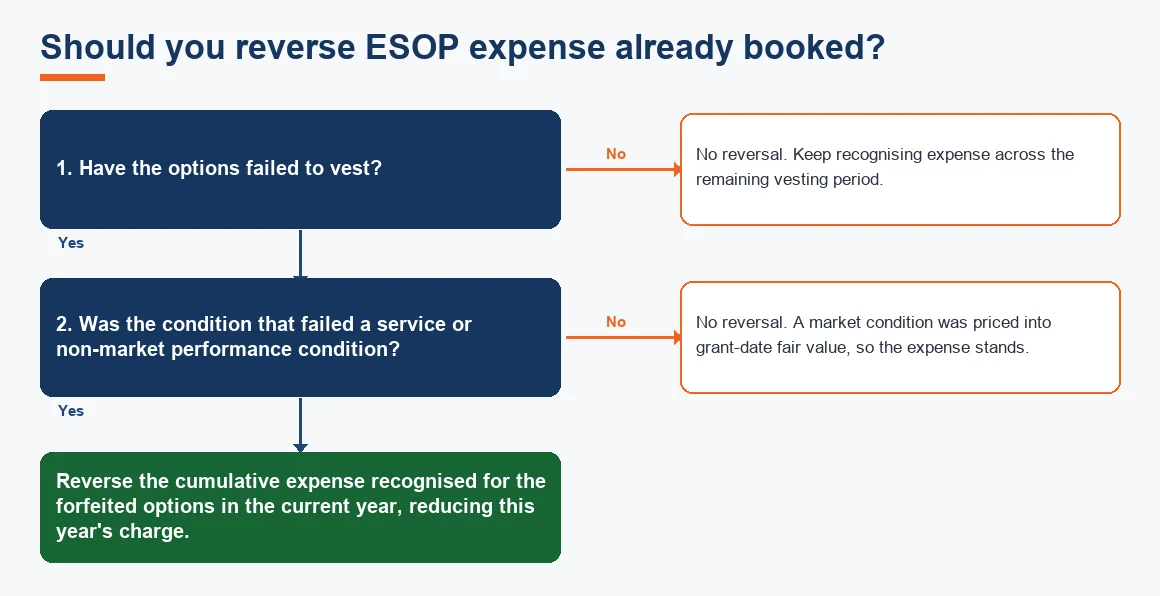
If someone leaves before completing the required service, or a target such as a revenue milestone is missed, the options are forfeited. The cumulative expense already recognised for those unvested options is reversed in the year of departure, which reduces that year's charge. In effect, the company had booked a cost expecting service it never received, so it takes the cost back.
Market conditions
If the option was conditional on a market target, such as the share price reaching a level, and that target is not met, there is no reversal. The grant-date fair value already factored in the probability of the market condition failing, so the expense stands even though the option never vested. This is the single most misread rule in the standard.
Separately, once options do vest but simply lapse unexercised, no charge returns to the P&L. The balance in the Share Options Outstanding Account is transferred within equity, usually to general reserve, because the service that earned those options was already received.
The decision below captures whether a reversal is due.
How ESOP affects the balance sheet, and where it is shown
Through the vesting period, the Share Options Outstanding Account grows inside the equity section of the balance sheet, typically shown under Other Equity as a reserve, with the movement disclosed in the statement of changes in equity and in the notes. There is no line under liabilities, because the company will settle by issuing its own shares, not by paying cash. When options are exercised, that reserve empties into share capital and securities premium. When they lapse, it moves to another reserve. Net worth is unaffected by the annual charge itself: the debit to expense reduces retained earnings while the equal credit builds the reserve, so total equity does not change until real cash comes in on exercise.
The recurring bookkeeping around all of this, running the reserve, posting the annual entries, reconciling the option register, sits alongside routine month-end work. If your books have fallen behind on schemes granted in earlier years, our Backlog Bookkeeping / Catch-Up service can rebuild the schedule, and the same discipline applies to Accounts Payable Outsourcing and Accounts Receivable Outsourcing where accuracy of the ledger matters just as much.
Summary: the four events and their accounting
The table pulls the whole treatment into one view.
| Event | Debit | Credit | Effect on profit |
|---|---|---|---|
| Each vesting year | Employee Benefits Expense | Share Options Outstanding Account | Reduces profit (non-cash) |
| Forfeiture (service condition) | Share Options Outstanding Account | Employee Benefits Expense | Increases profit (reversal) |
| Exercise | Bank and Share Options Outstanding Account | Share Capital and Securities Premium | No P&L effect, cash inflow |
| Lapse after vesting | Share Options Outstanding Account | General Reserve (within equity) | No P&L effect |
One point the accounting does not cover: the employee's own tax when they exercise. That is a separate perquisite computation, explained in ESOP Perquisite Tax for Employees. And if your scheme settles in cash rather than shares, the treatment differs materially, as set out in Cash-Settled vs Equity-Settled Share-Based Payments. To confirm which framework your company sits under in the first place, run the Ind AS Applicability Checker, and to see how the two frameworks differ line by line, the AS vs Ind AS Comparison Matrix lays it out.
Key terms
- Ind AS 102 Share-based Payment: the standard requiring grant-date fair value to be expensed over the vesting period.
- Vesting Period Graded Amortisation: spreading cost when options vest in instalments rather than in one block.
- ESOP Intrinsic Value Method: the older measurement basis, now largely replaced by fair value.
- Journal Entry: the paired debit and credit that records each ESOP event.
- Cap Table Dilution: the reduction in existing holders' percentage when option shares are issued on exercise.
Key takeaways
- Expense equals grant-date fair value spread over the vesting period, never re-measured for share price movements.
- Debit Employee Benefits Expense, credit Share Options Outstanding Account, an equity reserve, not a liability.
- Service-condition forfeitures reverse; market-condition failures do not.
- The charge is non-cash and leaves total equity unchanged until options are exercised.
- On the balance sheet ESOP appears within Other Equity, disclosed in the notes, not under liabilities.
Decision guide