In this guide
Under Ind AS 102, an ESOP is measured at its fair value at grant date, worked out with an option pricing model, and never at its intrinsic value. That single rule (esop fair value ind as 102) is the reason two companies can grant identical stock options yet report very different staff cost. Intrinsic value is simply the share price minus the exercise price on a given day. Fair value captures the full economic worth of the option, including the time and volatility that make it valuable even when the intrinsic value is nil. This article explains the difference, how each number is built, and which one your accounts must use.
What is the fair value of an ESOP?
Fair value is defined by Ind AS 113 as the price that would be received to sell an asset or paid to transfer a liability in an orderly transaction between market participants at the measurement date. Applied to a stock option, it is the market price a willing buyer would pay for that option today. Because options on unlisted shares are not actually traded, the number is estimated, not observed. Ind AS 102, the share-based payment standard notified by the Ministry of Corporate Affairs under the Companies (Indian Accounting Standards) Rules 2015, requires this fair value to be fixed once at grant date for equity-settled awards and then recognised as an expense across the years the employee earns the options. For the mechanics of spreading that cost, see our note on how to account for ESOP expense over the vesting period.
The key point is that fair value is forward-looking. An option granted at an exercise price equal to today's share price has zero intrinsic value, yet it still has real worth because the share may rise before it is exercised. Fair value measures exactly that worth.
Fair value vs intrinsic value: the core difference
Intrinsic value is the older, simpler basis: the amount by which the current share price exceeds the exercise price. If the two are equal, intrinsic value is nil and no cost is recorded. Fair value is larger because it also prices in the time until exercise, the expected volatility of the share, dividends foregone and the risk-free return. The table below summarises how the two bases behave on the same grant.
| Feature | Intrinsic value | Fair value (Ind AS 102) |
|---|---|---|
| Formula | Share price minus exercise price | Option pricing model output |
| At-the-money grant | Nil cost recognised | Positive cost recognised |
| Inputs used | Two prices on one date | Six model inputs (see below) |
| Permitted under Ind AS | No | Yes, mandatory |
| Permitted under AS | Yes, with fair value disclosed | Yes |
| Effect on reported profit | Often understates staff cost | Reflects true economic cost |
How is ESOP valued? Valuation methods and models
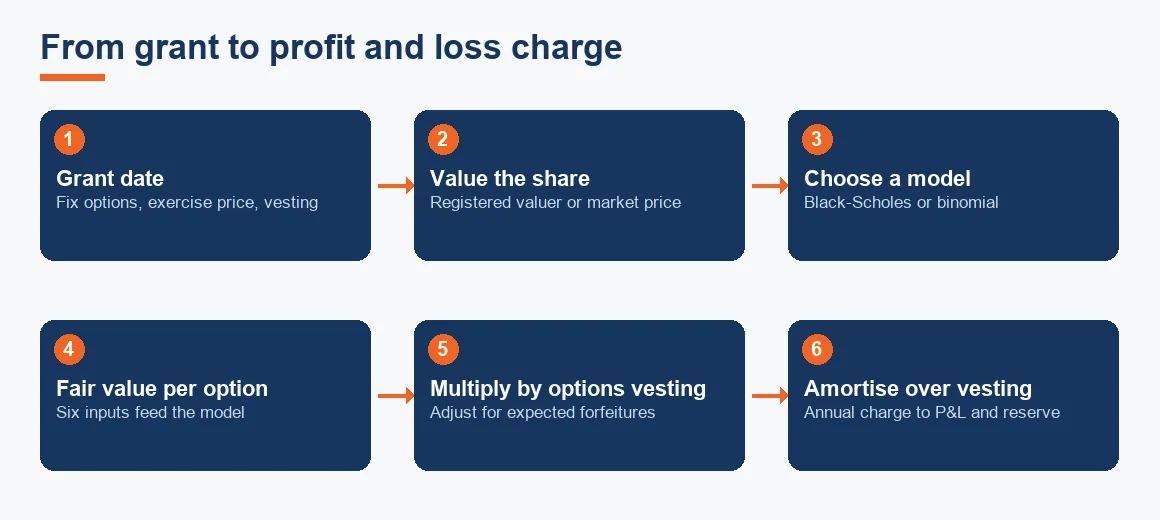
ESOP fair value is built with an option pricing model. The two common esop valuation methods are the closed-form Black-Scholes-Merton formula and the binomial (lattice) model. Both take six inputs: the share price at grant, the exercise price, the expected life of the option, the expected volatility of the share, the risk-free rate (typically a government security yield matching the option life) and the expected dividend yield. Multiply the per-option fair value by the number of options expected to vest and you have the total charge.
Black-Scholes vs binomial
Black-Scholes-Merton is the standard choice for a simple option with a single vesting date and no unusual exercise behaviour. A binomial or lattice model is used where vesting is graded, where employees tend to exercise early, or where performance conditions make a closed-form formula unsuitable. For an unlisted company, the underlying share value fed into the model is taken from a registered valuer rather than a market screen, which is what makes the exercise more involved than it looks. If you are unsure whether Ind AS even applies to your entity, our Ind AS applicability checker settles it in a couple of questions, and the AS vs Ind AS comparison matrix shows where the two frameworks diverge on share-based payment.
What is FMV in ESOP, and how it differs from accounting fair value
People often confuse two different numbers that both sound like "value". The accounting fair value under Ind AS 102 sits in your books and drives the expense. The fair market value (FMV) in ESOP taxation is a separate figure used to compute the employee's perquisite. For an unlisted share, FMV is the value certified by a SEBI-registered merchant banker on the exercise date, or on a date within 180 days before it, under Rule 3(8) of the Income Tax Rules. For a listed share it is the average of the opening and closing price on the exercise date.
So the accounting charge is fixed at grant using fair value, while the employee's tax is computed at exercise using FMV. They are measured on different dates, by different professionals, for different purposes. The employee side is covered in our guide to ESOP perquisite tax for employees.
Is valuation mandatory for ESOP?
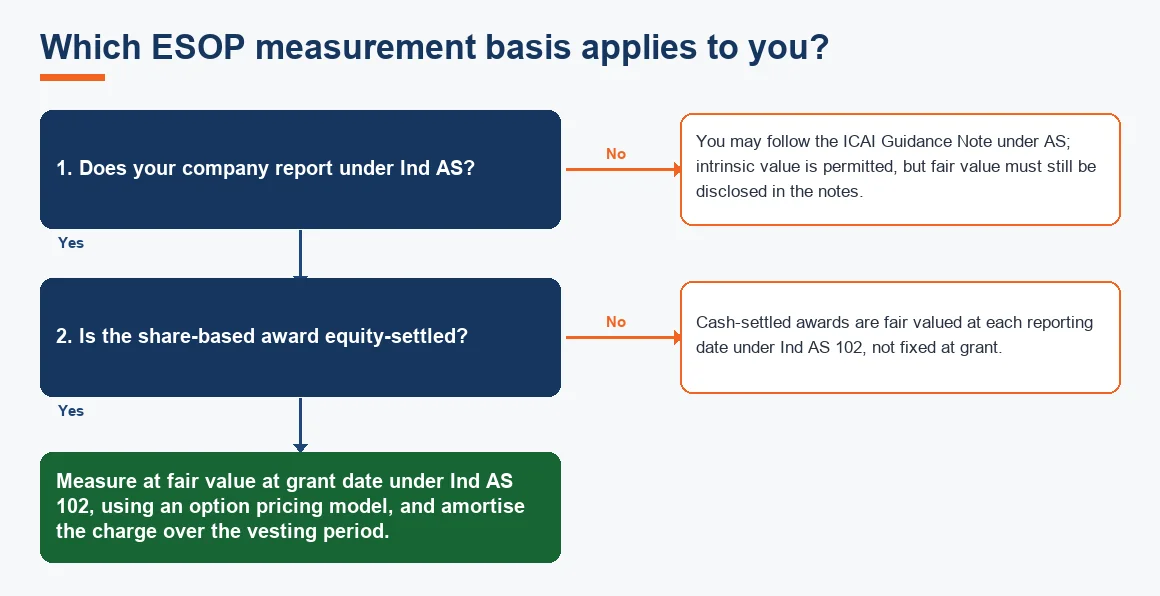
Yes, for any company that reports under Ind AS. Ind AS 102 mandates fair value measurement, so the older intrinsic value approach is simply unavailable to Ind AS preparers. The only entities that may still use intrinsic value are those following the ICAI Guidance Note on Accounting for Employee Share-based Payments under AS, and even they must disclose the fair value and its effect on profit in the notes to accounts. In practice, once a company crosses the Ind AS thresholds (or lists, or becomes a subsidiary of a listed group), intrinsic value stops being an option. The broader picture on the standard itself is in what is Ind AS 102, share-based payment accounting explained, and the distinction between equity-settled and cash-settled awards, which changes when you remeasure, is covered in cash-settled vs equity-settled share-based payments.
How to calculate and check your ESOP value: step by step
For a founder or CFO wanting to know how to calculate ESOP value and how to check ESOP value, the sequence is the same whether you do it in-house or with an adviser.
- Confirm your framework. Establish whether you report under Ind AS (fair value mandatory) or AS (intrinsic value permitted with disclosure).
- Fix the grant terms. Note the grant date, number of options, exercise price and vesting schedule from the board and ESOP scheme documents.
- Value the underlying share. For an unlisted company, obtain the share value from a registered valuer; for a listed company, use the market price.
- Gather model inputs. Expected life, expected volatility, risk-free rate and dividend yield.
- Run the model. Apply Black-Scholes-Merton or a binomial model to get the fair value per option.
- Estimate options expected to vest. Adjust for expected forfeitures over the vesting period.
- Compute and amortise the charge. Multiply fair value per option by options expected to vest, then spread the total over the vesting period as a journal entry each year.
Because this charge flows into your statutory accounts, it needs to sit on clean books. Teams that have fallen behind often pair the ESOP work with backlog bookkeeping and catch-up and reliable financial statement preparation so the share-based payment reserve and expense reconcile cleanly, alongside routine accounts payable and accounts receivable processes that keep the rest of the ledger current. For the commercial engagement itself, our ESOP accounting under Ind AS 102 service handles valuation coordination and the year-on-year charge; this article stays on the concepts.
Key terms
- Ind AS 102 Share-based Payment: the standard requiring fair value measurement of ESOPs and other share-based awards.
- ESOP Intrinsic Value Method: the older basis, share price minus exercise price, allowed only under AS with fair value disclosure.
- Vesting Period Graded Amortization: spreading the fair value charge across the years an employee earns the options.
- Cap Table Dilution: the reduction in existing shareholders' percentage as ESOP options convert to shares.
Worked example: intrinsic value vs fair value on one grant
Assume a company grants 10,000 stock options at an exercise price of Rs 100, when the share is also valued at Rs 100 (an at-the-money grant), vesting equally over four years. The Black-Scholes fair value is Rs 40 per option. The table shows how the two bases treat the same grant. Figures are illustrative, not a quotation.
| Item | Intrinsic value basis | Fair value basis (Ind AS 102) |
|---|---|---|
| Share price at grant | Rs 100 | Rs 100 |
| Exercise price | Rs 100 | Rs 100 |
| Value per option | Rs 0 (100 minus 100) | Rs 40 (model output) |
| Options granted | 10,000 | 10,000 |
| Total cost to recognise | Rs 0 | Rs 4,00,000 |
| Vesting period | 4 years | 4 years |
| Annual charge to P&L | Rs 0 | Rs 1,00,000 |
Under intrinsic value the company would report no staff cost at all for this grant, which plainly understates the economic reality. Under fair value it recognises Rs 4,00,000 over four years, Rs 1,00,000 a year, in the profit and loss statement with a matching credit to the share-based payment reserve in equity. That Rs 1,00,000 gap per year, ignored under the intrinsic method, is exactly why Ind AS 102 mandates fair value.
Key takeaways
- Ind AS 102 requires ESOPs to be measured at fair value at grant date; intrinsic value is not permitted for Ind AS preparers.
- Intrinsic value shows nil cost on an at-the-money grant, understating staff cost; fair value captures the real economic worth.
- Fair value is estimated with Black-Scholes-Merton or a binomial model using six inputs and charged over the vesting period.
- Accounting fair value (grant date, Ind AS 102) is a different number from tax FMV (exercise date, Rule 3(8)).
- Only AS entities using the ICAI Guidance Note may apply intrinsic value, and they must still disclose fair value.
For the underlying rules, refer to the standards issued by the Institute of Chartered Accountants of India, the Ind AS notified by the Ministry of Corporate Affairs under the Companies (Indian Accounting Standards) Rules, and the perquisite valuation rules of the Income Tax Department.
Decision guide