In this guide
ESOP taxation for employees in India happens at two separate points, and confusing them is where most of the tax panic starts. First, when you exercise your options and the shares are allotted to you, the gain between what the share is worth and what you paid is taxed as a salary perquisite at your slab rate. Second, when you eventually sell those shares, the further gain is taxed as capital gains. This article explains how each stage is calculated, who deposits the tax, and where employees commonly slip up. It is an explainer, not advice on a specific grant, so treat the numbers as illustrative.
How ESOP is taxed in India: two separate events
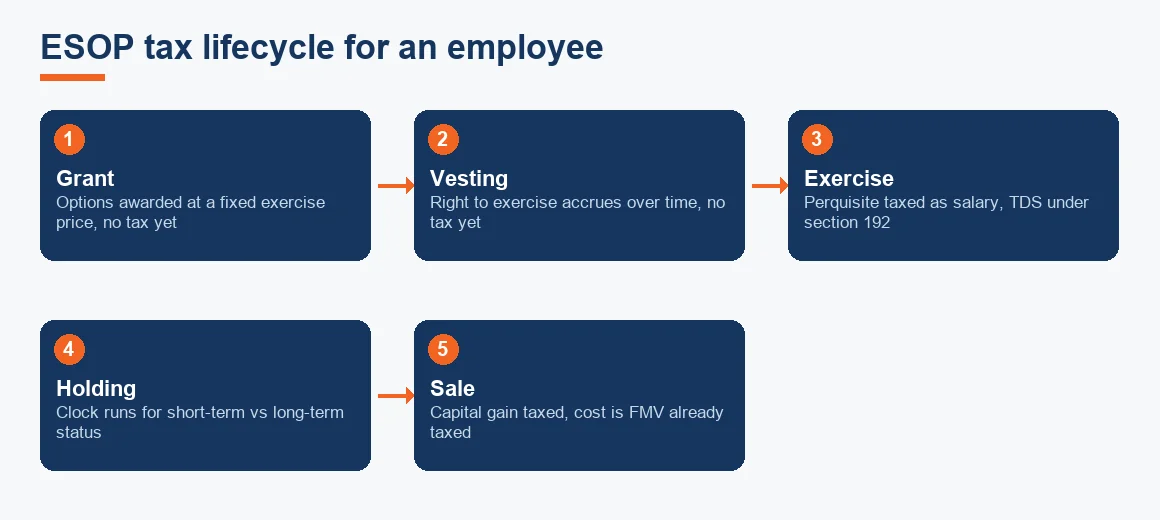
An employee stock option plan lets a company give employees the right to buy shares at a fixed price (the exercise price or grant price), usually below the eventual market value. The shares you receive are equity instruments, and the reward is real, so the tax follows it in two stages.
- On exercise: the difference between the fair market value on the exercise date and the price you actually pay is treated as a perquisite, taxed as part of salary under section 17(2)(vi) of the Income-tax Act.
- On sale: any gain over and above the value already taxed as a perquisite is treated as a capital gain in the year you sell.
The accounting side of the same grant, how the company books the expense over the vesting period, is a separate subject. If you are on the finance team rather than the receiving end, the mechanics sit in our note on ESOP Accounting (Ind AS 102) and the primer What Is Ind AS 102? Share-Based Payment Accounting Explained. This article stays on the employee's tax return.
What is perquisite tax on ESOP?
The perquisite is the benefit you receive by acquiring shares for less than they are worth. It is added to your salary income for the year of exercise and taxed at your applicable slab rate, exactly like a bonus. Because it is salary, your employer is required to deduct TDS on it under section 192, and this is why so many employees see a large TDS figure in the month they exercise even though no cash has changed hands.
How the perquisite value is calculated
The formula is straightforward:
Perquisite value = (fair market value on exercise date minus exercise price) multiplied by number of shares allotted.
The only real question is how the fair market value is fixed:
- Listed shares: the fair market value is the average of the opening and closing price of the share on a recognised stock exchange on the exercise date.
- Unlisted shares: the fair market value is determined by a Category I merchant banker on the exercise date (or a date within 180 days before it). A company auditor or an ordinary valuation will not do.
The valuation method and its inputs also drive the accounting charge, and the difference between the two commonly used approaches is set out in Fair Value vs Intrinsic Value for ESOP Under Ind AS 102. The full valuation basis is codified in section 17(2)(vi) read with Rule 3(8), which you can confirm on the Income Tax Department portal.
Do you pay capital gains tax on ESOP shares?
Yes, but only on the gain after exercise, and only when you sell. The cost of acquisition for the capital gains computation is the fair market value that was already taxed as a perquisite, not the low exercise price you actually paid. This is deliberate: it stops the same gain being taxed twice. The holding period is counted from the date of allotment on exercise, not from the grant date.
Whether the gain is short term or long term, and the rate that applies, depends on whether the shares are listed and how long you held them. The table below summarises the position for a sale in FY 2025-26.
| Feature | Listed shares (STT paid on sale) | Unlisted shares |
|---|---|---|
| Long-term holding period | More than 12 months | More than 24 months |
| Short-term capital gains rate | 20% under section 111A | Your slab rate |
| Long-term capital gains rate | 12.5% under section 112A, above the Rs 1,25,000 annual exemption | 12.5% without indexation |
| Cost of acquisition | Fair market value taxed as perquisite | Fair market value taxed as perquisite |
A worked example: perquisite plus capital gains
Assume you are allotted 1,000 listed shares on exercise. The exercise price is Rs 50 per share, the fair market value on the exercise date is Rs 300, and you sell 15 months later at Rs 450. Assume you are in the 30% slab (31.2% with cess) and have no other capital gains that year. All figures are indicative.
| Stage | Working | Amount (Rs) |
|---|---|---|
| Perquisite value on exercise | (300 minus 50) x 1,000 | 2,50,000 |
| TDS on perquisite under section 192 | 2,50,000 x 31.2% | 78,000 |
| Sale consideration | 450 x 1,000 | 4,50,000 |
| Cost of acquisition | 300 x 1,000 (FMV already taxed) | 3,00,000 |
| Long-term capital gain (held over 12 months) | 4,50,000 minus 3,00,000 | 1,50,000 |
| Taxable LTCG after Rs 1,25,000 exemption | 1,50,000 minus 1,25,000 | 25,000 |
| LTCG tax under section 112A | 25,000 x 12.5% | 3,125 |
So the bulk of the tax (Rs 78,000) is a salary perquisite collected at exercise, and the capital gains tax at sale is comparatively small because most of the value was already taxed and the annual LTCG exemption absorbs most of the rest.
Is ESOP taxable or tax deferred? Startup deferral under section 192(1C)
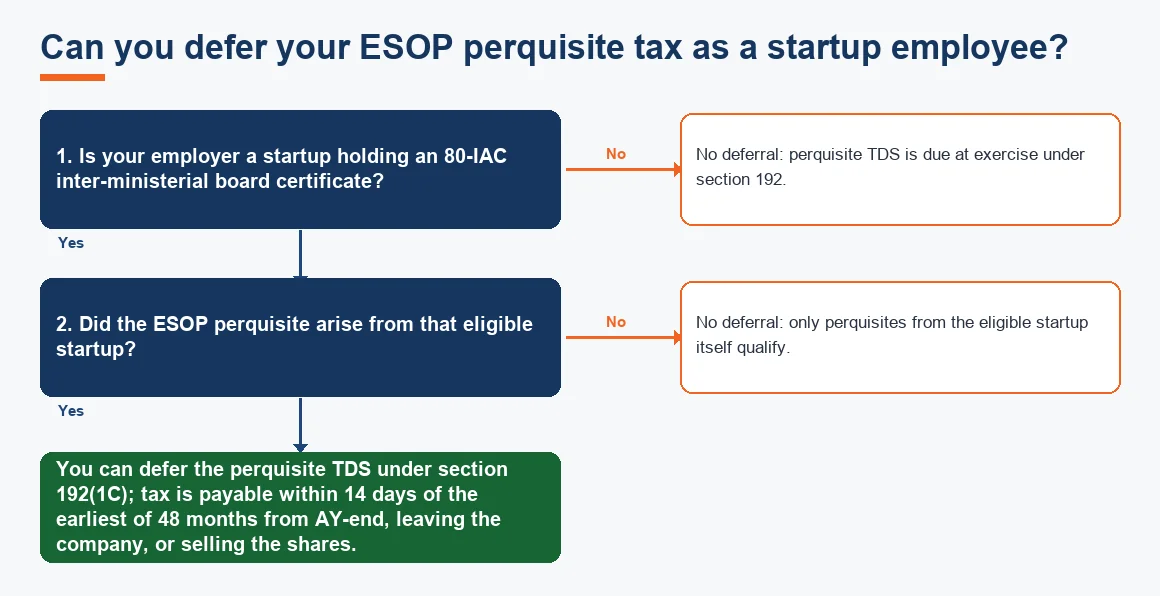
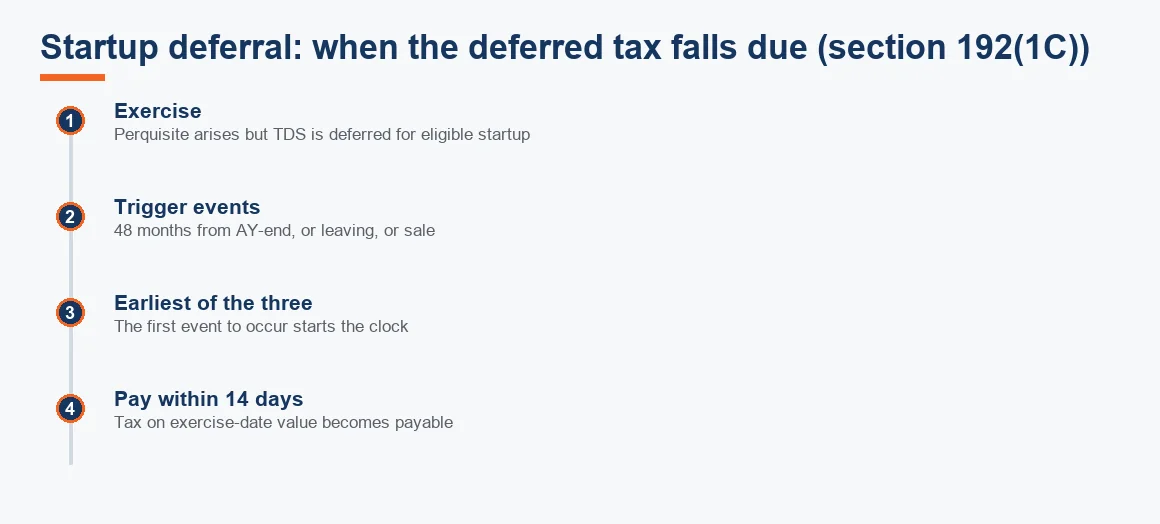
For most employees the perquisite tax is due at exercise and there is no deferral. There is one important exception. Employees of an eligible startup, meaning one that holds an inter-ministerial board certificate under section 80-IAC, can defer the TDS on the perquisite under section 192(1C). The tax itself is not waived, only the timing of collection is pushed out.
Where deferral applies, the tax must be paid within 14 days of the earliest of three events:
- The expiry of 48 months from the end of the assessment year in which the shares were exercised;
- The date you leave the company; or
- The date you sell the shares.
The deferral only helps a narrow set of startup employees, so confirm your employer's 80-IAC status before assuming it applies. This is a cash-flow relief, since it lets you avoid paying slab-rate tax on paper gains from unlisted shares you cannot easily sell.
Do I need to declare ESOP in my ITR?
Yes, at both stages. The perquisite already sits inside your salary income in Form 16, so it must be reported as salary in your return. The capital gain on sale is reported separately in Schedule CG in the year you sell. Two points catch employees out:
- Foreign parent shares: if your ESOP is in a foreign parent company and you are resident and ordinarily resident, the holding must also be disclosed in Schedule FA of ITR-2 or ITR-3. Omission attracts penalties under the Black Money Act, which are far heavier than ordinary income-tax penalties.
- Choosing the right ITR: once you have capital gains or foreign assets, ITR-1 is no longer available to you. You will usually file ITR-2, or ITR-3 if you also have business income.
The reporting requirements and the Schedule FA format are published on the Income Tax Department portal, and you should reconcile the perquisite against your Form 16 before filing.
How to save tax on ESOPs in India
There is no way to avoid the perquisite tax, but you can manage the timing and the capital gains leg sensibly:
- Plan the exercise around liquidity. Exercising when you cannot sell (unlisted shares, or a lock-in) means paying slab-rate tax out of pocket on a paper gain.
- Use the long-term window. Holding listed shares beyond 12 months moves the sale gain from 20% short-term to 12.5% long-term, and the first Rs 1,25,000 of long-term gains each year is exempt.
- Use the startup deferral if you qualify. For eligible startup employees, section 192(1C) defers the cash outflow.
- Reconcile before filing. Check the perquisite in Form 16 and the cost of acquisition you use on sale, so you never pay tax twice on the same amount.
Ballpark professional fees for preparing an ITR-2 with ESOP perquisite and capital gains reconciliation typically start around Rs 3,500 (indicative, Exl GST) depending on the number of grants and whether foreign disclosure is involved.
If your finance team is behind on the underlying records that feed these numbers, our Backlog Bookkeeping / Catch-Up support, along with Accounts Payable Outsourcing and Accounts Receivable Outsourcing, keeps the ledgers clean enough to compute a perquisite correctly. The vesting-period expense that mirrors this employee benefit is covered in How to Account for ESOP Expense Over the Vesting Period, and the settlement distinction between share and cash awards in Cash-Settled vs Equity-Settled Share-Based Payments. To model the deferred-tax effect of a share-based payment charge, the Deferred Tax (DTA/DTL) Calculator and the Ind AS Applicability Checker are a useful starting point.
Key terms
- Ind AS 102 Share-based Payment: the standard governing how a company accounts for the ESOP it grants.
- ESOP Intrinsic Value Method: a valuation approach measuring the excess of fair value over exercise price.
- Vesting Period Graded Amortization: spreading the ESOP expense over each tranche's own vesting schedule.
- Cap Table Dilution: the reduction in existing shareholders' ownership as ESOP shares are issued.
Key takeaways
- ESOPs are taxed twice: as a salary perquisite at exercise and as capital gains at sale.
- The perquisite equals fair market value on exercise minus exercise price, times shares, taxed at your slab rate under section 17(2)(vi).
- Your employer deducts TDS on the perquisite under section 192, usually in the month of exercise.
- Your cost for capital gains is the fair market value already taxed, so the same gain is never taxed twice.
- Eligible startup employees can defer the perquisite TDS under section 192(1C) until the earliest of three trigger events.
- Report the perquisite as salary, the sale in Schedule CG, and foreign parent shares in Schedule FA.
Decision guide