In this guide
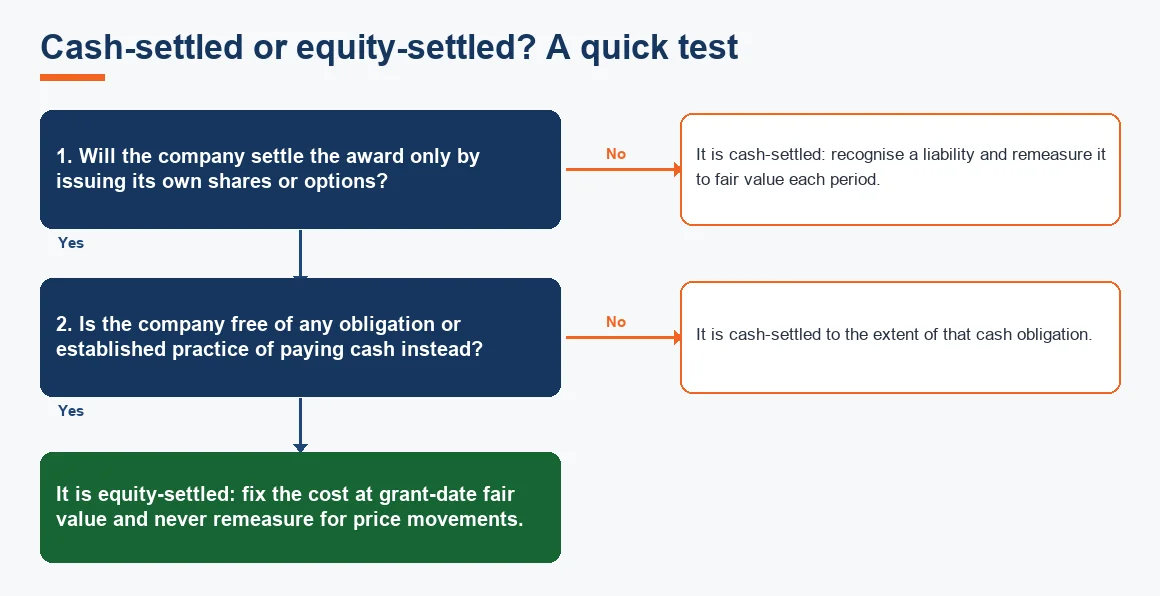
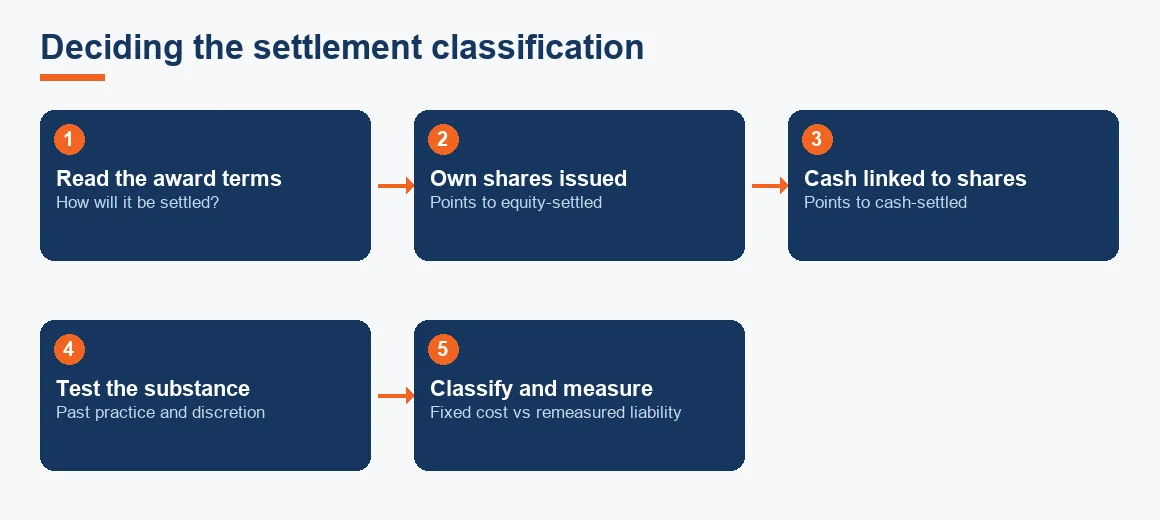
The difference between cash settled vs equity settled share-based payments comes down to one question: does the company hand over its own shares, or does it pay cash whose amount is linked to those shares? An equity-settled award is settled in the company's own equity instruments and its cost is fixed at grant-date fair value. A cash-settled award, such as a stock appreciation right or phantom stock, is a liability that is remeasured to fair value at every reporting date until it is paid. That single distinction changes how the charge is measured, how it moves through profit or loss, and how much it finally costs. This explainer sits alongside our fuller note on what Ind AS 102 requires, and it is informational only; if you want the entries drawn up and reviewed for your grants, that belongs with our ESOP Accounting (Ind AS 102) service.
What is a cash-settled share-based payment?
A cash-settled share-based payment gives the employee a cash amount that tracks the value of the company's shares, without ever transferring the shares themselves. The two common forms in India are stock appreciation rights (SARs), which pay the increase in share price between grant and exercise, and phantom stock, which mirrors the full value of a notional shareholding. Because the company will eventually pay out cash, Ind AS 102 treats the award as a liability, not equity.
Measurement follows the liability logic all the way through. The award is measured at the fair value of the liability, that fair value is spread over the vesting period, and it is then remeasured to fair value at each reporting date and again at settlement. Every movement in the liability, up or down, goes to profit or loss. So a share price that keeps climbing keeps increasing the charge, right up to the day the cash is paid.
What is an equity-settled share-based payment?
An equity-settled award is settled by delivering the company's own shares or options, the classic employee stock option plan being the everyday example. Here Ind AS 102 does something that surprises many owners: it fixes the cost at grant-date fair value and never revisits that value for later movements in the share price. If the option is worth Rs 300 at grant, Rs 300 is the per-unit cost even if the shares triple before exercise.
What does get revised is the number of awards expected to vest. If more employees leave than expected, the estimate of vesting awards falls and the cumulative charge is trued up. The corresponding credit accumulates in a share-based payment reserve inside equity, which is why an equity-settled grant never creates a cash liability on the balance sheet. For the mechanics of spreading that fixed cost, see our note on accounting for ESOP expense over the vesting period.
What is the difference between cash and equity-settled?
The cleanest way to see the difference is to line up the two treatments against the points that actually move numbers: what sits on the balance sheet, when the value is locked, and whether the total cost can drift. The comparison below summarises the position under Ind AS 102.
| Feature | Equity-settled | Cash-settled (SAR / phantom) |
|---|---|---|
| Settled by | Issuing own shares or options | Paying cash linked to share value |
| Balance sheet | Share-based payment reserve (equity) | Liability (provision) |
| Measurement date | Grant date, fixed | Each reporting date and settlement |
| Remeasured for price? | No, only vesting numbers revised | Yes, to fair value every period |
| Total cost known when? | At grant (for a fixed number) | Only at settlement |
| Cash outflow | None on settlement | Cash paid on exercise |
How are cash-settled transactions measured under Ind AS 102?
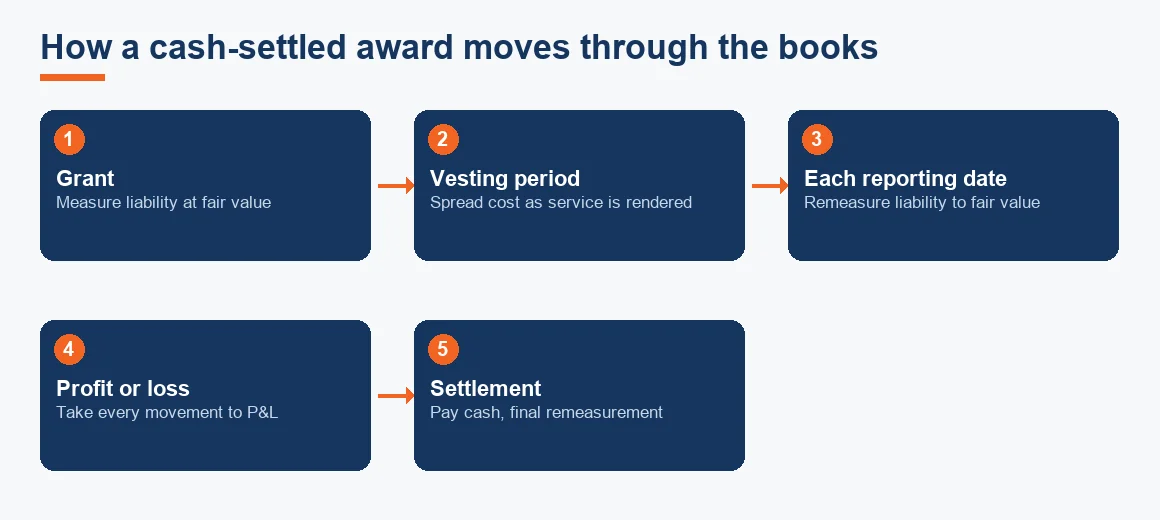
For a cash-settled award, measurement is a repeating cycle rather than a one-off calculation. The steps run in the same order every reporting period until the award is paid out.
- Estimate fair value of the liability at grant, using an option-pricing model appropriate to a SAR or phantom unit.
- Recognise over the vesting period, spreading the cost as the service is rendered (straight-line for a single vesting date, or graded where tranches vest separately).
- Remeasure to fair value at each reporting date, revising both the fair value per unit and the number expected to vest.
- Take the movement to profit or loss, so an increase in the liability is an extra expense and a fall is a credit.
- Settle in cash at exercise, with a final remeasurement to the amount actually paid.
Equity-settled awards share only the vesting logic; they skip the reporting-date remeasurement entirely, which is the whole reason the total cost is knowable up front. If the choice between locking value at grant and remeasuring it turns on intrinsic versus fair value, our note on fair value vs intrinsic value for ESOP covers that ground.
A worked example: SAR remeasurement over two years
Assume a company grants 1,000 stock appreciation rights that vest at the end of year two, settled in cash. The fair value per SAR is Rs 400 at the end of year one and Rs 520 at the end of year two (settlement). The liability builds up over the vesting period and is remeasured each year. All figures are illustrative.
| Reporting date | Fair value per SAR (Rs) | Portion vested | Cumulative liability (Rs) | Expense for the year (Rs) |
|---|---|---|---|---|
| End of Year 1 | 400 | 1 of 2 years | 2,00,000 | 2,00,000 |
| End of Year 2 (settlement) | 520 | 2 of 2 years | 5,20,000 | 3,20,000 |
| Total charged to profit or loss | 5,20,000 |
The cumulative liability at year one is Rs 400 × 1,000 × 1/2 = Rs 2,00,000. At year two it is Rs 520 × 1,000 × 2/2 = Rs 5,20,000, so the second-year charge is Rs 5,20,000 minus Rs 2,00,000 already recognised, or Rs 3,20,000. Had the same 1,000 units been granted as equity-settled options with a grant-date fair value of Rs 300 each, the total charge would have been fixed at Rs 3,00,000 whatever the share price did. Same headcount, same units, two very different totals: that is the practical cost of the settlement choice.
Key terms
- Ind AS 102 Share-based Payment: the standard that classifies and measures share-based awards in India.
- Vesting Period Graded Amortization: spreading the cost as separate tranches vest over time.
- ESOP Intrinsic Value Method: measuring an award by the excess of market price over exercise price.
- Cap Table Dilution: the reduction in existing holders' ownership when new equity is issued.
- Liabilities: present obligations that will result in an outflow, where a cash-settled award sits.
What is the tax treatment for cash-settled share-based payments?
Accounting classification and tax treatment run on separate tracks, and it helps to keep them apart. For the employee, the perquisite on an ESOP is taxed under the salary head when the shares are allotted, on the difference between fair market value and the exercise price; the mechanics are set out in our note on ESOP perquisite tax for employees. A cash-settled SAR payout is likewise a salary perquisite, taxed when the cash is received.
For the company, a cash-settled liability that is expensed in the books but only deductible when paid creates a temporary difference, which is where deferred tax comes in; the Deferred Tax (DTA/DTL) Calculator helps you size it. Whether Ind AS applies at all is a separate threshold test you can run through the Ind AS Applicability Checker. Companies still on Accounting Standards follow the ICAI Guidance Note rather than Ind AS 102, so confirm which framework governs you before applying any of the above.
Which standards and laws govern the choice in India?
Three layers apply. Ind AS 102 sets the accounting for companies on the Ind AS roadmap, and companies still applying AS follow the ICAI Guidance Note on Accounting for Share-based Payments. On the corporate-law side, unlisted companies issue options under section 62(1)(b) of the Companies Act 2013, and listed issuers also comply with the SEBI Share Based Employee Benefits and Sweat Equity Regulations 2021. The authoritative text of the accounting standard itself is published by the Institute of Chartered Accountants of India, and the salary-perquisite rules for employees sit with the Income Tax Department. Getting the classification right at grant keeps all three layers aligned.
When does each route suit a company?
Neither route is better in the abstract; they answer different needs. Equity-settled awards conserve cash and align the employee with shareholders, but they dilute the cap table and lock the accounting cost regardless of how the shares perform. Cash-settled awards avoid dilution and can suit an unlisted company that does not want new shareholders, but they carry a real cash outflow at exercise and an unpredictable charge along the way. The AS vs Ind AS Comparison Matrix is worth a look if you are still deciding which framework you report under. Where a business also needs the surrounding ledgers kept clean, our Backlog Bookkeeping / Catch-Up, Accounts Payable Outsourcing and Accounts Receivable Outsourcing services keep the payables and receivables tidy while the share-based charge runs through profit or loss.
Key takeaways
- Equity-settled means the company issues its own shares; cash-settled means it pays cash linked to the share price.
- Ind AS 102 fixes the equity-settled cost at grant-date fair value and never remeasures it for price movements.
- A cash-settled award is a liability, remeasured to fair value each reporting date and at settlement, with every movement in profit or loss.
- The total cost of an equity-settled grant is known up front; a cash-settled grant is only known when the cash is paid.
- Classify by substance, not by the plan's title, and settle the choice before the grant because it drives both accounting and tax.
Decision guide