
In this guide
Retainer and project billing for Gurugram agencies works on a simple principle: a monthly retainer is recognised as revenue evenly across the service period, while a fixed-fee project is recognised by progress towards completion. The retainer fee attracts GST on the earlier of the invoice or payment date and TDS at 10 percent under section 194J. This explainer sets out how a service firm in Gurugram should record retainer income, when the tax falls due, and how to close the books at year end. If you want the commercial engagement handled for you, that sits with our Service Sector Accounting (Project Billing) Gurugram page; here we stay on the how and the why.
What retainer and project billing means for a Gurugram service firm
Gurugram runs on service revenue. Marketing and creative agencies on Golf Course Road, consulting and design studios around Cyber Hub, and the captive service units of multinationals in Udyog Vihar and DLF Cyber City all bill either on a retainer or on a project basis, and many run both at once. The two models are not interchangeable in the ledger. A retainer is a promise to stand ready and deliver an agreed scope each month; a project is a defined deliverable for a fixed or milestone-linked fee. Getting the classification right decides when you recognise revenue, when you raise the tax invoice, and what appears as unbilled at the close.
The commercial detail of pricing and scoping a Gurugram engagement is covered on our parent Service Sector Accounting (Project Billing) service. What matters for your books is the accounting treatment, and that turns on a single question: is the customer consuming the benefit continuously (a retainer) or on completion of a deliverable (a project)?
How revenue recognition differs between a retainer and a fixed-fee project
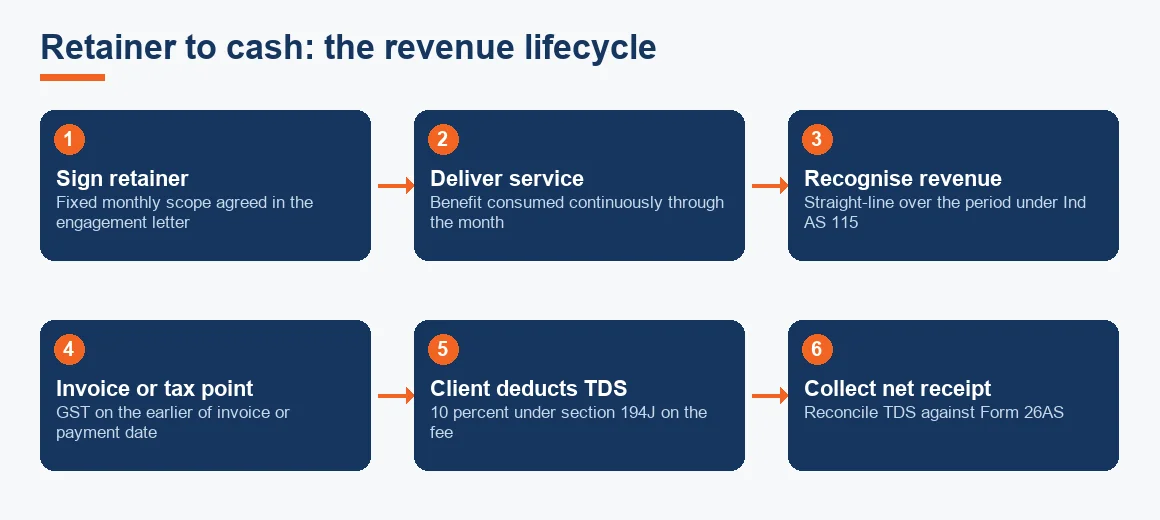
A retainer for a standing service is recognised straight-line across the month because the client consumes the benefit as it is delivered. A fixed-fee project is recognised by progress towards completion, usually cost incurred against total estimated cost, under Ind AS 115 and the percentage of completion method. Spreading a fixed fee evenly overstates early revenue whenever the effort is back-loaded, which is the usual pattern in a build-and-launch project.
The distinction between the two billing models is itself a defined concept: see milestone vs retainer billing. For a monthly retainer the performance obligation is satisfied over time, so an equal amount is taken to revenue each month regardless of how much work happened to land in a given week. For a project, you measure output or cost and recognise the matching share.
When GST is payable on a monthly retainer invoice
GST falls due on the earlier of the invoice date or the date the payment is received, and for a continuous supply of services the invoice must be issued within 30 days of the end of the service period under section 31(2) of the CGST Act. Where the contract fixes a payment date, tax is due on that date even if no invoice was raised. In plain terms, a retainer is taxed monthly and you cannot defer the liability by simply delaying the invoice. The Central Board of Indirect Taxes and Customs sets out the continuous-supply rule in the CGST Act published at cbic-gst.gov.in.
Standard professional and consultancy services are taxed at 18 percent. Input tax credit on your own costs is matched through GSTR-2B, so a clean vendor ledger directly protects your margin.
What TDS rate applies to a consultant's retainer fee
A retainer paid to a professional or a consultant outside an employment contract attracts TDS at 10 percent under section 194J on the fee, before GST. Fees for technical services, call-centre operations and royalty on film rights are deducted at 2 percent, so the classification of the service matters. Because a retainer is not salary, the section 192 slab deduction does not apply. The deductor deposits the tax by the 7th of the following month and issues Form 16A each quarter. The rate schedule sits with the Income Tax Department at incometax.gov.in.
Two points catch service firms out. First, TDS is deducted on the fee net of GST where the GST is shown separately on the invoice, not on the gross. Second, the payer, not the service provider, carries the deduction obligation, so as the Gurugram firm receiving a retainer you will see 10 percent withheld and should reconcile it against your Form 26AS.
How unbilled retainer revenue is recorded at year end
Service delivered but not invoiced by 31 March is accrued as unbilled revenue, a current asset, with the matching credit taken to the profit and loss account. Because GST is not payable until the invoice or payment date, the accrual is booked net of tax and the GST liability arises in the next period. When the April invoice is raised, you clear the accrual and book the output tax then. This is ordinary accrual accounting: the income belongs to the year in which the service was rendered.
The mirror image is deferred revenue: a retainer collected in advance for a service not yet delivered sits as a liability until it is earned. A firm that invoices a quarter upfront will carry deferred revenue at each month-end and release one third to income each month.
Does a Gurugram service exporter need a letter of undertaking
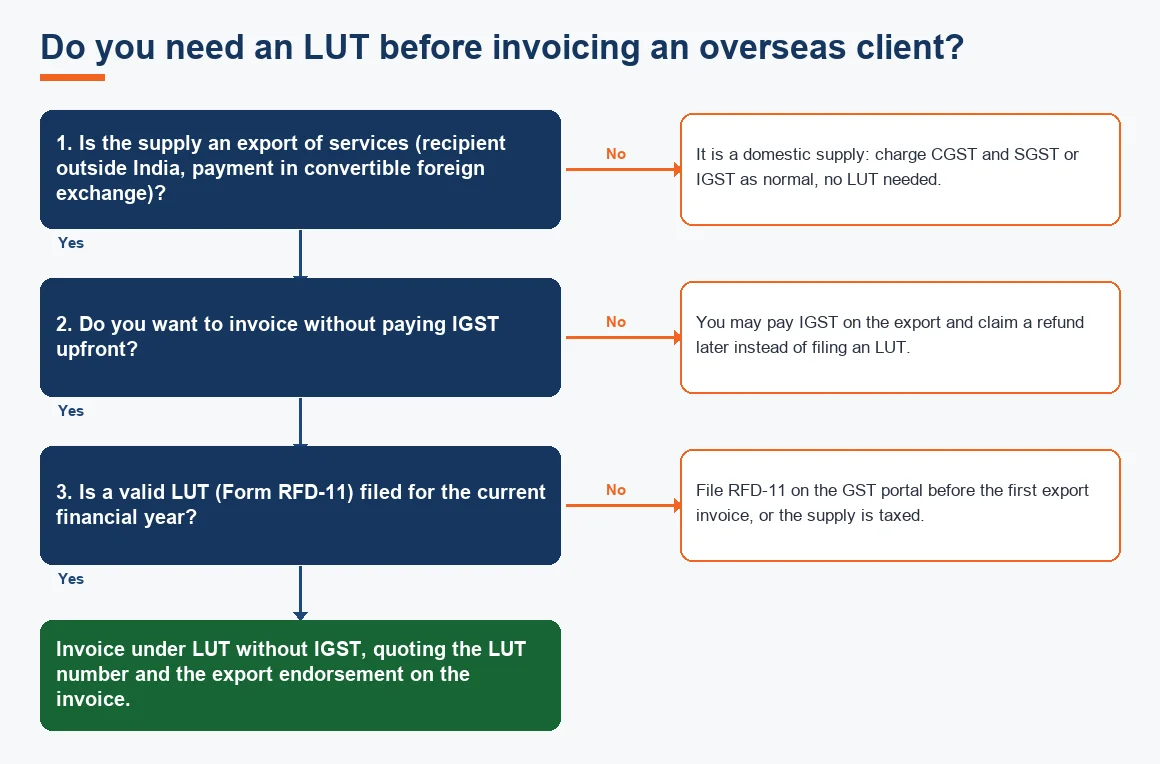
Yes. To export services without paying IGST, a Gurugram exporter files Form RFD-11, the letter of undertaking, on the GST portal for each financial year, ideally before the first export invoice. Quote the LUT number on the invoice with the endorsement that the supply is meant for export under LUT without payment of IGST. Without a valid LUT the IGST must be paid and then reclaimed as a refund, which ties up working capital. File the LUT on the government portal at gst.gov.in.
This is a live issue in Gurugram because so many firms invoice group parents and overseas clients in foreign currency. If the unit sits inside an SEZ, the SEZ overlay applies as well; the specifics for the local zone are set out under Udyog Vihar SEZ vs DTA compliance. A useful local relief: Haryana levies no professional tax, so unlike Maharashtra or Karnataka there is no monthly PT return on the payroll side. The wider employer position is walked through in Haryana Compliance for Employers: Shops Act, LWF and GST.
Month-end close for a retainer book: step by step
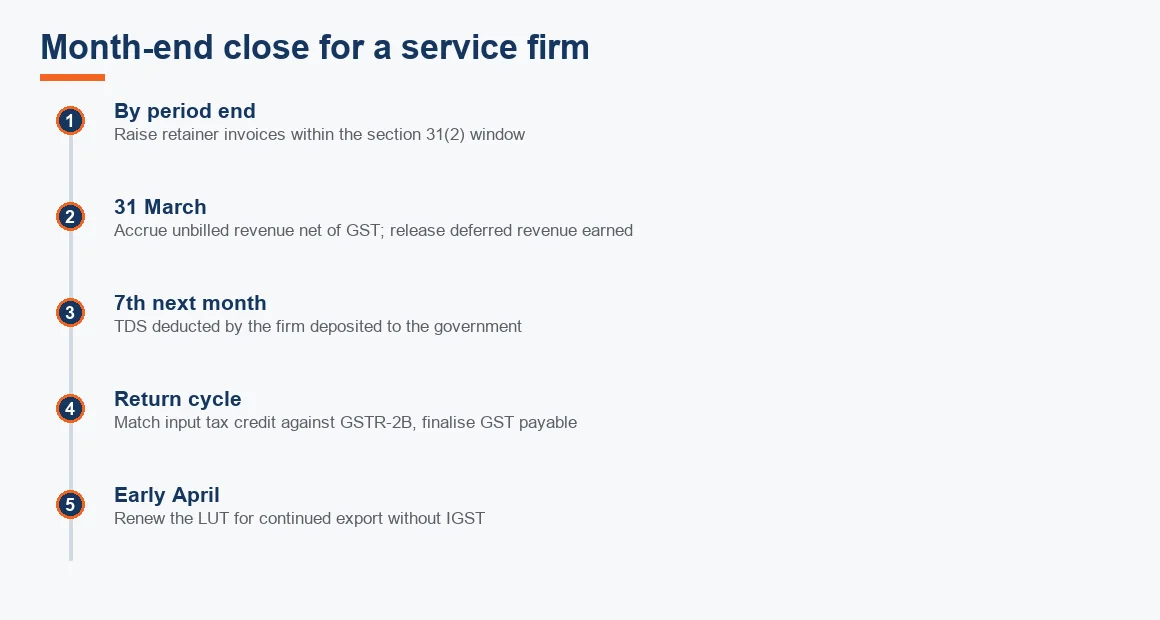
A tidy monthly routine keeps the retainer ledger audit-ready and the GST and TDS positions clean.
- Raise every retainer invoice for the service period within the section 31(2) window and post it to the general ledger.
- Accrue unbilled revenue for any scope delivered but not yet invoiced, net of GST.
- Release the earned portion of any advance sitting in deferred revenue.
- Reconcile TDS withheld by clients against Form 26AS and follow up on any short deduction.
- Match input tax credit against GSTR-2B before finalising the GST payable.
- Review project-wise profitability margin so retainer scope creep is visible before it erodes the fee.
Firms that want this run as a monthly service should look at the Gurugram service-sector page rather than build the function in-house. For the trade-offs of doing so, our note on the cost of outsourced accounting and virtual CFO in Gurugram and the virtual CFO checklist for Gurugram startups both help, as does the guide on choosing an accountant in Gurugram.
Worked example: a monthly retainer invoice with GST and TDS
Take a Gurugram consulting firm on a fixed monthly retainer of INR 150000 (indicative, Exl GST). Standard rate GST at 18 percent applies, and the client deducts TDS at 10 percent under section 194J on the fee before GST. The figures flow as follows.
| Line | Basis | Amount (INR) |
|---|---|---|
| Retainer fee | Agreed monthly scope | 150000 |
| Add: CGST 9 percent | 9% of 150000 | 13500 |
| Add: SGST 9 percent | 9% of 150000 | 13500 |
| Invoice total | Fee plus GST | 177000 |
| Less: TDS under 194J | 10% of 150000 | 15000 |
| Net amount received | 177000 minus 15000 | 162000 |
Revenue recognised for the month is INR 150000. The GST of INR 27000 is an output tax liability, not income. The INR 15000 TDS is not a cost; it is tax already paid on the firm's behalf, so it sits as a receivable against the year's tax and is claimed in the return once it appears in Form 26AS. If the service straddled the month-end and INR 30000 of scope was delivered but not invoiced, that INR 30000 would be accrued as unbilled revenue net of GST and cleared next month.
Key terms
- Ind AS 115 Revenue Recognition: the standard that decides whether revenue is recognised over time (retainer) or at a point in time or by progress (project).
- Unbilled Revenue (WIP Hours): service delivered but not yet invoiced, carried as a current asset at year end.
- Milestone vs Retainer Billing: the two billing models a service firm chooses between, each with a different recognition basis.
- Deferred Revenue (Unearned Revenue): a retainer collected in advance and held as a liability until the service is earned.
- Accrual Accounting: recognising income and expense in the period they relate to, not when cash moves.
Key takeaways
- Recognise a retainer straight-line over the month and a fixed-fee project by progress to completion.
- GST on a retainer is due on the earlier of the invoice or payment date, with the invoice raised within 30 days of the service period under section 31(2).
- A consultant's retainer attracts TDS at 10 percent under section 194J, deducted on the fee before GST, not as salary.
- Accrue unbilled revenue net of GST at 31 March; the output tax arises only when the April invoice is raised.
- Renew the LUT in early April to keep exporting services without IGST; Haryana charges no professional tax.
Two related books share these mechanics but from a software angle: our SaaS Accounting Services page covers subscription and recurring revenue, and the IT and software company accounting page covers export-heavy units, both of which many Gurugram firms straddle. Early-stage teams should start with Startup Accounting Services India. To sense-check whether Ind AS applies to your entity at all, run the Ind AS Applicability Checker. General bookkeeping for a Gurugram office sits under Accounting and Bookkeeping Services Gurugram, and SaaS-specific local support under SaaS Accounting Services Gurugram.
Decision guide