In this guide
If you run a company in Gurugram and want a straight answer on what accounting and virtual CFO support should cost, the honest reply is that there is no single price, only a set of drivers that move it. A monthly fee is built from your transaction volume, the number of GST registrations you hold, your payroll headcount and whether statutory filings sit inside or outside the scope. This guide explains how those drivers translate into fee bands for Gurugram MNCs, D2C brands and SaaS startups, what a virtual CFO retainer buys, and how the Haryana payroll rules quietly shift the maths. It is an explainer, not a quote: when you are ready to appoint, the commercial detail lives on our Accounting & Bookkeeping Services in India page.
What drives the monthly cost of accounting services in Gurugram?
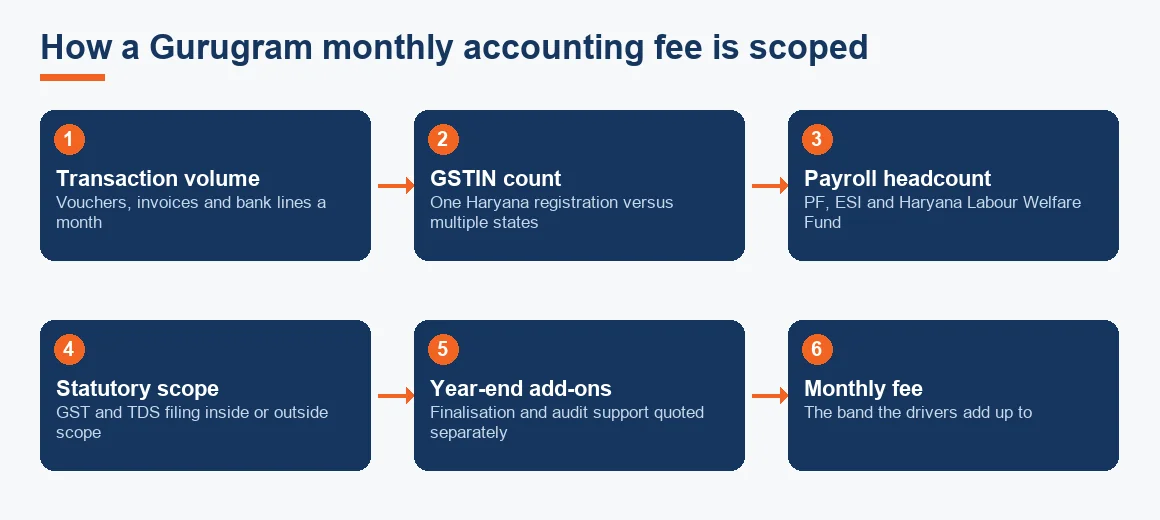
Four levers set almost every quote you will receive in Gurugram. Understanding them lets you read a proposal instead of guessing at it.
- Transaction volume. The count of vouchers, invoices and bank lines a month is the single biggest driver. Roughly 300 vouchers is a different job from 3,000.
- Number of GSTINs. One Haryana registration is straightforward; three state registrations mean three sets of GSTR-2B input tax credit matching and three return cycles.
- Payroll headcount. Running payroll for 15 people is light; 150 people brings provident fund, ESI and Haryana Labour Welfare Fund processing every month.
- Statutory scope. A quote that includes GST and TDS filing sits above one that only writes up the books and hands you a working capital position.
Two firms with identical turnover can pay very different fees because these levers, not revenue, decide the workload. A high-turnover trading company with clean, low-count invoices can cost less to service than a smaller SaaS business with foreign receivables, deferred revenue and three GSTINs.
Typical fee bands for accounting services in Gurugram
The bands below are indicative and Exl GST. They describe the shape of the market for outsourced monthly bookkeeping and compliance in Gurugram, not a fixed rate card. Use them to sanity-check quotes rather than to negotiate a number in isolation.
| Band | Typical Gurugram profile | What is usually inside scope | Indicative monthly fee (Exl GST) |
|---|---|---|---|
| Entry | Early D2C or single-founder services firm, one GSTIN, under 300 vouchers, up to 10 staff | Bookkeeping, bank reconciliation, GSTR-1 and GSTR-3B, TDS returns | Rs 12,000 to Rs 25,000 |
| Growth | Funded SaaS or scaling D2C brand, one to two GSTINs, 300 to 1,000 vouchers, payroll for 10 to 40 | Above, plus payroll, monthly MIS and vendor payables management | Rs 30,000 to Rs 60,000 |
| Corporate | MNC subsidiary or multi-entity group, multiple GSTINs, export documentation, 40+ staff | Above, plus consolidation, board pack and virtual CFO review layer | Rs 75,000 upwards |
Year end work such as finalisation, EBITDA normalisation for investors and tax audit support is normally quoted separately from the recurring fee. If a proposal folds everything into one number, ask what happens in September when audit season lands.
How much does a virtual CFO cost in Gurugram?
A virtual CFO engagement in Gurugram is almost always a fixed monthly retainer rather than a per-hour arrangement, because the deliverables repeat every month: management information, a cash flow forecast, a board pack, and a review of the GSTR-3B and TDS positions before anything is filed. The retainer sits above plain bookkeeping because it adds judgement, not just data entry. For SaaS and funded startups it usually also covers monthly recurring revenue (MRR) tracking and a cash runway calculation the board can act on.
One-off items sit outside the retainer and are quoted per project: a fund raise data room, due diligence support, an ERP migration or a first-time consolidation. Retainers are typically reviewed once a year as transaction volumes grow, so the fee you agree at seed stage is not the fee you will pay at Series A. Our Virtual CFO and financial-ops checklist for Gurugram startups sets out what the recurring deliverables should actually contain before you sign.
The Haryana angle: LWF, no professional tax and the Shops Act
This is where a Gurugram fee genuinely differs from a Mumbai or Bengaluru one, and it is worth understanding before you compare quotes across cities.
No professional tax in Haryana
Haryana does not levy professional tax. An employer in Gurugram has one fewer monthly deduction to run than a counterpart in Maharashtra or Karnataka, which slightly simplifies payroll processing and, at the margin, the fee for it.
Haryana Labour Welfare Fund
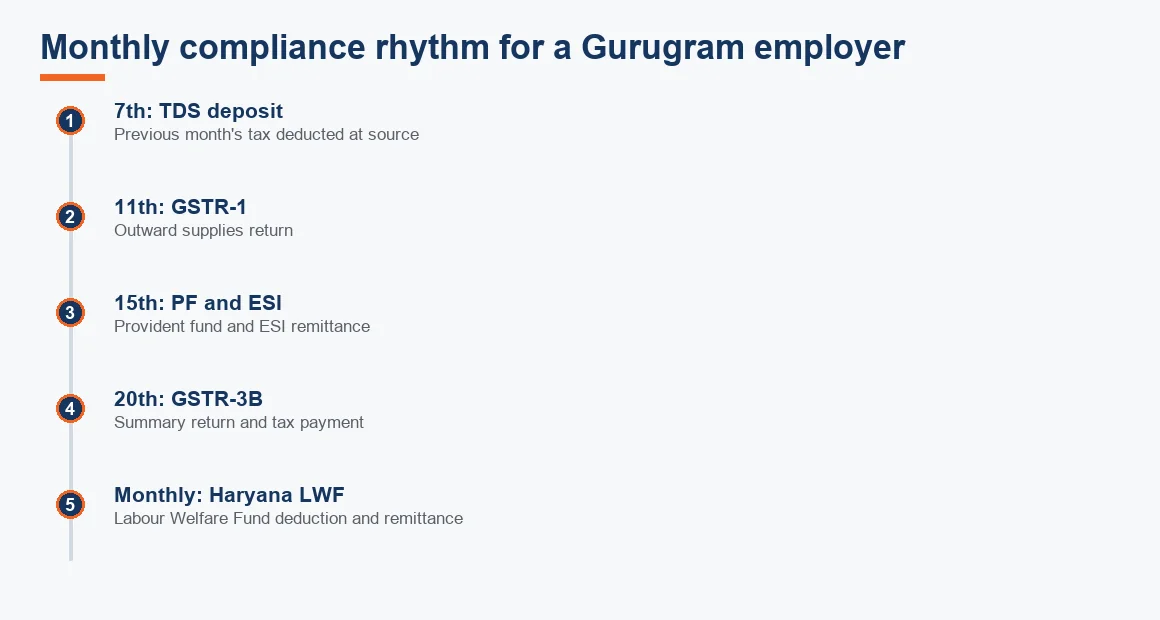
In place of professional tax, Haryana operates a Labour Welfare Fund. It is a small monthly contribution split between employee and employer, and it has to be deducted and remitted correctly for every payroll cycle. A firm quoting for Gurugram payroll should already have this in scope; if the proposal reads like a Delhi one, ask. The Haryana compliance guide for employers covers the Shops Act registration and LWF mechanics in full.
In-house accountant versus outsourced: the real cost comparison
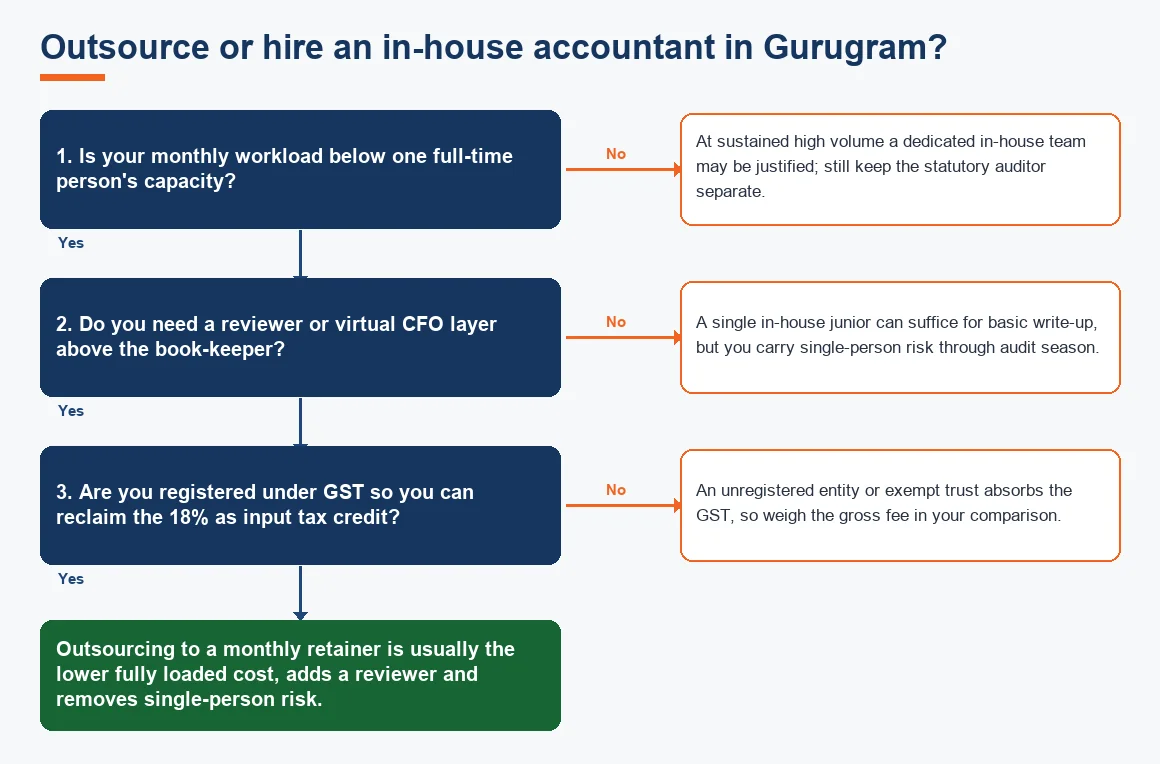
The question behind most fee enquiries is not "what does outsourcing cost" but "is it cheaper than hiring". An in-house accountant costs far more than the advertised salary once you add the employer's provident fund at 12% of basic wages, gratuity accrual, a workstation, accounting software and the cost of the business depending on one person through the September audit rush. Outsourcing converts that into a single monthly fee with a reviewer and a team behind it. The break-even usually arrives at the point where a second in-house hire would otherwise be needed.
A useful discipline is to compare the fully loaded annual cost of a hire against the annual retainer, not the salary against the monthly fee. The worked example below does exactly that. For the commercial engagement itself, the Accounting and Bookkeeping Services in Gurugram page is the right destination; industry-specific pages exist for Gurugram startups, IT and SaaS and e-commerce businesses.
What a monthly retainer does not include
Even a full-scope retainer stops at a clear line, and knowing where saves an awkward conversation later.
- Statutory audit. This is billed separately and cannot be performed by the firm keeping your books. Section 144 of the Companies Act bars an auditor from providing accounting and bookkeeping services to the same company, so the book-keeper and the auditor must be different firms.
- Tax audit under Section 44AB and transfer pricing work are quoted on their own, common for Gurugram MNC subsidiaries and IT exporters.
- Year-end finalisation and Schedule III financial statements are usually a separate annual fee rather than part of the monthly figure.
How to compare and negotiate accounting quotes in Gurugram
You can negotiate accountant fees, but the productive lever is scope, not a flat discount. Work through the quotes in order:
- List your drivers first. Write down monthly voucher count, GSTIN list, payroll headcount and which filings you want inside scope. This is your brief.
- Ask every firm to quote against that brief. Identical inputs make three proposals genuinely comparable.
- Separate recurring from one-off. Confirm what is monthly retainer and what is project-priced, so a low headline fee does not hide chargeable extras.
- Check the review layer. Ask who reviews the numbers before filing and whether a reviewer or a virtual CFO is included at your band.
- Confirm the annual review clause. Agree how and when the fee steps up as volumes grow, so there are no surprises at renewal.
Choosing on price alone tends to cost more later. Our guide on how to choose an accountant in Gurugram, from Cyber Hub to Golf Course Road, walks through the non-price signals that matter.
Worked example: fully loaded hire versus a Gurugram retainer
Take a growing Gurugram D2C brand weighing a junior in-house accountant against a growth-band retainer. All figures are indicative and Exl GST. The retainer attracts 18% GST, but a GST-registered client reclaims it as input tax credit, so the effective cost is the fee alone.
| Cost line | Basis | Annual cost (Rs) |
|---|---|---|
| In-house: gross salary | Rs 35,000 x 12 | 4,20,000 |
| In-house: employer PF | 12% of Rs 15,000 basic ceiling x 12 | 21,600 |
| In-house: gratuity accrual | 4.81% of Rs 15,000 x 12 | 8,658 |
| In-house: accounting software | Rs 1,500 x 12 | 18,000 |
| In-house: workspace and overhead | Rs 4,000 x 12 | 48,000 |
| In-house total (one person) | 5,16,258 | |
| Outsourced growth retainer | Rs 25,000 x 12 (GST reclaimed as ITC) | 3,00,000 |
| Indicative annual saving | 2,16,258 |
The retainer looks cheaper by roughly Rs 2.16 lakh a year at this profile, and it also removes single-person risk through audit season and adds a reviewer above the book-keeper. The picture flips only when volumes rise to the point where a dedicated second hire becomes justified. Note that this compares a fully loaded hire, not a salary, against the fee; comparing salary to fee is the most common way owners understate the true cost of hiring.
Where GST sits in the fee
Professional accounting, bookkeeping and virtual CFO services attract GST at 18%. A Haryana firm billing a Haryana client charges CGST plus SGST; where the client is in another state it charges IGST. A registered client claims that 18% back as input tax credit, so the fee is the true cost. An unregistered entity or an exempt trust cannot reclaim it and therefore absorbs the tax, which is worth factoring into the band you target. You can sense-check related year-end numbers with our depreciation calculator and deferred tax calculator before finalisation.
Key terms
- Monthly Recurring Revenue (MRR): the predictable monthly subscription revenue a SaaS or D2C business books, central to any virtual CFO pack.
- Cash Runway Calculation: how many months of operating cash remain at the current burn, the number a Gurugram board watches most.
- Days Sales Outstanding (DSO): the average time customers take to pay, a key input to working capital planning.
- Working Capital: current assets less current liabilities, the liquidity cushion a retainer helps you monitor.
- EBITDA: earnings before interest, tax, depreciation and amortisation, the profitability measure investors normalise at year end.
Key takeaways
- Fees follow drivers, not turnover: voucher count, GSTINs, payroll headcount and filing scope decide the number.
- Gurugram fee bands run from roughly Rs 12,000 at entry to Rs 75,000 and above for multi-entity corporate work, Exl GST and indicative.
- A virtual CFO is a fixed monthly retainer for recurring deliverables; fund raises and migrations are quoted per project.
- Haryana has no professional tax but does levy a Labour Welfare Fund, so confirm the payroll line reflects local rules.
- Compare a fully loaded annual hire against the annual retainer, and keep your book-keeper and statutory auditor separate as Section 144 requires.
For deeper local context, the wider accounting and bookkeeping hub covers process, software and industry pages, and the Manesar and Udyog Vihar manufacturing accounting guide is the right read if your workload includes bill of materials, WIP and job-work GST. Statutory positions cited here follow the Ministry of Corporate Affairs for the Companies Act, the CBIC and GST portal for GST rate and registration rules, and the Income Tax Department for tax audit thresholds.
Decision guide