
In this guide
A virtual CFO checklist for Gurugram startups sets out what a part-time finance head should deliver every month, and separates that review work from the day-to-day bookkeeping that sits beneath it. This guide walks through the monthly deliverables, the Haryana-specific dates a Cyber City or Golf Course Road founder should watch, a worked cash-release example, and a simple test for whether your company is ready for a virtual CFO at all. It is an explainer, not a pitch: when you decide to hire, the commercial detail lives on our Gurugram accounting and bookkeeping page.
What a virtual CFO actually does, and what is just bookkeeping
The confusion behind most searches is the line between bookkeeping and the CFO role. An accountant records and reports what has already happened: purchases, sales, payroll, bank entries, and the month-end close. A virtual CFO takes those closed numbers and decides what happens next, covering runway, pricing, hiring plans and capital structure. If you still need the mechanics of recording transactions handled, that is the parent discipline covered in our accounting and bookkeeping services in India, and the process, software and industry breakdown sits on the accounting and bookkeeping hub.
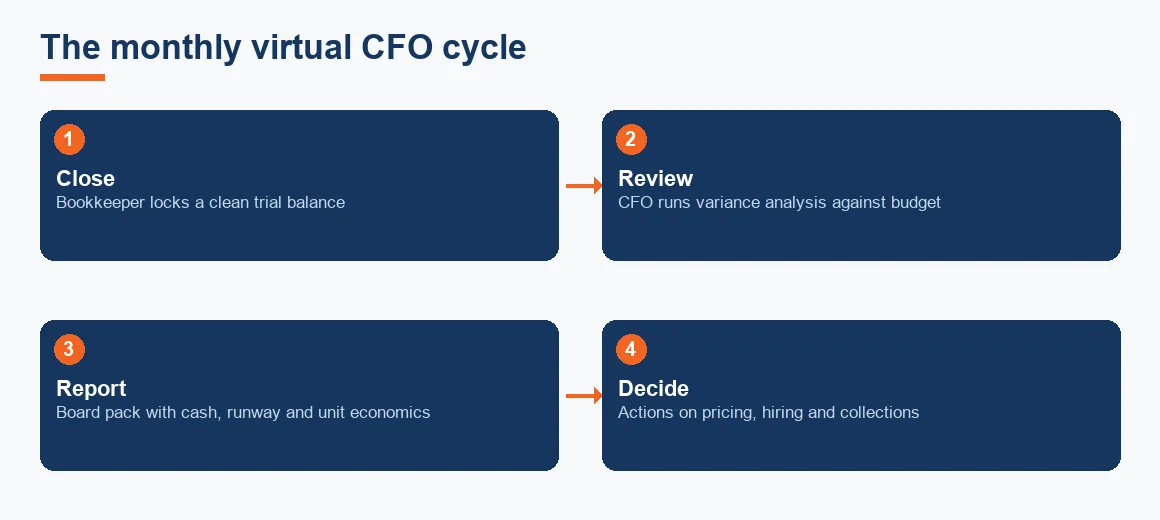
Put simply, the accountant closes the books and files the GST and TDS returns; the virtual CFO reviews the closed figures, runs a variance analysis against budget, and presents the story to the board or to investors. Most engagements run two to five days a month, rising during a funding round or a statutory audit. It is a senior review layer bolted onto a clean set of books, not a replacement for the bookkeeper.
The monthly virtual CFO checklist for a Gurugram startup
A useful monthly pack is short, comparable month to month, and reaches the board within 10 working days of month end. The core deliverables are:
- Profit and loss against budget, with a one-page commentary on the material variances.
- Cash position and operating cash runway in months, plus a rolling 13-week cash forecast.
- Receivable and payable ageing, tracked through a days sales outstanding figure.
- Unit economics: a contribution margin dashboard by product, plan or channel.
- Monthly burn rate and, for SaaS teams, recurring revenue and net retention.
- A compliance tracker for GST, TDS and ROC filings, flagging anything due before the next pack.
The order matters. The close comes first, the review second, the board report third, and the decisions fourth. A pack that arrives on day 25 has missed the point, because the numbers can no longer change the current month's spending.
Step by step: the month-end close and board pack
The checklist only works if the close underneath it is disciplined. A workable sequence for a Gurugram startup is:
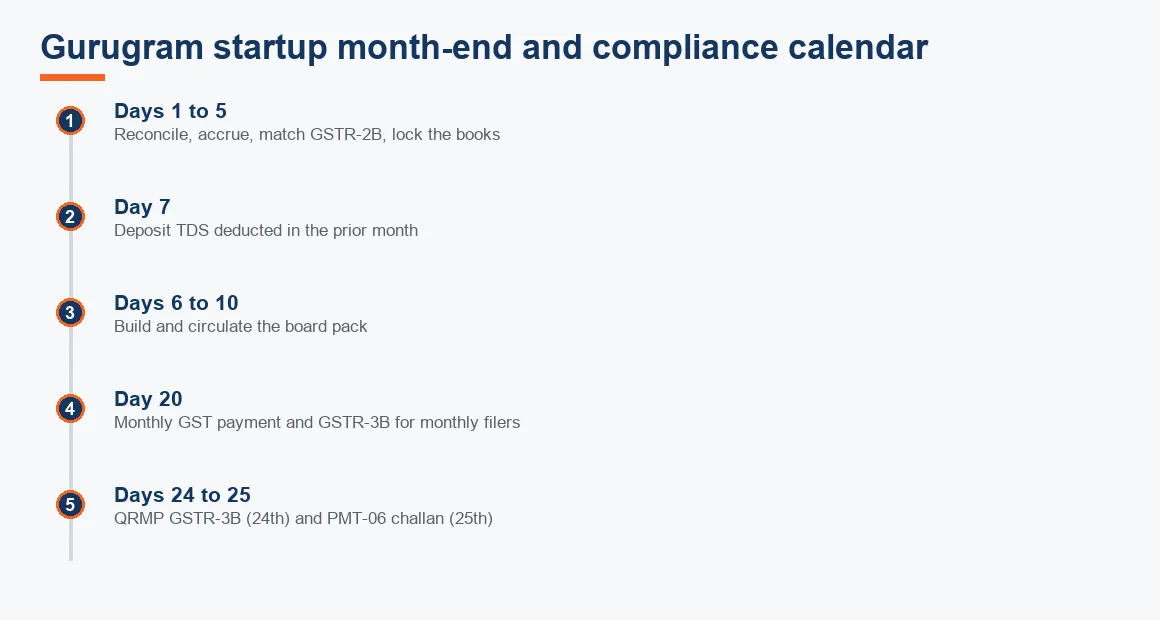
- Days 1 to 3: reconcile all bank and wallet accounts, post accruals and prepayments, and match GST input credit against GSTR-2B.
- Day 4: review the draft trial balance and clear suspense and unmapped ledgers.
- Day 5: lock the books and export the P&L, balance sheet and cash flow.
- Days 6 to 8: build the board pack, run the variance commentary and refresh the 13-week forecast.
- Days 9 to 10: hold the review call, agree actions, and circulate the final pack.
A written month-end close checklist keeps this repeatable when the team changes, and it is the single artefact that most reduces close time over the first quarter.
Haryana specifics a Gurugram virtual CFO must track
The local calendar is where a Gurugram engagement differs from a generic template. Two points matter most. First, Haryana levies no professional tax, so there is no monthly PT deduction or return to schedule, unlike Maharashtra or Karnataka. Second, a Haryana filer on the QRMP scheme with turnover up to Rs 5 crore files quarterly GSTR-3B on the 24th of the month following the quarter, because Haryana falls in the later filing group. Monthly filers still pay by the 20th, and the QRMP monthly tax challan (PMT-06) is due on the 25th. You can confirm the current due dates on the GST portal and in the CBIC notifications at cbic-gst.gov.in.
TDS deducted in a month must be deposited by the 7th of the next month, per the Income Tax Department, and ROC event-based and annual filings run to the MCA calendar. A Gurugram virtual CFO folds all three into the monthly compliance tracker so nothing is discovered late. For the wider employer-side picture, our note on Haryana compliance for employers covers the Shops Act and Labour Welfare Fund. Manufacturers in Manesar and Udyog Vihar carry extra costing and job-work tracking, which we cover in accounting for Manesar and Udyog Vihar.
Sector shapes the pack too. A D2C brand needs marketplace settlement and return provisions, which is why e-commerce accounting in Gurugram reads differently from SaaS accounting in Gurugram, where deferred revenue and dollar receivables dominate. Early-stage teams should start with the basics set out on the startup accounting page for Gurugram.
Virtual CFO versus accountant versus bookkeeper
The three roles are complementary, not interchangeable. The table below summarises who owns what.
| Dimension | Bookkeeper | Accountant | Virtual CFO |
|---|---|---|---|
| Core question | What happened? | What do the closed books say? | What should we do next? |
| Typical output | Ledgers, bank reconciliations | Trial balance, returns, financials | Board pack, forecast, strategy |
| Statutory filings | Prepares data | Files GST, TDS, ROC | Reviews and signs off |
| Time on the engagement | Ongoing, daily | Monthly and at year end | Two to five days a month |
| Decision authority | None | Advisory | Advises board and founders |
If you are weighing which of these to hire first, the local cost picture is set out in our guide to the cost of outsourced accounting and virtual CFO in Gurugram, and the selection criteria in how to choose an accountant in Gurugram.
Worked example: releasing cash by cutting receivable days
The fastest cash win a virtual CFO usually finds is tighter collections, not cost cuts. Take a Gurugram services startup with Rs 2 crore of annual revenue, which works out to about Rs 54,795 of billing per day. The table shows the cash locked in receivables at different DSO levels, and the cash released against a starting position of 75 days.
| Scenario | DSO (days) | Receivables locked (Rs) | Cash released vs 75 days (Rs) |
|---|---|---|---|
| Starting position | 75 | 41,09,589 | 0 |
| Moderate tightening | 60 | 32,87,671 | 8,21,918 |
| Firm follow-up | 45 | 24,65,753 | 16,43,836 |
| Net-30 discipline | 30 | 16,43,836 | 24,65,753 |
Pulling collections from 75 to 30 days frees roughly Rs 24.7 lakh of working capital without raising a rupee of external funding. That is often more than a full year of the virtual CFO fee, which makes this line the first one a good pack attacks. The mechanics are unglamorous: cleaner invoicing, a defined follow-up cadence, and timing statutory outflows so cash leaves on the due date and not before.
What to look for in a Gurugram virtual CFO
Choose for fit at your stage and sector, not for a long client list. The features that matter are hands-on experience with companies your size, familiarity with the Haryana specifics above, a genuine fundraise or audit track record, and a written scope that names deliverables and dates rather than promising unspecified strategy. Ask how many days a month they commit, who does the underlying close, and what the board pack will actually contain. If the topic is likely to touch Ind AS applicability as you scale, the Ind AS applicability checker is a quick way to see where you stand before the conversation.
Key terms
- Operating Cash Runway: the number of months current cash lasts at the present burn rate.
- Variance Analysis: comparing actuals against budget to explain the gap.
- Days Sales Outstanding (DSO): the average number of days to collect a rupee of sales.
- Monthly Burn Rate: net cash consumed each month before external funding.
- Month-End Close Checklist: the fixed sequence that locks the books each month.
Key takeaways
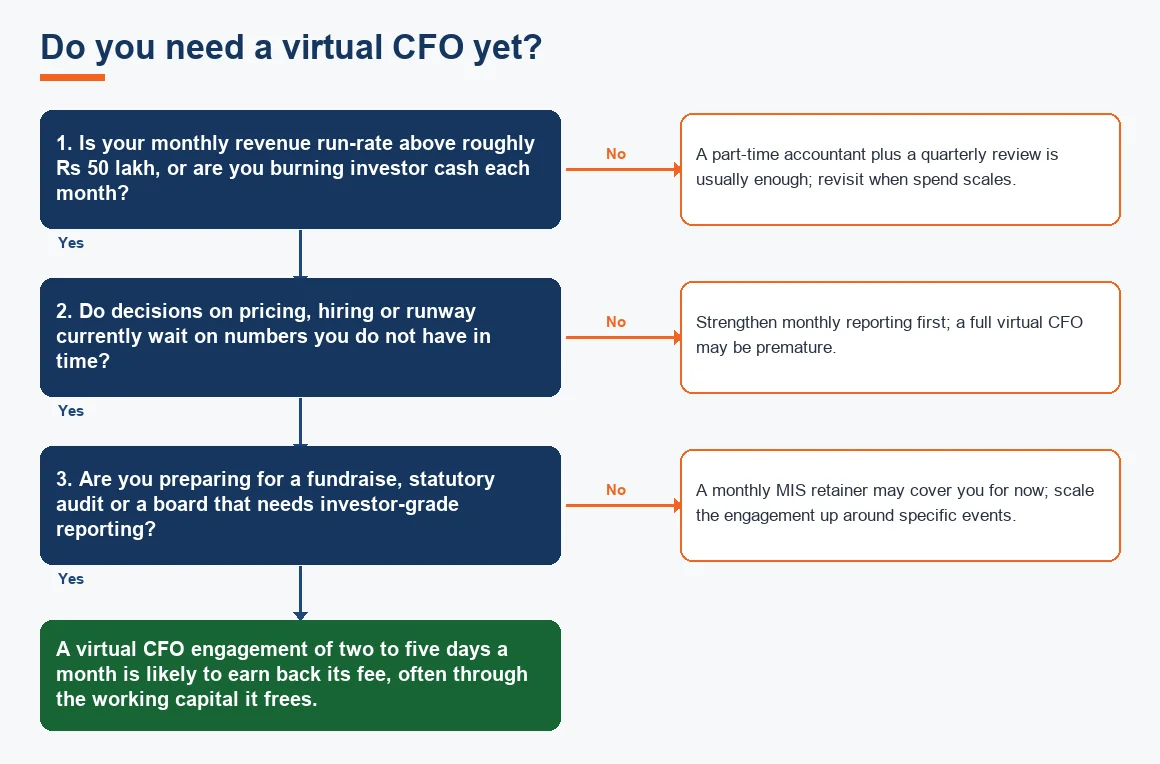
- A virtual CFO is a review and decision layer of two to five days a month, sitting on top of a clean bookkeeping close, not a replacement for it.
- The monthly pack should land within 10 working days of month end, ahead of the 20th GST date, and carry P&L versus budget, cash and runway, ageing, unit economics and a compliance tracker.
- Gurugram has no professional tax, and QRMP filers up to Rs 5 crore file GSTR-3B on the 24th, so build the local calendar around those facts.
- Tightening DSO is usually the largest quick cash win: on Rs 2 crore of revenue, moving from 75 to 30 days releases about Rs 24.7 lakh.
- Hire for stage and sector fit and a written scope; the commercial decision belongs on the Gurugram service page, not in this checklist.
Decision guide