
In this guide
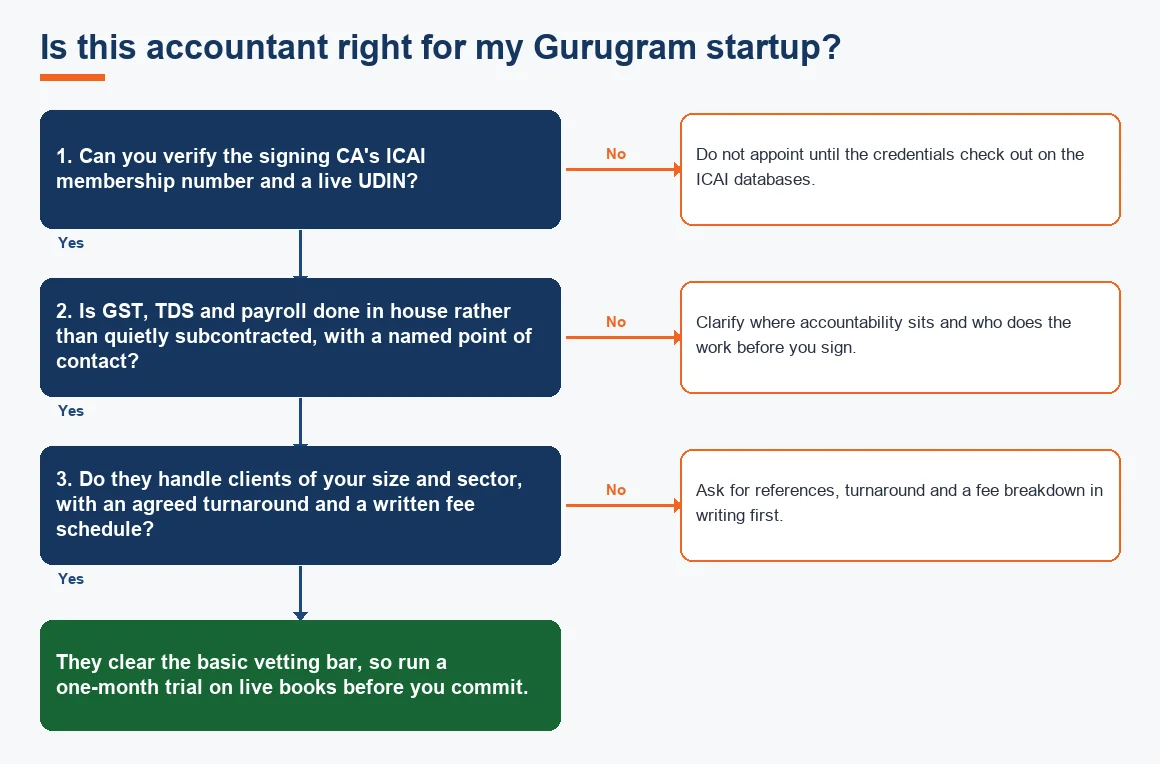
Choosing an accountant for a startup in Gurugram means checking three things before you sign anything: the ICAI membership number of the chartered accountant who will actually sign your filings, whether GST, TDS and payroll are handled in house or quietly subcontracted, and how many businesses of your size and sector the firm already runs. Get those right and the rest, such as fees, location and software, becomes a matter of fit rather than risk. This guide is a vetting checklist for founders around Cyber Hub, Golf Course Road and Golf Course Extension Road; for a done-for-you engagement, the commercial accounting and bookkeeping service in Gurugram is the right place to start.
What to check before you appoint an accountant
Most disputes between a founder and an accountant trace back to something that was never confirmed at the start. Before you appoint anyone, get clear answers on five points and, ideally, get them in writing.
- Who signs. A practising chartered accountant holds a certificate of practice and an ICAI membership number. Only that person can sign a statutory audit report, a tax audit under section 44AB or certify Form 15CB for a foreign remittance. Ask for the name and number of the individual, not just the firm.
- In house or subcontracted. Some firms take the retainer and then pass GST, TDS or payroll to a third party you never meet. That is not wrong in itself, but you should know where accountability sits.
- Sector fit. A firm that runs ten SaaS or D2C startups of your size will spot issues a generalist misses, from ESOP accounting to marketplace settlements.
- Turnaround. Agree the number of working days for monthly books and for returns, and what a delay from your side does to that clock.
- Fee schedule. Ask for a written list of what sits inside the retainer and what is billed separately.
Bookkeeper or chartered accountant: which does a Gurugram startup need?
These are different roles and most startups need both. A bookkeeper records transactions, reconciles the bank and keeps the ledgers clean at a lower hourly rate. A chartered accountant in practice is the only one who can sign a statutory or tax audit and file the certificates a funded company eventually needs. The common pattern in Gurugram is a bookkeeper for daily entries and a CA firm for filings, audit and board reporting. If you want the economics of that split laid out for the local market, the companion piece on the cost of outsourced accounting and virtual CFO in Gurugram breaks the numbers down, and the difference between the two assurance layers is covered under statutory versus internal audit.
Red flags when hiring an accountant
A few signals should slow you down before you appoint. None is automatically disqualifying, but each deserves a direct question.
- Reluctance to share a membership number or a UDIN on a certificate they have issued.
- A single all-in fee with no written breakdown of what falls outside it.
- No named point of contact, so your work rotates between junior staff each month.
- Vague answers on your specific sector, or a client list that is all one industry unlike yours.
- No defined turnaround, so books and returns are always finalised at the last hour.
- Filings signed in a name you cannot trace back to a practising CA.
How to verify a chartered accountant's credentials
Verification takes minutes and every founder should do it before signing. Search the membership number on the ICAI member search and the firm registration number on the ICAI firm database at the Institute of Chartered Accountants of India. A practising CA can be looked up by name and city. On any certificate they issue, ask for the Unique Document Identification Number, since UDIN is mandatory and independently verifiable online. If a firm hesitates on any of these, treat it as an answer.
Local accountant or remote CA firm for a Gurugram startup?
Founders around Cyber Hub and Golf Course Extension Road often assume they must hire within a short drive. In practice, location matters less than portal access and a defined turnaround, because GST, TDS, ROC and income tax filings are entirely online. A remote firm can serve a Gurugram startup as well as a local one. A local presence still helps for physical GST verification, a department hearing or signing hard copies, which is why many founders keep a Haryana-registered firm on record for representation even when the monthly work is done remotely.
| Consideration | Local Gurugram firm | Remote CA firm |
|---|---|---|
| Portal filings (GST, TDS, ROC, IT) | Online, no advantage | Online, no disadvantage |
| Physical GST verification and hearings | Handled in person | Needs a local associate |
| Signing hard copies and notices | Same-day possible | By courier or e-sign |
| Sector specialisation | Depends on the firm | Wider pool to choose from |
| Fee level | Often higher in NCR | Frequently more competitive |
The pragmatic answer for most is a hybrid: a firm that does the monthly work remotely with strong portal discipline, plus a Haryana-registered contact for anything that has to happen in person. If your team is scaling and you need forward-looking numbers rather than only compliance, the virtual CFO and financial-ops checklist for Gurugram startups sets out what that layer should deliver.
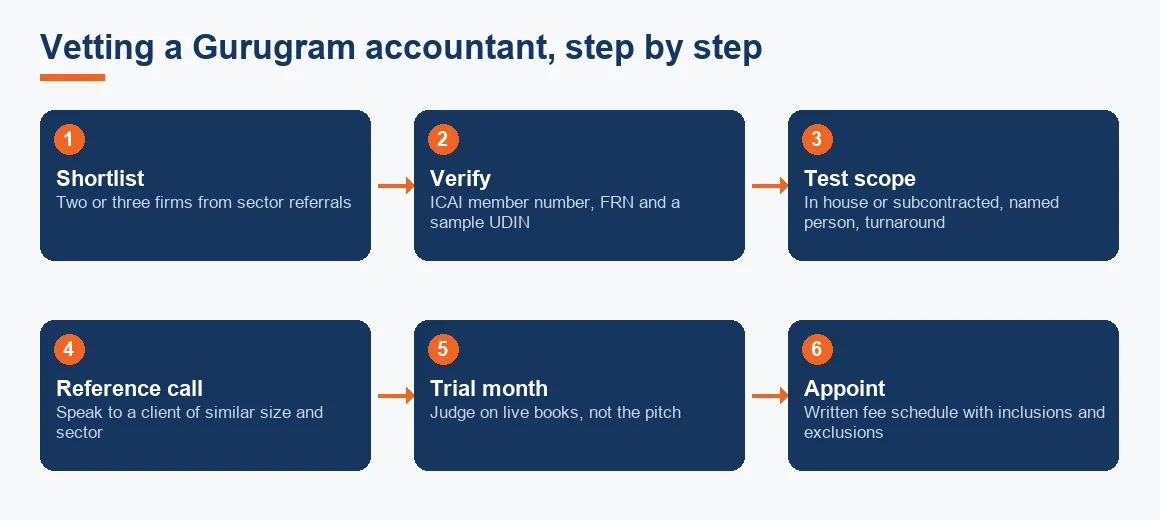
A step-by-step way to vet a Gurugram accountant
Run the same process for every candidate so you are comparing like with like.
- Shortlist two or three firms from referrals in your own sector, not generic directories.
- Verify credentials on the ICAI databases: member number, firm registration number and a sample UDIN.
- Test the scope and team: confirm what is in house, who the named person is and the agreed turnaround.
- Take a reference call with a current client of similar size and sector.
- Run a one-month trial on live books, then judge on the actual output.
- Appoint in writing with a fee schedule that lists retainer inclusions and exclusions.
A firm worth keeping will already work to a month-end close checklist, maintain basic financial internal controls and observe segregation of duties so that the person recording a payment is not the only person approving it. Ask to see how they run the monthly bank reconciliation; the answer tells you a great deal about their discipline.
The compliance calendar your accountant must hold
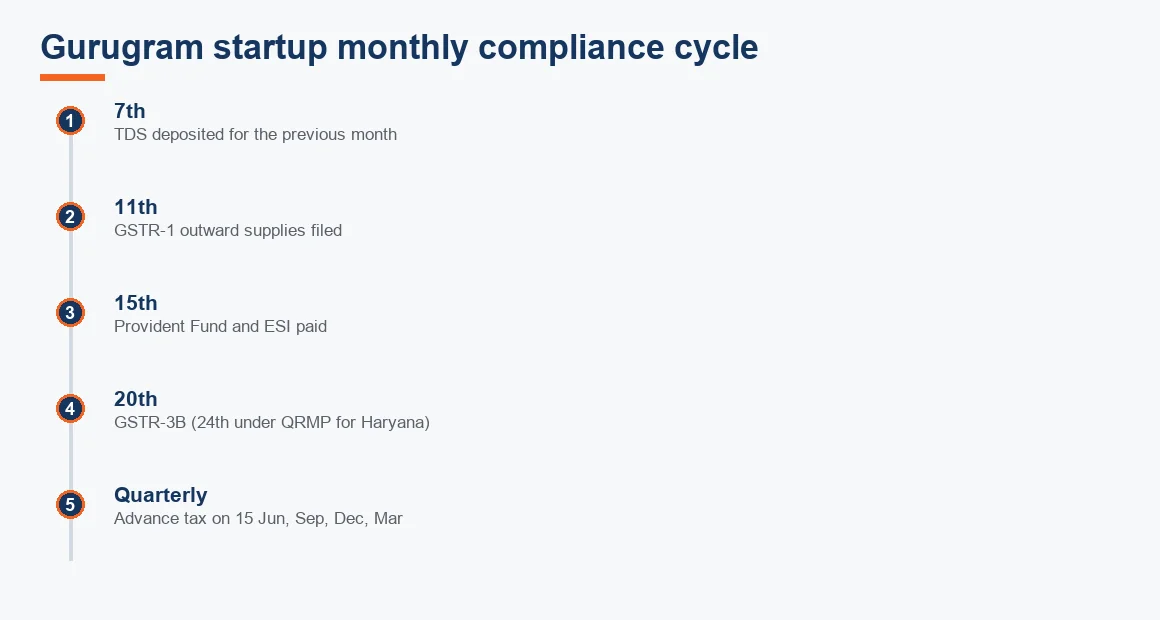
Whoever you appoint has to run a fixed monthly cycle, and a Gurugram employer's version is lighter than most because Haryana levies no professional tax. TDS is deposited by the 7th of the following month, GSTR-1 by the 11th and GSTR-3B by the 20th for monthly filers, or the 24th for Haryana taxpayers under the quarterly QRMP scheme on the GST portal. Provident fund and ESI fall due on the 15th. Advance tax instalments on 15 June, 15 September, 15 December and 15 March complete the year, per the Income Tax Department. The Haryana-specific labour angle, including the Shops Act and Labour Welfare Fund, is covered in the guide to Haryana compliance for employers.
Worked example: comparing two fee quotes over a full year
Two Gurugram firms quote a startup for the same scope. Firm A gives one all-in monthly retainer; Firm B gives a lower headline monthly figure but bills annual work separately. All figures are indicative and Exl GST.
| Item | Firm A (all-in) | Firm B (headline plus extras) |
|---|---|---|
| Monthly retainer | ₹8,000 × 12 = ₹96,000 | ₹5,000 × 12 = ₹60,000 |
| Annual GST return (GSTR-9) | Included | ₹6,000 |
| TDS return filing (4 quarters) | Included | ₹1,500 × 4 = ₹6,000 |
| ITR and tax audit support | Included | ₹18,000 |
| Year-end finalisation | Included | ₹12,000 |
| Full-year total | ₹96,000 | ₹1,02,000 |
The headline that looked 37 per cent cheaper each month ends up dearer by ₹6,000 across the year once the excluded work is priced in. This is not an argument for the higher quote; it is an argument for comparing full-year totals with every exclusion listed. Ask both firms to quote on the identical scope so the comparison is honest.
Key terms
- Statutory vs Internal Audit: the difference between an audit the law requires and one you commission for your own controls.
- Month-End Close Checklist: the fixed list of tasks a good firm completes to close each month's books on time.
- Financial Internal Controls: the checks that stop errors and fraud in how money is recorded and approved.
- Segregation of Duties (SoD): splitting recording, approval and payment across different people to reduce risk.
- Bank Reconciliation: matching the ledger to the bank statement so every transaction is accounted for.
Key takeaways
- Verify the signing chartered accountant's ICAI membership number and a live UDIN before you appoint anyone.
- Confirm whether GST, TDS and payroll are done in house or subcontracted, and get a named point of contact.
- For a Gurugram startup, portal access and a defined turnaround beat a Cyber Hub postcode; a hybrid remote-plus-local model works well.
- Haryana has no professional tax, so the monthly cycle is TDS on the 7th, GSTR-1 on the 11th, PF and ESI on the 15th and GSTR-3B on the 20th (or 24th under QRMP).
- Compare full-year fees with every exclusion listed, not the headline monthly figure.
Once you have shortlisted a firm, the next step is scope and price for your specific stage. Founders comparing engagements can start from the parent accounting and bookkeeping services in India or the broader accounting and bookkeeping hub covering process, software and industry, and startups specifically can look at startup accounting services in Gurugram, with a dedicated option for SaaS and IT accounting in Gurugram. Manufacturers around Manesar and Udyog Vihar have a distinct set of needs set out in accounting for Manesar and Udyog Vihar manufacturers. To sense-check which reporting standards apply as you scale, the Ind AS applicability checker is a quick interactive starting point.
Decision guide