
In this guide
Employers in Gurugram often ask a simple question: what are the professional tax and labour welfare fund rules in Haryana, and how do they differ from other states? The short answer is that Haryana does not levy professional tax at all, so there is no monthly PT deduction on the payslip. What remains is the Haryana Labour Welfare Fund, a modest monthly contribution, alongside registration and record-keeping duties under the Haryana Shops and Commercial Establishments Act. This explainer walks through each of those in plain terms so you can set your payroll and registers up correctly.
Does Haryana levy professional tax?
No. Professional tax is a state subject, and each state decides whether to impose it. Maharashtra, Karnataka, West Bengal and several others do; Haryana, Delhi and Chandigarh do not. So a business operating only in Gurugram has no PT registration, no PT slab to apply and no monthly PT challan to file. If you have run payroll in Mumbai or Bengaluru before, you can drop that line item entirely for your Haryana staff.
The practical trap is a payroll template carried over from another state. Teams migrating a business into Gurugram, or running a single payroll across offices in Delhi and Haryana, sometimes leave a PT deduction column switched on out of habit. It should read nil for every Haryana employee. The same nil position applies just across the border in the capital, which is why the Delhi nil professional tax regime is a useful comparison point for NCR employers.
The Haryana Labour Welfare Fund: who pays and how much
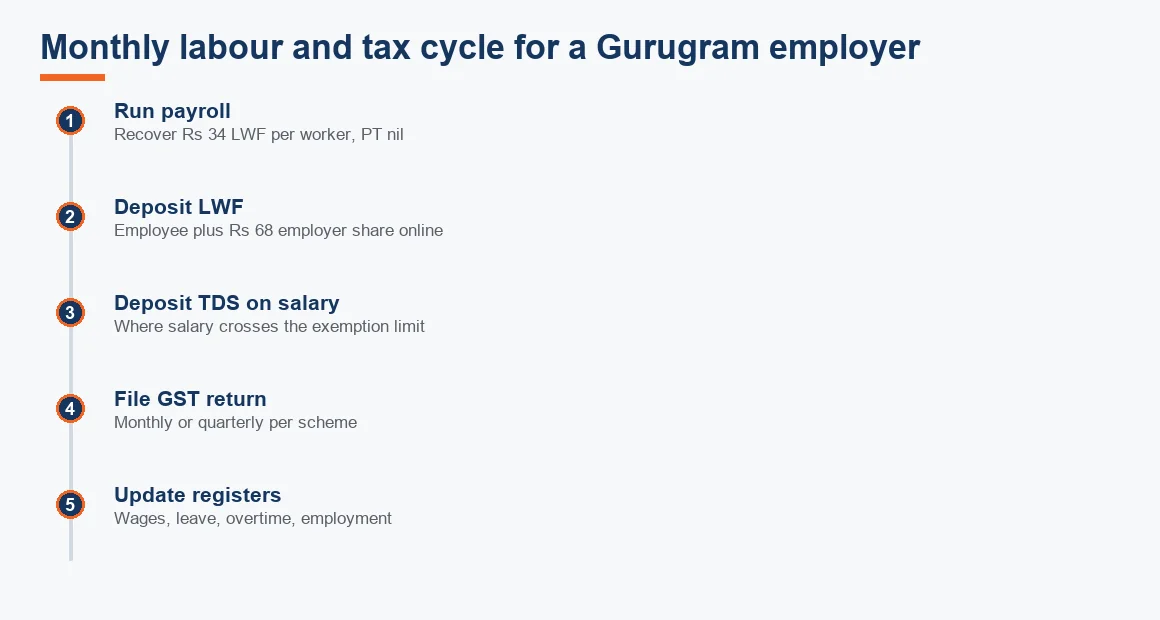
Although there is no professional tax, the Labour Welfare Fund still applies. It is a welfare levy, not an income tax, and it funds schemes for workers and their families. The rate is fixed: Rs 34 a month is recovered from the employee and Rs 68 a month is added by the employer, so Rs 102 a month is deposited for every covered worker. It is a flat monthly amount, computed at 0.2 per cent of wages up to the notified cap, not a large percentage of pay.
The fund derives from the Punjab Labour Welfare Fund Act as extended to Haryana. It covers factories registered under the Factories Act and shops or commercial establishments covered by the Haryana Shops Act, for every employee drawing wages, other than those in a genuine managerial or supervisory role above the notified wage limit. Contractors deposit for the contract labour they deploy at a site. The contribution is deducted monthly; it can be remitted online each month on the state labour department portal or deposited by the annual deadline, along with an employee-wise statement.
Shops Act registration in Gurugram: the twenty-worker line
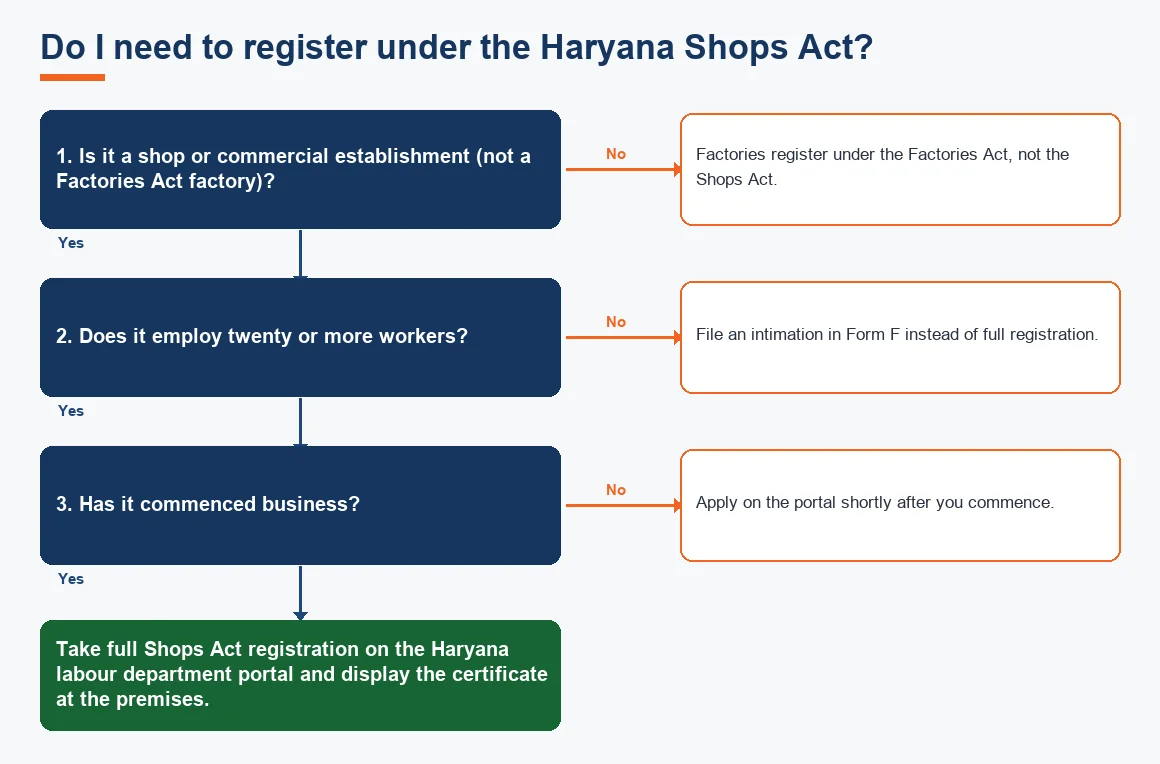
The Haryana Shops and Commercial Establishments Act governs most non-factory workplaces: offices, retail shops, restaurants, salons, clinics and warehouses. The threshold that decides your obligation is the headcount.
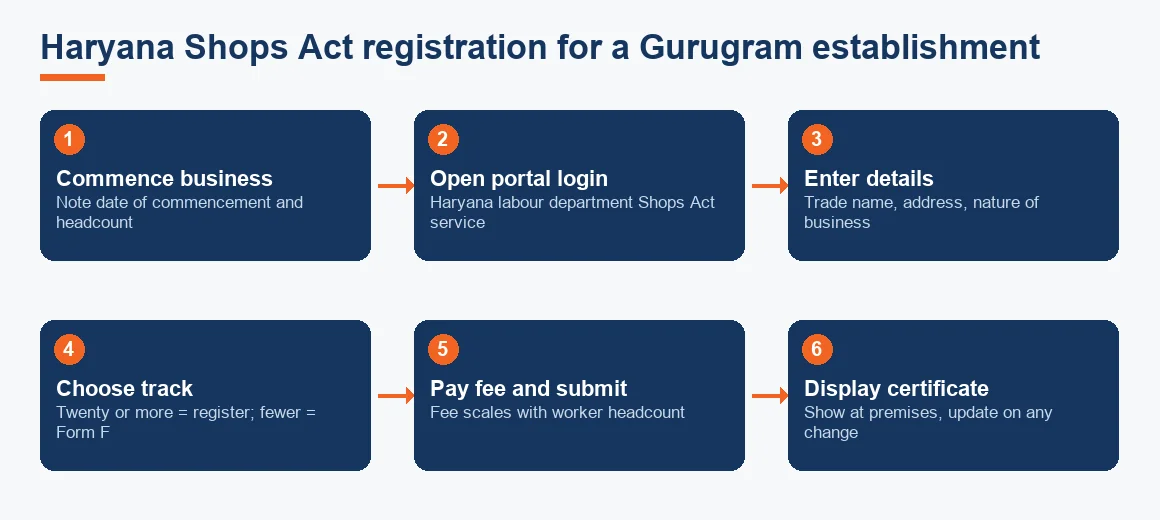
An establishment that employs twenty or more workers must take full registration and hold a certificate. An establishment with fewer than twenty workers does not register in the same way; it files an intimation in Form F instead. Either way, the paperwork is done on the Haryana labour department portal shortly after you commence business. The steps are straightforward:
- Create a login on the Haryana labour department portal and select the Shops Act service.
- Enter establishment details: trade name, address, nature of business and date of commencement.
- State your worker headcount so the system routes you to registration (twenty or more) or Form F intimation (fewer than twenty).
- Upload identity and address proof, and the employer and manager details.
- Pay the prescribed fee, which scales with headcount, and submit.
- Download the certificate, display it at the premises and update it whenever the details change.
If you are opening a second outlet on Golf Course Road or a warehouse in Manesar, each distinct establishment is assessed on its own headcount. A separate view of the local trade-offs sits in our note on choosing an accountant in Gurugram, and the fee side of running a finance function locally is covered in the cost of accounting services in Gurugram piece.
Registers, notices and records you must keep
Registration is only the start; the Act also expects a set of records to be maintained and produced on inspection. In practice you should keep:
- A register of employment showing hours worked, rest intervals and weekly holidays.
- A register of wages with the deductions made, including the LWF recovery.
- A leave register recording earned, casual and sick leave.
- A record of overtime hours and the overtime wage paid.
Alongside the registers, a notice of the weekly closing day and the working hours is displayed at the premises, and appointment letters are issued to staff. Records must be produced to an inspector when asked and are generally retained for three years. Good segregation of duties between whoever runs payroll and whoever approves it keeps these registers clean and audit-ready.
Working hours, overtime and the weekly holiday
The Shops Act sets working-time limits that a Gurugram employer has to respect. Ordinary working is nine hours a day and forty-eight hours a week. Work beyond that is overtime, paid at twice the ordinary wage rate, and total hours including overtime are capped as prescribed. Every employee is entitled to one paid holiday each week, and the establishment declares a closing day. Night shifts for women are permitted only where the notified safety and transport conditions are met, which matters for the many BPO and retail operations that run late in the city.
Key terms
- Delhi Nil Professional Tax Regime: the neighbouring capital's position of levying no professional tax, mirroring Haryana.
- Accrued Liabilities: amounts owed but not yet paid, such as the employer LWF share awaiting monthly deposit.
- HSIIDC Plot & Haryana e-Filing Compliance: the state e-filing rhythm that Haryana industrial-estate units follow.
- Segregation of Duties (SoD): splitting record-keeping and approval so payroll and statutory registers stay controlled.
Where GST and TDS fit alongside labour compliance
Labour compliance runs in parallel with the tax registrations you already know. A Gurugram business crossing the turnover threshold registers for GST and files its monthly or quarterly returns on the GST portal, with rate and procedure guidance issued through CBIC. Salary payments above the exemption limit attract TDS under the salary provisions, deposited and reported to the Income Tax Department. None of these replace the LWF or the Shops Act duties; they simply sit next to them on the monthly calendar. For the industrial belt, the Udyog Vihar SEZ versus DTA distinction and IMT Manesar industrial costing add their own layers, which our Manesar and Udyog Vihar manufacturing note unpacks.
Worked example: monthly payroll deductions for a Gurugram shop
Take a small Gurugram retail shop with four covered workers on a gross of Rs 25,000 each. The example below shows what actually leaves the payslip and what the employer adds on top. Professional tax is nil because it does not exist in Haryana; the LWF is the only welfare recovery. Figures are per worker per month.
| Line item | Employee share (Rs) | Employer share (Rs) | Notes |
|---|---|---|---|
| Gross wage | 25,000 | - | Basis for other components |
| Professional tax | 0 | 0 | No PT in Haryana |
| Labour Welfare Fund | 34 | 68 | Flat monthly, Rs 102 total |
| EPF (illustrative 12%) | 3,000 | 3,000 | Where EPF applies |
| Total statutory outflow | 3,034 | 3,068 | Per worker, per month |
For four workers, the LWF alone is Rs 136 recovered from staff (4 x 34) and Rs 272 added by the employer (4 x 68), so Rs 408 is deposited that month. The EPF row is indicative and shown only to place the LWF in context; it applies where the EPF scheme covers the establishment. All figures are indicative and Exl GST.
Haryana against its neighbours: a quick snapshot
Because Gurugram sits inside the NCR, employers frequently run staff across state lines and need to know where the rules diverge. The table summarises the labour-levy position; it is a snapshot, not a substitute for checking the current notification.
| State | Professional tax | Labour Welfare Fund | LWF frequency |
|---|---|---|---|
| Haryana | Nil | Rs 34 employee + Rs 68 employer | Monthly |
| Delhi | Nil | Payable at notified rate | Half-yearly |
| Maharashtra | Up to Rs 2,500 a year | Payable at notified rate | Half-yearly |
| Karnataka | Up to Rs 2,500 a year | Payable at notified rate | Yearly |
Getting the local set-up right
For most Gurugram employers the picture is reassuringly simple: no professional tax, a small monthly LWF, a Shops Act registration once you reach twenty workers, and a tidy set of registers. Get the payroll template and the monthly deposit right early and the compliance runs on rails. Local businesses building this out often start with the virtual CFO checklist for Gurugram startups, and city-specific service context sits on the Gurugram accounting page, with sector variants for retail, startups and manufacturing in the city.
Key takeaways
- Haryana has no professional tax, so PT is nil on every Gurugram payslip.
- The Labour Welfare Fund is deducted monthly: Rs 34 employee plus Rs 68 employer, Rs 102 per covered worker.
- Register under the Haryana Shops Act at twenty or more workers; below that, file Form F intimation.
- Keep the employment, wages, leave and overtime registers, and display the closing-day notice.
- Ordinary hours are nine a day and forty-eight a week, with overtime at twice the wage and one paid weekly holiday.
- This is an informational explainer; for a fee-based engagement, speak to the team via the accounting and bookkeeping services page or the process and software hub.
Decision guide