
In this guide
Accounting for a Delhi consultancy or professional-services firm is really about three things done well: recognising revenue in the period the work is actually delivered, applying GST correctly when clients sit in other states, and keeping the deductions clients make at source reconciled against your books. This guide is a plain explainer of how those pieces fit together for a Delhi practice. If you want the commercial engagement instead, that sits with our Service Sector Accounting (Project Billing) Delhi page.
What do consultants actually do in their accounting?
A consultancy has almost no inventory and very little in the way of physical assets. Its balance sheet is dominated by people's time, receivables and, importantly, work that has been done but not yet billed. So the accounting effort shifts away from stock and towards two questions: how much of each assignment has been earned, and how much of what has been billed relates to work still to come. Compared with a trading or manufacturing business, a Delhi consultancy spends far more of its bookkeeping time on timesheets, project margins and receivables than on purchases. The mechanics of double entry stay the same, but the judgement sits in revenue.
Recognising revenue on project and retainer billing
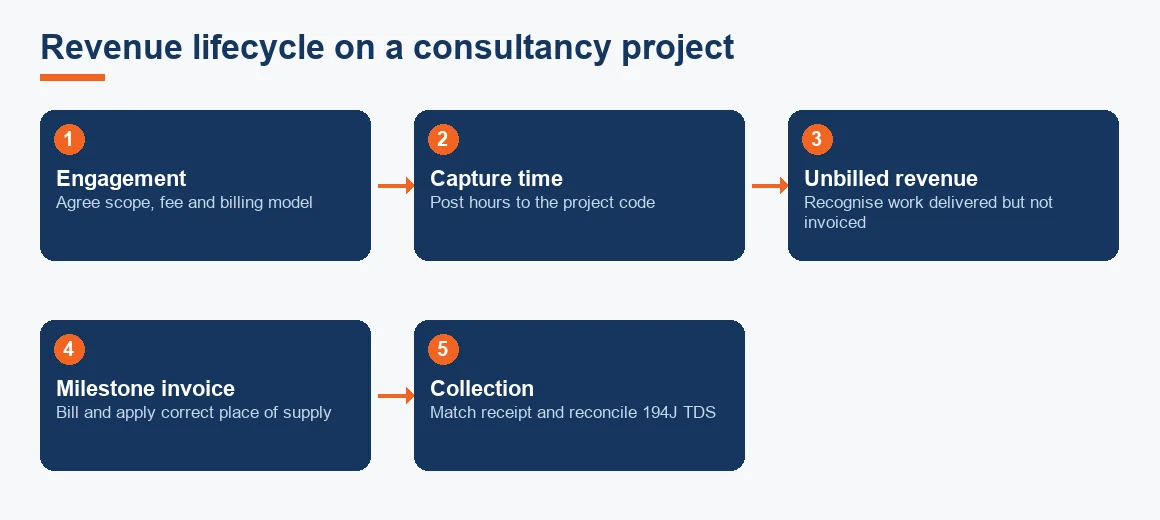
Under accrual accounting, revenue is recognised as the service is performed, not when the money arrives or the invoice is raised. For a fixed-fee assignment this usually means measuring the stage of completion, for example hours delivered against total estimated hours, or milestones cleared against the agreed plan. Work done but not yet invoiced becomes unbilled revenue on the asset side, and money collected ahead of delivery sits as an advance from clients, a liability, until it is earned.
Retainers behave differently from milestone work. A monthly retainer is generally earned evenly across the month regardless of hours, whereas a milestone contract earns nothing until the deliverable is accepted. Choosing which model applies to each engagement is the single biggest driver of clean consultancy accounts, and it is worth reading up on milestone vs retainer billing before you set your invoicing schedule. Firms that run large fixed-scope projects often apply the percentage of completion method formally.
Place of supply and interstate GST for Delhi consultancies
Most Delhi consultancies serve clients across India, so the GST place of supply rule decides the tax you charge. For a service supplied to a GST-registered business, the place of supply under Section 12 of the IGST Act is the location of that recipient. A Delhi firm advising a registered company in Bengaluru therefore raises an IGST invoice, while the same advice to a Delhi client carries CGST plus SGST. For an unregistered client, the place of supply is the recipient's address if it is on record, otherwise the supplier's location. Consultancy services attract GST at 18 percent. The official position is set out by the CBIC.
GST registration threshold and reimbursed expenses
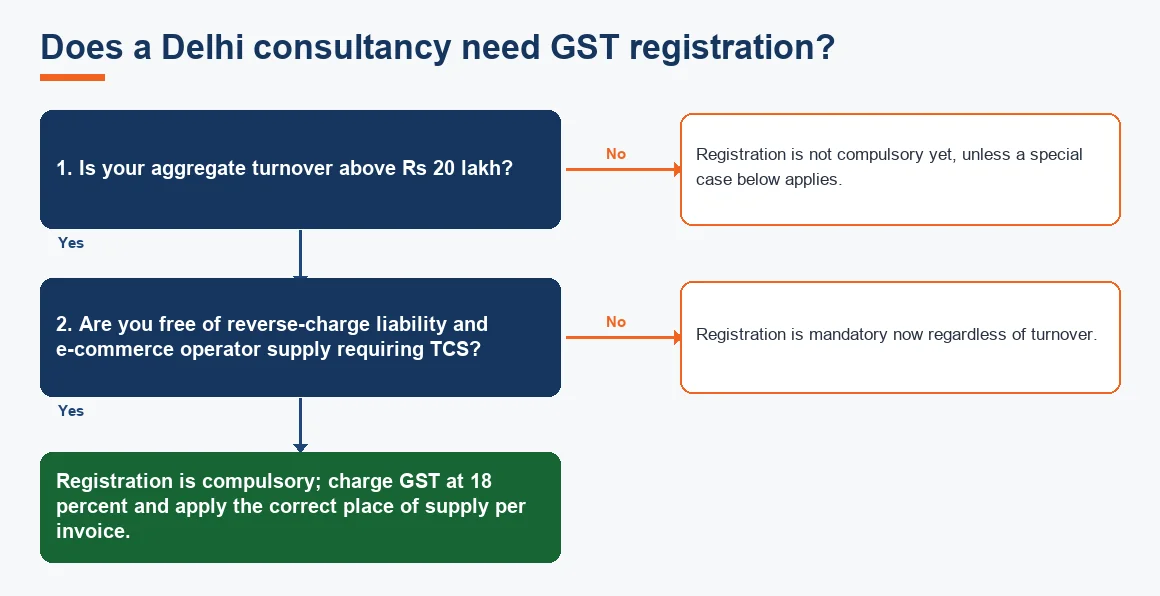
A service provider making interstate supplies is not forced to register for GST until aggregate turnover crosses Rs 20 lakh, under Notification 10/2017 Integrated Tax. Registration becomes mandatory earlier only in specific situations, such as supplying through an e-commerce operator that must collect tax at source, or a liability arising under reverse charge. Below the threshold, a Delhi consultant serving clients in other states can remain unregistered.
Reimbursements need care. A cost incurred as a pure agent under Rule 33 of the CGST Rules, such as a government fee paid in the client's name and shown separately on the invoice, is excluded from the taxable value. Everything else recharged at cost, including travel, courier and printing, forms part of the consideration and carries GST at 18 percent. Getting this wrong is a frequent audit point, and our GST and TDS health-check for Delhi MSMEs walks through the common slips.
TDS under Section 194J on your professional fees
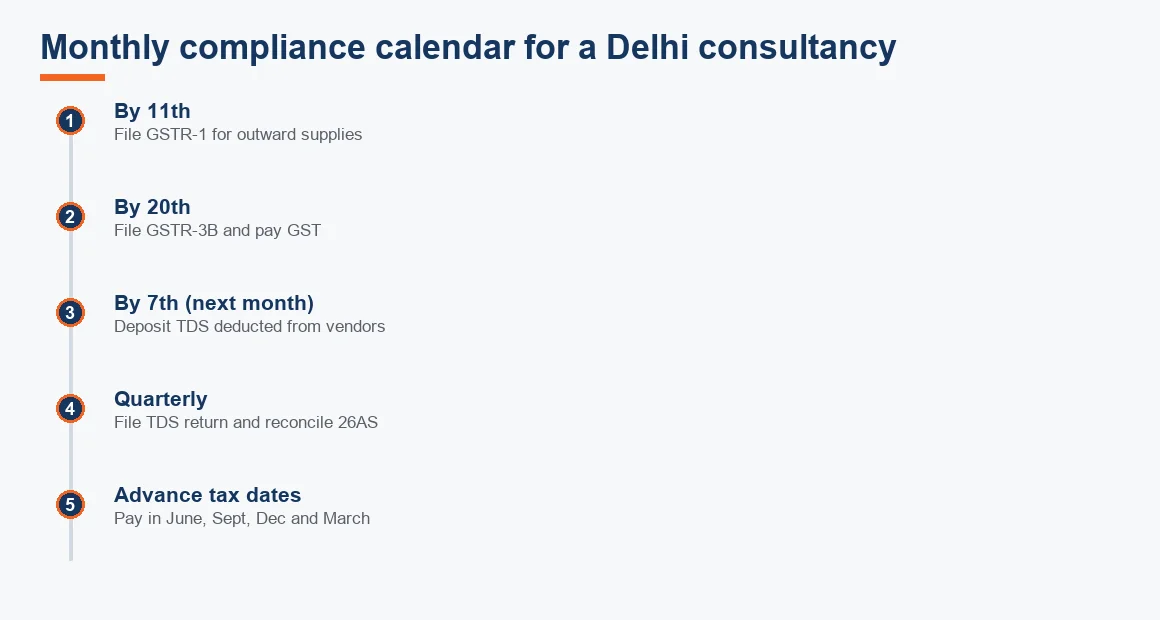
When a business client pays your consultancy, it deducts tax at source under Section 194J at 10 percent on professional or technical fees once the payment crosses Rs 30,000 in a financial year for that nature of service. The rate is 2 percent for certain technical services and call-centre work. This deducted tax is not a cost: it is an advance against your own income tax, visible in your Form 26AS and Annual Information Statement. The discipline that matters is reconciling every credit in 26AS against the invoices you raised, because a mismatch delays your refund. The Income Tax Department portal is where you check these credits.
Presumptive taxation under Section 44ADA
A resident individual or partnership firm in a notified profession can use Section 44ADA to declare 50 percent of gross receipts as income, provided receipts stay within Rs 50 lakh, or Rs 75 lakh where cash receipts are 5 percent or less of the total. Under this scheme you are not required to maintain detailed books or undergo audit, which suits a solo Delhi consultant with lean expenses. It is not available to an LLP or a private limited company, which must keep regular books either way. The trade-off is worth thinking through, and the Section 44ADA presumptive cap glossary entry covers the eligibility fine print.
Presumptive scheme against regular books
The choice usually comes down to your real expense ratio and your business structure.
| Point | Section 44ADA (presumptive) | Regular books |
|---|---|---|
| Who can use it | Resident individual or partnership firm in a notified profession | Any structure, including LLP and company |
| Receipts limit | Rs 50 lakh (Rs 75 lakh if cash is 5% or less) | No limit |
| Income taxed | Deemed 50% of gross receipts | Actual profit after allowable expenses |
| Books and audit | Detailed books not required | Full books; tax audit if thresholds crossed |
| Best when | Real expenses are below half of receipts | Real expenses exceed half of receipts |
Delhi-specific points: no professional tax, one Shops registration
Delhi is one of the states that does not levy professional tax at all, so a consultancy here has no monthly or annual PT filing to run, unlike a firm in Maharashtra or Karnataka. That is a genuine administrative saving and one reason Delhi practices keep their compliance calendar shorter. You do still register under the Delhi Shops and Establishments Act if you employ staff, and the detail of that sits in our note on Delhi Shops and Establishment plus GST and TDS compliance for employers. The zero-PT position is captured in the Delhi nil professional tax regime reference.
Worked example: recognising revenue on a fixed-fee assignment
Suppose a Nehru Place consultancy agrees a fixed fee of Rs 8,00,000 (indicative, Exl GST) for a project estimated at 400 hours. By 31 March it has delivered 260 hours and billed one milestone of Rs 3,00,000. Stage of completion is 260 divided by 400, or 65 percent, so revenue earned is 65 percent of Rs 8,00,000, which is Rs 5,20,000. Because it has billed only Rs 3,00,000, the difference is unbilled revenue.
| Item | Basis | Amount (Rs) |
|---|---|---|
| Agreed fee | Contract | 8,00,000 |
| Hours delivered / estimated | 260 / 400 | 65% |
| Revenue to recognise | 65% of 8,00,000 | 5,20,000 |
| Billed to date | Milestone 1 | 3,00,000 |
| Unbilled revenue (asset) | 5,20,000 minus 3,00,000 | 2,20,000 |
If instead the firm had billed Rs 6,00,000 against only 65 percent earned, the excess Rs 80,000 would sit as an advance from the client, a liability, until further work is delivered. A view of margins by project-wise profitability margin is what turns this entry from a compliance chore into a management tool.
A simple month-end close for a Delhi consultancy
A tidy monthly routine keeps year end painless. The sequence below works for most small and mid-sized practices.
- Post all timesheets to project codes and update stage of completion for each live assignment.
- Raise milestone or retainer invoices due for the month and record any client advances separately.
- Book unbilled revenue for work delivered but not yet invoiced, and reverse the prior month's unbilled entry.
- Reconcile the bank, then match GST output on sales and input credit from vendor bills against GSTR-2B.
- Reconcile TDS credits in Form 26AS against invoices raised, and note any client who has not deposited.
- Review project margins and receivables ageing before closing the ledgers.
Key terms
- Unbilled Revenue (WIP Hours): work delivered but not yet invoiced, carried as an asset.
- Milestone vs Retainer Billing: two billing models that earn revenue on very different timelines.
- Percentage of Completion Method (POCM): recognising revenue in proportion to work completed.
- Section 44ADA Presumptive Cap: the receipts ceiling for the 50 percent presumptive scheme.
- Delhi Nil Professional Tax Regime: Delhi levies no professional tax on employers or professionals.
Where this sits with related work
If your consultancy is really a software or product practice, the revenue treatment leans towards subscriptions and the detail sits with our SaaS Accounting Services and IT and software company accounting pages instead. Early-stage firms setting up their books for the first time are better served by Startup Accounting Services India. The broader project-billing engagement is our Service Sector Accounting (Project Billing) service, and a general Delhi engagement sits at accounting and bookkeeping services in Delhi. For budgeting, our 2026 price guide for Delhi and the note on choosing an accountant in Delhi are useful starting points. To size depreciation on your laptops and office fit-out, the depreciation calculator handles Schedule II rates, and the deferred tax calculator helps once you move off the presumptive scheme.
Key takeaways
- Recognise revenue as work is delivered, and track unbilled hours and client advances as separate balances.
- Place of supply follows the client's location, so out-of-state registered clients get an IGST invoice at 18 percent.
- Interstate service providers need GST registration only once turnover crosses Rs 20 lakh, subject to specific exceptions.
- Reconcile Section 194J TDS credits in Form 26AS every quarter to protect your refund.
- Delhi has no professional tax, which trims one recurring filing from your compliance calendar.
Decision guide