In this guide
To choose an accountant in Delhi, start by verifying that the firm is genuinely qualified, then check who will actually handle your books, which software they use and how they track GST and TDS deadlines. The office may sit in Nehru Place, Rohini or Connaught Place, but the address matters far less than the two things you can check in an afternoon: the firm's ICAI registration and two client references in your own line of business. This guide walks through what to verify, the red flags to watch, and how in-house and outsourced options compare for a Delhi firm. When you are ready to compare quotes rather than research, the accounting and bookkeeping services page for Delhi is the right place to go.
What to check before you appoint an accountant in Delhi
Most owners judge an accountant on price and a warm referral. Both are weak signals on their own. Before you appoint anyone, confirm five practical points in writing:
- Who handles the file day to day. The partner you meet is rarely the person doing your entries. Ask for the name and seniority of the article or accountant on your account.
- Which software the books sit in. Zoho Books, Tally or Xero all work; what matters is that you own the login and can export data at any time.
- How deadlines are tracked. Ask how GST returns and TDS returns are diarised and who chases you for missing bills.
- What the monthly pack contains. A ledger dump is not a report. You want a profit and loss, a balance sheet and a short note on what changed.
- How prior errors are fixed. If you are switching, ask how the previous accountant's mistakes and open balances will be cleaned up.
These are the same questions we cover for compliance risk in our GST and TDS health-check for Delhi MSMEs, which is worth reading before your first meeting.
How to verify a chartered accountant firm in India
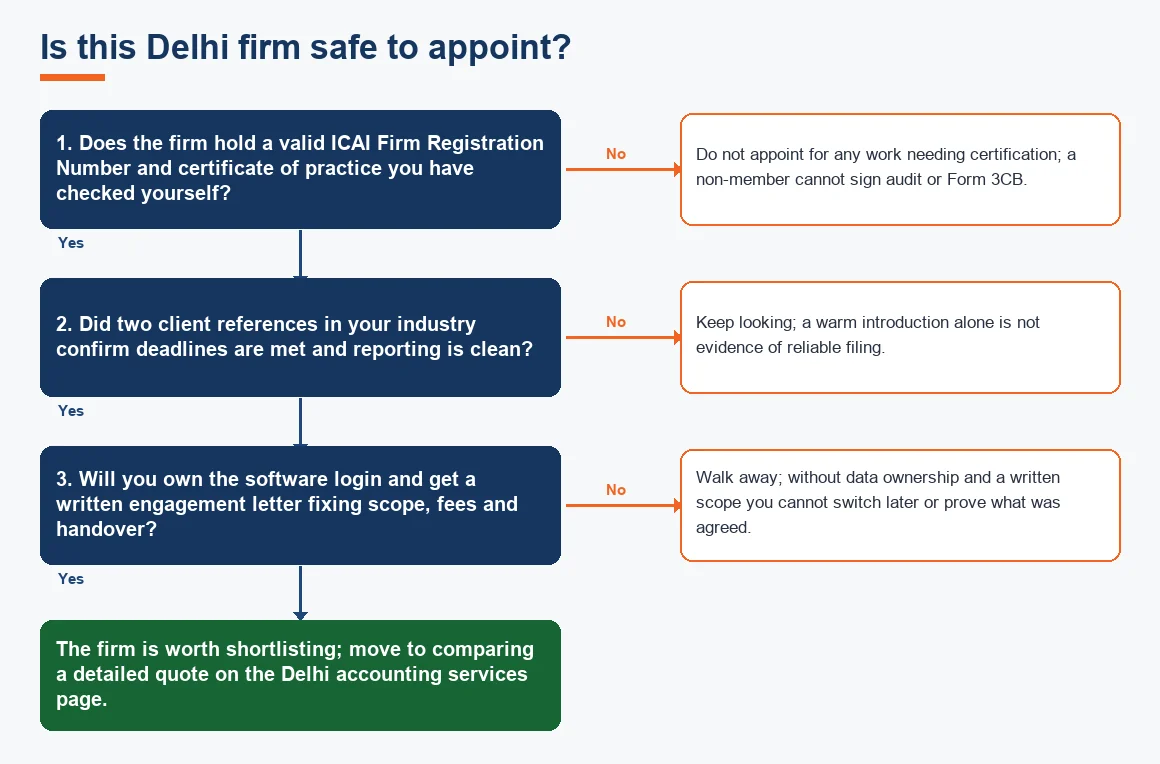
Every practising CA firm in India has a Firm Registration Number issued by the Institute of Chartered Accountants of India, and every member has a six-digit membership number. Both can be checked free on the ICAI website using the member and firm search. Ask for the FRN, then confirm it yourself rather than trusting a letterhead. A firm holding a valid certificate of practice can sign a statutory audit report and the tax audit Form 3CB; a tax consultant without membership cannot. You can confirm ICAI status directly at the ICAI website, and the tax audit requirement under section 44AB is set out by the Income Tax Department.
Chartered accountant, accountant or tax consultant: which do you need?
Most Delhi businesses need a mix rather than one person. A chartered accountant has cleared the ICAI examinations and holds a certificate of practice, which allows statutory audit, tax audit and certification. An accountant or bookkeeper records transactions, files returns and prepares schedules but cannot certify. A tax consultant advises and files but may hold no ICAI membership at all. The sensible structure for a small or mid-size firm is routine bookkeeping done at lower cost, with review and sign-off by a CA. The table below sets out who can do what.
| Task | Bookkeeper / accountant | Tax consultant (non-CA) | Chartered accountant (with CoP) |
|---|---|---|---|
| Daily entries, invoicing, ledgers | Yes | Sometimes | Yes, at higher cost |
| GST and TDS return filing | Yes | Yes | Yes |
| Statutory audit sign-off | No | No | Yes |
| Tax audit (Form 3CB / 3CD) | No | No | Yes |
| Net-worth / turnover certificates | No | No | Yes |
If you want the underlying scope of a full engagement, the accounting and bookkeeping hub breaks the work down by process, software and industry, and the national accounting and bookkeeping services page explains how sign-off and bookkeeping fit together.
Does location in Nehru Place, Rohini or CP still matter?
Twenty years ago you chose the accountant nearest your shop because ledgers and vouchers moved by hand. That has largely gone. Bookkeeping for most Delhi firms now runs on cloud software with automatic bank reconciliation from bank feeds, so your accountant can sit in Rohini while your office is in Okhla and nothing is lost. Location still helps in three narrow cases: if you deal in cash and need physical vouchers collected, if you want face-to-face meetings during an assessment at the local GST office, or if you value being able to walk in during quarter-end. For a services or online business, weight responsiveness and review quality above the pin code. Nehru Place firms often quote higher on the strength of the address alone.
If you run a factory unit, proximity does carry more weight because stock and job-work documents are physical; our note on accounting for Delhi manufacturers in Bawana and Okhla explains why.
A step-by-step way to vet a Delhi accountant
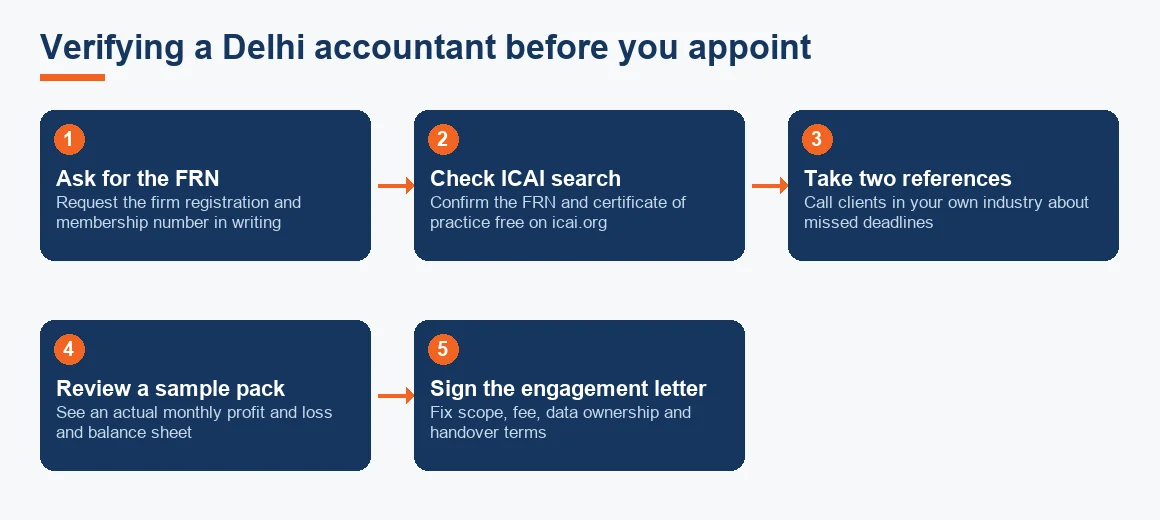
Run every candidate through the same short process so you are comparing like with like:
- Confirm the FRN and CoP on the ICAI search before the first paid meeting.
- Take two references in your own industry and actually call them; ask about missed deadlines, not just friendliness.
- Ask for a sample monthly pack and an engagement letter template.
- Agree the software and data ownership in writing so the login stays in your name.
- Fix the scope and fee line by line, including what falls outside the retainer.
- Set the handover plan if you are switching, including opening balances and the cut-off date.
Delhi charges no professional tax, so unlike Maharashtra or Karnataka you will not see a monthly PT deduction in the payroll scope; our Delhi Shops and Establishment and GST compliance guide covers what employers here do have to file. The Delhi nil professional tax regime is a small but real cost saving worth confirming your accountant reflects correctly.
Red flags when hiring an accountant
Some warning signs are worth walking away over:
- No FRN, or reluctance to share it.
- The books will sit on the accountant's own login with no export access for you.
- A quote far below the market with no written scope, which usually means returns filed and nothing reconciled.
- Statutory audit offered by the same firm that keeps your books, which is not permitted for the same company.
- No segregation of duties, so one person raises invoices, records receipts and reconciles the bank unchecked.
In-house accountant or outsourced firm in Delhi?
A full-time accountant in Delhi costs materially more than the salary alone once you add employer EPF, software and supervision. Outsourced monthly bookkeeping for a small company typically runs well below that and adds review by a qualified person. In-house starts to make sense only when transaction volume needs daily, same-day attention, or when the work is too confidential to send out. For most small and mid-size firms the outsourced route is cheaper and better supervised. Start-ups in particular tend to outsource early; see the start-up accounting services for Delhi page for how that scope is usually framed.
Worked example: in-house versus outsourced for a small Delhi company
Take a small trading company in Delhi with a monthly gross salary of Rs 35,000 for one accountant. Because the gross wage is above the Rs 21,000 ESI ceiling, no employer ESI applies, but employer EPF, software and CA supervision still do. All figures are indicative and Exl GST.
| Cost line | In-house (per year) | Outsourced (per year) |
|---|---|---|
| Salary / retainer | Rs 4,20,000 | Rs 1,44,000 |
| Employer EPF (approx Rs 1,950 / month) | Rs 23,400 | Included |
| Accounting software licence | Rs 12,000 | Included |
| CA review and supervision | Rs 36,000 | Included |
| Total | Rs 4,91,400 | Rs 1,44,000 |
The in-house total of Rs 4,91,400 sits inside the usual Rs 3.5 lakh to Rs 6 lakh range once oncosts are counted, while the outsourced arrangement lands near Rs 1,44,000 with review built in. The gap narrows as volume rises, because an outsourced fee scales with transaction count while a salary does not. For a fuller local breakdown, our cost of accounting services in Delhi 2026 price guide sets out current retainer bands.
What the engagement letter should cover
Never start work on a verbal understanding. The engagement letter should list the exact scope (bookkeeping, GST returns, TDS returns, payroll, annual accounts), the delivery date for each, the fee and what falls outside it, who supplies source documents, data ownership and handover terms, and a confidentiality clause. It should state clearly that statutory audit will not be combined with bookkeeping for the same company. If your books need cleaning before the arrangement starts, the letter should name the opening cut-off date so responsibility for the past is not left vague.
Key terms
- Statutory vs Internal Audit: the difference between the audit the law requires and the review a firm runs for its own control, and why one firm cannot do both plus your books.
- Double-Entry Bookkeeping: the method every credible accountant uses, where each transaction hits two accounts and the books always balance.
- Bank Reconciliation: matching the ledger to the bank statement so nothing is missed or double-counted, ideally monthly.
- Segregation of Duties (SoD): splitting recording, approval and reconciliation across people so no single person controls a transaction end to end.
Onboarding a new accountant without losing a filing
The month you switch is the riskiest. Line up the handover so no GST or TDS deadline falls in the gap. A clean transition runs roughly as follows over your first quarter.
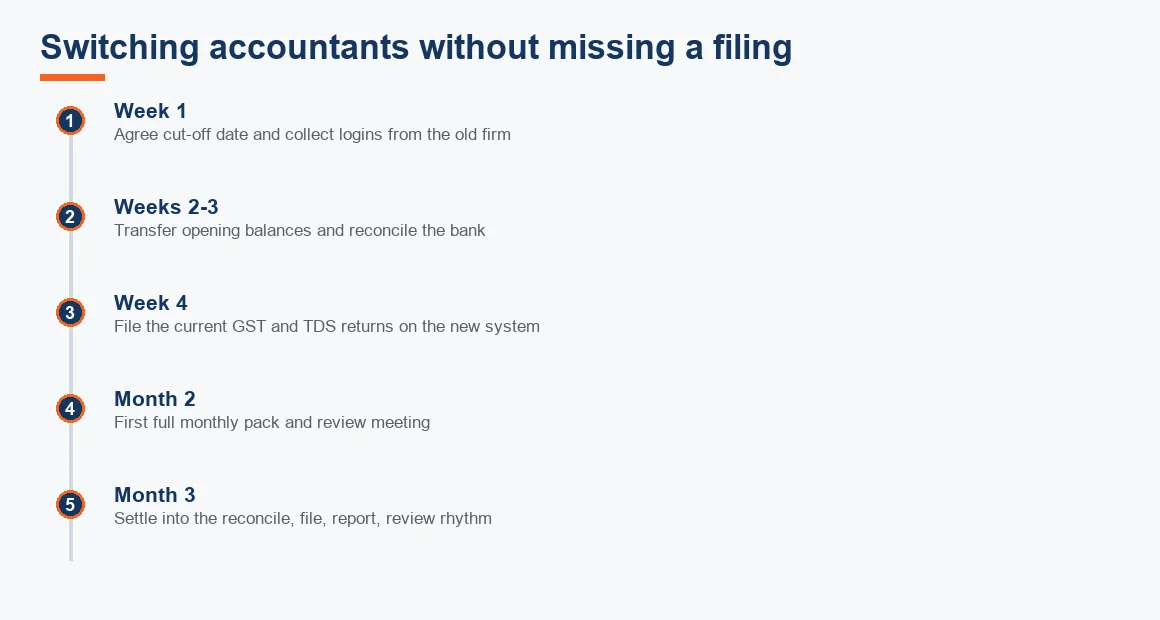
Once the handover is done, a good accountant will settle into a monthly rhythm: reconcile, file, report, review. If you want to sanity-check any capital allowance figures they produce, our depreciation calculator follows Schedule II, and larger companies moving to Ind AS can use the AS versus Ind AS comparison matrix to see what changes.
Key takeaways
- Verify the ICAI Firm Registration Number and certificate of practice before any paid meeting; only a CA can certify audit and Form 3CB.
- Judge a Delhi accountant on who handles your file, the software, deadline tracking and the monthly pack, not on a Nehru Place or CP address.
- Cloud bookkeeping with bank feeds means location rarely matters except for cash-heavy or factory units.
- For a small firm, outsourcing usually costs well below an in-house accountant once EPF, software and supervision are counted.
- Insist on a written engagement letter that fixes scope, fees, data ownership and handover, and never lets audit and bookkeeping sit with the same firm.
Once you have shortlisted a firm and are ready to compare a proper quote, move from research to the commercial accounting services page for Delhi, which is where pricing and engagement for the city are handled.
Decision guide