
In this guide
How much do accountants charge in Delhi? For most small and mid-sized businesses, outsourced monthly accounting runs from about Rs 3,000 to Rs 35,000 a month (indicative, Exl GST), with the figure driven mainly by transaction volume, the number of GST registrations and whether payroll and TDS work is included. This guide sets out the price bands honestly, explains what actually moves the number, and shows a worked yearly build-up for a North Delhi trading firm. It stays informational: if you want a fixed quote for your books, the commercial accounting and bookkeeping service page for Delhi is the place to ask.
What accounting services cost in Delhi, by turnover
There is no single Delhi rate. Quotes cluster into bands that track turnover and workload rather than a firm's postcode in Nehru Place, Rohini or Connaught Place. The table below is indicative, Exl GST, and assumes a stated voucher cap, which most Delhi quotes build in.
| Business profile | Turnover band | Typical monthly scope | Indicative fee (Exl GST) |
|---|---|---|---|
| Micro trader or professional | Under Rs 40 lakh | Under 100 vouchers, single GSTIN, GSTR-1 and 3B | Rs 3,000 to Rs 8,000 |
| Small trading or services firm | Rs 40 lakh to Rs 1 crore | 100 to 300 vouchers, TDS, monthly accounts | Rs 8,000 to Rs 18,000 |
| Growing SME | Rs 1 crore to Rs 5 crore | Payroll, multi-head TDS, MIS reporting | Rs 18,000 to Rs 35,000 |
| Larger or multi-state | Above Rs 5 crore | Multiple GSTINs, consolidation, Ind AS review | Rs 35,000 and above |
Treat these as starting points, not fixed prices. A firm quoting well below the band for your volume is usually assuming a lower transaction cap than you actually generate, which surfaces later as a revision.
What sits inside a monthly retainer
A standard Delhi monthly retainer covers purchase, sales and bank entry, bank reconciliation, GSTR-1 and GSTR-3B filing, TDS computation with challan payment, and a monthly profit and loss account with a balance sheet. Input tax credit work, including GSTR-2B matching, is normally part of the GST scope. What is usually quoted separately is payroll processing, ROC annual filings, the statutory audit and the income tax return. Ask for the transaction cap in writing, because a quote priced for 100 vouchers a month behaves very differently once you are running 250.
What makes accounting fees vary between Delhi firms
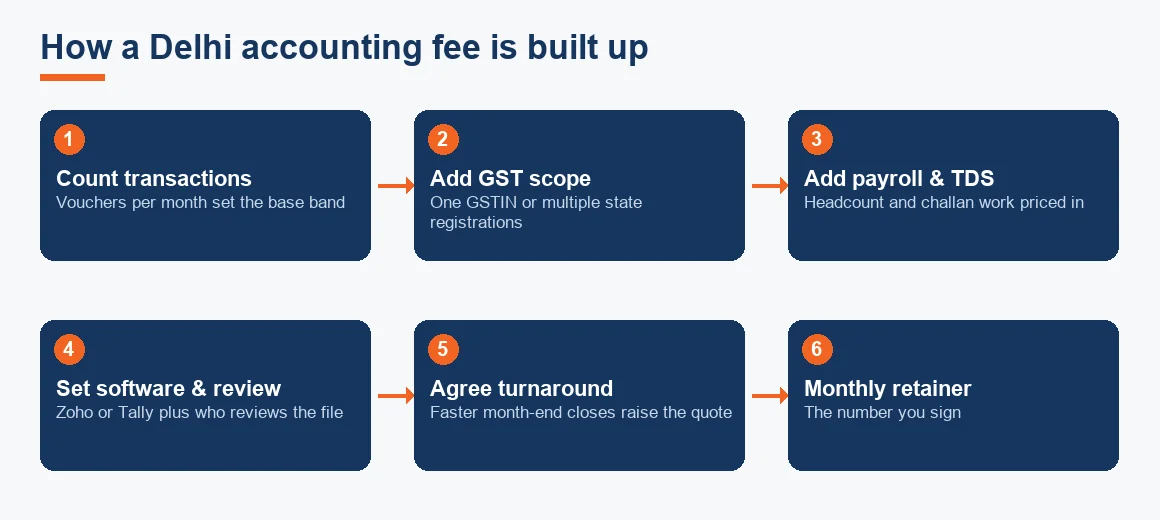
Fees move with a handful of levers. Transaction volume sets the base. The number of GST registrations matters, because a single-GSTIN trader is far lighter than a firm with registrations across several states. Payroll headcount and the spread of TDS sections add work. The software used (Zoho, Tally or an ERP) and the seniority of the person reviewing the file both feed the rate, as does any promise of a faster month-end close. A business needing an statutory audit sign-off or Ind AS reporting sits at the top of every band. If you are still shortlisting providers, our companion piece on how to choose an accountant in Delhi walks through the selection criteria in detail.
Outsourced versus an in-house accountant in Delhi
An in-house accountant in Delhi costs roughly Rs 25,000 to Rs 45,000 a month in salary, plus provident fund, gratuity accrual, software licences and desk space. Outsourced monthly accounting for comparable volume typically runs Rs 8,000 to Rs 25,000. The crossover sits at roughly 300 transactions a month: below it, outsourcing almost always wins on cost; above it, an in-house resource with a CA firm reviewing the file periodically often works out cheaper and gives you day-to-day control. Many Delhi businesses run a hybrid, keeping data entry in-house while a firm owns compliance and review. For sector-specific volumes, our notes on GST and TDS health-checks for Delhi MSMEs are a useful cross-reference.
What Delhi's nil professional tax regime changes
Delhi does not levy professional tax on salaries. Unlike Maharashtra, Karnataka or West Bengal, there is no monthly PT deduction and no PT return to file for a Delhi-registered employer under the Delhi nil professional tax regime. In practice this trims a small recurring line from a Delhi payroll and removes one filing from the compliance calendar, which is why a Delhi payroll runs marginally cheaper than a comparable one in Mumbai or Bengaluru. It does not touch your core GST, TDS or income tax obligations, so treat it as a modest saving rather than a headline one. Employers still carry Delhi Shops and Establishment registration and the usual PF and ESI duties, covered in our note on Delhi Shops and Establishment plus GST and TDS compliance.
Annual compliance cost for a Delhi private limited company
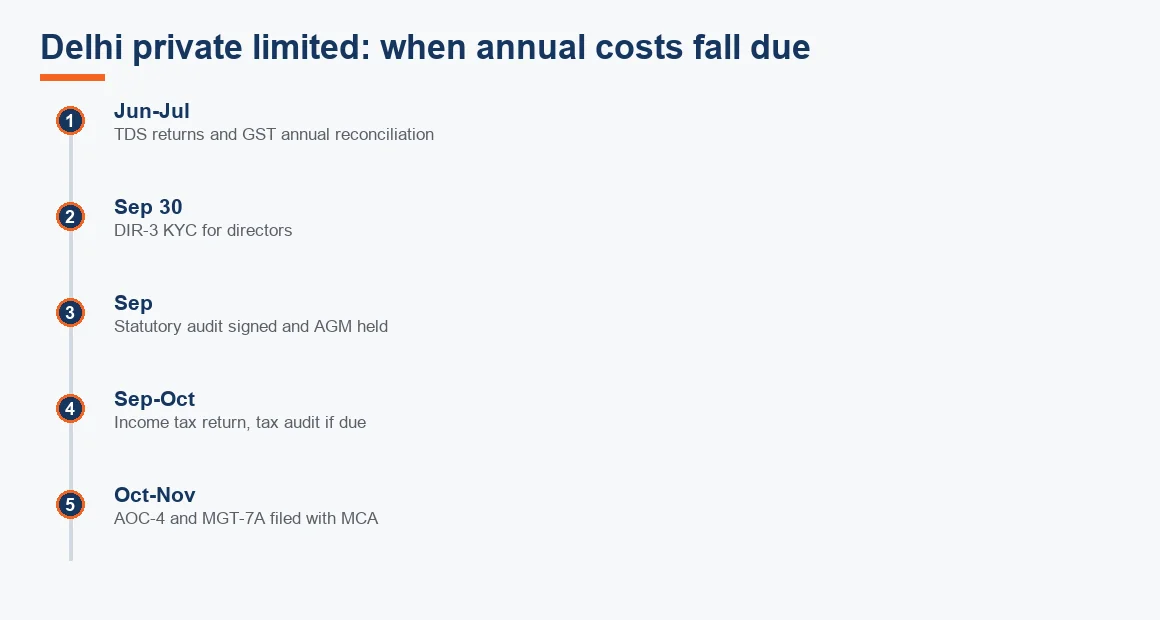
Monthly bookkeeping is only part of the yearly cost. A small Delhi private limited company should budget roughly Rs 40,000 to Rs 1,20,000 a year on top of the retainer, covering ROC filings in AOC-4 and MGT-7A, director KYC, the statutory audit, board minutes and the income tax return. Normal ROC government fees are slab-based on authorised capital and add about Rs 300 to Rs 600 per form. Late filing is expensive: MCA charges an additional Rs 100 per day per form with no upper cap, so a missed AOC-4 quietly compounds. Where a tax audit under section 44AB applies, factor the auditor's fee in as well. Startups budgeting their first full year of compliance will find the Delhi startup accounting page a practical starting point.
When to move from a freelance accountant to a CA firm
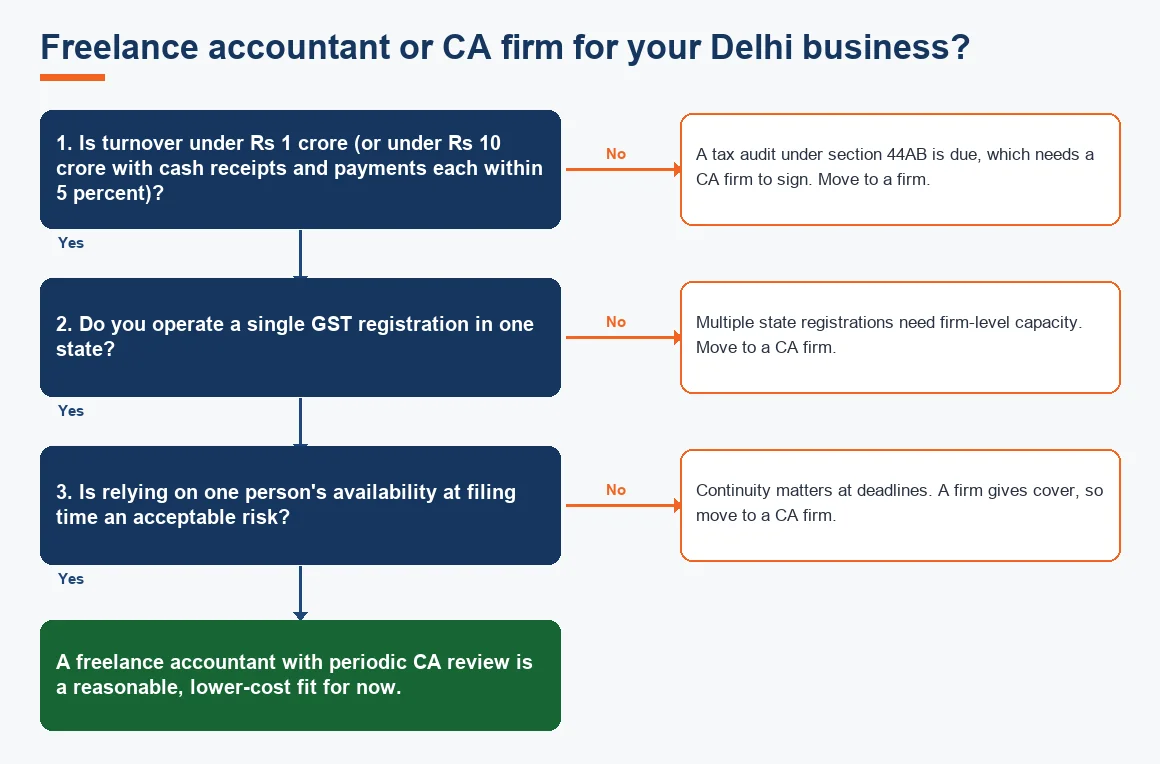
A freelance accountant is fine while the business is small and single-state. The trigger points are clear. Move once turnover crosses about Rs 1 crore, once a statutory or tax audit falls due, or once you register in a second state. Tax audit under section 44AB applies above Rs 1 crore turnover, extended to Rs 10 crore where cash receipts and cash payments are each within 5 percent (see the Income Tax Department for the section text). A firm also gives continuity: if one person is unavailable at filing time, your GSTR-3B still goes in. Manufacturers scaling up in Bawana or Okhla will find volume-specific pointers in our piece on accounting for Delhi manufacturers.
Worked example: a North Delhi trading firm's yearly cost
Take a Rohini-based trading private limited company with turnover near Rs 2 crore, a single Delhi GSTIN, eight employees and around 150 vouchers a month. All figures are indicative and Exl GST. Because receipts and payments are largely digital, no section 44AB tax audit is due below Rs 10 crore, but a statutory audit under the Companies Act still applies.
| Cost head | Scope / assumption | Basis | Annual (INR, Exl GST) |
|---|---|---|---|
| Core bookkeeping retainer | Up to 150 vouchers, 1 GSTIN, GSTR-1 and 3B, TDS | Rs 15,000 x 12 | 1,80,000 |
| Payroll processing | 8 employees, PF and ESI, no Delhi PT | Rs 3,000 x 12 | 36,000 |
| Statutory audit | Companies Act audit and sign-off | One-off | 35,000 |
| ROC annual filings | AOC-4, MGT-7A, DIR-3 KYC | One-off | 15,000 |
| Income tax return | Company ITR and computation | One-off | 12,000 |
| Total | Full-year accounting and compliance | 2,78,000 |
That is roughly Rs 23,200 a month all-in for a Rs 2 crore trading company that keeps clean records. Poor or backdated records push it up, because catch-up bookkeeping is billed on top. The annual items do not fall evenly, so plan the cash outflow against the compliance calendar below.
How to keep the fee fair, and the calendar in view
Two habits keep the number honest. First, watch your MSME payment discipline: unpaid micro and small vendor bills beyond the statutory window trip the section 43B(h) MSME clock and can raise taxable profit, which is a cost your accountant cannot fix retrospectively. Second, keep filings on the government calendar. GSTR-1 and GSTR-3B due dates are published on the GST portal and by CBIC, while ROC and audit timelines sit with MCA. If Ind AS applicability is in doubt as you scale, the Ind AS applicability checker settles it quickly, and the depreciation calculator helps size the audit workload on your fixed assets. For the full menu of what a retainer can include, see our accounting and bookkeeping services in India overview and the process, software and industry hub.
Key terms
- Delhi Nil Professional Tax Regime: Delhi levies no professional tax, so no PT deduction or PT return applies to a Delhi employer.
- Bank Reconciliation: matching book balances to the bank statement, a standard inclusion in any monthly retainer.
- GSTR-2B Input Tax Credit Matching: reconciling purchase credit against the auto-drafted GSTR-2B before claiming ITC.
- Statutory vs Internal Audit: the mandatory Companies Act audit versus a voluntary internal control review, priced differently.
- Catch-Up Bookkeeping: bringing backlogged or backdated records current, billed on top of the regular retainer.
Key takeaways
- Delhi monthly accounting typically runs Rs 3,000 to Rs 35,000 (Exl GST), set by volume, GST registrations and whether payroll and TDS are included.
- Outsourcing usually wins below about 300 transactions a month; above that, in-house with CA review often costs less.
- Delhi's nil professional tax trims the payroll line slightly but does not touch GST, TDS or income tax duties.
- Budget Rs 40,000 to Rs 1,20,000 a year extra for a small private limited company's audit, ROC and ITR, and remember MCA late fees run at Rs 100 per day per form with no cap.
- Move from a freelancer to a firm at Rs 1 crore turnover, at a first audit, or on a second-state GST registration.
Decision guide