In this guide
If you run a shop, office or commercial establishment in Delhi, the compliance picture is a little simpler than in most states, because Delhi levies no professional tax at all. What still applies is registration under the Delhi Shops and Establishments Act 1954, along with the usual payroll registrations (EPF, ESI, TAN) and the ordinary GST and salary TDS duties. This guide sets out what a Delhi employer has to do, in what order and by when, and where the Delhi nil professional tax regime changes the checklist. It is an explainer, not a service pitch: if you want the work done for you, our Accounting & Bookkeeping Services in India team handles the full Delhi payroll cycle.
Does Delhi charge professional tax?
No. Professional tax is a state levy, and the Delhi government has never notified it. So a business paying salaries in Delhi has no PT enrolment certificate, no employer registration certificate, no monthly or annual PT deduction from wages, and no PT return to file. This is the opposite of a Mumbai or Bengaluru employer, who deducts PT from every salaried employee each month and remits it to the state. Owners moving a business into Delhi from another state often keep a PT line in their payroll software out of habit; in Delhi that line should be set to zero.
Two points cause confusion. First, the absence of PT does not remove the Labour Welfare Fund: Delhi still runs a small half-yearly LWF contribution, which is a separate levy. Second, no PT does not mean no local licensing. A trade or health licence from the municipal body may still be needed for certain premises, and the MCD commercial trade licensing rules sit alongside, not inside, the Shops Act. For a full read on why Delhi's local burden differs from other metros, our GST & TDS health-check for Delhi MSMEs walks through the common gaps.
Delhi Shops and Establishment Act registration process
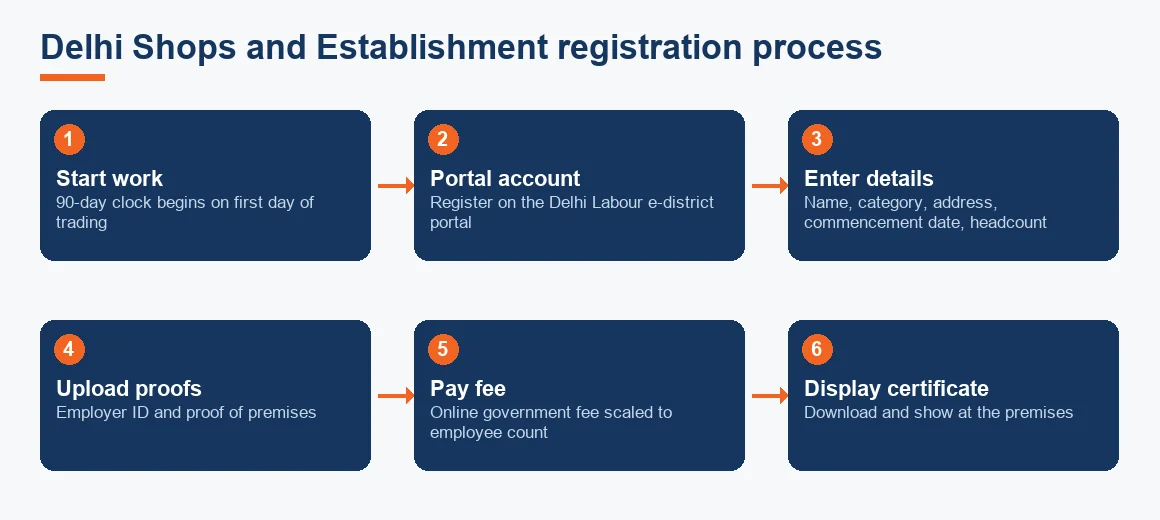
Registration under the Delhi Shops and Establishments Act 1954 is compulsory for every shop and commercial establishment, whatever the number of workers. There is no minimum-headcount threshold and no separate Form F intimation route as some states allow. You register within 90 days of the establishment starting work, online through the Delhi Labour Department portal.
Who must register and when
Any premises where a trade, business or profession is carried on, or where clerical work is done in connection with a trade, is covered. A single-owner consultancy in Connaught Place, a retail counter in Lajpat Nagar and a back-office in Nehru Place are all establishments for this purpose. The 90-day clock runs from the date work commences, so date-stamp your first day of trading and diarise the deadline.
The registration steps
- Create an account on the Delhi Labour Department e-district portal and select the Shops and Establishment registration service.
- Enter the establishment name, category, address, date of commencement and the number of employees.
- Upload the identity and address proof of the employer and proof of the premises (rent agreement or ownership document).
- Pay the prescribed government fee online; the amount scales with the number of employees.
- Download the registration certificate once approved and display it at the premises.
Keep the certificate accessible: banks routinely ask for it when opening a current account, and marketplaces ask for it during seller onboarding. Any change in the particulars, such as a new address or a jump in employee count, must be notified within the prescribed period.
Working hours, leave and registers under the Act
The Act sets the working conditions employers must follow. Working hours are capped at 9 per day and 48 per week, with overtime paid at twice the ordinary wage, and an interval for rest after 5 hours of continuous work. Every establishment observes one weekly closing day. Section 22 entitles an employee to at least 15 days of privilege leave after 12 months of continuous service, plus at least 12 days of sickness or casual leave in the year.
The record-keeping obligations sit in Section 33: employers maintain an attendance register, a wage register and a leave register at the premises, and display the registration certificate. These registers are the same source documents your accountant uses to build the monthly payroll, so it pays to keep them clean from day one. Delhi manufacturers with a factory footprint have extra registers under separate labour law; our note on accounting for Delhi manufacturers in Bawana and Okhla covers those.
Payroll registrations a Delhi employer still needs
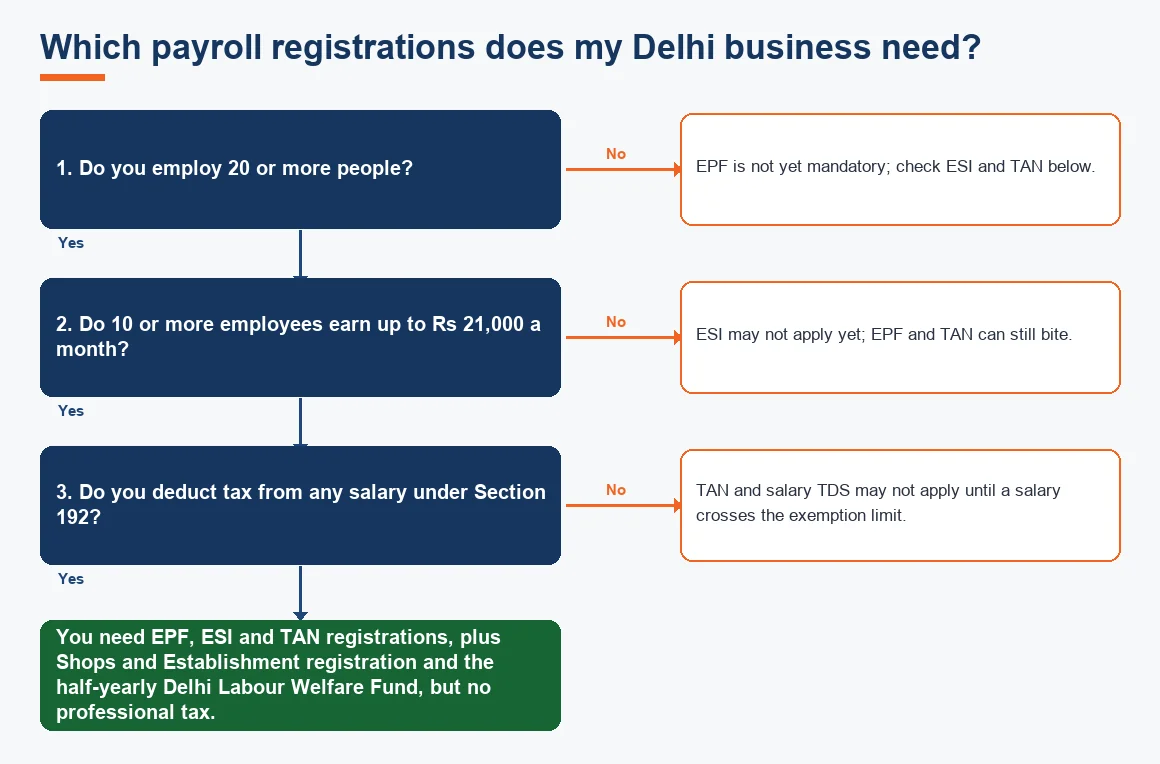
With no professional tax to worry about, the payroll registrations that a Delhi employer has to line up are EPF, ESI, TAN and the Delhi Labour Welfare Fund. Each has its own trigger, so a very small shop may need none of the social-security registrations at the start and pick them up as it grows.
| Registration | When it applies in Delhi | Core obligation |
|---|---|---|
| EPF (Provident Fund) | Once 20 or more employees are engaged | Employer and employee contribution at 12% of wages; monthly ECR filing and payment by the 15th |
| ESI | 10 or more employees, where wages are up to Rs 21,000 a month | Contribution on covered employees; monthly payment by the 15th |
| TAN + salary TDS | As soon as you deduct tax under Section 192 | Deposit TDS by the 7th; file Form 24Q quarterly; issue Form 16 |
| Delhi Labour Welfare Fund | Establishments covered by the Act | Small employer and employee contribution deducted and paid half-yearly |
| Professional tax | Never (not levied in Delhi) | No enrolment, no deduction, no return |
If you are unsure which of these you have already crossed, our decision aid below maps the triggers, and for a business that is scaling fast our startup accounting service for Delhi keeps the thresholds monitored so a registration does not become overdue.
GST and TDS duties for a Delhi employer
Beyond payroll, a Delhi business carries the ordinary GST and TDS load. GST registration follows the standard thresholds: turnover above Rs 40 lakh for a supplier of goods, or Rs 20 lakh for services, in a normal-category state such as Delhi. Once registered you file GSTR-1 and GSTR-3B monthly (or quarterly under QRMP), and you reconcile input credit against GSTR-2B input tax credit matching before claiming it. A Delhi trader buying from suppliers across the NCR should also watch place-of-supply rules, which is where NCR inter-state GST reconciliation earns its keep.
On the direct-tax side, salary TDS under Section 192 is the recurring duty. Tax deducted from wages is paid by the 7th of the following month, except for March where the deadline is 30 April. Form 24Q, the quarterly salary TDS return, falls due on 31 July, 31 October, 31 January and 31 May, and Form 16 is handed to employees by 15 June after the year ends. Businesses that buy goods above the annual limit also come into Section 194Q TDS on goods, a separate deduction from vendor payments. The Income Tax Department's TRACES and e-filing portals at incometax.gov.in host the return utilities, and the GST duties are filed at gst.gov.in; the CBIC site at cbic-gst.gov.in carries the underlying notifications.
Worked example: monthly compliance for a Delhi shop with 12 staff
Consider a retail establishment in Karol Bagh with 12 employees, a total monthly gross payroll of Rs 4,80,000, and eight of those employees earning up to Rs 21,000 a month (so ESI-covered). Because there are fewer than 20 employees, EPF is not yet mandatory. The table shows the statutory deductions and employer costs for the month. Figures are indicative and rounded.
| Item | Basis | Amount (Rs) |
|---|---|---|
| Professional tax deducted | Delhi levies none | 0 |
| ESI, employee share (0.75%) | On covered wages of Rs 1,60,000 | 1,200 |
| ESI, employer share (3.25%) | On covered wages of Rs 1,60,000 | 5,200 |
| Salary TDS under Section 192 | Assume one employee above exemption | 3,500 |
| Delhi LWF (half-yearly, per-month accrual) | Nominal per employee | 5 |
| EPF | Not applicable below 20 employees | 0 |
The employer's added statutory cost for the month is roughly Rs 5,205 (ESI employer share plus the LWF accrual), while Rs 4,700 is deducted from employees (ESI employee share plus the TDS). Note how the PT line reads zero throughout: a comparable Mumbai shop would deduct up to Rs 200 per employee, around Rs 2,400 a month, that a Delhi employer simply does not incur. The depreciation calculator is separately useful when you capitalise shop fittings for the year-end accounts.
The Delhi employer compliance calendar
The individual dates are easier to hold together as a rolling monthly and quarterly rhythm. The timeline below shows the recurring obligations once every registration is in place.
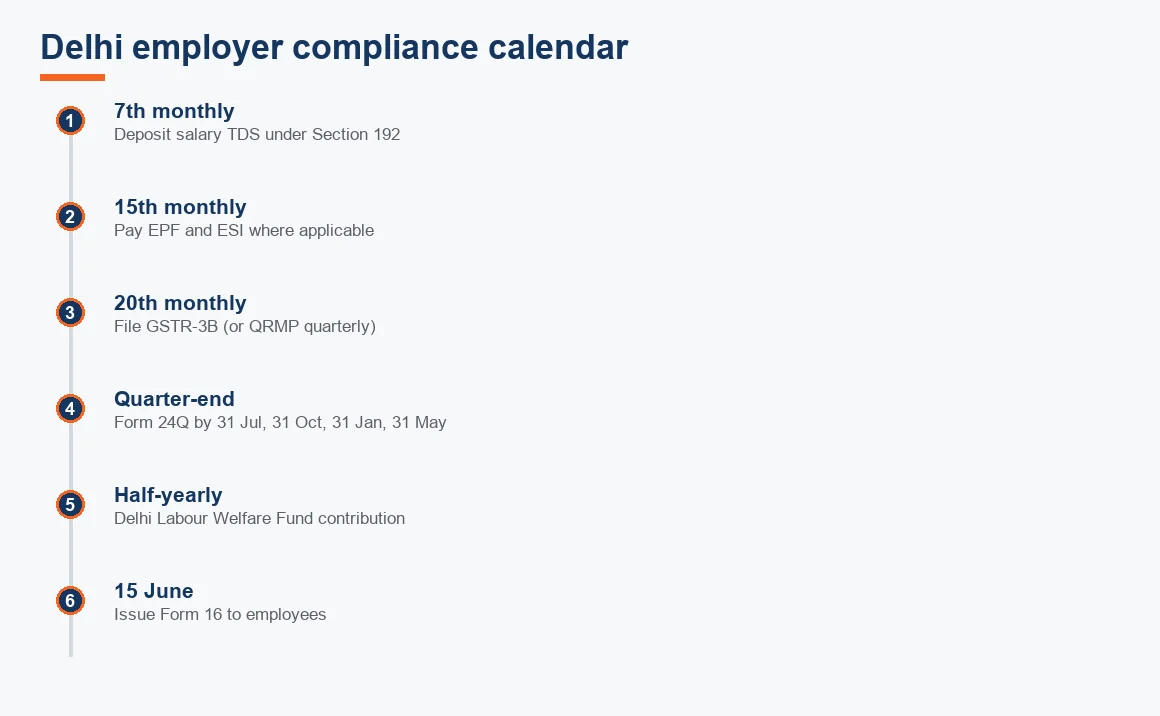
Getting the calendar right is the whole game: a missed TDS deposit attracts interest at 1.5% a month and a late Form 24Q draws a daily fee, neither of which is worth incurring on a Rs 3,500 liability. If you would rather hand the calendar to someone, compare providers first with our guide to choosing an accountant in Delhi and the 2026 price guide for accounting services in Delhi. The full-service option, with the Shops Act, GST and payroll run under one roof, sits on our Delhi accounting service page, and the underlying process, software and industry detail lives on the accounting and bookkeeping hub.
Key terms
- Delhi Nil Professional Tax Regime: Delhi does not levy professional tax, so no PT is deducted or remitted from salaries.
- MCD Commercial Trade Licensing: the municipal trade or health licence for certain premises, separate from the Shops Act.
- GSTR-2B Input Tax Credit Matching: reconciling purchase credit against the auto-drafted GSTR-2B before claiming it.
- NCR Inter-State GST Reconciliation: aligning place-of-supply and credit across Delhi, Gurugram and Noida transactions.
- Section 194Q TDS on Goods: TDS on purchases of goods above the annual limit, deducted from vendor payments.
Key takeaways
- Delhi has no professional tax: zero the PT line in your payroll software and never file a PT return.
- Shops and Establishment registration is compulsory for every establishment regardless of headcount, within 90 days, online through the Labour Department.
- The real payroll registrations are EPF at 20 employees, ESI at 10 (wages up to Rs 21,000), TAN for salary TDS and the half-yearly Delhi LWF.
- Salary TDS is due by the 7th (30 April for March), Form 24Q quarterly, Form 16 by 15 June.
- GST and TDS run on the ordinary national calendar; keep the Section 33 registers reconciled to payroll every month.
Decision guide