
In this guide
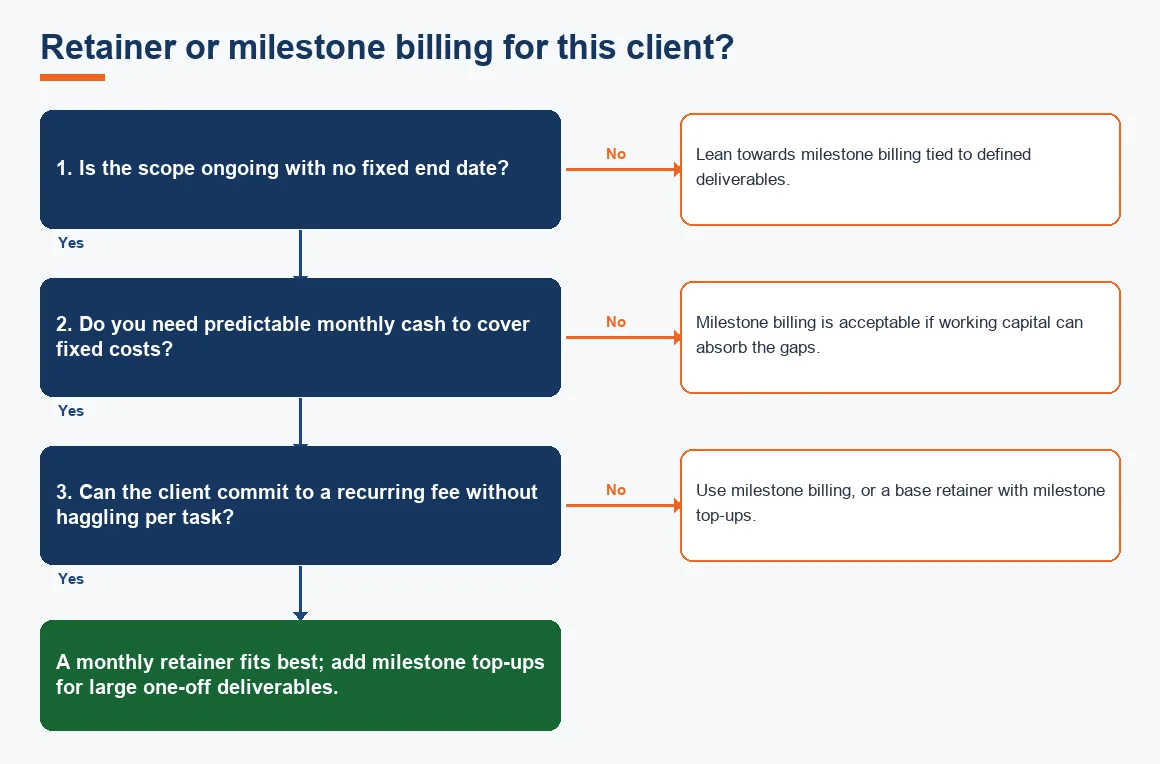
The difference between retainer vs milestone billing comes down to what triggers the invoice. A retainer charges a fixed fee each period (usually a month) for ongoing access to your team, so billing is tied to time. Milestone billing charges an agreed amount only when a defined stage of work is delivered and accepted, so billing is tied to output. For an Indian agency the choice is not just commercial: it decides when you recognise revenue, when GST becomes payable, and how long your cash stays locked between doing the work and collecting for it. This guide explains both models, the accounting behind them, and a worked example. If you want us to set up the ledgers, that sits with Service Sector Accounting (Project Billing).
What is a retainer in billing?
A retainer is a recurring fixed fee a client pays to keep your team available for an agreed scope over a period. It is the model behind most monthly agency, consultancy and managed-service contracts. The client pays whether or not they use every hour, in exchange for guaranteed priority and a predictable relationship. Two flavours exist in practice: a pay-for-access retainer where the fee simply reserves capacity, and a pay-for-work retainer that includes a block of hours or deliverables each month. The accounting for unused hours turns entirely on this contract wording, which we return to below.
How does retainer pricing work?
Retainer pricing is normally set by estimating the monthly hours or deliverables a client needs, applying your blended rate, and rounding to a round monthly number. Many agencies build in a small discount versus ad-hoc rates in return for the commitment and the smoother cash flow. Because the fee recurs, a retainer book behaves like monthly recurring revenue, which is easier to forecast and to value than one-off project income.
What does milestone billing mean?
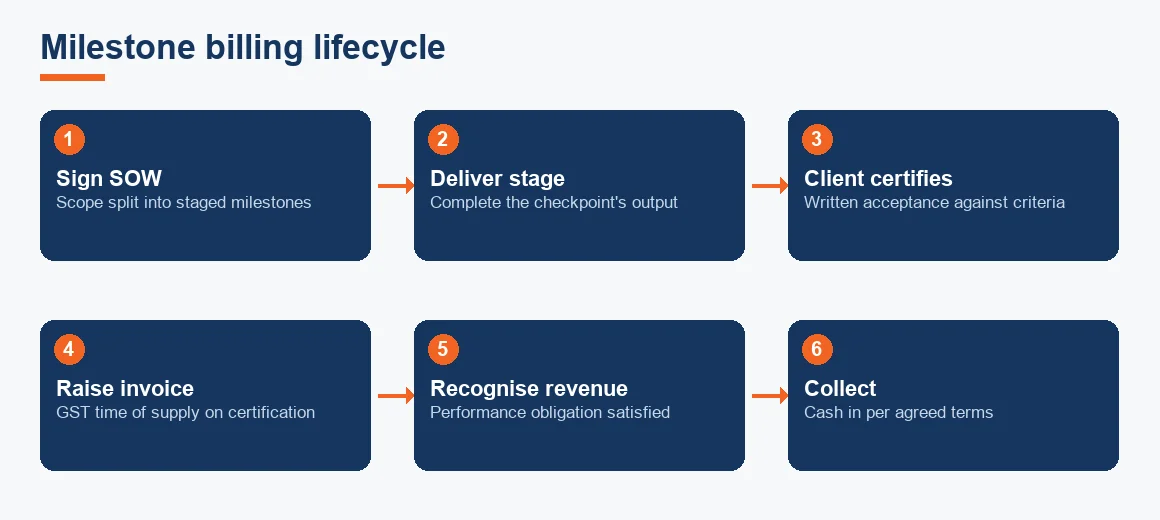
Milestone billing means the total project fee is split across defined checkpoints, and each checkpoint becomes payable when its deliverable is completed and signed off. A website build might bill 25% on design approval, 50% on development sign-off and 25% on go-live. Milestones link cash to progress, which protects both sides: the client pays for demonstrable output, and you are not carrying the full project cost to the end. The trade-off is that a single delayed sign-off holds up the whole invoice for that stage.
What is the difference between progress payment and milestone payment?
People use these terms loosely, but they are not identical. A milestone payment is triggered by an event: a specific deliverable is accepted. A progress payment is triggered by measured completion: you bill for the proportion of work done in a period, often certified as a percentage. Milestones are common in agency and software work where deliverables are discrete; progress payments dominate construction and long engineering contracts where output is continuous and measured by a surveyor or engineer. In revenue-recognition terms, progress payments align naturally with the percentage of completion method, while milestones align with recognising revenue as each performance obligation is satisfied.
Retainer vs milestone billing: the core comparison
The table below sets the two models side by side on the points that actually change your books and your bank balance. It is the fastest way to see why many Indian agencies run a base retainer with milestone top-ups rather than choosing one outright.
| Dimension | Retainer | Milestone billing |
|---|---|---|
| Invoice trigger | Passage of time (monthly) | Deliverable accepted |
| Revenue predictability | High and recurring | Lumpy, tied to sign-offs |
| Cash conversion cycle | Shorter, roughly 45 days on 15-day terms | Longer, 90 days or more if a stage slips |
| Best suited to | Ongoing scope, managed services | Defined-scope projects |
| Main risk | Scope creep beyond the fee | Delayed acceptance parks the invoice |
| GST time of supply | Every month on invoice or advance | On milestone certification or advance |
What is the difference between a retainer and a fixed fee?
A fixed fee is a single agreed price for a defined piece of work, billed once (or in instalments) and closed when the work is done. A retainer is a fixed fee that recurs for continuing access, with no natural end date until someone gives notice. So a fixed fee answers "what does this project cost?", while a retainer answers "what does keeping us on call cost each month?". The confusion arises because a milestone schedule breaks a fixed-fee project into parts, which can look like a retainer's regular billing, but the trigger is different: a milestone waits for a deliverable, a retainer waits for the calendar.
What are the disadvantages of a retainer fee?
Retainers are not free of problems. The most common is scope creep: because the fee is fixed, clients tend to push more work into the month than the retainer was priced for, quietly eroding your margin. Track this with project profitability tracking for a services business so you can renegotiate before a client account turns loss-making. Other drawbacks include client churn hitting recurring revenue in one step, and the awkward month-end question of what happens to hours the client did not use. There is also a discipline cost: retainers can make a team complacent about logging time, which hides the true cost of serving each account.
Is a retainer an asset or liability?
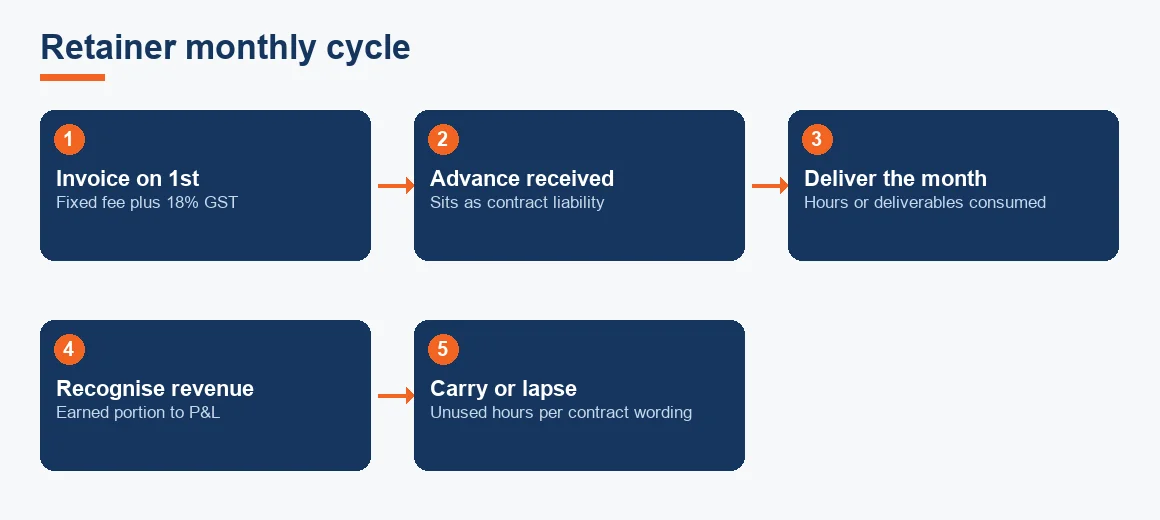
From the agency's side, a retainer received in advance is a liability, specifically a contract liability (deferred revenue), because you owe future service against money already collected. It only becomes revenue as you perform. From the client's side, a retainer paid in advance is a prepaid asset until the service is delivered. Under Ind AS 115 (and AS 9 for entities not on Ind AS), you recognise revenue as each performance obligation is satisfied, which is why the contract wording on lapsing versus carry-forward hours decides the entry. Where hours lapse each month, the whole retainer is earned that month; where they carry forward, the unconsumed slice stays as deferred revenue. A delivered-but-uncertified milestone works the other way: the cost sits as unbilled revenue or work in progress until acceptance lets you invoice.
Types of billing methods for service firms
Retainer and milestone are two points on a wider menu Indian agencies use. Knowing the full set helps you match the model to the engagement rather than forcing every client into one pattern.
- Retainer: fixed recurring fee for ongoing access.
- Milestone: staged payments on accepted deliverables.
- Fixed fee: one price for a defined project.
- Time and materials: billed on actual hours at agreed rates, common for open-ended work.
- Progress or percentage-of-completion: billed on measured completion, used in long contracts.
- Value or outcome based: tied to a result, rare and hard to certify.
Whichever you pick, the GST and TDS treatment follows the invoice, not the label. A consultancy retainer and a milestone both attract GST on the service value, and clients paying professional fees deduct TDS, which you reclaim as covered in Section 194J TDS and how consultants claim credit via 26AS and AIS. Cross-border SaaS and IT engagements add place-of-supply questions handled in GST on consultancy services in India.
Worked example: GST and revenue on a monthly retainer
Take an agency on a ₹1,00,000 per month retainer (indicative, Exl GST) at 18% GST, invoiced on the 1st with 15-day terms. The contract lets unused hours carry forward, and in month one the client consumes 80% of the block. GST on a service advance is payable at the time of supply even though only 80% is earned, so the tax and revenue timelines diverge. The journal entries are set out below.
| Step | Account | Debit (₹) | Credit (₹) |
|---|---|---|---|
| 1. Advance received (1st) | Bank | 1,18,000 | - |
| Contract liability (retainer) | - | 1,00,000 | |
| GST payable (output) | - | 18,000 | |
| 2. Revenue earned (80% consumed) | Contract liability (retainer) | 80,000 | - |
| Retainer revenue | - | 80,000 | |
| 3. Carried forward (20%) | ₹20,000 stays in contract liability until consumed | ||
The full ₹18,000 GST is paid to the government for that month regardless of the 80/20 split, because for services the tax point is the earlier of invoice or receipt of payment. Only ₹80,000 hits the profit and loss account, and ₹20,000 remains a liability. Had the contract said unused hours lapse, all ₹1,00,000 would be revenue in month one and the contract liability would clear to nil. The GST figure would not change either way.
Which model gives a healthier cash cycle?
For most agencies, retainers win on cash. A retainer invoiced on the 1st with 15-day terms turns into cash in roughly 45 days end to end, and it repeats predictably, which shortens your days sales outstanding. Milestone billing can leave 90 days or more between spending on a stage and collecting for it whenever certification slips, straining working capital precisely when the project is most active. That is why service firms often anchor a client on a base retainer for steady coverage of fixed costs, then add milestone top-ups for larger deliverables. The same logic applies whether you run a design studio, an IT and SaaS business, an IT and software company, or an early-stage startup.
Key terms
- Milestone vs Retainer Billing: the two invoice triggers, output-based versus time-based.
- Deferred Revenue (Unearned Revenue): cash collected for service not yet delivered.
- Ind AS 115 Revenue Recognition: recognise revenue as each performance obligation is satisfied.
- Unbilled Revenue (WIP Hours): work delivered but not yet invoiceable.
- Days Sales Outstanding (DSO): average days to collect a receivable.
If you are unsure whether Ind AS applies to your firm before choosing how to present these balances, our Ind AS Applicability Checker gives a quick read. For the statutory detail behind advances and credit notes, the authority is the CBIC guidance on time of supply and credit notes under the CGST Act and the GST portal, while the revenue-recognition standard sits with the ICAI.
Key takeaways
- Retainers bill on time; milestones bill on accepted deliverables. That single difference drives revenue timing and cash flow.
- Retainers usually shorten the cash conversion cycle; milestone billing can stretch collections when sign-offs slip.
- GST on a service advance is payable on receipt, so tax and revenue timelines rarely match.
- Carry-forward retainer hours are a contract liability; delivered-but-uncertified milestones are unbilled revenue or WIP.
- Many Indian agencies blend a base retainer with milestone top-ups to get predictable cash and fair project pricing.
Decision guide