In this guide
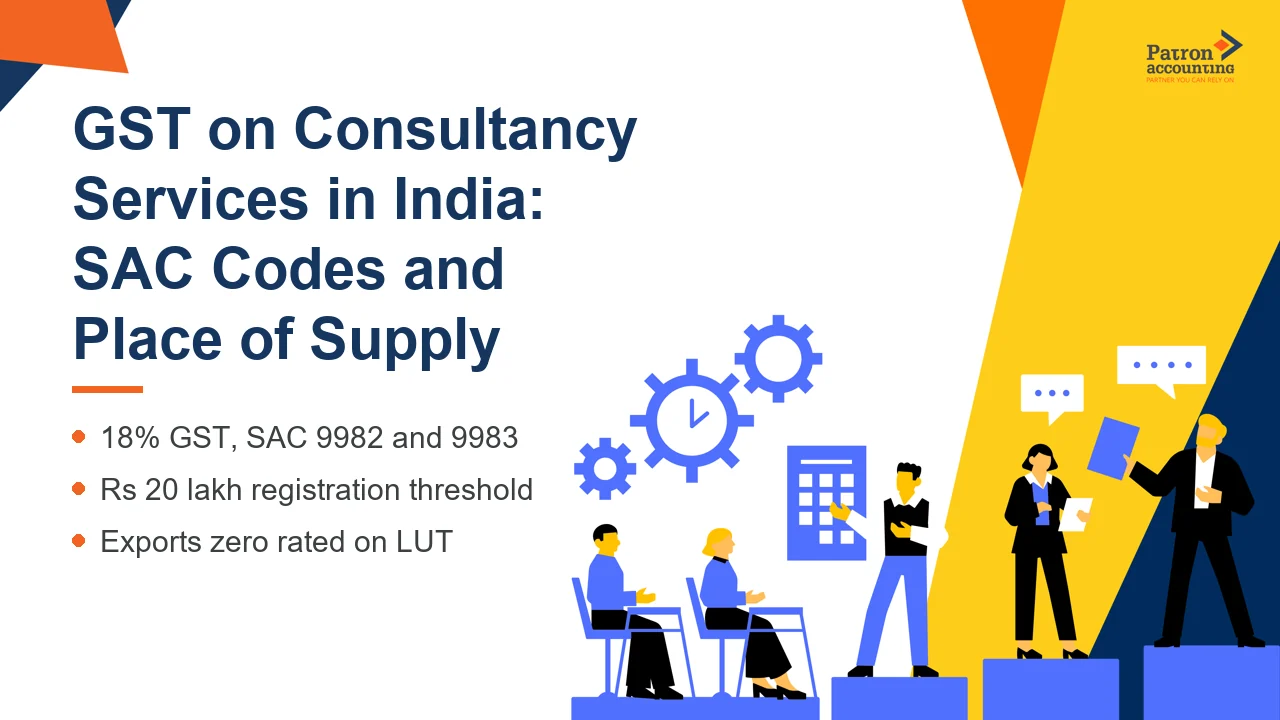
Yes, GST is applicable on consultancy services in India, and the rate is 18% across almost every kind of advisory work: management, technical, engineering, legal, financial and IT consulting. The service is classified under the SAC groups 9982 and 9983, no lower slab exists for professional consultancy, and the tax follows the place of supply. What changes from one consultant to the next is not the rate but whether registration is needed at all, how an inter-state or export invoice is treated, and what happens to expenses billed back to the client. This explainer works through each of those, with the arithmetic shown rather than assumed.
GST rate on consultancy services and SAC codes
Consultancy is a supply of service, so it carries GST at 18%. That single rate covers the whole spread of advisory work. The classification sits in two Service Accounting Code groups: 9982 for legal and accounting services, and 9983 for other professional, technical and business services, which is where most management, engineering and IT consultants fall. You quote the SAC on the invoice at the six digit level, for example 998311 for management consulting or 998312 for business consulting. The rate does not move with the code; every consultancy line under these groups is taxed at 18%. The Central Board of Indirect Taxes and Customs publishes the full rate and code schedule at cbic-gst.gov.in, which is the reference to cite if a client queries the classification.
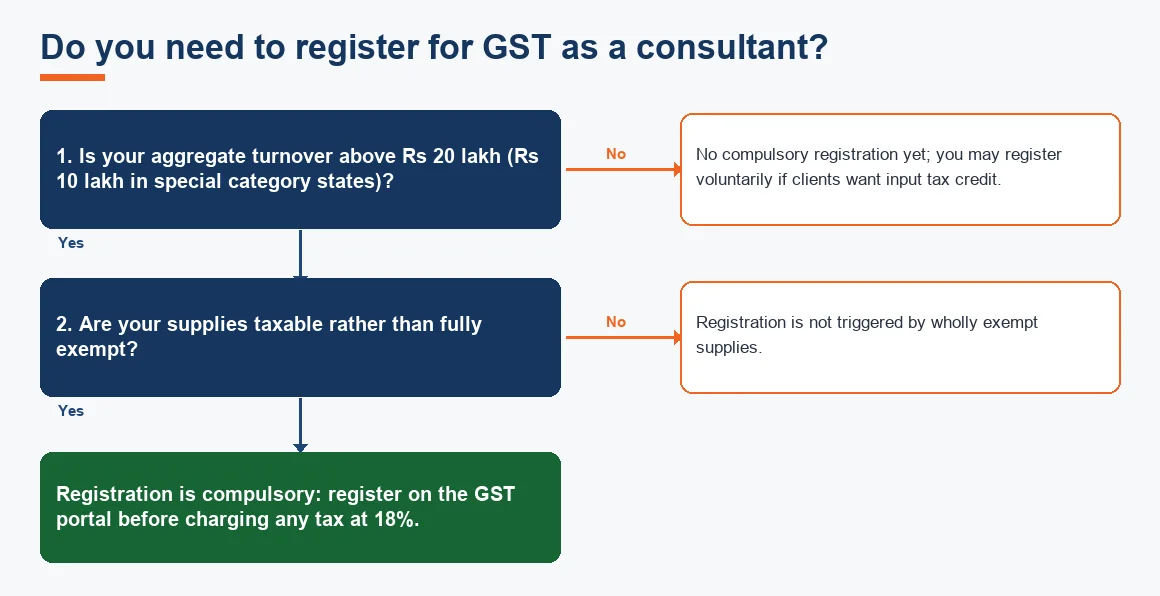
Do you need GST registration as a consultant?
Registration becomes compulsory once your aggregate turnover crosses Rs 20 lakh in a financial year. For consultants based in the special category states of Manipur, Mizoram, Nagaland and Tripura, the threshold is Rs 10 lakh. The higher Rs 40 lakh limit that people often quote applies only to suppliers of goods, never to services, so a consultant cannot rely on it. Below the threshold you may still register voluntarily, which is common when your clients are companies that want to claim input tax credit on your fee.
Aggregate turnover here means all your taxable, exempt and export supplies on the same PAN across India, not the income of a single client. Once you are within scope, registration on the GST portal is a prerequisite before you can charge any tax. If your consulting sits alongside a broader books-and-filings need, the informational picture here connects to hands-on Service Sector Accounting (Project Billing) for the commercial side of setting the practice up.
Which professional services are exempt from GST?
Very few genuine consultancy activities are exempt. The exemptions in the services space are narrow and specific: certain healthcare and educational services, some services to government, and a handful of others listed in the exemption notification. Ordinary management, financial, technical or IT consultancy does not fall into any of them. So the honest answer to "which professional services are exempt" is: for a working consultant, effectively none. What consultants more often use is not an exemption but a threshold (staying below Rs 20 lakh) or a zero rating (exporting the service), and those are different mechanisms with different paperwork.
Place of supply: intra-state, inter-state and export
The place of supply decides how the 18% is split, and getting it wrong is expensive to unwind. For consultancy provided to a registered business, the place of supply is generally the location of the recipient. Three situations follow from that:
| Scenario | Place of supply | Tax charged on an 18% fee |
|---|---|---|
| Client in the same state as you | Your state | CGST 9% + SGST 9% |
| Client in another Indian state | Client's state | IGST 18% |
| Client outside India (export) | Outside India | Zero rated, 0% on a LUT |
Export of services is zero rated under Section 16 of the IGST Act, provided payment is received in convertible foreign exchange and the recipient is located outside India. You have two routes: file a Letter of Undertaking and bill without tax, or pay IGST and claim a refund later. Either way, keep the FIRC or bank realisation evidence matched invoice by invoice, because that is what a refund officer will ask for. For software and IT-led consulting that exports regularly, the related build is covered under SaaS Accounting Services (IT & SaaS) and IT & Software Company Accounting Services, which handle the recurring export documentation.
GST on reimbursements and out-of-pocket expenses
If you book a client's travel, hotel or courier in your own name and then bill it back, that recovery is taxable at 18%, because it forms part of the value of supply under Section 15 of the CGST Act. The only way a reimbursement stays outside the taxable value is a strict pure agent arrangement under Rule 33, where you incur the exact third party cost on the client's authority, bill it separately at cost, and add no margin. Miss any of those conditions and the whole recovery is taxed. This is where a lot of consultants lose margin quietly, so it is worth setting the billing template up correctly from the first invoice.
The composition scheme option for consultants
A service provider can opt into the composition scheme up to Rs 50 lakh of turnover. Notification 2/2019-Central Tax (Rate) lets you pay 6% composition tax (3% CGST plus 3% SGST) on all supplies. The trade-off is real: no input tax credit on your own costs, and you cannot recover the tax from the client, so the 6% is an absolute cost out of your fee. Filing is CMP-08 quarterly with GSTR-4 annually. It suits a consultant selling mostly to individuals or unregistered clients who cannot use your credit anyway; it rarely suits one billing companies, who would rather take the 18% credit.
Step by step: how a consultant charges and files GST
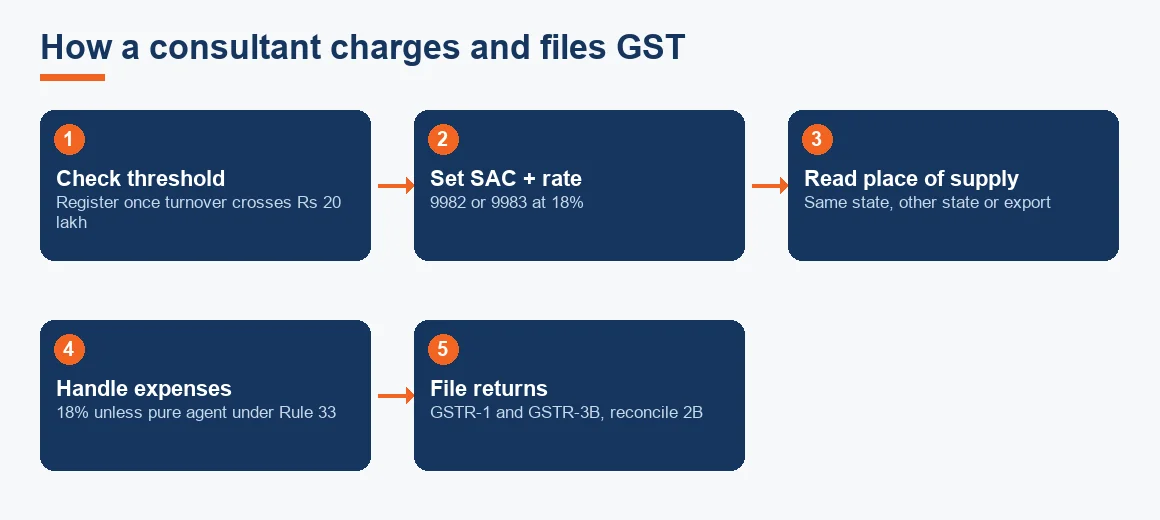
- Check the threshold. Track aggregate turnover across the PAN; register once it crosses Rs 20 lakh (Rs 10 lakh in special category states), or voluntarily if clients want the credit.
- Set the SAC and rate. Classify under 9982 or 9983 and apply 18% on every invoice.
- Read the place of supply. Same state means CGST plus SGST; another state means IGST; outside India means zero rated on a LUT.
- Handle expenses. Tax reimbursements at 18% unless the Rule 33 pure agent test is fully met.
- File the returns. GSTR-1 for outward supplies and GSTR-3B for the summary and payment, monthly or under QRMP, reconciling input credit against GSTR-2B.
Worked example: GST on a consultancy invoice
Take a Pune-based management consultant on a Rs 1,00,000 fee (indicative and Exl GST), with Rs 12,000 of travel recovered. The tax depends entirely on where the client sits. The figures below are arithmetically exact at the current 18% rate.
| Line | Client in Maharashtra | Client in Karnataka | Client in the USA (export) |
|---|---|---|---|
| Professional fee | Rs 1,00,000 | Rs 1,00,000 | Rs 1,00,000 |
| Travel recovered (not pure agent) | Rs 12,000 | Rs 12,000 | Rs 12,000 |
| Taxable value | Rs 1,12,000 | Rs 1,12,000 | Rs 1,12,000 |
| CGST 9% | Rs 10,080 | Nil | Nil |
| SGST 9% | Rs 10,080 | Nil | Nil |
| IGST 18% | Nil | Rs 20,160 | Nil (zero rated on LUT) |
| Invoice total | Rs 1,32,160 | Rs 1,32,160 | Rs 1,12,000 |
The total tax of Rs 20,160 is identical whether it is one IGST line or two CGST/SGST lines; only the split changes. On the export invoice the tax is nil, but the taxable value is still recorded and the foreign exchange receipt has to be evidenced. If travel had qualified as a genuine pure agent recovery, the Rs 12,000 would sit outside the taxable value and each tax figure would fall accordingly.
Filing calendar for a registered consultant
Once registered, the compliance rhythm is monthly or quarterly depending on turnover and whether you opt into QRMP. The recurring dates below are the ones that matter for a services practice.
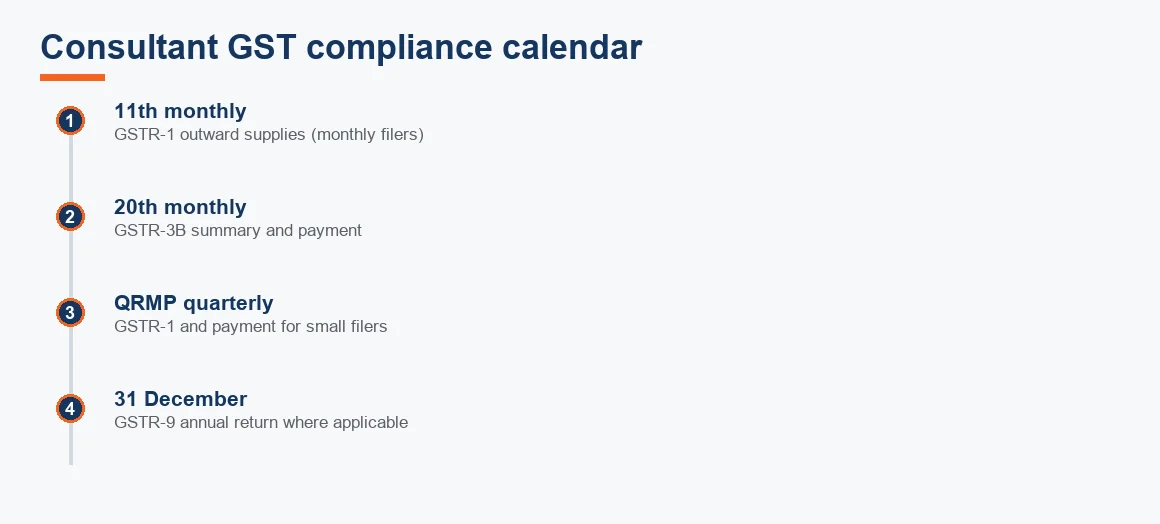
How this connects to your own books, from recognising revenue to tracking accounts receivable, is covered in more depth by sibling explainers on unbilled revenue and WIP and project profitability tracking, and the TDS side of your fee (which is separate from GST) is set out in Section 194J TDS for consultants.
Key terms
- GSTR-2B Input Tax Credit Matching: the auto-drafted statement you reconcile input credit against before claiming it in GSTR-3B.
- Foreign Currency Receivables: export invoices awaiting settlement in convertible foreign exchange, the evidence base for a zero-rated claim.
- Section 44ADA Presumptive Cap: the income-tax presumptive scheme many small consultants use; it is distinct from GST but caps eligibility by receipts.
- STPI / SOFTEX Export Filing: the export-documentation route relevant to software-led consulting billing overseas.
How this fits a consultant setting up in practice
If you are just starting out, the pattern is usually voluntary registration early (so corporate clients get their credit), an LUT if you export, and a clean two-line invoice template that separates fee from any reimbursement. New practices often pair this with wider setup support such as Startup Accounting Services India, and the choice between retainer and milestone billing (which changes when GST is triggered on advances) is weighed in retainer vs milestone billing. For the fixed-asset side of a new consultancy setup, a quick check with the depreciation calculator helps size the capital allowance, and LUT and refund functionality both live inside the same GST portal account.
Key takeaways
- Consultancy is taxed at a flat 18% under SAC 9982 and 9983; there is no professional-services discount rate.
- Register once aggregate turnover crosses Rs 20 lakh (Rs 10 lakh in special category states); the Rs 40 lakh limit is for goods only.
- The place of supply decides CGST plus SGST versus IGST, but the total tax is the same 18%.
- Exports are zero rated on a LUT or against a refund, with foreign-exchange evidence kept invoice by invoice.
- Reimbursed expenses are taxable at 18% unless the full Rule 33 pure agent test is met.
Decision guide