In this guide
Under Section 194J, a business that pays you professional or technical fees must deduct tax at source before releasing the money, and that deducted tax is not lost: it sits as a credit against your final income tax bill. For a consultant, 194J TDS is really two jobs. First, understand when the deduction applies and at what rate. Second, make sure every rupee deducted actually lands in your Form 26AS and Annual Information Statement so you can claim it in your return. This explainer walks through both, with a worked example and a reconciliation you can copy. It is an informational guide, not a filing service; if you want your books and returns handled end to end, see our Service Sector Accounting (Project Billing) page.
Is TDS applicable on consultancy services?
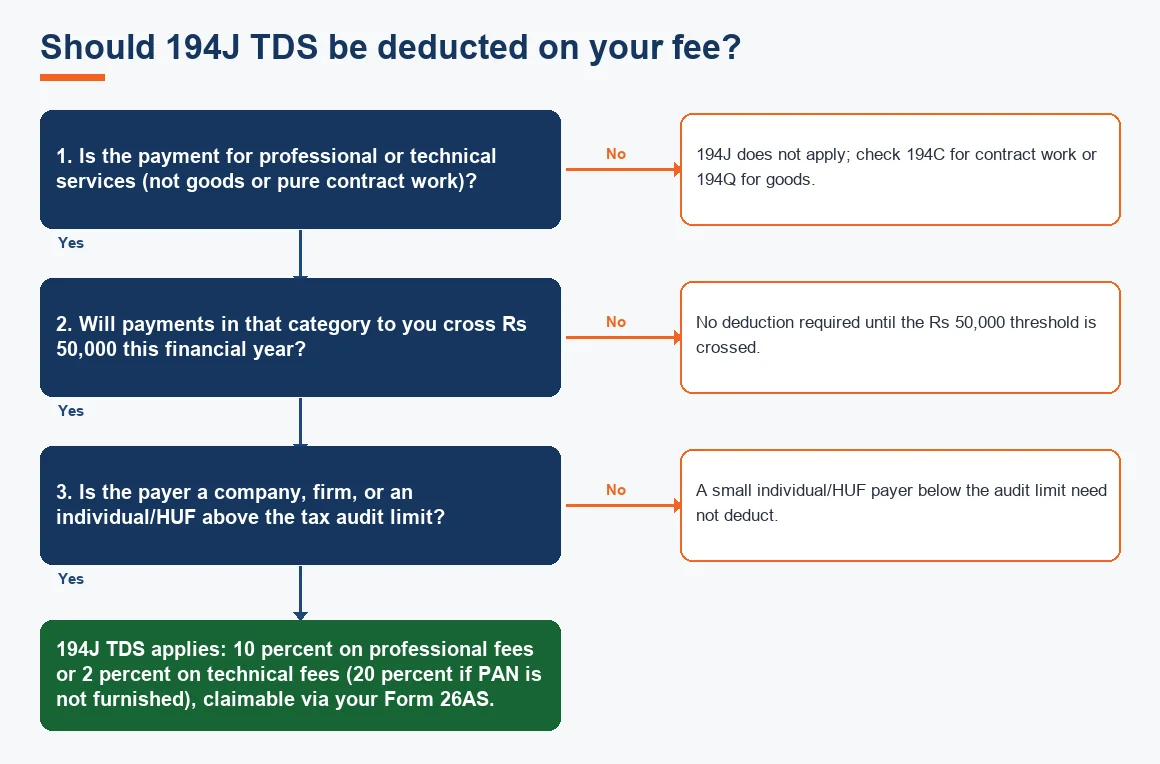
Yes. Payments for professional or technical services fall squarely within Section 194J of the Income Tax Act, so almost every company or firm that engages a consultant is required to deduct tax before paying. The obligation sits with the payer (the deductor), not with you, but the consequence lands on your cash flow because you receive the fee net of tax. The one relief is scale: an individual or HUF payer must deduct only if their turnover in the previous year crossed the tax audit limit, so a very small proprietor client may pay you gross. Companies, LLPs and firms deduct regardless of size. The Income Tax Department sets out the section in full on its official portal.
Note that 194J covers services, not goods. If a client buys goods from you above the annual threshold, that is Section 194Q territory, a different rate and a different clause; see Section 194Q TDS on Goods for the distinction.
What is the 194J TDS rate for consultancy services?
The headline rate is 10 percent, deducted on the fee value. Section 194J actually carries two rates, and getting the split right matters because it changes how much cash you receive up front:
- 10 percent on fees for professional services, royalty and non-compete payments.
- 2 percent on fees for technical services, call centre operations, and royalty for the sale of cinematographic films.
- 20 percent where you have not furnished a valid PAN, under Section 206AA. This is a penalty rate, easily avoided.
The letters in 194J simply refer to the section and its sub-clause in the Act; there is no hidden meaning to decode. One point that trips up many consultants: GST charged separately on the invoice is excluded from the deduction base. If your invoice shows the fee and the GST on distinct lines, the client deducts only on the fee. Where a single lump sum is billed with no GST breakup, tax may be deducted on the whole figure, so always itemise. The GST treatment of a consultant's invoice is a topic in its own right, covered in GST on Consultancy Services in India.
What is the difference between 194C and 194J?
This is the most common classification dispute, because the rate gap is real money. Section 194C applies to payments to contractors for carrying out work, at 1 percent (individual or HUF payee) or 2 percent (others). Section 194J applies to professional and technical fees at 10 percent or 2 percent. A designer running a print job on your brief may be a 194C contractor; the same designer giving branding strategy is a 194J professional. The contract wording and the true nature of the service decide the section, not the label on the invoice. The table below summarises where consultants usually land.
| Feature | Section 194C (contract work) | Section 194J (professional or technical) |
|---|---|---|
| Typical payee | Contractor executing defined work | Consultant, professional, technical expert |
| Rate | 1 percent (Ind/HUF) or 2 percent (others) | 10 percent professional; 2 percent technical |
| Annual threshold (FY 2025-26) | Rs 30,000 single / Rs 1,00,000 aggregate | Rs 50,000 per category |
| Deducted on | Contract value (GST excluded if shown separately) | Fee value (GST excluded if shown separately) |
| PAN not furnished | 20 percent under Section 206AA | 20 percent under Section 206AA |
What is the TDS limit for professional fees in FY 2025-26?
No deduction is required until payments in a given category to a single person cross Rs 50,000 in a financial year. This threshold was raised from Rs 30,000 with effect from 1 April 2025, giving smaller engagements more breathing room. Two features catch people out. First, the limit is per category, so professional fees and technical fees are counted separately. Second, once you cross Rs 50,000 the tax applies to the full amount for the year, not merely the slice above Rs 50,000. So a consultant billing Rs 60,000 across the year faces TDS on the whole Rs 60,000, not on Rs 10,000. Plan your cash flow on the assumption that a repeat client will breach the threshold early and deduct on everything thereafter.
How TDS reaches your Form 26AS and AIS
Deducting tax is only half the journey. The deduction becomes your credit only after the payer deposits it with the government and files a TDS return quoting your PAN. That return feeds two statements you should treat as your source of truth:
Form 26AS shows tax deducted, tax collected, advance tax and refunds against your PAN. The Annual Information Statement (AIS) is wider: it adds interest, dividend, securities transactions, foreign remittances and GST turnover reported by third parties, and it lets you file online feedback on wrong entries. For 194J, the deductor also issues you a quarterly Form 16A, which should tie exactly to what 26AS shows. If a client deducted tax but it does not appear in 26AS, the money is effectively stranded: your return will only allow credit for what the department can see. The fix is a correction to the deductor's TDS return, after which 26AS updates, not a manual override in your ITR. Reconciling these before filing is the single most valuable hour a consultant spends each year, and it sits alongside the same discipline used in GSTR-2B Input Tax Credit Matching on the GST side.
Step by step: from invoice to credit claimed
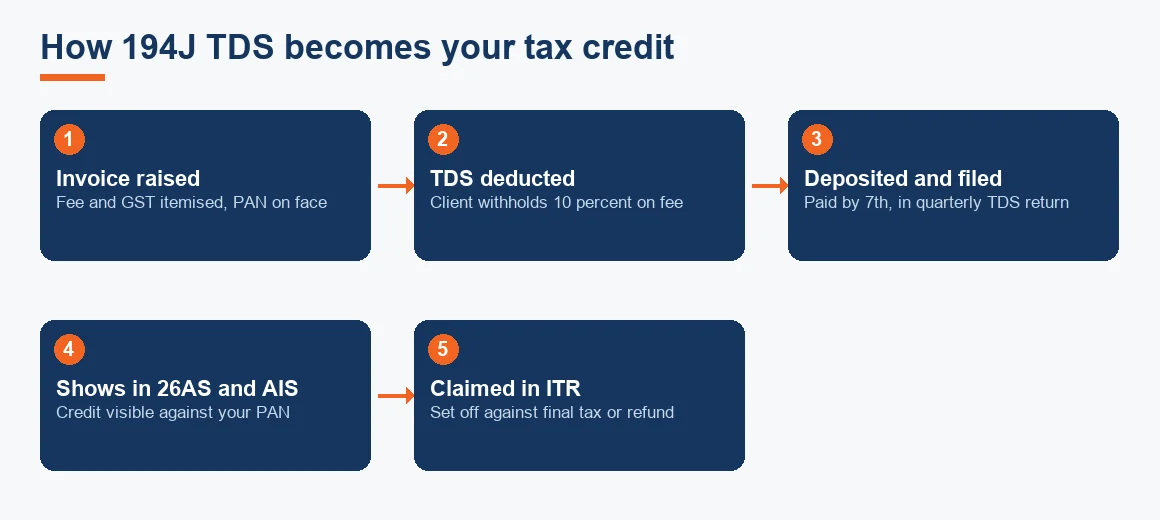
The lifecycle is predictable once you see it laid out. Follow the same sequence for every client so nothing slips.
- Raise a clean invoice with the fee and GST on separate lines and your PAN on the face of the document.
- Receive net payment. The client deducts 194J TDS and pays you the balance; record the gross fee as income and the TDS as a receivable, not as a discount.
- Client deposits and files. TDS is deposited by the 7th of the following month and reported in the quarterly TDS return.
- Check Form 16A and 26AS. Match the quarterly certificate and the 26AS entry to your own register.
- Claim in your ITR. Report the gross fee as professional income and set the 26AS TDS off against your final tax, carrying any excess as a refund.
Because you book the gross fee as revenue and the TDS as a receivable, your Accounts Receivable and prepaid tax stay clean, which matters if you follow Accrual Accounting. For a services firm the same rigour that tracks Unbilled Revenue (WIP Hours) keeps your TDS ledger honest, a point we expand in Unbilled Revenue and WIP for Service Firms.
Worked example: a Rs 5,00,000 consulting invoice
Assume you invoice a corporate client a professional fee of Rs 5,00,000 plus GST at 18 percent, itemised on separate lines. The client deducts 194J TDS at 10 percent on the fee only. All figures are indicative and exclusive of GST on the fee line.
| Line | Amount (Rs) | Note |
|---|---|---|
| Professional fee | 5,00,000 | 194J deduction base |
| GST at 18 percent | 90,000 | Excluded from TDS base |
| Invoice total | 5,90,000 | Fee plus GST |
| Less: 194J TDS at 10 percent | (50,000) | 10 percent of 5,00,000 |
| Net amount received | 5,40,000 | Cash into your bank |
| TDS credit in 26AS | 50,000 | Set off against final tax |
You still recognise Rs 5,00,000 as income and pay GST of Rs 90,000 to the government separately. The Rs 50,000 is not a cost; it is tax paid on your behalf, so it reduces whatever income tax you finally owe. If your total tax liability for the year is below Rs 50,000, the difference comes back as a refund once you file.
What is technical consultancy under 44ADA, and which ITR applies?
Fees for technical services means managerial, technical or consultancy services, including the provision of technical personnel, but excluding construction, assembly, mining or a project undertaken by the recipient, and excluding salary. These attract the lower 2 percent rate. Whether a service is technical (2 percent) or professional (10 percent) is where disputes arise, so describe the scope precisely in the contract.
On the return side, a resident consultant can declare professional income on a presumptive basis under Section 44ADA and file ITR-4, offering 50 percent of gross receipts as income without maintaining detailed books, subject to the Section 44ADA Presumptive Cap. A consultant who keeps regular books with a profit and loss account files ITR-3. Section 44ADA is open to a resident individual or partnership firm, but not to an LLP or a company; companies receiving 194J income file ITR-6. Either way, the 26AS TDS is claimed in the same fashion. If you operate as a software or IT consultancy, our SaaS Accounting Services (IT & SaaS) and IT & Software Company Accounting Services pages cover the wider compliance picture, and early-stage founders may prefer Startup Accounting Services India.
Reconciling 26AS mismatches before you file
Timing differences and PAN errors are the two usual reasons your 26AS does not match your books. A December invoice paid in January may show TDS in the Q4 statement, not Q3, so read across quarters before deciding a deduction is missing. A wrong PAN in the deductor's return will route your credit to someone else entirely. Where you spot a genuine gap, contact the client's accounts team, ask them to file a correction statement, and hold your filing until 26AS reflects it if the amount is material. The AIS feedback facility is useful for flagging clearly wrong entries, but it does not compel a deductor to correct their return; that still needs the correction statement. The discipline mirrors how agencies reconcile retainer and milestone billing and monitor project profitability across a portfolio of clients.
Key terms
- Section 44ADA Presumptive Cap: the receipts ceiling up to which a resident professional can offer 50 percent of gross receipts as income without full books.
- Section 194Q TDS on Goods: the parallel clause covering TDS on purchase of goods, distinct from 194J services.
- Accrual Accounting: recognising income when earned rather than when cash arrives, which keeps TDS receivables visible.
- Accounts Receivable: amounts owed to you by clients, against which deducted TDS sits as a separate receivable.
- GSTR-2B Input Tax Credit Matching: the GST-side reconciliation whose match-before-claim logic mirrors 26AS matching.
When professional advice pays for itself
For a consultant with a handful of clients, the 194J routine is a manageable annual habit: itemise invoices, book the TDS as a receivable, reconcile to 26AS, and claim in the right ITR. It gets harder when you cross the 44ADA cap, run technical and professional lines that attract different rates, or field mismatch notices. At that point a review by a professional is worth the fee. A deferred tax calculator can help you model the timing effect of large receivables if you maintain regular books. If you would rather hand off the reconciliation and filing altogether, our service sector accounting team handles the full cycle for consultants and agencies.
Key takeaways
- 194J deducts 10 percent on professional fees and 2 percent on technical fees; a missing PAN pushes both to 20 percent.
- The FY 2025-26 threshold is Rs 50,000 per category, and crossing it taxes the whole year's fees, not just the excess.
- GST shown separately on the invoice is excluded from the deduction base, so always itemise.
- Your claim is limited to what Form 26AS and AIS show; a shortfall is fixed by the deductor's TDS return correction.
- Reconcile 26AS client by client in late May, then file ITR-4 (44ADA) or ITR-3 (regular books) accordingly.
Decision guide