
In this guide
Unbilled revenue accounting is the practice of recognising income for work a service firm has already performed but has not yet raised an invoice for. Under accrual accounting, revenue belongs to the period in which the work was done, not the period in which the bill happens to go out. So if your team delivered work in March but the invoice only goes out in April, the value earned in March is booked as unbilled revenue at the year end. It sits on the balance sheet as an asset and it is one of the most misunderstood lines in service-sector books.
This is a common headache for consultancies, agencies, law firms and IT services businesses billing on retainers or milestones. If you run a project-based practice, the commercial help sits on our Service Sector Accounting (Project Billing) page; this article is the plain explainer of how the number actually works.
What is an unbilled revenue account?
An unbilled revenue account is a current asset that holds the selling value of services delivered but not yet invoiced. The name is misleading. Despite carrying the word revenue, it is not a revenue account: the revenue sits in your profit and loss statement, while the debit balance representing the amount you are owed sits on the balance sheet. Under Ind AS 115 it is formally called a contract asset, because your right to the cash is still conditional on either raising the invoice or completing a further step of performance.
Another name for it, used interchangeably in Indian practice, is accrued revenue or unbilled revenue on WIP hours. The idea rests on accrual accounting: match the income to the effort, regardless of billing dates.
Is WIP the same as unbilled revenue?
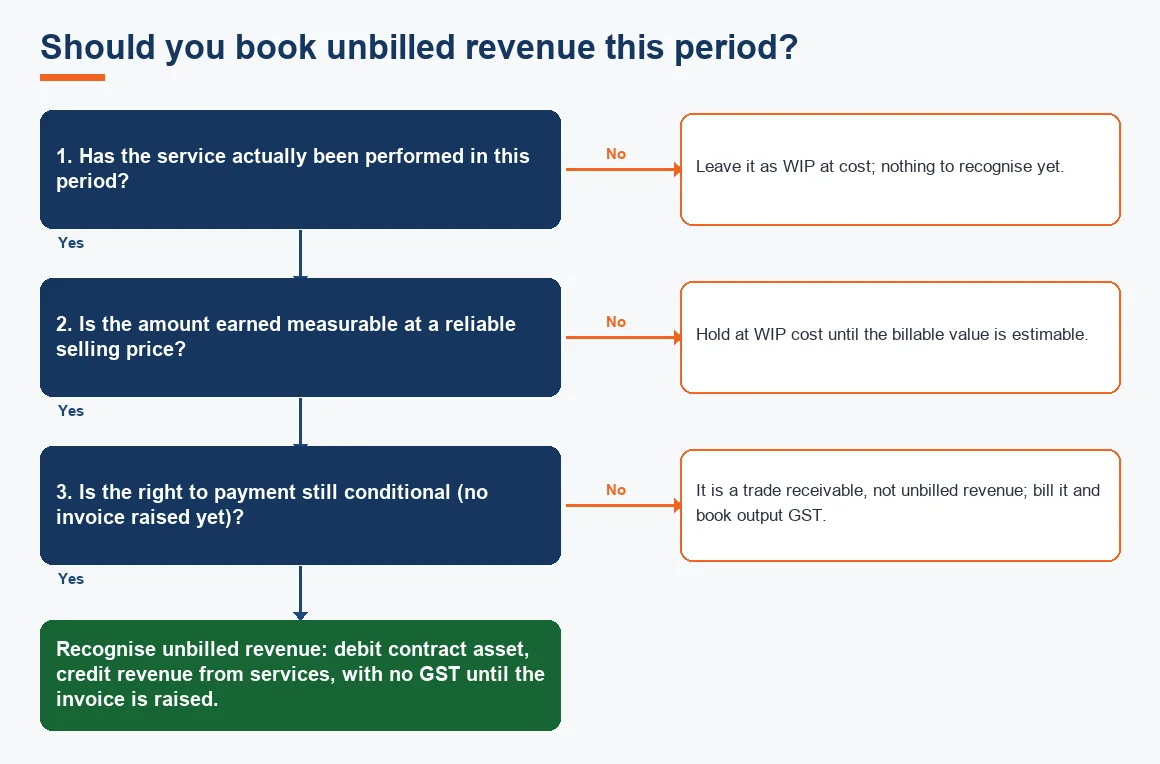
No, and confusing the two is the single most common error in service-firm books. Work in progress (WIP) is carried at cost: the salaries, subcontractor fees and direct expenses sunk into a job that is not finished. Unbilled revenue is carried at selling price: what the work is worth to the client once revenue has been recognised.
The distinction turns on whether you have recognised revenue for that performance. If you have not, the effort sits as WIP valuation at cost. Once the revenue recognition criteria are met, the same job flips to unbilled revenue at its billable value, and your margin on the work appears. A consultancy that has spent Rs 4 lakh delivering work billable at Rs 6 lakh shows either Rs 4 lakh of WIP or Rs 6 lakh of unbilled revenue, never both for the same slice of work.
Is unbilled revenue an asset or a liability?
Unbilled revenue is an asset, specifically a contract asset presented under current assets. It is a current asset because you expect to bill and collect it within the operating cycle. The reason it is an asset is simple: the firm has done the work and is owed money for it, so it holds economic value.
It is shown separately from trade receivables because the two represent different rights. A trade receivable is an unconditional right to cash backed by an invoice. Unbilled revenue is a conditional right, still dependent on raising the bill or finishing a milestone. Amounts you expect to bill more than twelve months out are reclassified to non-current assets.
Accrued vs unbilled revenue, and unbilled vs deferred revenue
These three terms get tangled constantly, so it helps to line them up. Accrued revenue and unbilled revenue are, in most Indian service-firm usage, the same thing: income earned but not yet invoiced. Deferred revenue is the mirror image: cash received in advance for work not yet done, which is a liability, not an asset.
| Item | What it means | Balance sheet side | Carried at |
|---|---|---|---|
| Work in progress (WIP) | Unfinished work, revenue not yet recognised | Current asset | Cost |
| Unbilled / accrued revenue | Work performed, earned, not yet invoiced | Current asset (contract asset) | Selling price |
| Trade receivables | Work invoiced, awaiting payment | Current asset | Invoice value |
| Deferred / unearned revenue | Cash taken in advance, work not yet done | Current liability | Amount received |
How do you record unbilled revenue? The journal entries
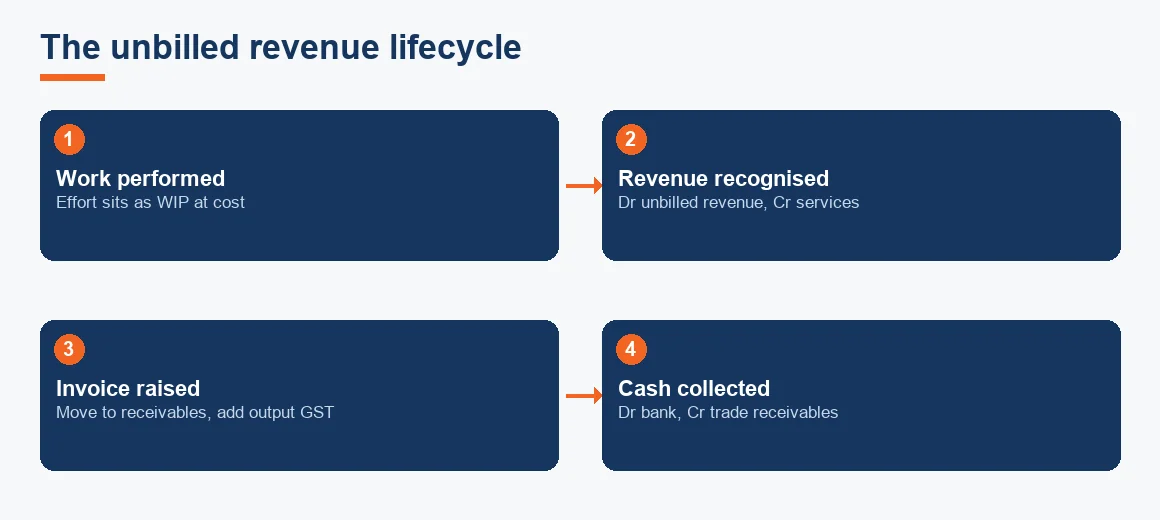
Recording unbilled revenue is a three-stage cycle. The journal entries below use accrual accounting and keep GST out of the picture until an invoice exists.
- Recognise the earned work at period-end. Debit unbilled revenue, credit revenue from services with the amount earned. No GST is recorded here, because the time of supply has not arisen.
- Raise the invoice. When the bill goes out, debit trade receivables, credit unbilled revenue with the same base amount, and credit output GST on the invoice value. This is the point at which GST becomes payable.
- Collect the cash. Debit bank, credit trade receivables. The contract asset has now fully converted to cash.
The critical control is that step 2 must clear the exact amount parked in step 1. If billing values drift from recognised values, your unbilled ledger will not empty, and that residue is what auditors chase. For firms weighing how they bill in the first place, our note on retainer vs milestone billing covers the trade-offs, and tracking project profitability shows how the recognised margin feeds your management reports.
Do you pay GST on unbilled revenue?
No, not at the point you recognise it in the books. GST is driven by the time of supply, not by accounting accrual. For services, the time of supply under Section 13 of the CGST Act is the earlier of the date of invoice (where the invoice is issued within the 30-day window allowed by Section 31) or the date of receipt of payment. Recognising unbilled revenue for accounting does neither, so no output GST attaches until you raise the invoice or receive payment. The Central Board of Indirect Taxes and Customs sets this out at cbic-gst.gov.in.
That said, do not let unbilled work sit indefinitely. If services are supplied but no invoice is raised within the time limit, the time of supply reverts to the date the service was provided. Delayed billing is a compliance risk, not just a cash-flow one. If your firm bills professional services, the mechanics of rates and place of supply are covered in our explainer on GST on consultancy services in India.
What is unbilled revenue in GSTR-9C?
Unbilled revenue is one of the standard reconciling items in Form GSTR-9C, the reconciliation statement between your audited books and your annual GST return. Your profit and loss turnover includes revenue you recognised on an accrual basis, including unbilled amounts. Your GST turnover only includes supplies where the time of supply arose during the year. The gap between the two is reconciled in the turnover adjustment rows of GSTR-9C.
In practice you add back the opening unbilled revenue (billed and taxed this year) and deduct the closing unbilled revenue (recognised in books but not yet a taxable supply). Getting this reconciliation clean each year is far easier when the unbilled ledger is reviewed monthly rather than reconstructed under deadline pressure. The GST portal for filing is gst.gov.in.
Worked example: recognising and then billing unbilled revenue
Suppose a consultancy completes a project phase in March 2026 worth Rs 6,00,000 (indicative, Exl GST), having incurred Rs 4,00,000 of direct cost. The invoice, with 18% GST, is raised on 12 April 2026. The entries flow as follows.
| Date | Account | Debit (Rs) | Credit (Rs) |
|---|---|---|---|
| 31 Mar 2026 | Unbilled revenue (contract asset) | 6,00,000 | |
| 31 Mar 2026 | Revenue from services | 6,00,000 | |
| 12 Apr 2026 | Trade receivables | 7,08,000 | |
| 12 Apr 2026 | Unbilled revenue (contract asset) | 6,00,000 | |
| 12 Apr 2026 | Output GST (18%) | 1,08,000 |
At 31 March the balance sheet shows Rs 6,00,000 of unbilled revenue and the P&L shows Rs 6,00,000 of income, giving a Rs 2,00,000 margin over the Rs 4,00,000 cost already booked. GST of Rs 1,08,000 appears only on 12 April, when the invoice creates the taxable supply, and the contract asset clears to nil.
Key terms
- Unbilled Revenue (WIP Hours): earned but uninvoiced work, held as a contract asset at selling price.
- Work-in-Progress (WIP) Valuation: unfinished jobs carried at accumulated cost, before revenue is recognised.
- Deferred Revenue (Unearned Revenue): advances received for work not yet performed, shown as a liability.
- Ind AS 115 Revenue Recognition: the standard that defines contract assets and when revenue is earned.
- Schedule III Balance Sheet: the format requiring unbilled revenue to be disclosed apart from receivables.
Where it goes wrong: disclosure and audit
The recurring problem is unbilled balances that never clear. Revenue recognised on work a client later disputes, or never formally accepted, has to be reversed in the following period. Auditors do not test unbilled revenue against invoices, they test it against evidence of performance: signed timesheets, milestone certificates and client acknowledgements, and then check whether the amount was actually billed after year-end. The Ministry of Corporate Affairs prescribes the Schedule III disclosure at mca.gov.in, and the Institute of Chartered Accountants of India publishes the underlying revenue standard at icai.org.
If you run a technology or subscription practice, the recognition timing interacts with your billing model, which we cover from the software angle on our SaaS accounting services and IT and software company accounting pages, and for early-stage firms on startup accounting services. To sense-check whether Ind AS 115 even applies to your entity, the Ind AS Applicability Checker and the AS vs Ind AS comparison matrix are a quick starting point. Consultants chasing TDS credit on the billed side should also see how to claim Section 194J credit via 26AS and AIS.
Key takeaways
- Unbilled revenue recognises earned-but-uninvoiced work so income lands in the correct period.
- It is a contract asset carried at selling price, shown separately from trade receivables under Schedule III.
- WIP is the same work carried at cost before revenue is recognised; the two never overlap for one job.
- No GST arises until the invoice is raised or payment received, because that is when time of supply occurs.
- Review the unbilled ledger monthly to keep GSTR-9C clean and avoid stale balances at audit.
Decision guide