In this guide
OTA reconciliation in hotel accounting is the process of agreeing the gross room tariff your property earned against the net amount an online travel agent such as MakeMyTrip, Goibibo, Booking.com or Agoda actually pays into your bank, once its commission, the GST on that commission and tax collected at source have been stripped out. Get it right and your revenue, your input tax credit and your bank balance all tell the same story. Get it wrong and the commission quietly vanishes into a smaller sales figure, understating both turnover and the tax you can reclaim. This guide sets out the working, not just the rule, for hotels doing their own Hotel & Restaurant Accounting.
What is OTA reconciliation?
An OTA, or online travel agent, is a platform that sells your rooms to guests and remits the balance to you after taking its cut. OTA reconciliation is the monthly discipline of taking each settlement statement the platform sends, matching every line to a booking in your books, and confirming that the payout equals the gross tariff less the deductions the platform is entitled to make. It sits alongside ordinary bank reconciliation but is a distinct exercise, because the deductions are contractual and tax-driven rather than accidental timing differences. Treated properly it is a form of marketplace settlement reconciliation, the same problem an e-commerce seller faces with Amazon or Flipkart, applied to room nights instead of parcels.
Why one OTA payout never matches a single day's revenue
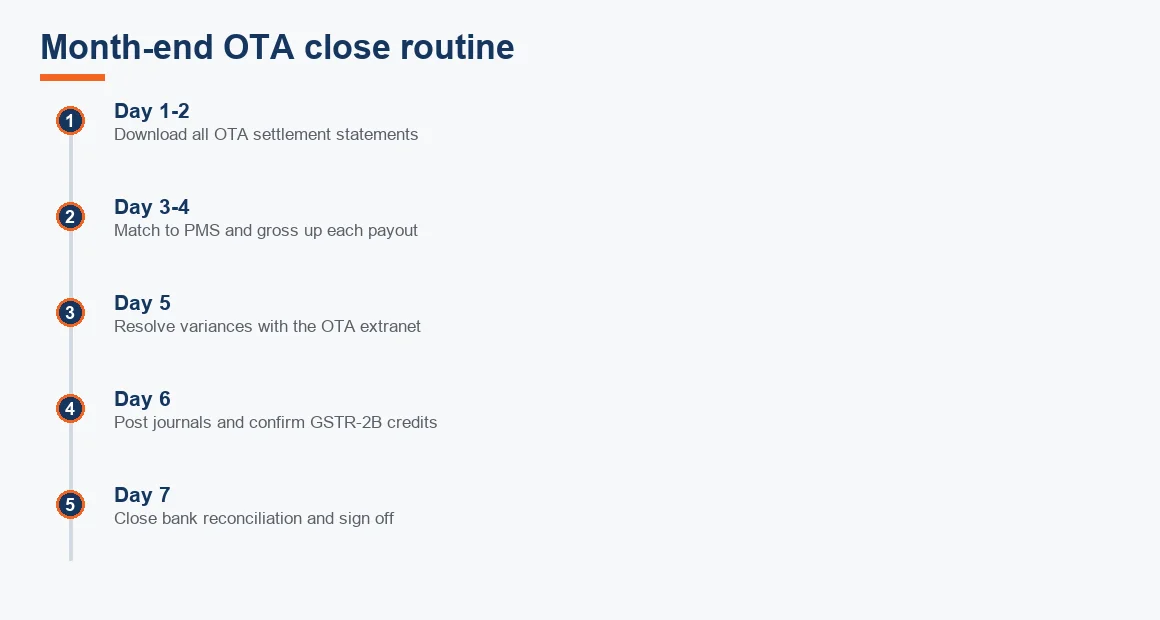
Reconciliation in the hotel industry means agreeing the room revenue recorded in the property management system (PMS) for a given period against what actually reached the bank from each channel: walk-in guests, corporate billing, card settlements and each OTA. The catch with OTAs is that a single remittance almost never lines up with a single day. A payout dated the 15th might settle four bookings that checked in on the 2nd, 6th, 9th and 11th, net of commission and TCS on all four. So the amount hitting your bank has no direct twin anywhere in your day book. The only way to prove it is to gross the payout back up, booking by booking, until the total ties to the statement. If you sell rooms across several platforms, this repeats for each, which is why the exercise belongs in a formal month-end routine rather than a quick glance at the passbook.
What deductions an OTA takes before it pays you
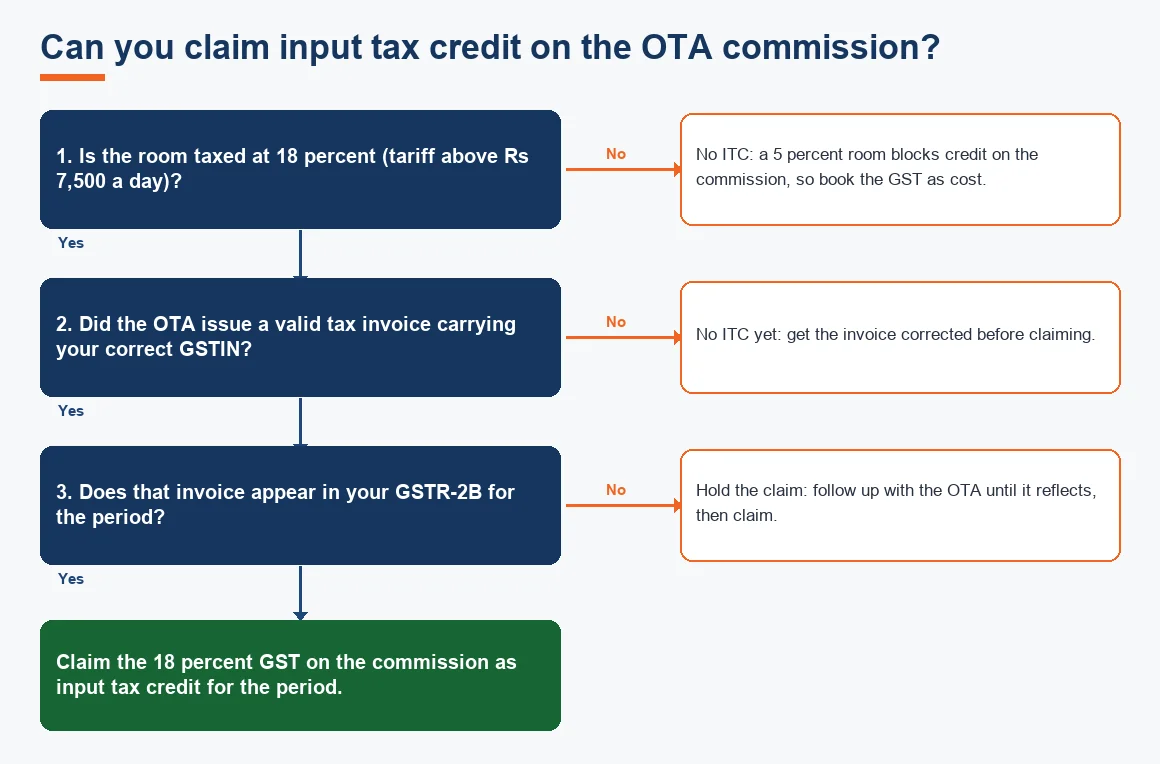
OTA fees for hotels are not a single number. A typical settlement carries three separate heads, and each lands in a different place in your ledgers. Commission is the platform's charge for the sale, usually a percentage of the tariff. On top of that the OTA charges 18 percent GST on its commission and issues you a tax invoice, which is your ticket to input tax credit. Finally, as an e-commerce operator it collects tax at source under section 52 of the CGST Act. Recording all three as one lump, or netting them off against sales, is where most hotels go wrong. The table below shows where each head belongs.
| Deduction on the OTA statement | What it is | Where it goes in your books |
|---|---|---|
| Commission | Platform's charge, a percentage of the room tariff | Selling expense (commission), debit |
| GST on commission (18%) | Tax the OTA charges on its own service | Input tax credit, debit (claim via GSTR-2B) |
| TCS under section 52 (0.5%) | Tax the OTA collects on your net taxable supply | TCS receivable, reaches electronic cash ledger |
| Net amount remitted | Tariff plus room GST, less the three heads above | Bank, debit |
How to reconcile OTA settlements step by step
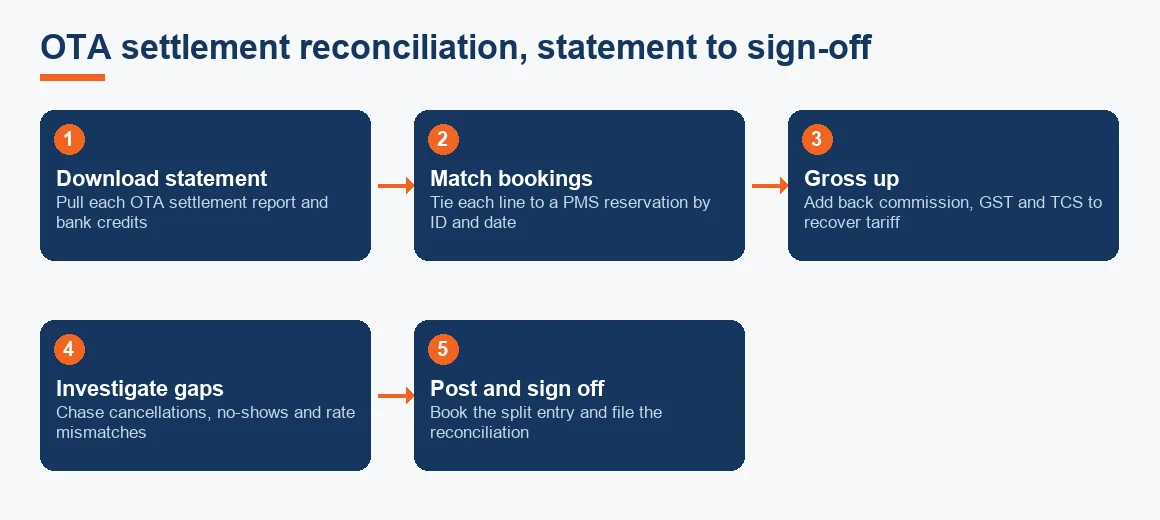
The generic five-step reconciliation process, gather, match, identify differences, adjust, then document, maps neatly onto OTA settlements. The five stages of reconciliation for a hotel channel are as follows.
- Gather the statement. Download the settlement or remittance report from each OTA extranet for the period, and pull the matching bank credits.
- Match booking by booking. Tie each line on the statement to a reservation in the PMS using the booking ID, check-in date and guest name.
- Gross each payout up. Add commission, GST on commission and TCS back to the net figure to recover the gross tariff, and confirm it equals what the PMS recorded.
- Investigate the differences. Chase cancellations, no-shows, rate mismatches, part payments and any booking that appears in one system but not the other.
- Post and document. Record the journal entry splitting revenue, commission, ITC, TCS and bank, then sign off the reconciliation and file the statement.
The three types of reconciliation a hotel runs
Ask what the three types of reconciliation are in a hospitality setting and the answer is best framed by what you are agreeing against what. First, bank reconciliation: your cash book against the bank statement, the classic timing exercise. Second, revenue reconciliation: the PMS night audit total against the revenue posted in the general ledger, proving nothing was missed between the front desk and the books. Third, channel or settlement reconciliation: each OTA and card acquirer statement against the bank, which is where commission, GST and TCS get untangled. The three feed each other. A clean OTA settlement reconciliation is what lets the bank reconciliation close without a pile of unexplained credits. For the deeper controls behind all three, a formal reconciliation and audit function keeps the process repeatable month after month.
Grossing up: recording the tariff, not the payout
Grossing up is the heart of OTA accounting. The principle is simple: revenue is the full tariff the guest paid for the room, not the trimmed amount the platform forwards. If a guest books a room at Rs 10,000 and the OTA remits Rs 8,000 after its charges, your sales figure is Rs 10,000, and the Rs 2,000 gap is broken out into commission, tax and TCS. This matters for three reasons. Your GST output liability is on the room value, so understating revenue understates the tax you owe and invites a mismatch notice. Your commission is a deductible business expense that also carries reclaimable GST, so hiding it costs you an input credit and a deduction. And your occupancy and room-night yield metrics only make sense on gross tariffs. The same logic drives the separate question of income-tax TDS under section 194H on aggregator commission, which we cover in its own guide.
Worked example: booking through an OTA, from tariff to bank
Take a single room sold through an OTA at a tariff of Rs 10,000 for one night. The room is above Rs 7,500 a day, so it carries 18 percent GST with input tax credit. The OTA's commission is 18 percent of the tariff, GST on that commission is 18 percent, and TCS is 0.5 percent of the net taxable value of Rs 10,000. All figures are indicative and Exl GST where noted.
| Line | Debit (Rs) | Credit (Rs) |
|---|---|---|
| Bank (net remitted) | 9,626 | |
| Commission expense (18% of 10,000) | 1,800 | |
| Input tax credit (18% GST on commission) | 324 | |
| TCS receivable (0.5% of 10,000) | 50 | |
| Room revenue | 10,000 | |
| Output GST payable (18% on room) | 1,800 | |
| Total | 11,800 | 11,800 |
The guest paid Rs 11,800 (Rs 10,000 room plus Rs 1,800 GST) to the OTA. The OTA kept Rs 1,800 commission, Rs 324 GST on that commission and Rs 50 TCS, then remitted Rs 9,626. Revenue is recorded at the full Rs 10,000, the Rs 324 becomes input tax credit once it shows in your GSTR-2B, and the Rs 50 TCS lands in your electronic cash ledger through the TDS and TCS credit received statement. The entry balances at Rs 11,800, and nothing has disappeared.
PMS and OTA: getting the two systems to agree
A PMS is your property management system, the software that holds reservations, the night audit and the guest folio; the OTA is the external sales channel. The two connect through a channel manager that pushes rates and availability out and pulls bookings in. Reconciliation is where you prove the connection held: every booking the OTA billed you for should exist in the PMS, and every OTA reservation in the PMS should appear on a settlement. Gaps usually trace to cancellations processed on one side only, rate parity overrides, or a booking modified after check-in. Because hotels also carry heavy fixed assets, remember that room refurbishment and equipment run on their own depreciation schedule quite apart from this channel work. The revenue discipline here is a cousin of the wider hospitality reporting we set out in the restaurant P&L guide and the food cost percentage guide, and it complements the slab detail in our GST on hotel rooms and restaurant food explainer.
Statutory anchors are worth checking at source. The 0.5 percent TCS rate and the section 52 mechanism sit with CBIC, the input tax credit condition that the invoice must appear in your GSTR-2B is enforced through the GST portal, and the move to a two-rate 5 percent and 18 percent split for hotel rooms on the actual value of supply, effective 22 September 2025, was notified by CBIC as well. The same settlement mechanics apply, with different sector rules, to firms we support in SaaS Accounting, broader IT & Software company accounting, and early-stage startup accounting, and they all rest on the standard accounting services a hotel needs to close its books cleanly.
Key terms
- Marketplace Settlement Reconciliation: agreeing a platform's net payout back to gross sales less each deduction.
- Online Travel Agency (OTA) Deductions: the commission, GST and TCS an OTA strips out before remitting.
- Section 52 TCS under GST: tax an e-commerce operator collects at 0.5 percent of net taxable value.
- GSTR-2B Input Tax Credit Matching: the auto-drafted statement that confirms an invoice is eligible for ITC.
- Room Night Occupancy Yield: revenue performance per available room, read on gross tariffs.
Key takeaways
- Record the full room tariff as revenue and split every OTA deduction into its own line; never book the net payout as sales.
- One OTA remittance settles several bookings across dates, so gross it up booking by booking to tie it back to the statement.
- Commission carries 18 percent GST that is reclaimable only when the invoice appears in your GSTR-2B.
- TCS at 0.5 percent under section 52 reaches your electronic cash ledger via the TDS and TCS credit received statement.
- ITC on commission is lost when the room is taxed at 5 percent, so track the two GST bands separately.
Decision guide