In this guide
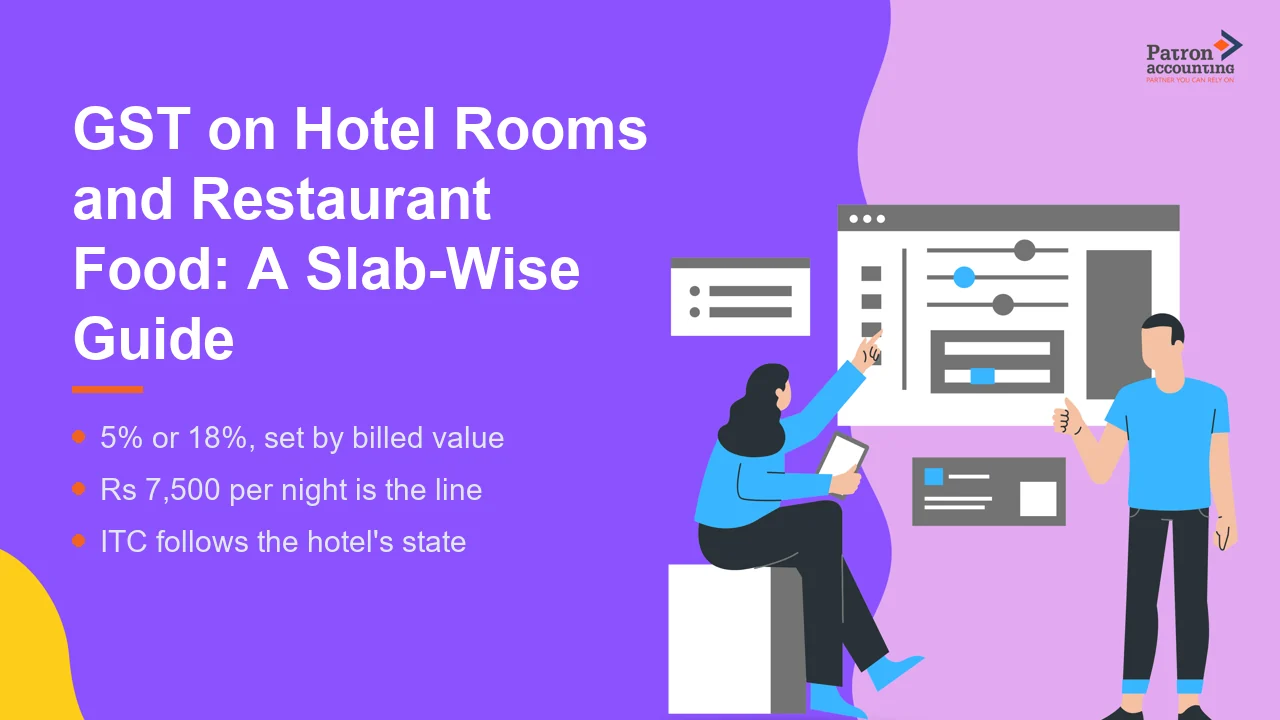
GST on hotel and restaurant supplies runs on two simple ideas: what you are billed for the room decides the room rate, and where the restaurant sits decides the food rate. A room charged up to Rs 7,500 per unit per day carries 5% with no input tax credit, while a room charged above Rs 7,500 carries 18% with full credit. Restaurant food is 5% without credit in most places, rising to 18% with credit only when the eatery is inside qualifying hotel premises. This guide sets out each slab with the working, so an owner or a finance team can read a bill correctly rather than guess. For the accounting side of running a property, our Hotel & Restaurant Accounting service covers the books; this article stays on the tax rule.
GST rate on hotel rooms: the Rs 7,500 line
Hotel accommodation is charged on the value of supply per unit per day. Where that value is up to Rs 7,500, the rate is 5% and the hotel cannot take input credit on its own costs for those rooms. Where the value crosses Rs 7,500, the rate is 18% and the hotel gets full input credit. The important change is that the declared tariff or rack rate no longer matters. From 1 April 2025 the Government withdrew the declared tariff concept, so the rate follows the amount actually charged for the night. A room with a printed tariff of Rs 9,000 sold on a discount at Rs 7,200 is taxed at 5%; the same room billed at Rs 8,200 is taxed at 18%. You can confirm the notification history on the CBIC GST portal.
GST on restaurant food: 5% versus 18%
A standalone restaurant, meaning one that is not inside qualifying hotel premises, charges 5% GST without input tax credit. This is the common rate you see at the great majority of eateries, cafes and takeaway counters across India. The higher 18% rate with credit is not a free choice; it applies only when the restaurant is located inside specified premises. So the honest answer to "is restaurant GST 5 or 18" is that 5% is the default and 18% is the exception tied to the hotel it belongs to. Outdoor catering supplied from such premises follows the same 18% rate. When you track menu margins alongside the tax, our note on food cost percentage for restaurants pairs well with this.
What are specified premises?
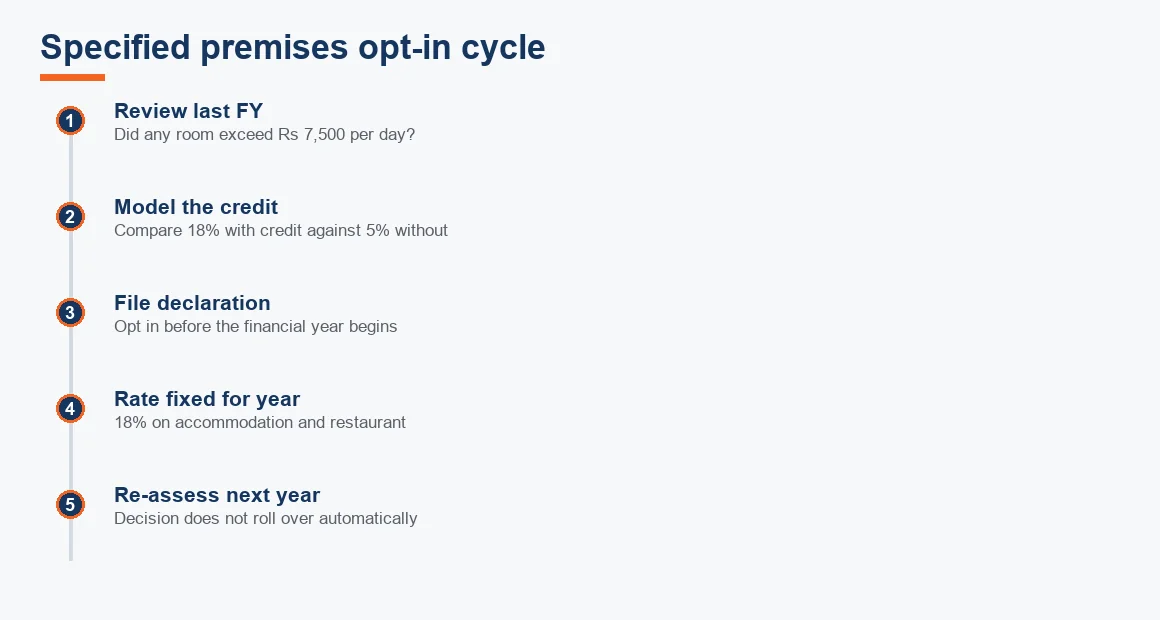
Specified premises is the phrase that decides whether a hotel restaurant sits at 5% or 18%. A hotel becomes specified premises for a financial year in either of two ways. First, by value: if any unit of accommodation in the hotel was supplied above Rs 7,500 per unit per day at any point in the preceding financial year, the restaurant inside it charges 18% with credit for the whole current year. Second, by choice: since 1 April 2025 a hotel that does not meet the value test can still opt in by filing a declaration before the financial year begins. That opt-in fixes 18% for both its accommodation and its restaurant, and it runs for the entire year with no mid-year switching.
Why a hotel might opt in
Opting into 18% is usually about credit. A property that spends heavily on refurbishment, rent, energy or agency commissions may prefer 18% with full input credit over 5% with none, because the credit it recovers can outweigh the higher output rate for its business clientele. This is a modelling exercise, not a default, and it should be checked each year before the deadline.
Can you claim ITC on a hotel stay?
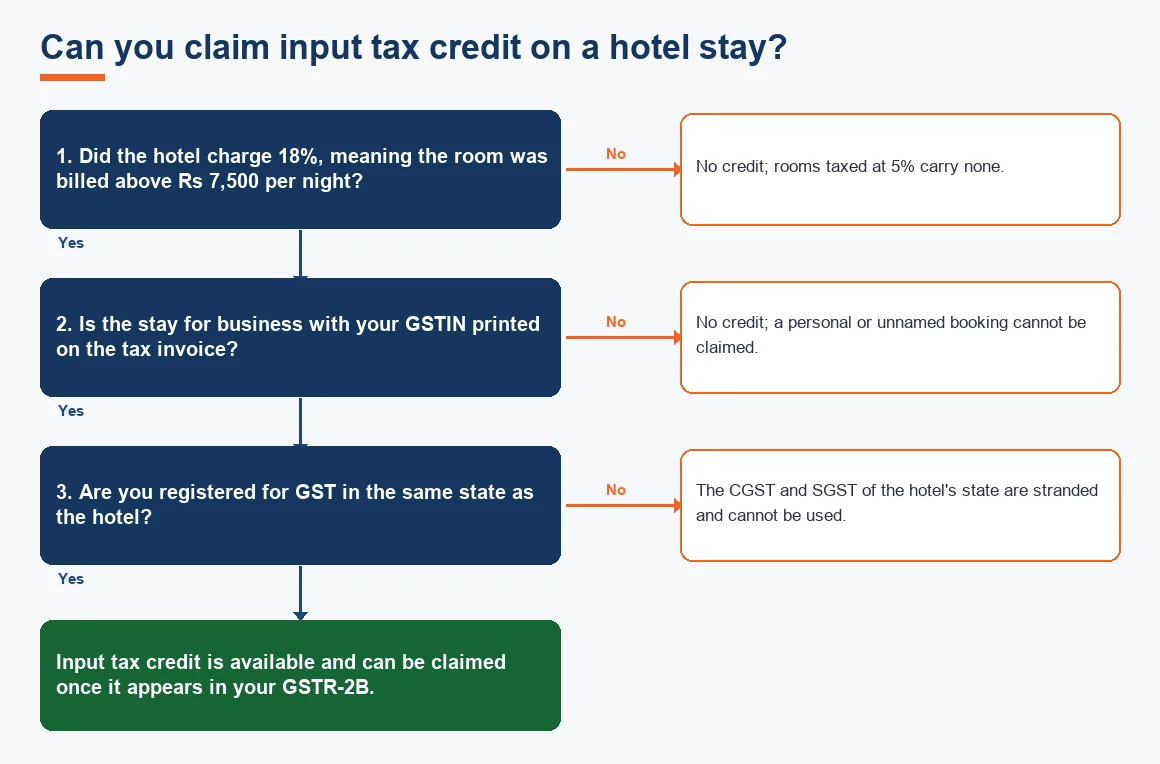
Input tax credit on accommodation is narrow. Three conditions must all hold: the hotel must have charged 18%, meaning the room was billed above Rs 7,500; the stay must be for business; and your GSTIN must appear on the tax invoice. Rooms taxed at 5% carry no credit at all, so no amount of paperwork rescues them. The catch that surprises most companies is place of supply. For accommodation, the place of supply is the state where the hotel physically stands. A Mumbai company whose staff stay in a Delhi hotel receives Delhi CGST and SGST on the invoice, and unless the company holds a Delhi registration it cannot use that credit. The rule is set out in the IGST place of supply provisions on the GST portal.
Reconciling what actually lands in your credit ledger is a monthly job. The rooms your staff stayed in should show up in your GSTR-2B input tax credit matching before you claim, and anything not reflected there should not be taken.
Room service, breakfast and bundled supplies
Not everything on a hotel folio follows the room rate. Food sent up as room service is billed to the guest, and it follows the restaurant rate rather than the accommodation rate. So in a specified premises hotel the club sandwich on room service is at 18%, tracking the restaurant, even though the room itself might have been a different figure. Breakfast works the other way: where it is bundled into a single room tariff and not separately priced, it is treated as part of the accommodation supply and taxed at the room rate. The moment breakfast is charged as a distinct line, it takes the restaurant rate. Getting the POS and PMS to split these correctly is worth a point-of-sale day-end audit so the day's revenue lands under the right tax head.
GST on hotel and restaurant at a glance
The table below summarises the slabs so you can match any line on an invoice to a rate and a credit position.
| Supply | Rate | Input tax credit | Condition |
|---|---|---|---|
| Room up to Rs 7,500 per unit per day | 5% | None | Based on value actually charged |
| Room above Rs 7,500 per unit per day | 18% | Full | Based on value actually charged |
| Standalone restaurant | 5% | None | Not inside specified premises |
| Restaurant in specified premises | 18% | Full | Room above Rs 7,500 last year, or opted in |
| Outdoor catering from specified premises | 18% | Full | Same specified premises test |
Worked example: reading a hotel folio
Take a two-night business trip at a hotel that is a specified premises, because it let rooms above Rs 7,500 last financial year. The room is billed at Rs 8,200 per night, the guest eats in the restaurant, and one meal goes up as room service. All figures are indicative and Exl GST. Because the room is above Rs 7,500 and the property is specified premises, every line here sits at 18%.
| Line item | Value (Exl GST) | Rate | GST | ITC eligible |
|---|---|---|---|---|
| Room: Rs 8,200 x 2 nights | Rs 16,400 | 18% | Rs 2,952 | Yes |
| Restaurant meals | Rs 3,000 | 18% | Rs 540 | Yes |
| Room service food | Rs 1,000 | 18% | Rs 180 | Yes |
| Total | Rs 20,400 | Rs 3,672 |
The Rs 3,672 is claimable only if the company is registered in the hotel's state and its GSTIN is on the invoice. Had the same guest paid Rs 7,200 a night at a budget property, the room lines would be 5% with no credit at all, and the arithmetic changes completely.
How to fix the right rate on each bill
The decision is mechanical once you break it into steps. Running it the same way every day keeps your general ledger clean and your returns defensible.
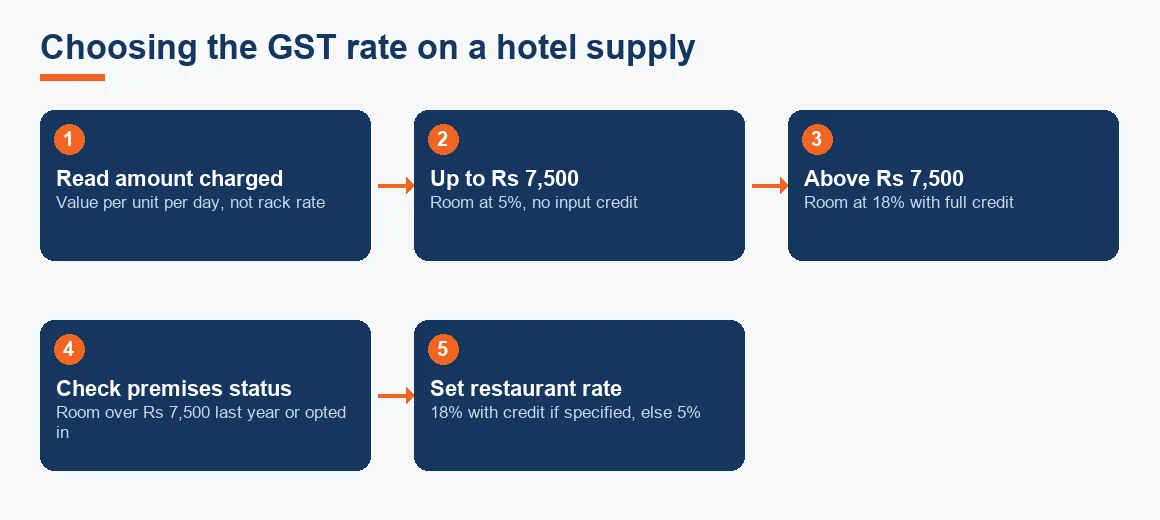
- Read the amount actually charged for the room per unit per day, not the rack rate.
- Up to Rs 7,500, apply 5% with no input credit; above Rs 7,500, apply 18% with full credit.
- Check whether the property is specified premises: did any room exceed Rs 7,500 last financial year, or has it opted in?
- If yes, the restaurant, room service and outdoor catering all move to 18% with credit; if no, the restaurant stays at 5% without credit.
- For breakfast, tax it at the room rate when bundled and at the restaurant rate when separately charged.
- Record the guest GSTIN and the hotel's state on the invoice so business credit is not lost later.
Where hotel GST meets your books
Rates are only half the job; the numbers still have to flow into revenue and cost reporting cleanly. Hotel and restaurant operators track occupancy through room night occupancy yield and kitchen efficiency through food cost variance percentage, and both sit alongside the GST you collect. Agency bookings add another layer: commission deducted by portals attracts its own tax handling, which we cover in Section 194H TDS on OTA and aggregator commission, while the settlement side is set out in how to reconcile OTA settlements in your books. To pull the whole picture together into a working statement, see how to build a restaurant P&L step by step. If your property runs on Ind AS, the depreciation calculator and the Ind AS applicability checker help keep the fixed-asset and reporting side straight.
Industry-specific accounting is not unique to hospitality: the same care over rate mapping and credit shows up for e-commerce sellers, for Startup accounting clients, and for IT & software companies and SaaS accounting businesses that run cross-state supplies. The tax rule differs by sector; the discipline of reading each invoice correctly does not.
Key terms
- GSTR-2B Input Tax Credit Matching: the monthly check that your claimed hotel credit actually appears in the auto-drafted statement.
- Room Night Occupancy Yield: revenue earned per available room night, the core hotel performance measure.
- Food Cost Variance Percentage: the gap between expected and actual kitchen cost as a share of food sales.
- Online Travel Agency (OTA) Deductions: commissions and charges portals net off before remitting your booking money.
- Point-of-Sale (POS) Day-End Audit: the daily reconciliation that maps each sale to the right tax head.
Key takeaways
- Room GST is set by the value actually charged: 5% no credit up to Rs 7,500, 18% with credit above it.
- The declared tariff concept ended on 1 April 2025; the billed figure now decides the slab.
- Restaurant food is 5% without credit unless the eatery is inside specified premises, where it is 18% with credit.
- Specified premises means a room above Rs 7,500 last year, or a voluntary opt-in filed before the year starts.
- Hotel-stay credit needs 18% on the bill, a business purpose, your GSTIN on the invoice, and registration in the hotel's state.
Decision guide