
In this guide
Section 194H requires any person, other than an individual or HUF not liable to tax audit, to deduct TDS on commission or brokerage paid to a resident. The current rate is 2 per cent, reduced from 5 per cent with effect from 1 October 2024, and no tax is deducted where the total paid to one person in the financial year does not cross Rs 20,000. The rule matters most in industries that pay agents and platforms, and it becomes tricky for hotels and restaurants where an online travel agent keeps its commission out of the payout rather than raising a separate bill.
What does Section 194H mean?
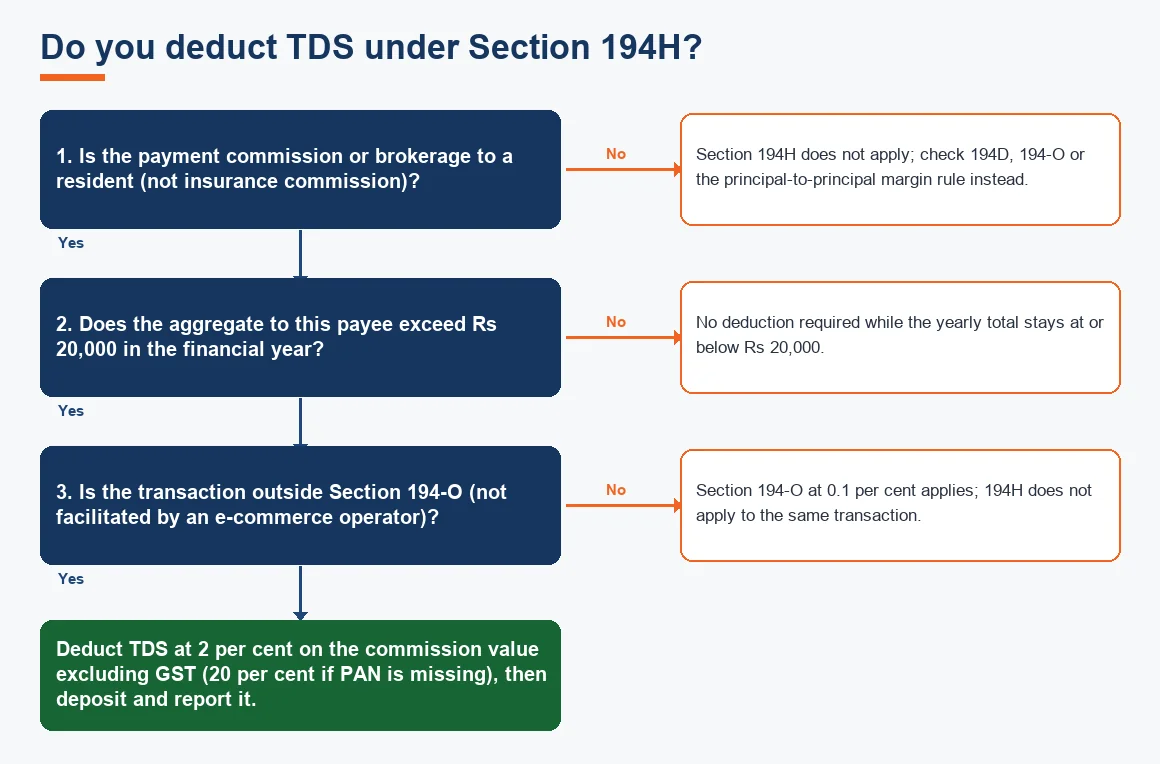
Section 194H of the Income Tax Act deals with tax deducted at source on any income by way of commission (not being insurance commission covered under Section 194D) or brokerage. Commission or brokerage here means a payment received or receivable, directly or indirectly, by a person acting on behalf of another for services rendered, for any services in the course of buying or selling goods, or in relation to a transaction relating to an asset, valuable article or thing. In plain terms, if you pay someone a fee for bringing you business or facilitating a sale, that fee is likely to attract Section 194H.
The person making the payment is the deductor. The agent, broker or platform receiving the fee is the payee. The deductor must withhold tax before releasing the amount and deposit it with the government. This is a compliance duty owned by the payer, and getting it wrong invites disallowance of the expense and interest, so it is worth understanding before the settlement lands. For the hospitality sector this sits alongside the wider bookkeeping we describe in our Hotel & Restaurant Accounting service.
What is the TDS rate under Section 194H?
The rate is 2 per cent of the commission or brokerage, applied with effect from 1 October 2024. Before that date the rate was 5 per cent, so payments straddling the change must use the rate applicable on the date of credit or payment, whichever is earlier. No surcharge or education cess is added for resident payees, so the flat 2 per cent is the full deduction. If the payee does not furnish a valid PAN, Section 206AA overrides this and tax is deducted at 20 per cent.
What is the 194H TDS limit?
No deduction is required where the aggregate commission or brokerage credited or paid to one person during the financial year does not exceed Rs 20,000. This threshold was raised from Rs 15,000 with effect from 1 April 2025. The test is cumulative across the year, not per invoice, so once total payments to a single agent cross Rs 20,000 you must deduct on the whole amount, including the earlier bills that individually sat below the limit. Track each payee's running total rather than judging each bill in isolation.
How does the OTA commission netting work?
This is where hotels most often trip up. When a platform such as an online travel agent books a room as agent for the hotel, collects the tariff from the guest and remits it net of its commission, the hotel has still, in law, paid that commission. The hotel is therefore treated as having paid commission and must deduct TDS under Section 194H on the gross commission, not on the reduced amount it actually receives. The netting is only a settlement convenience; it does not remove the deduction duty.
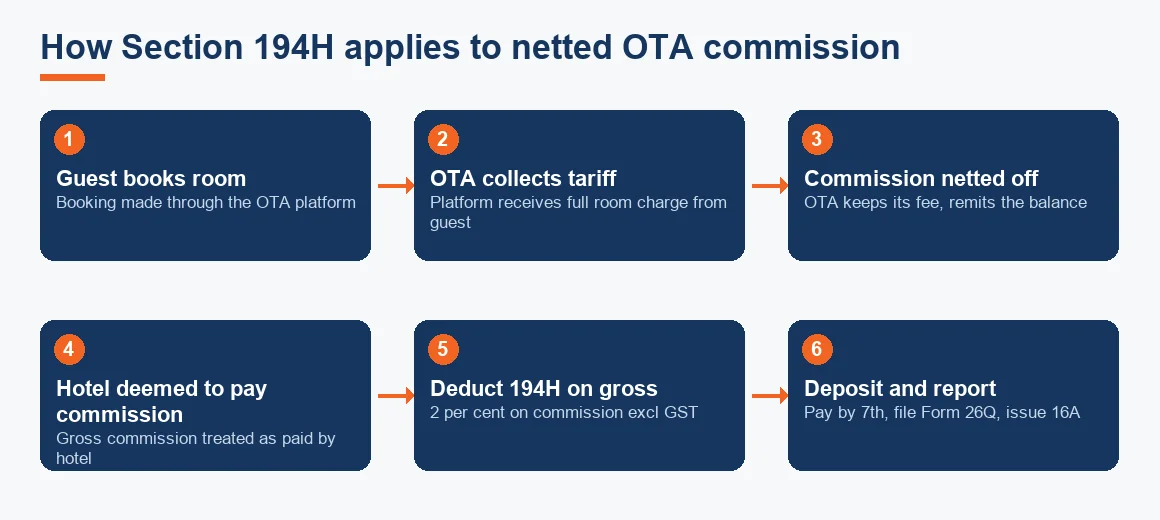
The distinction that changes everything is the commercial model. Where the platform buys room inventory on its own account and resells it at a margin, that margin is the platform's own trading profit, not commission for services, and Section 194H does not apply. Read the contract: an agency (commission) model attracts 194H, a principal-to-principal (merchant or net-rate) model does not. Reconciling these payout statements line by line is a task in its own right, which we cover in how to reconcile OTA settlements in your books.
How to calculate TDS on commission step by step
The mechanics are the same whether you receive a plain commission invoice or a netted settlement statement.
- Identify the commission or brokerage value for the period and confirm the payee is a resident.
- Strip out the GST if it is shown separately on the invoice; TDS is worked out on the value excluding GST.
- Check the payee's cumulative total for the year against the Rs 20,000 threshold.
- Apply 2 per cent (or 20 per cent if PAN is missing) to the commission value.
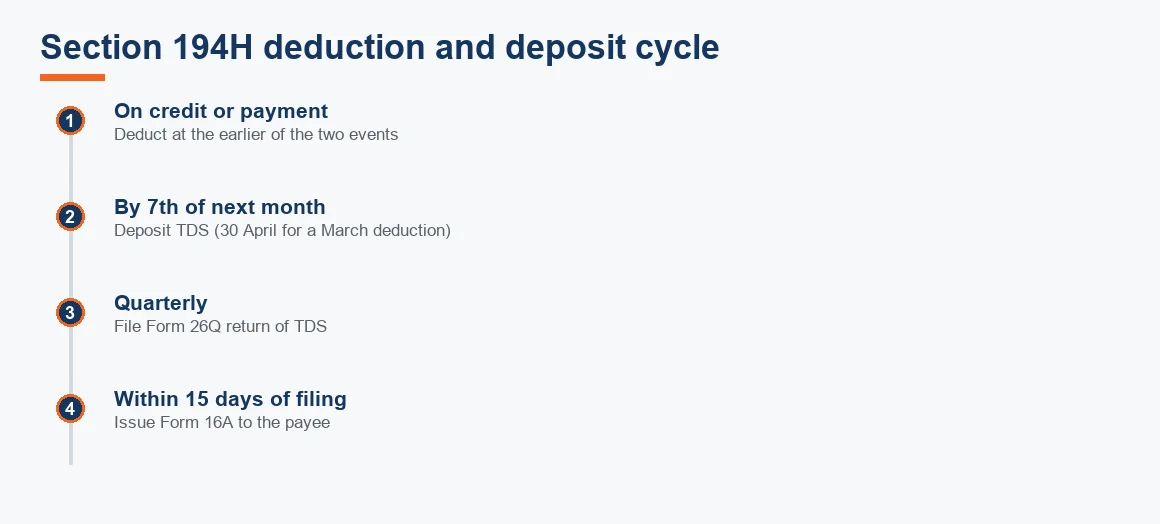
- Deposit the tax by the 7th of the following month (30 April for a March deduction) and report it in the quarterly Form 26Q.
- Issue Form 16A to the payee so they can claim credit.
Is TDS deducted on the GST part of a commission invoice?
No, as long as GST is shown separately. CBDT Circular 23 of 2017 confirms that for services, tax at source is deducted on the amount payable excluding the GST component when that tax is indicated distinctly on the invoice. If the agent quotes one consolidated figure without separating the tax, TDS applies to the whole amount. The practical lesson for agents is simple: always show GST on its own line so your customer deducts on the base commission only. This mirrors the discipline needed on marketplace settlements, tracked through marketplace settlement reconciliation.
Worked example: TDS on a month of OTA commission
Assume a hotel routes Rs 5,00,000 of room tariff through an online travel agent in a month on an agency model, and the platform charges 18 per cent commission plus GST, netting it off the payout. All figures are indicative and exclusive of GST where marked.
| Particular | Amount (Rs) |
|---|---|
| Room tariff routed through OTA (month) | 5,00,000 |
| OTA commission at 18 per cent of tariff (Exl GST) | 90,000 |
| GST at 18 per cent on commission | 16,200 |
| TDS under Section 194H at 2 per cent on commission (excl GST) | 1,800 |
| Commission net of TDS due to OTA | 88,200 |
| Net tariff remitted by OTA (5,00,000 − 90,000 − 16,200) | 3,93,800 |
The hotel books the commission of Rs 90,000 as an expense, the GST of Rs 16,200 as input tax credit where eligible, and the Rs 1,800 as TDS payable to the government. The credit side records what is due to the platform through accounts payable, and the entry is a standard multi-line journal entry.
How is commission income treated, and where does it go in the ITR?
For the agent receiving the commission, the income is almost always taxed under profits and gains of business or profession, because an agent runs an organised, continuing activity for a fee. It falls under income from other sources only where the receipt is isolated and there is no such activity. Section 194H governs only the deduction at source; it does not decide the head of income. In the return, business commission is reported in the profit and loss schedule of ITR-3 (or the presumptive schedule where Section 44AD applies), and the TDS shown in Form 26AS and the Annual Information Statement is claimed as credit against the final liability. A tool such as our deferred tax calculator helps where timing differences between books and tax affect the year-end provision.
Section 194H versus Section 194-O
The two provisions often look interchangeable but apply to different arrangements, and only one can govern a transaction. Section 194-O sits with the e-commerce operator and covers the gross value facilitated through the platform, while 194H sits with the payer of a specific commission. Where 194-O applies, 194H does not apply to the same transaction.
| Feature | Section 194H | Section 194-O |
|---|---|---|
| Applies to | Commission or brokerage paid to a resident | Sale of goods or services facilitated through an e-commerce platform |
| Who deducts | The person paying the commission | The e-commerce operator |
| Rate | 2 per cent | 0.1 per cent |
| Threshold | Rs 20,000 per payee per year | Rs 5,00,000 per year for individual/HUF furnishing PAN |
| Computed on | Commission value, excl GST if shown separately | Gross amount of sales or services |
A related provision worth distinguishing is Section 194Q on the purchase of goods, and on the GST side, marketplace collections are governed by Section 52 TCS under GST, which is separate from income-tax TDS altogether. Getting occupancy and rate reporting right also feeds the wider hospitality metrics such as room night occupancy yield.
Key terms
- Online Travel Agency (OTA) Deductions: the commission and charges a platform keeps back before remitting room tariff to the hotel.
- Marketplace Settlement Reconciliation: matching platform payout statements to bookings, commission and taxes in your books.
- Section 194Q TDS on Goods: TDS a buyer deducts on high-value purchases of goods, distinct from commission TDS.
- Section 52 TCS under GST: tax an e-commerce operator collects under GST law, separate from income-tax deduction.
The same commission mechanics show up in other platform-driven sectors we work with, from SaaS accounting and IT company accounting to startup accounting, and the surrounding hospitality reporting is covered in our guides on GST on hotel rooms and restaurant food, food cost percentage and building a restaurant P&L statement.
Key takeaways
- Section 194H TDS is 2 per cent on commission or brokerage to residents from 1 October 2024, with a Rs 20,000 annual threshold per payee from 1 April 2025.
- Where an OTA nets its commission off the payout on an agency model, deduct on the gross commission, not the net receipt; a merchant or net-rate model is not commission.
- Work out TDS on the value excluding GST only when GST is shown separately on the invoice.
- Section 194-O at 0.1 per cent overrides 194H for the same e-commerce transaction.
- Agree in the contract that platform settlements are net of statutory TDS, so the 2 per cent does not become an unrecovered monthly cost.
The statutory text of Section 194H and the current rates are published by the Income Tax Department, the GST treatment of the tax component rests on CBDT Circular 23 of 2017 available through the same portal, and GST invoicing rules are set out by the Central Board of Indirect Taxes and Customs. Always confirm the position for your specific settlement model before finalising a deduction.
Decision guide