


Talk to an Expert
Talk to an Expert ✆ +91 945 945 6700
Trusted by 10,000+ Businesses

Accounting for Hotels and Restaurants

Reviewed by CA and CS Team, Patron Accounting LLP ICAI & ICSI Registered| 15+ Years Experience| Last Updated: July 2026 Verify Credentials →

Gross revenue behind net remittances: We post OTA and aggregator payouts back to the gross booking value they represent, not just what hits the bank.

Food cost per outlet: You see which kitchen is losing margin in the month it starts, while the portioning and purchase rate are still fresh.

A tariff position you can prove: We record each night sold at the value it was actually let for, room by room.

Liquor kept out of credit: We keep alcoholic liquor outside GST, running it through state excise and VAT and reconciling bar sales to the stock register.

15+ YearsIndustry Experience
CA & CSCertified Experts
4.9
Based on real Google reviews

Get Free Consultation

Talk to a CA/CS expert today

🇮🇳 +91

Our team will get back to you shortly. No spam.

Real Stories from Real People

Verified Google reviews from founders and businesses Patron works with across India.

Join 3,000+ Founders and Businesses on Patron

Rated 4.9 on Google - trusted for startup accounting since 2019.

Talk to an Expert
10,000+Businesses ServedGST compliance and litigation support across India.
15+Years ExperienceDeep expertise in IP registration, GST & business compliance.
50,000+Documents FiledReturns, appeals, and filings handled accurately.
4.9★Client RatingTrusted by entrepreneurs, startups, and growing businesses.
ISO CertifiedProfessional standards and documented processes.
SSL SecureYour financial and business data is fully protected.

What Hotel and Restaurant Accounting Covers — Scope, Deliverables and Who It Suits

📌 TL;DR - Hospitality Sector Accounting Services at a Glance

Accounting for hotels and restaurants tracks food cost and wastage outlet by outlet instead of one kitchen expense head. Room, banquet and food revenue are split for GST rate purposes. Patron grosses up aggregator commission from Swiggy and Zomato, claims the Section 194-O credit and reports outlet profit and loss with food-cost percentage. Typically chosen by hotels, restaurant groups and cloud kitchens.

Very little of the money arrives the way it was billed. A guest folio settles part in card, part in cash, part against a corporate account; an OTA remits net of commission, well after checkout, in a lump covering many stays; the delivery aggregator pays on its own cycle. Patron unpicks those settlements, posts gross revenue against net receipts, and closes each outlet on the same calendar. Matching OTA settlement reports is where most of the time goes.

Hotel accounting services here take in the daily revenue postings, the purchase and consumption side, and the settlement reconciliations. Payroll for a large casual workforce, licence renewals and stock counts on the floor are handled separately. The engagement expands as outlets multiply and further aggregator and OTA channels go live, and with the registrations you hold on the Goods and Services Tax portal.

What Is Hotel and Restaurant Accounting?

Each outlet is the unit everything is organised around here, with each hotel, restaurant or cloud kitchen closed on its own set of numbers. Accounting for hotels and restaurants is the service built on that unit. It follows food cost and wastage for each outlet in turn, and splits room, banquet and food revenue so each is booked at the correct GST rate.

Commission that aggregators and travel portals deduct before remitting is grossed up, and gross revenue is posted against the net amount actually received. It reports profit and loss for each outlet, with the food-cost percentage set beside it. Liquor sales, which sit outside the GST credit chain, are kept in a separate ledger. Restaurant accounting services of this kind close every outlet on one calendar, so a group can be read as a whole rather than one property at a time. Accounting for hotels covers the books and the settlement reconciliations; the GST returns behind them are filed elsewhere.

Key Terms for Hospitality Sector Accounting:

What Is Hotel and Restaurant Accounting. Each outlet is the unit everything is organised around here, with each

Who Needs Hotel and Restaurant Accounting in India?

Accounting for hotels and restaurants suits operators whose takings split across cash, card, corporate folios and third-party channels that all settle on different days. It becomes essential the moment a single kitchen or property turns into a group with separate menus and tariffs.

  • Hotels taking OTA bookings that remit net of commission, long after the guest has left.
  • Restaurants and cloud kitchens paid by Swiggy and Zomato on the aggregator's cycle, not at the sale.
  • Bars and licensed restaurants selling liquor that sits outside the GST credit chain.
  • Banquet and event venues taking deposits months before a function that must be held as liability.
  • Hotels charging room tariffs across GST slabs that must be proven against the notified value.
  • Multi-outlet restaurant groups that cannot rank formats until food cost is tracked per kitchen.
  • Resorts bundling stay, meals and services into one package that has to be unpicked for GST.
  • Establishments collecting a service charge that must stay apart from taxable revenue.

The software and platforms we work with

Swiggy
Zomato

Our Hotel and Restaurant Accounting Services

ServiceWhat We Do
Night audit and daily revenue postingNight audit and daily sales reports from the PMS or POS posted and reconciled into month-end revenue for rooms, food and beverage Monthly
OTA settlement reconciliationGross room revenue reconciled behind net OTA remittances, recovering commission and TDS deductions the way we reconcile OTA settlements each month Monthly
Food and beverage cost controlKitchen, store and bar physical counts turned into food cost and consumption reports per outlet, giving restaurant accounting services that protect margins Monthly
Room tariff and GST slab mappingRoom revenue split by tariff slab for GST rate purposes and packages unbundled into room and food, giving a defensible tax position Monthly
Liquor and excise stock accountingLiquor purchases and bar sales maintained through the excise stock register outside the GST credit chain, with duty and VAT positions reconciled Monthly
Banquet advances and service charge poolBanquet event advances held as liabilities until the event and the service charge pool accounted separately, keeping hospitality accounting services clean On event / as needed
Monthly hotel accounts and MISA full monthly close delivered as accounting for hotels, with department-wise profit and loss, occupancy and RevPAR reporting for owners Monthly
Our Process

How Hotel and Restaurant Accounting Works — Our Process

How Patron delivers hospitality sector accounting, step by step from onboarding to a clean monthly close.

Step 1

Posting the night audit

The daily sales and night audit report from the property system is reconciled to the month-end revenue summary and posted by stream. Rooms sold, average rate and yield statistics are captured at the same time so the operating numbers tie to the ledger.

Illustration for Posting the night audit: The daily sales and night audit report from the property system is reconciled to
Step 2

Mapping tariff slabs to rates

Room revenue is split by the value actually charged per unit per day, because that value decides which accommodation rate and credit position applies. The preceding year's position is also checked, since it governs how restaurant service inside the hotel is taxed.

Illustration for Mapping tariff slabs to rates: Room revenue is split by the value actually charged per unit per day,
Step 3

Unbundling packages and F&B

Inclusive rates, meal plans and stay packages are broken into their room and food and beverage components, because the two carry different treatment. Complimentary rooms, staff meals and house use are stripped out of saleable revenue.

Illustration for Unbundling packages and F&B: Inclusive rates, meal plans and stay packages are broken into their room and
Step 4

Liquor outside the GST ledger

Alcoholic liquor for human consumption stays outside GST and runs on state excise and value added tax, which differ by state. We reconcile bar sales to the excise daily stock register and keep liquor purchases out of the input credit pool.

Illustration for Liquor outside the GST ledger: Alcoholic liquor for human consumption stays outside GST and runs on state
Step 5

Food cost from physical counts

Kitchen, stores and bar counts are converted into consumption for the period and read against covers served, giving a food and beverage cost percentage. Wastage, staff meals and inter-outlet transfers are separated so the cost figure means something.

Illustration for Food cost from physical counts: Kitchen, stores and bar counts are converted into consumption for the
Step 6

Banquet advances against events

Banquet event orders are matched to the advances and deposits collected, and those balances stay as liabilities until the event is held. Cancellations, forfeitures and unadjusted deposits are reviewed rather than left sitting in the ledger.

Illustration for Banquet advances against events: Banquet event orders are matched to the advances and deposits collected,
Step 7

Service charge pool accounting

Any service charge collected and passed to staff is accounted through the distribution record rather than treated as ordinary revenue, and the payroll effect of the distribution is recorded. Shift rosters are reconciled to the payroll register for the period.

Illustration for Service charge pool accounting: Any service charge collected and passed to staff is accounted through the

Documents Required for Hotel and Restaurant Accounting

Room tariff decides the GST rate and occupancy explains the numbers, and both live in the property management system rather than the ledger.

  • Occupancy and covers statistics (rooms sold, ARR, RevPAR, covers and average cover value)
  • Room-tariff-slab revenue split for GST rate purposes (units at or below the notified value versus above it)
  • Liquor purchase invoices and the excise daily stock register (FL-3 / bar licence register)
  • State VAT / excise returns and duty payment challans on liquor sales
  • F&B and beverage physical stock counts (kitchen, stores, bar) with the food-cost / consumption report
  • Banquet Event Orders (BEO) and the banquet / event advance and deposit register
  • Daily Sales Report / night audit report from the PMS or POS, with the month-end revenue summary
  • Bank statements plus card, UPI and payment-gateway settlement reports
  • Payroll register with shift rosters, plus the service-charge / tip pool distribution record
Client Portal

How You Work With Patron

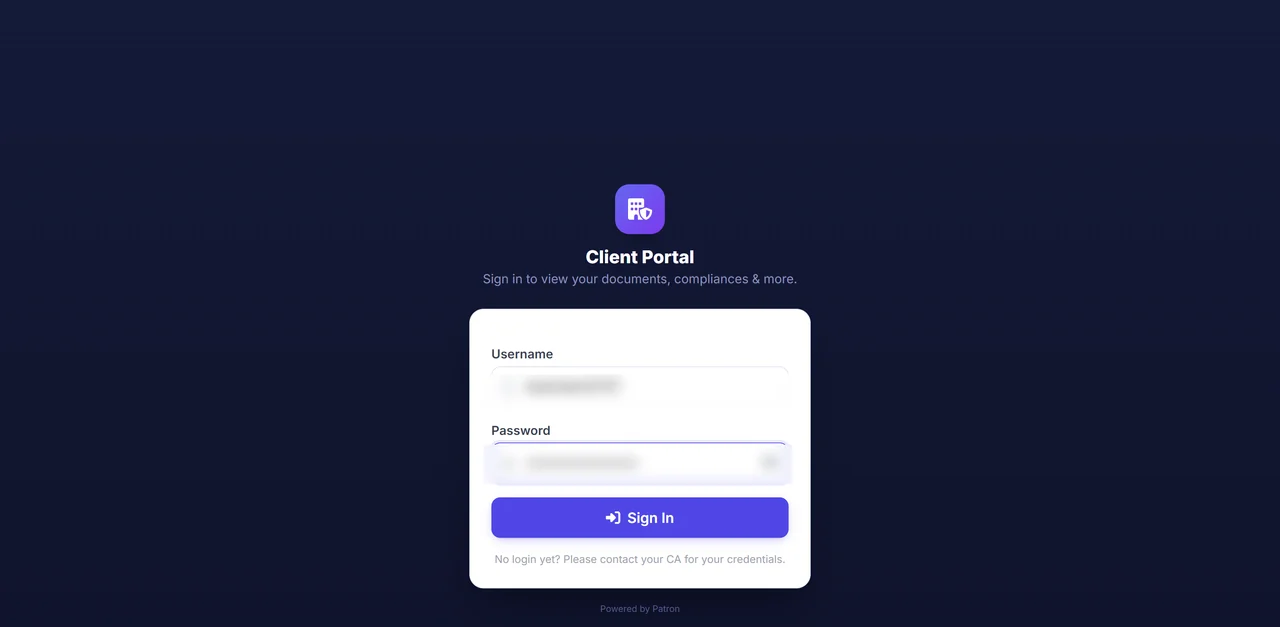
Everything happens in one secure login. You can see your active services, the Patron team on your account, and anything still pending. Once you raise a request, it moves through the same clear steps every time, so you always know exactly where your work stands.

Secure client portal login screen
1

Sign in securely

Your books, documents and requests all sit behind one private, password protected login. The team handling your account is shown on screen, so nothing sensitive ever needs to travel over email or WhatsApp.

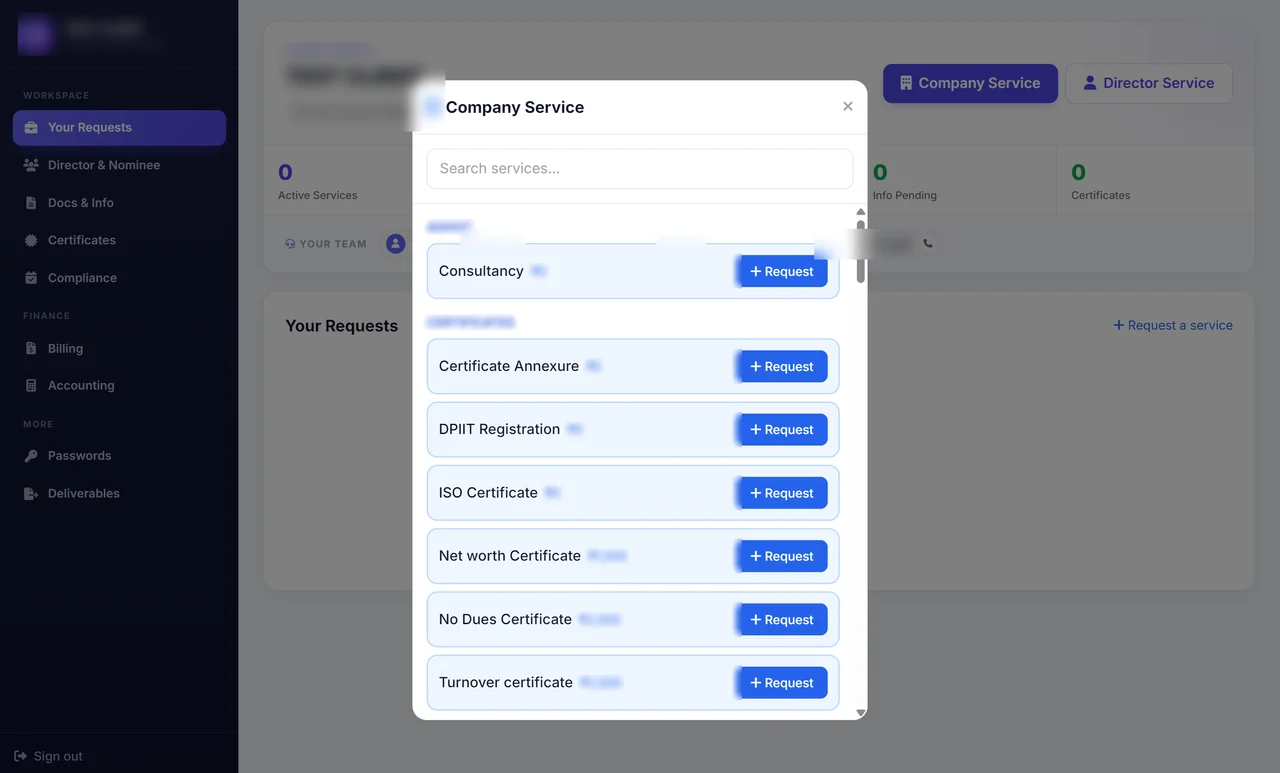
Service catalogue inside the client portal
2

Raise your request

Choose the service you need from the menu inside the portal, where the price is shown before you go ahead. Your request is logged the moment you send it, with no phone calls or reminder emails to wait on.

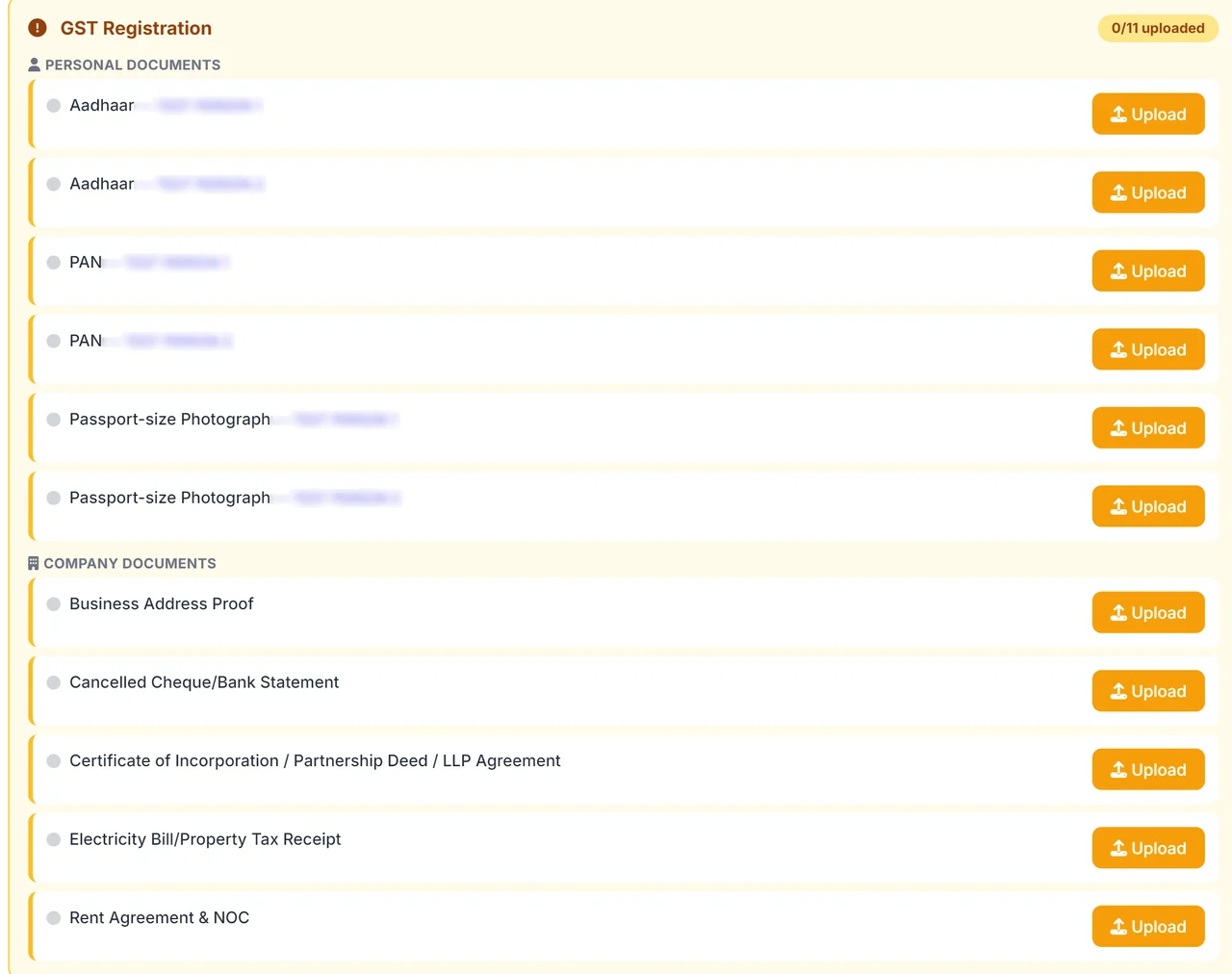
GST registration document checklist in the client portal, with an upload button beside each item
3

Share what the service asks for

For every service, the portal lists the exact documents it needs, each with its own upload button. The example shown here is the GST registration checklist. When a service needs nothing from you, it simply asks for nothing.

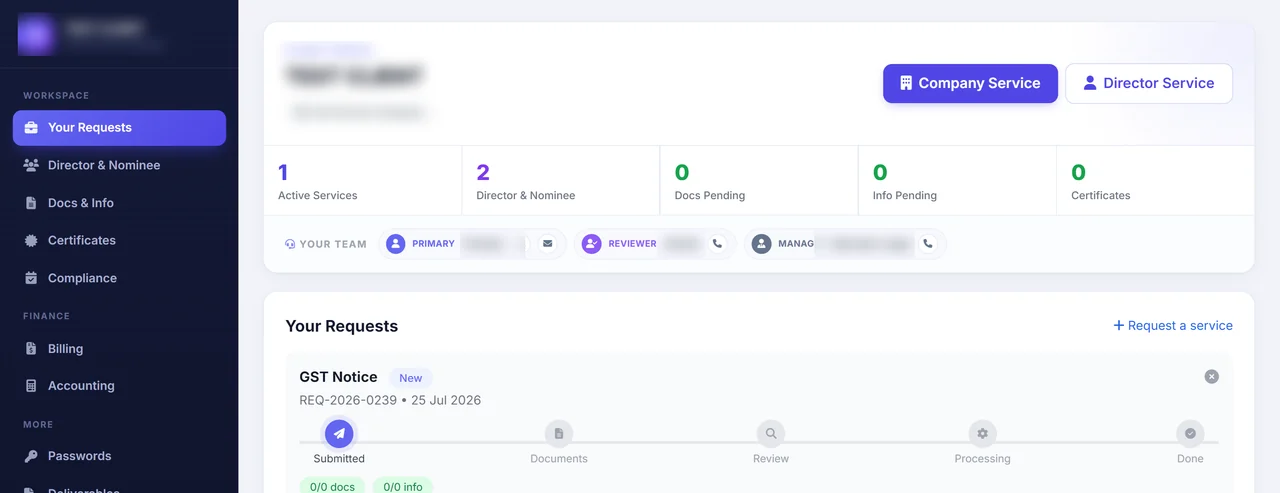
Live request tracker inside the client portal
4

We review, prepare and file

Once your documents are in, your team checks them, prepares the work and files it for you. A live tracker shows each stage as it happens, from review to processing to done, so you never have to ask where things stand.

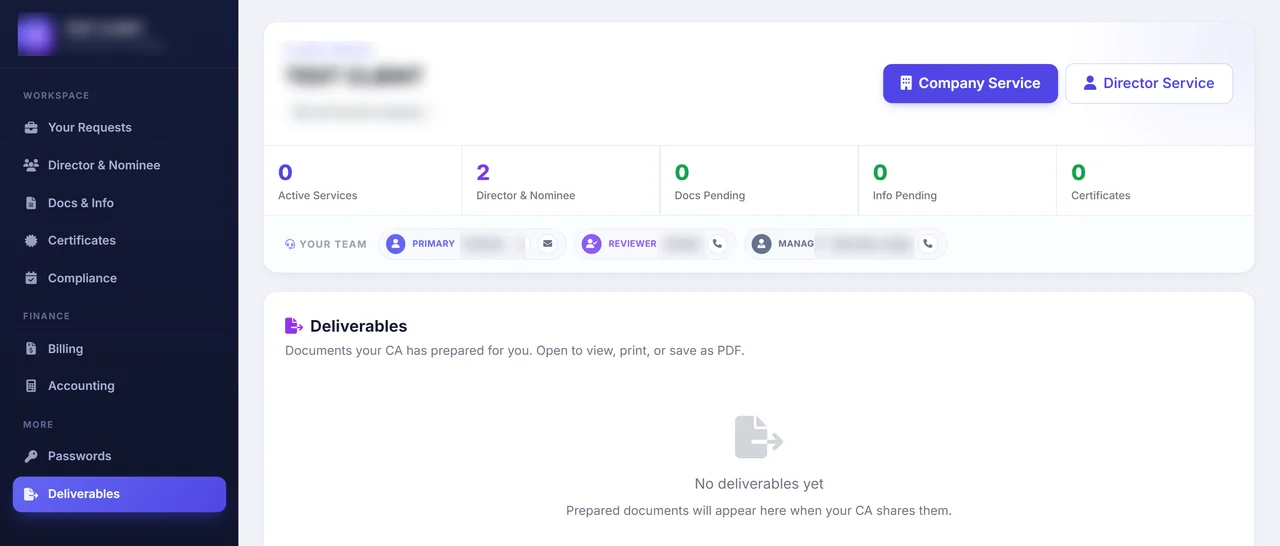
Deliverables area of the client portal
5

Collect your finished work

Every completed return, computation and certificate is placed in your Deliverables area. You can open, print or download any of them as a PDF whenever you need a copy.

Common Hotel and Restaurant Accounting Challenges and How We Solve Them

ChallengeImpactHow Patron Accounting Solves It
Banquet and event advances booked as revenue on receiptRevenue recognised before the event, distorting the month and pulling GST timing forwardHold event deposits as advance liability and recognise on the function date; banquet catering follows the GST on hotel and restaurant food slab
Service charge and tips mixed into hotel revenueA distribution liability sits inside income, overstating turnover and misstating staff payoutsRoute service charge to a payable pool and settle it to staff, keeping it out of revenue
Inter-outlet stock transfers untracked between kitchen and barOutlet food and beverage costs distort, and one outlet quietly subsidises anotherRecord requisition-based transfers at cost, so each outlet carries its true consumption and food-cost percentage
Complimentary rooms and covers left unrecordedOccupancy and cover counts overstate yield while the cost of the comp disappearsBook comps at cost against a contra head, so occupancy yield and food cost stay honest
Night-audit cut-off blurs revenue across the date changeA stay spanning midnight lands in the wrong day, so month-end room revenue misstatesLock the night-audit close at a stated hour, so occupied-room revenue falls in the correct period

Hotel and Restaurant Accounting Fees

Fee ComponentAmount
Starter — one outlet with routine monthly covers and stockINR 3,999
Excl. GST & Government Charges
Growth — more outlets, higher covers and larger consumable stock trackingOn quote
Managed — multi-outlet hotel and restaurant books with custom reportingOn quote

Hotel and restaurant books begin at INR 3,999 for one outlet with routine monthly covers and stock. Accounting for hotels grows in price with more outlets, higher covers and the consumable stock you carry. Speak with an accounting specialist on +91 94594 56700.

Fees exclude GST and government charges. Final quote confirmed after a scoping review.

All fees and charges listed are indicative only and do not constitute a binding offer. Final amounts may vary depending on the volume of work and the complexity involved.

Professional accounting and compliance charges are scoped to your number of entities, funding stage and monthly transaction volume, and are separate from statutory and government charges. Contact us for a detailed, fixed quote.

Get a free Hospitality Sector Accounting consultation - Call +91 945 945 6700 or WhatsApp us. No-obligation assessment.

Hotel and Restaurant Accounting Compliance Calendar 2026

ComplianceDue DateApplies To
TDS / TCS deposit (Challan ITNS-281)7th of every month (30 April for March)Every business that deducts tax at source on salaries, rent, contractor or professional fees
GSTR-1 (outward supplies)11th of every month for monthly filersGST-registered businesses filing monthly returns
Provident Fund (ECR) and ESI contribution15th of every monthEmployers registered under EPF and ESI
GSTR-3B (summary return and tax payment)20th of every month for monthly filersGST-registered businesses filing monthly; QRMP filers pay via PMT-06
Advance tax second instalment (45% cumulative)15 September 2026Companies, firms and individuals liable to advance tax
Tax audit report (Form 3CA/3CB-3CD)30 September 2026Businesses crossing the Section 44AB turnover threshold
Income-tax return, audit cases31 October 2026Companies and audit-liable firms
Annual GST return GSTR-9 and reconciliation GSTR-9C31 December 2026GST-registered businesses above the annual-return and audit thresholds

For a hotel or restaurant the 20th GSTR-3B and the 15th for PF and ESI recur monthly, with the tax audit on 30 September. Room and food supplies carry different GST rates, and OTA settlements and food-cost variance need reconciling first. Patron aligns hospitality accounting with each due date so rate-wise output tax is right. Call +91 94594 56700 for a 2026 calendar mapped to your books.

Key Benefits

Why Professional Hotel and Restaurant Accounting Matters

Gross revenue behind net remittances

We post OTA and aggregator payouts back to the gross booking value they represent, not just what hits the bank.

  • Commission grossed up from the night audit postings
  • OTA and aggregator settlements restored to gross booking value
  • Without it, turnover disagrees with platform-reported revenue

Food cost per outlet

You see which kitchen is losing margin in the month it starts, while the portioning and purchase rate are still fresh.

  • Food cost drawn from F&B stock counts and consumption
  • Margin loss traced to one kitchen each month
  • Without it, kitchen slippage surfaces a year too late

A tariff position you can prove

We record each night sold at the value it was actually let for, room by room.

  • Room-tariff-slab revenue split holds each night at its rate
  • You can show the rate applied if it is questioned
  • Without it, discounted nights cannot be separated out later

Liquor kept out of credit

We keep alcoholic liquor outside GST, running it through state excise and VAT and reconciling bar sales to the stock register.

  • Bar sales reconciled to the FL-3 excise daily stock register
  • State VAT returns cover liquor, kept out of input credit
  • Without it, you claim input credit that was never available

Event advances held as liability

We hold banquet advances and deposits as liabilities against the event order until the function is actually held.

  • Banquet Event Orders and advance register carry the liability
  • Cancellations and forfeitures reviewed before revenue is recognised
  • Without it, a busy season inflates one month, cost lands next

Service charge handled separately

We record service charge collected and passed to staff through the distribution record, not as your own revenue.

  • Tip pool distribution record carries the amount passed to staff
  • Payroll effect posted alongside the service charge
  • Without it, turnover and staff cost are both misstated

Why Businesses Choose Patron Accounting for Hotel & Restaurant Accounting

Five things a founder can check before handing over the books. Each is a claim with the proof behind it.

Outlet-wise food cost and wastage tracking

We track food cost and wastage outlet by outlet instead of one kitchen expense line, so a leaking site shows up in the month it happens. This food cost detail comes from 15+ years of experience.

Aggregator commission grossed up and 194-O credits claimed

We gross up Swiggy and Zomato revenue to the full sale, not the net remittance, and claim the 194-O tax collected as credit. We also handle TDS on aggregator commission, part of 25,000+ filings completed.

POS, aggregator settlements and inventory in one ledger

We set up the software your finance team already runs, whether Zoho Books, Xero, Tally Prime or Odoo. Your POS, Swiggy and Zomato settlements and stock all feed into a single ledger.

Outlet P&L with food-cost percentage each month

Every month each outlet gets its own profit and loss statement with food-cost percentage, so you compare sites on the same measure. Restaurant groups rate this 4.9 on Google.

Hotels and restaurants among 3,000+ businesses served

Hotels, restaurant groups and cloud kitchens sit among the 3,000+ businesses we have served since 2019. Our in-house team of CAs and CS brings 15+ years of experience and a 4.9 star Google rating.

Figures reflect Patron Accounting LLP engagements since 2019. Scope and turnaround are confirmed in your engagement letter.

Owned Property vs OTA-Led Revenue Accounting

CriterionOwned PropertyOTA-Led Revenue Accounting
Revenue sourceOwned: guest pays the hotel directly, full tariff booked.OTA-led: booking flows through an aggregator, net of commission.
Gross versus netOwned: gross room revenue shows clearly on the folio.OTA-led: gross must be grossed up before netting commission.
Commission and TDSOwned: no aggregator commission, no Section 194H exposure.OTA-led: commission attracts Section 194H TDS obligations.
Reconciliation effortOwned: the PMS ties to bank with few variances.OTA-led: settlement reports need matching against payouts and deductions.
Occupancy visibilityOwned: room-night yield read straight from the PMS.OTA-led: channel mix distorts yield until settlements are posted.
Cash-flow timingOwned: cash collected at guest checkout, immediate inflow.OTA-led: payout delayed to the aggregator cycle, financing gap.
VerdictDirect, owned-property hotels can keep simpler gross accounting; properties leaning on aggregators must record gross revenue then reconcile deductions, since net-only booking understates turnover and GST. Reliable accounting for hotels means learning to reconcile OTA settlements precisely.

Legal and Regulatory Framework for Hotel and Restaurant Accounting

What the exchequer is protecting across a hotel and its restaurant is a clean split between differently taxed revenue streams, and Section 35 of the CGST Act is where the demand to keep those records begins. A room night, a restaurant cover and a banquet advance each carry their own GST treatment, and blurring them is where liability leaks.

So the books are built to keep the streams apart from the first invoice. Room tariff and food and beverage sit on different GST slabs with restricted credit, advances are held until the stay or the event is delivered, and rent to a landlord carries its own deduction. That is why an Online Travel Agency (OTA) Deductions reconciliation and a live Food Cost Variance Percentage are compliance tools as much as management ones. Accounting for hotels and restaurants answers to the provisions below.

  • Notification 11/2017-Central Tax (Rate)Room tariffs and restaurant supply carry their own GST slabs with restricted input tax credit, so the books keep the two streams apart.
  • AS 9 / Ind AS 115Room and banquet revenue is recognised on occupancy and event completion, with advances held as unearned income until then.
  • Section 194-I, Income-tax Act 1961Rent for premises and equipment attracts TDS, kept distinct from contractor payments deducted under 194C.
  • AS 2 / Ind AS 2, Valuation of InventoriesFood, beverage and consumables stock is valued at the lower of cost and net realisable value, with day-end wastage recorded.
  • Section 35(1), CGST Act 2017Accounts of outward supplies, input tax credit and output tax are kept at the principal place of business for each registered outlet.
  • Rule 3(1), Companies (Accounts) Rules 2014The POS and accounting software keep the audit trail enabled, so a voided cover or a re-rated tariff is logged. Filing runs from the hub page.

Official sources: Ministry of Corporate Affairs · Income Tax Department · GST Portal · Startup India (DPIIT)

What does accounting for a hotel or restaurant cover?

It covers daily sales reconciliation from the POS and property management system, food and beverage stock accounting, purchase and vendor entries, OTA and aggregator payout matching, payroll, GST returns, TDS and monthly departmental profit reporting. Year end finalisation and support for the statutory or tax audit are included in the annual scope rather than billed as a surprise.

How do you reconcile OTA payouts from platforms like MakeMyTrip and Booking.com?

Each booking in the property management system is matched to the platform remittance advice, then split into gross tariff, platform commission, taxes collected at source and cancellations. The net credit reaching your bank is never equal to room revenue, so we book revenue gross with commission shown as an expense, which is the treatment your GST and income tax positions require.

How do you match daily POS sales with Swiggy and Zomato settlements?

Daily POS sales are reconciled against card settlements, UPI credits and aggregator payouts, with commission, packaging charges and refunds shown separately. Aggregators deduct TDS under Section 194-O at 0.1 percent and GST TCS under Section 52 at 0.5 percent, so the bank credit sits well below billed sales. Every payout cycle is matched back to the day it relates to.

How is GST handled for restaurant sales and hotel room revenue?

Standalone restaurants charge GST at 5 percent without input tax credit. Inside a hotel, the rate on restaurant supplies and on room revenue follows the value of supply per unit per day, with Rs 7,500 as the dividing threshold. The declared tariff test was withdrawn from 1 April 2025, so classification now follows actual transaction value. We confirm your banding in writing before the first return.

How do you account for food and beverage stock and wastage?

Food and beverage stock runs on a monthly consumption cycle of opening stock plus purchases less closing stock, supported by a physical count on the last day of the month. Wastage, staff meals and complimentary covers are recorded separately so they do not inflate cost of goods sold, and the variance against your standard recipe cost is reported to management.

Can you produce cost per cover and departmental profit reports?

Yes. Cost per cover, average revenue per cover, food cost percentage and departmental profit for rooms, food and beverage and banquets reach you with the month end pack, usually inside ten working days. Figures are pulled from your POS and property management exports and mapped to the ledger, so outlet managers never key the same numbers twice.

What does hospitality accounting cost per outlet each month?

Hospitality accounting typically costs Rs 12,000 to Rs 45,000 a month per outlet, depending on covers, the number of aggregator and OTA channels and whether payroll is included. A single restaurant on one GSTIN sits at the lower end, while a hotel with rooms, banquets and several revenue centres sits higher. Multi outlet groups get a reduced per unit rate.

How do you handle several outlets under one GSTIN versus separate ones?

Outlets in the same state can run under one GSTIN with separate cost centres in the books, while outlets in different states need their own registration and their own returns. Outlet wise profit and loss accounts are maintained in both cases, so you can compare units on equal terms even when the tax filing is consolidated at state level.

What happens if reported turnover does not match POS and aggregator data?

A gap between reported turnover and POS or aggregator data has to be closed before the audit, because the department receives aggregator and tax collected at source data independently of your returns. We rebuild sales from source reports, quantify the shortfall, correct returns where the period is still open and compute tax and interest so you can regularise deliberately.

How is service charge, tips and hotel payroll treated in the accounts?

Service charge collected from guests is recorded as a liability where it is pooled for distribution to staff and as income only where the business retains it, so the treatment follows your written policy. Tips paid directly by guests stay outside revenue. Payroll entries cover wages, PF, ESI and professional tax in states that levy it, such as Maharashtra and Gujarat.

Quick Answers

Very little of the money arrives the way it was billed. A guest folio settles part in card, part in cash, part against a corporate account; an OTA remits net of commission, well after checkout, in a lump covering many stays; the delivery aggregator pays on its own cycle. Patron unpicks those settlements, posts gross.

Hospitality Sector Accounting Deadlines You Cannot Afford to Miss

TDS / TCS deposit (Challan ITNS-281) is due 7th of every month (30 April for March). GSTR-1 (outward supplies) is due 11th of every month for monthly filers. Provident Fund (ECR) and ESI contribution is due 15th of every month. Patron tracks each against your books so nothing is reconstructed after the fact. Call +91 94594 56700 to set up a filing-reminder schedule.

Start Your Hotel and Restaurant Accounting with Patron Accounting

Most operators notice it at the second outlet. One property a manager could hold in one head; two, with different menus, different tariffs and separate settlements, and nobody can say which one is making money. Accounting for hotels stops being a bookkeeping chore at that point and becomes the only way to see the group.

Landlords and lenders both ask the same question before a new lease is signed: what does this format actually earn once rent, salaries and consumption are charged against it. Accounting for restaurants answers that directly from a comparable site, so the next deal is negotiated from a number rather than an average.

Your channel list comes first: which OTAs and aggregators remit to you, and whether the property management and point-of-sale systems export at the level a ledger actually needs. Each of them settles on its own cycle. The same reconciliation habit drives how recurring revenue is booked.

Book a Free Consultation - No Obligation.

Explore Our Accounting Services

Related services our CA-led team delivers for businesses across India.

Reviewed by the CA & CS Team, Patron Accounting LLP
ICAI & ICSI registered  ·  15+ years in Indian accounting & compliance  ·  Last reviewed 23 July 2026  ·  Next review 23 October 2026