


Talk to an Expert
Talk to an Expert ✆ +91 945 945 6700
Trusted by 10,000+ Businesses

Accounts Reconciliation Services and Audit Support

Reviewed by CA and CS Team, Patron Accounting LLP ICAI & ICSI Registered| 15+ Years Experience| Last Updated: July 2026 Verify Credentials →

Ownership for every control account: We give each account that must be reconciled a named owner, a frequency and the evidence that proves it.

Sub-ledgers that agree at source: Receivables, payables, fixed assets and inventory tie to their control accounts through the entry that caused each difference.

Third-party evidence behind each balance: Bank, customer, vendor, lender and related-party confirmations sit behind your balances, with every difference already broken down.

Input credit traced to evidence: We agree your input credit to the evidence behind it, so each claim traces to a matched record.

15+ YearsIndustry Experience
CA & CSCertified Experts
4.9
Based on real Google reviews

Get Free Consultation

Talk to a CA/CS expert today

🇮🇳 +91

Our team will get back to you shortly. No spam.

Real Stories from Real People

Verified Google reviews from founders and businesses Patron works with across India.

Join 3,000+ Founders and Businesses on Patron

Rated 4.9 on Google - trusted for startup accounting since 2019.

Talk to an Expert
10,000+Businesses ServedGST compliance and litigation support across India.
15+Years ExperienceDeep expertise in IP registration, GST & business compliance.
50,000+Documents FiledReturns, appeals, and filings handled accurately.
4.9★Client RatingTrusted by entrepreneurs, startups, and growing businesses.
ISO CertifiedProfessional standards and documented processes.
SSL SecureYour financial and business data is fully protected.

What Accounts Reconciliation Covers — Scope, Deliverables and Who It Suits

📌 TL;DR - Accounts Reconciliation and Audit Services at a Glance

Accounts reconciliation services close every control account: GST, TDS, inter-company, bank and stock. Patron matches GSTR-2B against the purchase register and Form 26AS against TDS deducted, line by line, then hands over a pack with each exception owned and dated. Audit queries are then answered from that pack. Best suited to businesses facing statutory, internal or due-diligence review.

Control accounts are worked through in a fixed order, bank first, then the statutory ledgers, then inter-company and stock, so that a difference surfacing late in the run does not send the earlier accounts reconciliation work back to the start again. Balances are agreed to third-party statements rather than to internal reports, and every adjusting entry is drafted and put up for your approval before it is posted, following the method set out in this guide to reconciliation types.

An unmatched credit is not merely a bookkeeping nuisance. It becomes input tax reversed with interest, or a deduction denied at assessment, and both of those surface long after the period has been shut. Reconciliation services move with the count of ledgers, bank accounts and registrations in play, and with how clean the GST portal records come back. Forensic investigation is scoped separately.

What Is Accounts Reconciliation?

Every control account in your ledger, bank, GST, TDS, inter-company and stock, carries a balance that has to be proved against something outside the business. Accounts reconciliation services are the engagement that proves each of those balances and lists whatever will not agree.

Control accounts are worked in a set order, each balance agreed to a third-party statement rather than an internal report. Every correcting entry is drafted for your approval before it is posted. It matches the GST credit statement to the purchase register and the tax-credit statement to tax actually deducted, line by line. Timing differences and genuine breaks are separated, not merged into one figure. Accounts reconciliation services then hand over a pack in which each unmatched item is owned by a name and carries a date. From that pack, an auditor's questions can be answered directly. The reconciliation services stop there: the statutory audit opinion itself, and any forensic investigation, are separate engagements.

Key Terms for Accounts Reconciliation and Audit:

What Is Accounts Reconciliation. Every control account in your ledger, bank, GST, TDS, inter-company and stock,

Who Needs Accounts Reconciliation in India?

Accounts reconciliation services are for businesses where someone outside has begun asking questions the internal reports were never built to answer. When control accounts no longer agree to their evidence, the organisations below need each balance proved.

  • Companies facing a first statutory audit, with a new auditor asking for schedules they never kept.
  • Businesses inside buyer due diligence, needing balances confirmed by the party on the other side.
  • Groups carrying inter-company balances that refuse to eliminate against each other at period end.
  • Firms whose GSTR-2B will not match the purchase register, with input credit at risk of reversal.
  • Businesses where Form 26AS and the TDS receivable in the books have drifted apart.
  • Companies carrying old customer and vendor differences forward from one year to the next.
  • Businesses whose sub-ledgers for receivables, payables and stock no longer tie to their control accounts.
  • Firms facing an internal audit or lender review that wants balances proved rather than described.

Our Accounts Reconciliation Services

ServiceWhat We Do
Reconciliation scope mappingOur accounts reconciliation services define every control account to be reconciled, so nothing on the balance sheet is left without an owner Monthly
Sub-ledger to control tie-outWe tie receivables, payables, fixed assets and inventory sub-ledgers to their control accounts, so each agrees at source before review Monthly
Third-party confirmationsWe obtain balance confirmations from banks, vendors and lenders, and run customer reconciliation, so evidence sits behind every material balance Quarterly
Statutory position reconciliationWe reconcile GSTR-2B to the purchase register and Form 26AS to the books, so input credit and TDS trace to evidence Monthly
Inter-company eliminationWe reconcile and eliminate inter-company and inter-branch balances, following this account reconciliation types guide, so group balances net off cleanly Monthly
Audit schedule preparationWe prepare audit-ready schedules in advance and support your auditor's queries, so reconciliation services carry through to a smoother statutory audit Annually
Our Process

How Accounts Reconciliation Works — Our Process

How Patron delivers accounts reconciliation and audit, step by step from onboarding to a clean monthly close.

Step 1

Define the reconciliation universe

We list every account that must be reconciled, who owns it, how often, and what evidence proves it. Most reconciliation failures are not arithmetic. They are accounts nobody was ever made responsible for, which then go unreconciled for years.

Illustration for Define the reconciliation universe: We list every account that must be reconciled, who owns it, how often,
Step 2

Tie sub-ledgers to control accounts

Receivables, payables, fixed assets and inventory sub-ledgers are agreed to their control accounts in the general ledger. Differences are traced back to the individual entry that caused them and corrected, never squared off with a journal that makes the two columns match.

Illustration for Tie sub-ledgers to control accounts: Receivables, payables, fixed assets and inventory sub-ledgers are
Step 3

Obtain third-party confirmations

Confirmations are sought from banks, customers, vendors, lenders and related parties, and each is compared with the ledger. Differences are analysed into their real causes, such as items in transit, charges never recorded or disputed debits, rather than reported as a single unexplained number.

Illustration for Obtain third-party confirmations: Confirmations are sought from banks, customers, vendors, lenders and
Step 4

Reconcile the statutory positions

GSTR-2B is reconciled to the purchase register, GSTR-1 and 3B to the books, and both to the electronic credit and cash ledgers. Form 26AS and the annual information statement are agreed to revenue recorded and to tax deducted at source shown as receivable.

Illustration for Reconcile the statutory positions: GSTR-2B is reconciled to the purchase register, GSTR-1 and 3B to the
Step 5

Eliminate inter-company balances

Inter-company and inter-branch balances are matched pair by pair and any mismatch resolved at source before elimination. Timing differences, exchange differences and unrealised margin on stock still held within the group are identified separately in the elimination schedule.

Illustration for Eliminate inter-company balances: Inter-company and inter-branch balances are matched pair by pair and any
Step 6

Prepare the audit schedules

We build the lead schedules the auditor will ask for, each agreed to the trial balance, with movement workings and indexed supporting documents behind them. A well-built file shortens the audit because the questions are answered before they are asked.

Illustration for Prepare the audit schedules: We build the lead schedules the auditor will ask for, each agreed to the trial
Step 7

Support the auditor's queries

During fieldwork we respond to observations, retrieve documents and prepare the adjustments management agrees to pass. The statutory audit itself, and the opinion on the financial statements, remain the work of your appointed auditor. We support that process; we do not perform it.

Illustration for Support the auditor's queries: During fieldwork we respond to observations, retrieve documents and prepare

Documents Required for Accounts Reconciliation

Reconciliation is an evidence exercise: every balance in your books has to be agreed back to something issued by somebody else.

  • Third-party balance confirmations from banks, customers, vendors, lenders and related parties
  • Inter-company and inter-branch reconciliations with elimination schedules
  • GSTR-2B versus purchase register, and GSTR-1/3B versus books, with the electronic credit and cash ledgers
  • Form 26AS and AIS reconciled against revenue in the books and TDS receivable
  • Fixed asset register agreed to the general ledger, with the physical verification report
  • Book stock versus physical count reconciliation with explanations for material differences
  • Trial balance and full general ledger for the period under review
  • Sub-ledger detail for receivables, payables, fixed assets and inventory, tied to their control accounts
  • Bank statements and the completed bank reconciliation statement for every account
Client Portal

How You Work With Patron

Everything happens in one secure login. You can see your active services, the Patron team on your account, and anything still pending. Once you raise a request, it moves through the same clear steps every time, so you always know exactly where your work stands.

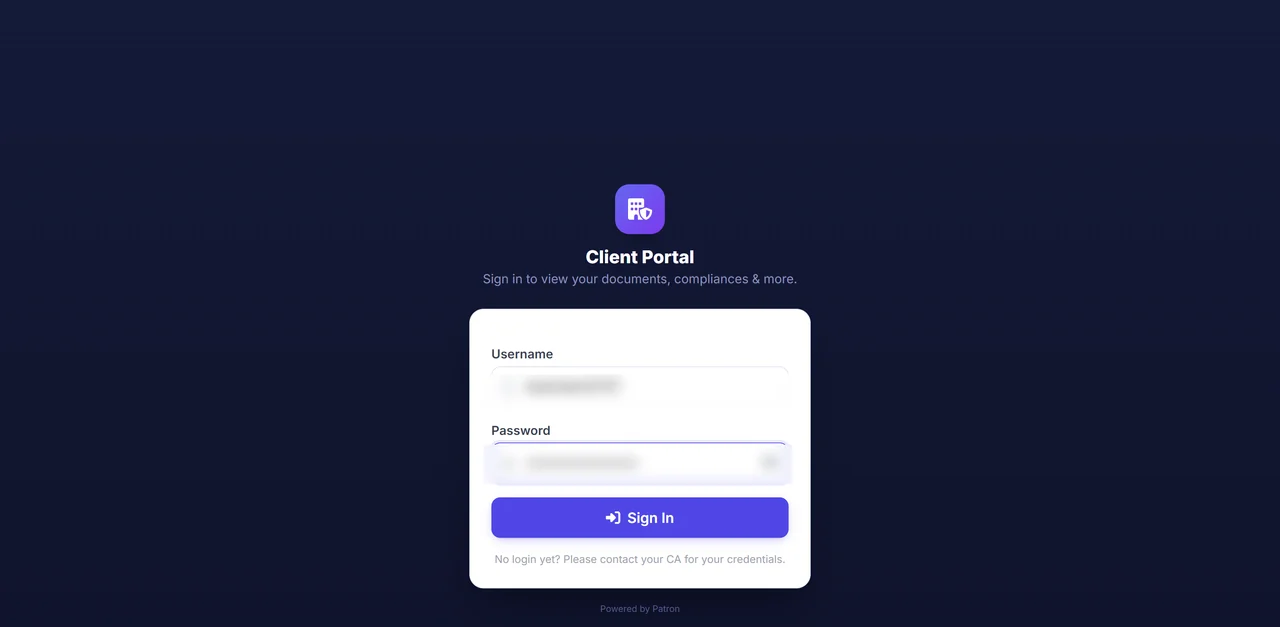
Secure client portal login screen
1

Sign in securely

Your books, documents and requests all sit behind one private, password protected login. The team handling your account is shown on screen, so nothing sensitive ever needs to travel over email or WhatsApp.

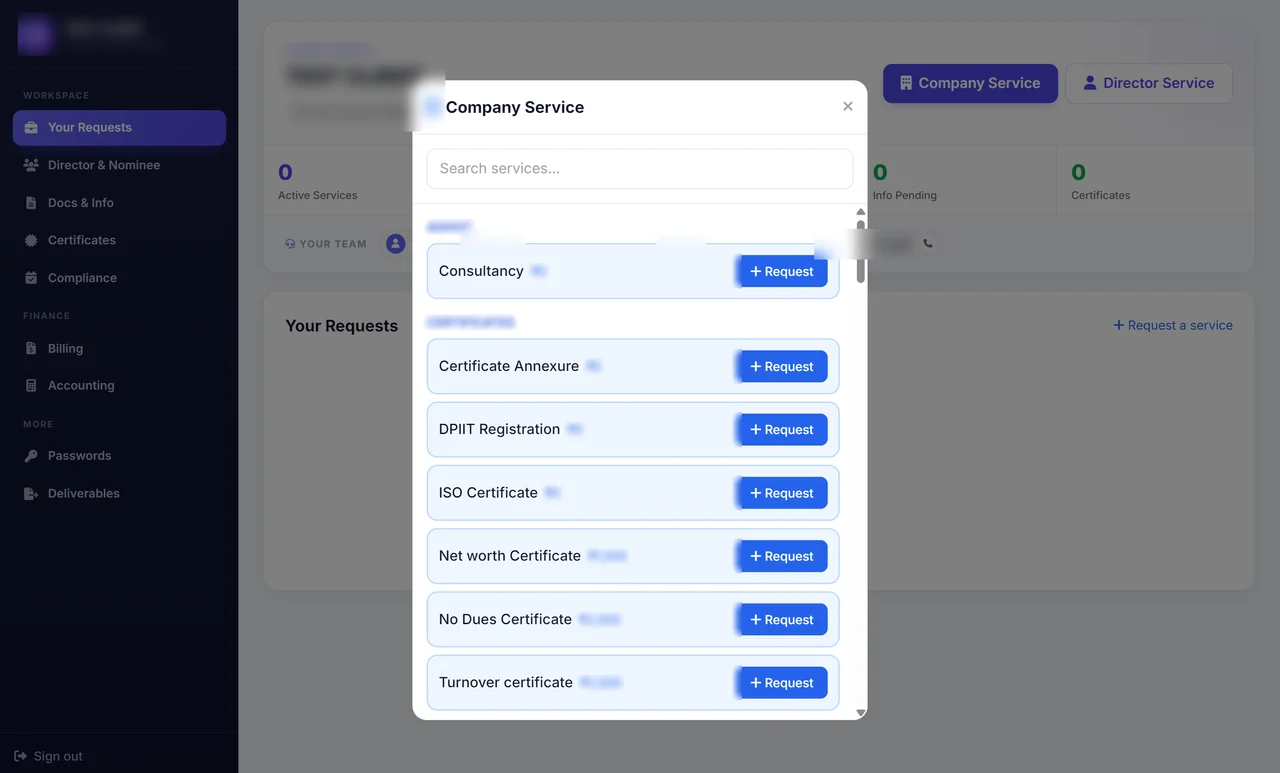
Service catalogue inside the client portal
2

Raise your request

Choose the service you need from the menu inside the portal, where the price is shown before you go ahead. Your request is logged the moment you send it, with no phone calls or reminder emails to wait on.

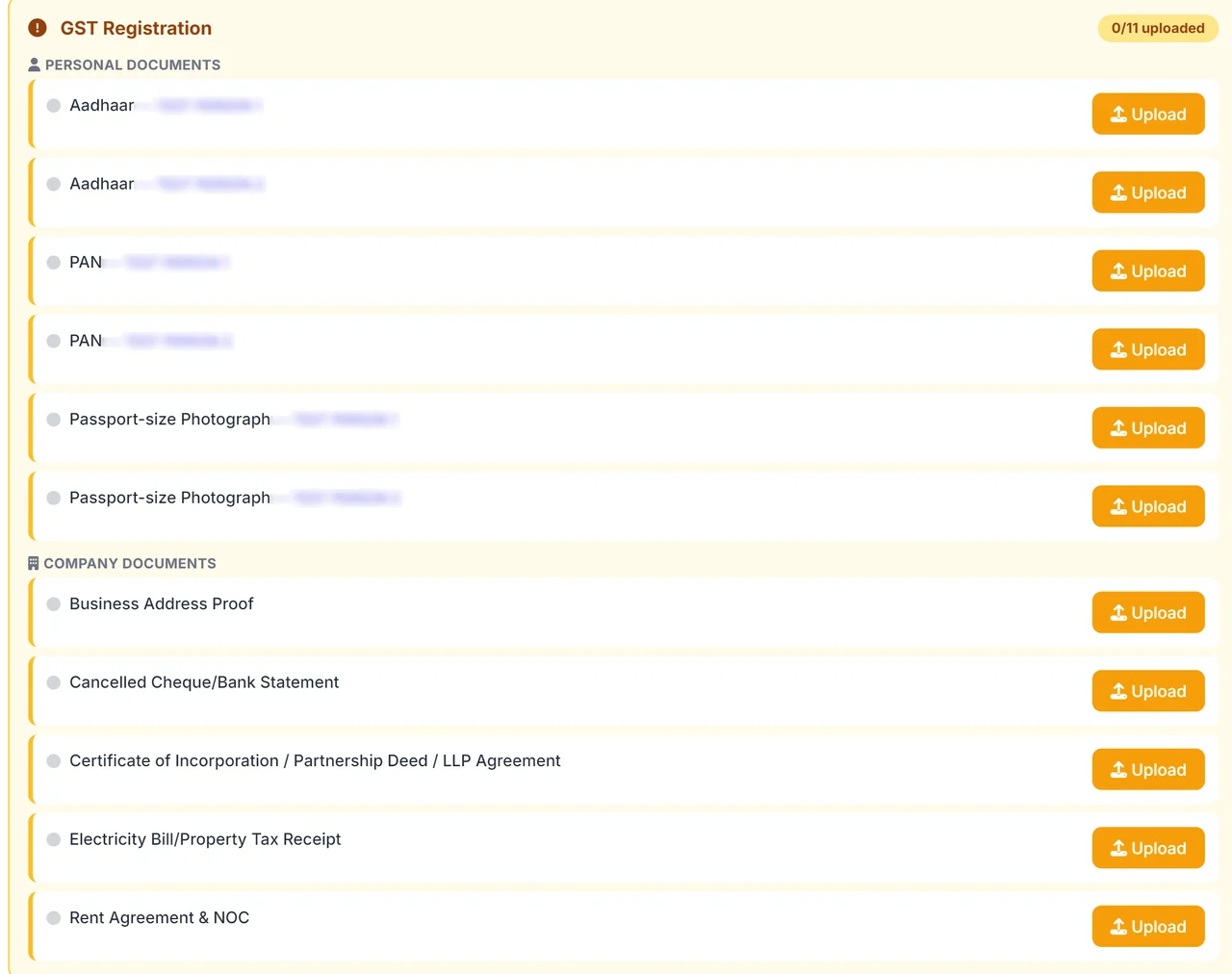
GST registration document checklist in the client portal, with an upload button beside each item
3

Share what the service asks for

For every service, the portal lists the exact documents it needs, each with its own upload button. The example shown here is the GST registration checklist. When a service needs nothing from you, it simply asks for nothing.

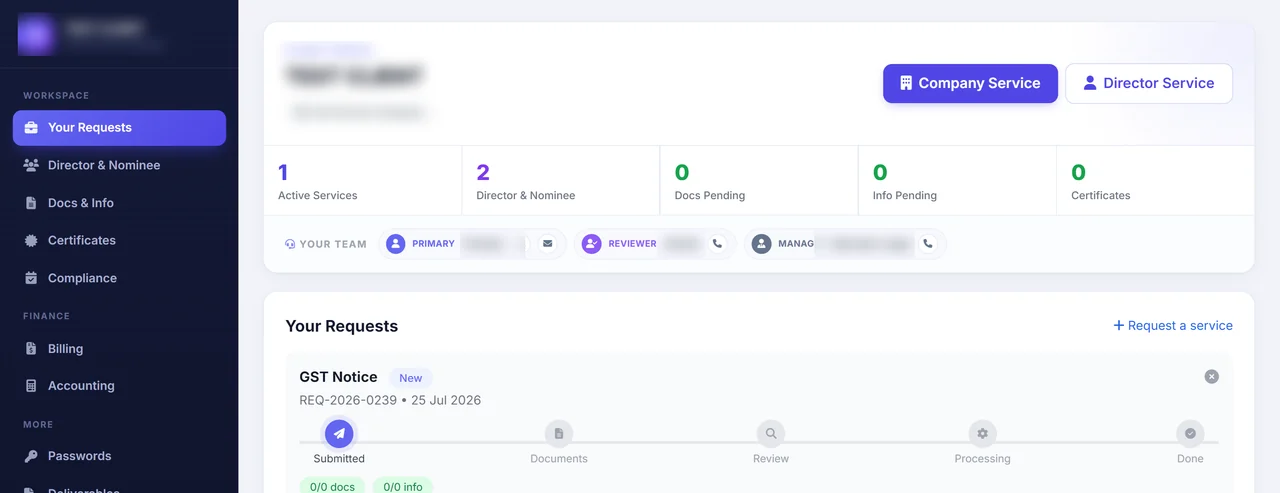
Live request tracker inside the client portal
4

We review, prepare and file

Once your documents are in, your team checks them, prepares the work and files it for you. A live tracker shows each stage as it happens, from review to processing to done, so you never have to ask where things stand.

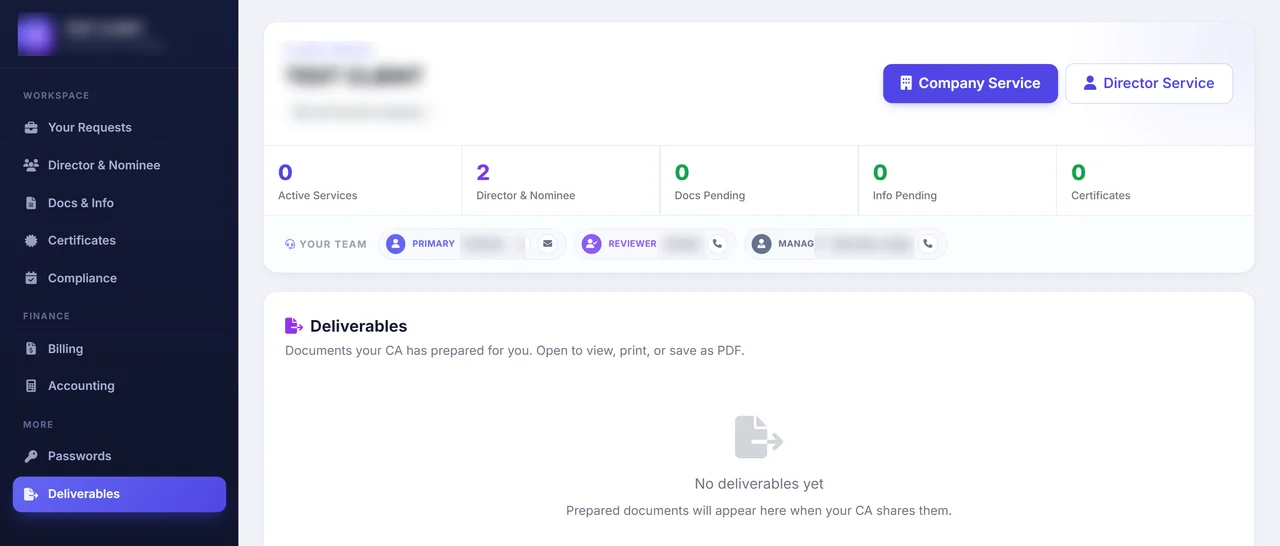
Deliverables area of the client portal
5

Collect your finished work

Every completed return, computation and certificate is placed in your Deliverables area. You can open, print or download any of them as a PDF whenever you need a copy.

Common Accounts Reconciliation Challenges and How We Solve Them

ChallengeImpactHow Patron Accounting Solves It
Party ledgers disagree with customer and supplier statementsDisputed balances stall collections and payments, and confirmations sent for audit come back mismatched.Patron runs party-wise reconciliation, agreeing each customer and vendor balance to their statement before confirmations go out.
Suspense and clearing accounts accumulate unexplained balancesThe trial balance carries figures no one can source, and every one becomes an audit query.We clear suspense and clearing accounts, ageing each item to an owner; see balance-sheet reconciliation checklist.
The fixed asset register drifts from the general ledgerDepreciation is charged on assets that no longer exist, and written-down values no longer tie out.Patron reconciles the fixed asset register to the ledger, tagging additions and disposals to each account.
Sales register, GSTR-1 and e-invoice IRNs disagreeTurnover reported three ways diverges, inviting reconciliation notices comparing your returns against reported invoices.Our team runs a three-way turnover reconciliation across the sales register, GSTR-1 and generated e-invoice IRNs.
Payment-gateway payouts never matched back to invoicesNet settlements hide fees and refunds, so recorded revenue and bank credits stop agreeing.Patron matches each gateway payout to its invoices, stripping fees and refunds to a clean revenue figure.

Accounts Reconciliation Fees

Fee ComponentAmount
Standard — a defined set of accounts across a single periodINR 9,999
Excl. GST & Government Charges
Complex — larger data volumes, longer history or a multi-entity scopeOn quote

The INR 9,999 Standard project reconciles a defined set of accounts for one period, matching ledgers to statements and flagging the breaks. Scope widens the fee: more accounts, a longer history or several entities in the review. Ask for a fixed quote on +91 94594 56700.

Fees exclude GST and government charges. Final quote confirmed after a scoping review.

All fees and charges listed are indicative only and do not constitute a binding offer. Final amounts may vary depending on the volume of work and the complexity involved.

Professional accounting and compliance charges are scoped to your number of entities, funding stage and monthly transaction volume, and are separate from statutory and government charges. Contact us for a detailed, fixed quote.

Get a free Accounts Reconciliation and Audit consultation - Call +91 945 945 6700 or WhatsApp us. No-obligation assessment.

Accounts Reconciliation Compliance Calendar 2026

ComplianceDue DateApplies To
TDS / TCS deposit (Challan ITNS-281)7th of every month (30 April for March)Every business that deducts tax at source on salaries, rent, contractor or professional fees
GSTR-1 (outward supplies)11th of every month for monthly filersGST-registered businesses filing monthly returns
GSTR-3B (summary return and tax payment)20th of every month for monthly filersGST-registered businesses filing monthly; QRMP filers pay via PMT-06
TDS return for Jan-Mar quarter (Form 24Q / 26Q)31 May 2026Deductors filing quarterly TDS statements
Tax audit report (Form 3CA/3CB-3CD)30 September 2026Businesses crossing the Section 44AB turnover threshold
Annual GST return GSTR-9 and reconciliation GSTR-9C31 December 2026GST-registered businesses above the annual-return and audit thresholds

Reconciliation is the work that clears before every date that matters: the 20th GSTR-3B, the quarterly TDS return on 31 May and the tax audit on 30 September. Patron runs account reconciliation so differences are settled long before a filing or auditor asks. Call +91 94594 56700 for a 2026 calendar mapped to your books.

Key Benefits

Why Professional Accounts Reconciliation Matters

Ownership for every control account

We give each account that must be reconciled a named owner, a frequency and the evidence that proves it.

  • Owner, frequency and proving evidence set for every control account
  • Without it, unowned accounts drift for years until diligence forces them open

Sub-ledgers that agree at source

Receivables, payables, fixed assets and inventory tie to their control accounts through the entry that caused each difference.

  • Differences explained by real entries, not a balancing journal
  • Without it, a squared-off schedule collapses the moment a balance is sampled

Third-party evidence behind each balance

Bank, customer, vendor, lender and related-party confirmations sit behind your balances, with every difference already broken down.

  • Differences split into items in transit, unrecorded charges or disputed debits
  • Without it, the counterparty's figure contradicts yours before you can explain it

Input credit traced to evidence

We agree your input credit to the evidence behind it, so each claim traces to a matched record.

  • GSTR-2B agreed to the purchase register and electronic credit ledger
  • Form 26AS agreed to revenue and tax deducted as receivable
  • Without the match, credit is reversed once the supplier stops responding

Group balances that eliminate cleanly

You get consolidated figures built from matched pairs, with whatever remains named as timing, exchange or intra-group margin.

  • Inter-company balances eliminated through matched pairs, not a balancing entry
  • Residuals named: timing, exchange, or margin on stock inside the group
  • Without it, a plug at consolidation opens every entity behind it

Audit schedules ready in advance

Your lead schedules come indexed and agreed to the trial balance, so the month keeps closing while fieldwork runs.

  • Movement workings and supporting documents filed behind each schedule
  • Without them, fieldwork is spent retrieving papers and the next close slips

Why Businesses Choose Patron Accounting for Accounts Reconciliation & Audit

Five things a founder can check before handing over the books. Each is a claim with the proof behind it.

Every control account reconciled, GST to stock

A clean set of books turns on control accounts agreeing. We reconcile every one, from GST and TDS to inter-company and stock, alongside dedicated bank and credit card reconciliation, so each balance carries audit evidence.

GSTR-2B versus books and 26AS versus TDS matched

We match GSTR-2B against the purchase register and 26AS against your TDS, line by line, so input credit is not reversed. Our 25,000+ filings make this our regular work, not a year-end panic.

Reconciliation run from the ledger with a documented exception list

We run reconciliations inside Zoho Books, Xero, Tally Prime or Odoo, whichever ledger you keep. Every exception is listed and documented, so you see what did not match and why, ready for the auditor.

Full reconciliation pack after every period close

After each period close you receive a full reconciliation pack, sub-ledgers tied to source and third-party confirmations attached. You can follow the method in a month-end reconciliation checklist we publish.

Reconciliation and audit among 3,000+ businesses served

Reconciliation and internal audit engagements sit among the 3,000+ businesses we have served since 2019. With 15+ years of experience and a 4.9 star Google rating, our in-house team of CAs and CS owns each balance.

Figures reflect Patron Accounting LLP engagements since 2019. Scope and turnaround are confirmed in your engagement letter.

Internal Audit vs Statutory Audit Support

CriterionInternal AuditStatutory Audit Support
PurposeInternal audit: ongoing check of controls and processes.Statutory audit support: readying books for the external auditor.
TriggerInternal audit: chosen by management, voluntary for most.Statutory audit support: needed where statute mandates an audit.
FocusInternal audit: risk, fraud and efficiency across the year.Statutory audit support: accuracy of the year-end financial statements.
FrequencyInternal audit: continuous or quarterly reviews through the year.Statutory audit support: annual, concentrated at the close.
Who relies on itInternal audit: the board and owners for decisions.Statutory audit support: the auditor, lenders and regulators.
Reconciliation linkInternal audit: keeps ledgers reconciled through the year.Statutory audit support: clean reconciliations speed the audit sign-off.
VerdictGrowing SMEs gain from continuous internal audit that catches errors early, while statutory audit support becomes essential once a mandatory audit applies. Strong accounts reconciliation services underpin both, as an internal versus statutory audit comparison shows.

Legal and Regulatory Framework for Accounts Reconciliation

An incorporated business triggers the fullest compliance of any entity type, and reconciliation is what makes that compliance survivable: every control account has to be proved against an outside record before an auditor or an assessing officer reads it. Section 128 requires the books to be true and fair, and a reconciled ledger is how that claim is defended.

The framework therefore treats reconciliation as audit preparation, not housekeeping. A bank, a GST credit register and an inter-company balance each have to agree with a source outside the ledger, which is why Vendor Balance Confirmation and Inter-Company Ledger Reconciliation are evidence an auditor relies on. Accounts reconciliation services close those differences against the provisions below, and the distinction between Statutory vs Internal Audit decides who then relies on the result.

  • Section 128, Companies Act 2013The books are kept true and fair on accrual and double entry, which a reconciled set of control accounts is what proves.
  • Section 44AB, Income-tax Act 1961Where turnover crosses Rs 1 crore, or Rs 10 crore with cash within 5%, or Rs 50 lakh for professionals, the reconciled accounts feed the tax audit report.
  • Section 128 and Section 44AA, Income-tax Act 1961The underlying double-entry obligation applies to every entity, so the same reconciliation discipline covers companies and non-corporates alike.
  • Section 44AA, Income-tax Act 1961A non-corporate business maintains books once the limits are crossed, and reconciliation is how those books are kept defensible.
  • Rule 3(1), Companies (Accounts) Rules 2014The audit trail stays enabled, so any adjusting entry made during reconciliation is itself on record. Conducting the statutory audit sits on the hub page.

Official sources: Ministry of Corporate Affairs · Income Tax Department · GST Portal · Startup India (DPIIT)

What is customer reconciliation?

Customer reconciliation is the process of matching the balance your books show for a customer against the balance that customer shows for you, then identifying and clearing every difference. Typical differences are invoices not booked, credit notes, TDS deducted by the customer, short payments, discounts and payments in transit. The exercise closes with a signed balance confirmation from the customer.

Is a bank reconciliation statement prepared by the bank or by the customer?

A bank reconciliation statement is prepared by the account holder, not by the bank. The bank only issues a statement of the transactions it has recorded. Your accounts team compares that statement with the cash book and explains the gaps, which usually arise from cheques issued but not presented, deposits not yet cleared, bank charges and direct credits not yet entered.

What are global reconciliation services?

Global reconciliation services means reconciling accounts across multiple entities, currencies and accounting systems into one consistent position, usually for a group with Indian and overseas operations. The work covers intercompany balances, foreign currency revaluation, bank accounts in different countries and mapping local ledgers to a group chart of accounts before consolidation. Every adjustment carries a documented audit trail.

How do you run vendor reconciliation across a large supplier base?

Vendor reconciliation is run in batches, top 50 suppliers by value first, and a base of several hundred vendors is normally cleared in four to six weeks. We collect supplier statements, match them against the purchase ledger, split differences into unbooked invoices, debit notes, TDS and advances, and close each account with a written confirmation from the supplier.

What documents do you need to start a reconciliation assignment?

We need your trial balance, party wise ledgers, bank statements for the period, purchase and sales registers, GST returns already filed, TDS challans and returns, and any counterparty statements you already hold. Read only access to your Tally or Zoho Books data speeds the work up considerably. Fieldwork can begin within three working days of receiving these.

What is an account reconciliation?

An account reconciliation compares a balance in your books against an independent record, such as a bank statement, a supplier statement or a GST return, and explains every difference until the two agree. Differences usually arise from timing, unbooked invoices, TDS deducted by the counterparty, bank charges and posting errors. Each item is documented and cleared through a journal entry your management approves.

What are the main types of account reconciliation?

Account reconciliation covers five main types in practice: bank, customer or debtor, vendor or creditor, inter company, and statutory reconciliations such as the purchase register against GSTR-2B. Each compares an internal ledger with an external record and explains the gap. Bank reconciliation is only the starting point, and the vendor and GST ones usually surface the larger money differences.

What audit support is provided during a statutory audit?

Audit support means preparing the schedules your auditor asks for, answering queries and sitting with the audit team through fieldwork. That covers fixed asset registers, ageing of debtors and creditors, stock summaries, related party listings, statutory dues workings and confirmation letters. Our team absorbs the back and forth so your finance staff are not pulled off routine monthly work.

Is the purchase register reconciled with GSTR-2B every month?

Yes, the purchase register is matched against GSTR-2B monthly and we report credit that is available, credit missing because the supplier has not filed, and credit claimed in your books without support. Suppliers who repeatedly fail to file are escalated in writing so payment can be held back, which protects the credit instead of chasing it a year later.

What does a reconciliation and audit support assignment cost?

A one off reconciliation and audit support assignment usually costs Rs 25,000 to Rs 1,50,000, priced on the number of ledgers, the period covered and the condition of the records. Ongoing monthly reconciliation bundled into a bookkeeping retainer costs much less. We quote a fixed fee after reviewing your trial balance and a sample of open items.

Quick Answers

Control accounts are worked through in a fixed order, bank first, then the statutory ledgers, then inter-company and stock, so that a difference surfacing late in the run does not send the earlier accounts reconciliation work back to the start again. Balances are agreed to third-party statements rather than to.

Accounts Reconciliation and Audit Deadlines You Cannot Afford to Miss

TDS / TCS deposit (Challan ITNS-281) is due 7th of every month (30 April for March). GSTR-1 (outward supplies) is due 11th of every month for monthly filers. GSTR-3B (summary return and tax payment) is due 20th of every month for monthly filers. Patron tracks each against your books so nothing is reconstructed after the fact. Call +91 94594 56700 to set up a filing-reminder schedule.

Start Your Accounts Reconciliation with Patron Accounting

Most engagements begin with a new auditor asking for schedules. A buyer's diligence list does the same, as does a lender wanting balances confirmed by the other side. In each case somebody outside the business has asked a question the internal reports were never built to answer, and accounts reconciliation services follow.

Customer reconciliation returns a difference you can close rather than one you can describe. Every open item is traceable to where it started and to whoever can settle it, so the list shortens instead of being carried forward another year. Nothing sits in suspense waiting for a decision nobody owns.

Scope is the open question: which control accounts are in doubt, and how old the differences are. Then who the pack is for, because an auditor, a buyer and a bank want the same balances proved differently. Rebuilding years of missing entries is separate work.

Book a Free Consultation - No Obligation.

Explore Our Accounting Services

Related services our CA-led team delivers for businesses across India.

Reviewed by the CA & CS Team, Patron Accounting LLP
ICAI & ICSI registered  ·  15+ years in Indian accounting & compliance  ·  Last reviewed 23 July 2026  ·  Next review 23 October 2026