
In this guide
Amazon and Flipkart settlement reconciliation for Pune sellers is the routine of matching each settlement report, line by line, back to the orders, fees, taxes and returns that produced it, so that the figure hitting your bank account can be explained rather than simply banked. For a Pune-based direct-to-consumer (D2C) brand the reconciliation is where most bookkeeping errors are born, because the amount the marketplace pays you bears no resemblance to the sales you actually invoiced. This explainer walks through why the two never match and how to close the gap correctly. The commercial engagement itself sits on our E-Commerce Accounting Services Pune page; here we stay on the how-to.
Why a Pune seller's Amazon settlement never matches the GST sales figure
The settlement is a net number. It is what remains after the operator has subtracted its commission, fulfilment and shipping charges, your advertising spend, the value of returned and return-to-origin (RTO) orders, GST tax collected at source (TCS) at 0.5% and tax deducted at source (TDS) under Section 194-O at 0.1%. Your GSTR-1, by contrast, reports the gross invoice value of every order despatched. A month that invoices at Rs 10,00,000 can settle in the bank at roughly Rs 7,50,000, and the Rs 2,50,000 difference is not a loss, it is a stack of deductions that each need their own ledger. Book the bank credit as turnover and you understate GSTR-1, break the trail against the operator's GSTR-8 return, and quietly forfeit the TCS and TDS credits sitting inside the gap.
What a marketplace settlement report actually contains
Open any Amazon Payments or Flipkart settlement statement and every rupee falls into one of a few buckets. Reading them correctly is the whole job:
- Gross sales: the invoice value of despatched orders, which is your turnover for GSTR-1.
- Selling and closing fees: commission charged as a percentage of order value, plus fixed closing fees.
- Fulfilment and shipping: FBA pick-pack-ship or Flipkart Smart fulfilment charges.
- Advertising: sponsored product and display spend recovered from the same settlement.
- Returns and RTO: reversals for orders the customer sent back or that never reached the door.
- GST TCS and Section 194-O TDS: statutory deductions the operator remits on your behalf.
The settlement reconciliation exercise is simply to prove that gross sales minus each of these buckets equals the amount credited, for every settlement ID.
How to reconcile a marketplace settlement, step by step
The same sequence works for Amazon, Flipkart, Meesho or your own Shopify D2C store, and it is the routine our Pune bookkeeping teams run for sellers in Kharadi and Hinjewadi every fortnight.
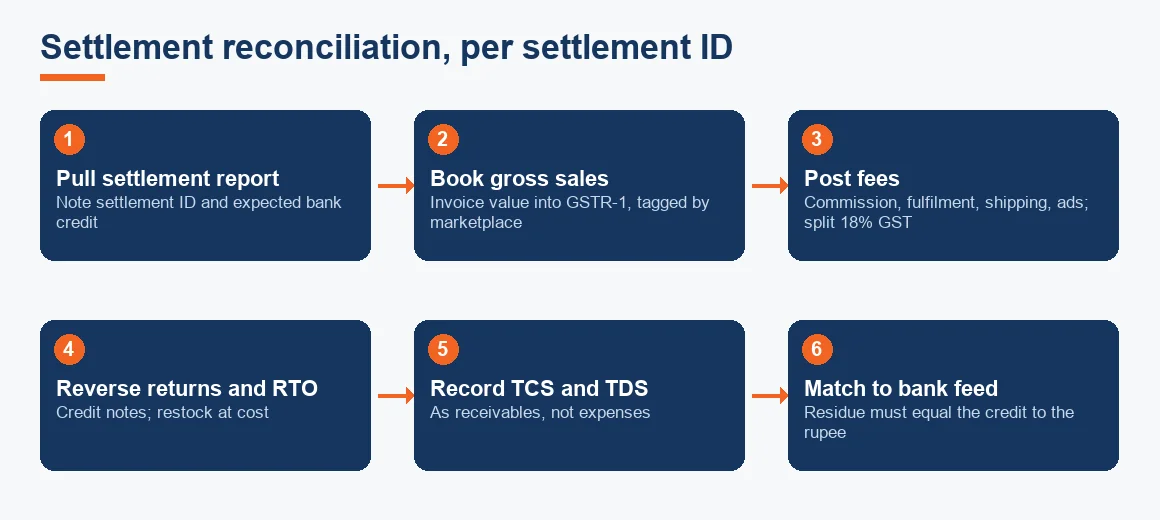
- Pull the settlement report for the payment cycle and note the settlement ID and the exact bank credit it should produce.
- Book gross sales at invoice value into the sales ledger, tagged to the marketplace, so GSTR-1 carries the full turnover.
- Post each fee (commission, fulfilment, shipping, advertising) to its own expense head, splitting out the 18% GST for the input credit claim.
- Reverse returns and RTO through credit notes and restore the goods to inventory at cost.
- Record TCS and TDS as receivables, not expenses, because both are recovered against your own tax.
- Match to the bank feed: the residue must equal the actual credit to the rupee. Any gap is an unbooked fee, a missed return or a fee dispute worth raising inside the platform window.
GST TCS and Section 194-O TDS on marketplace sales
Two statutory deductions sit inside every settlement and both are your money, held on account. GST TCS under Section 52 is collected by the e-commerce operator at 0.5% (0.25% CGST plus 0.25% SGST, or 0.5% IGST) on the net value of taxable supplies, and it appears in your electronic cash ledger once the operator files GSTR-8. You claim it there; it is not an expense. Income-tax TDS under Section 194-O is deducted at 0.1% of the gross sale value and shows up in your Form 26AS, to be set off against your income-tax liability. The current CBIC position on TCS collection by operators is set out on the CBIC GST portal, and the Section 194-O framework is published by the Income Tax Department. Both credits are lost if you never book the receivable, because there is nothing in the ledger to match them against.
Input tax credit on marketplace fees through GSTR-2B
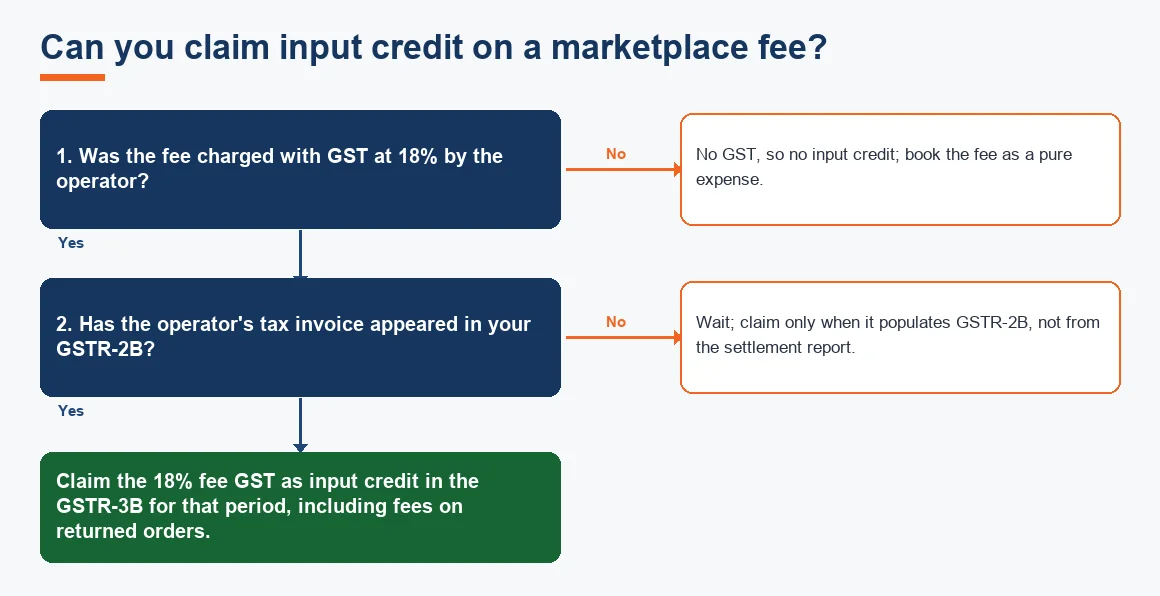
Commission, fulfilment, shipping, storage and advertising fees all carry GST at 18%, and that credit is real money for a Pune seller. The catch is documentary: the settlement report is not a valid tax document. You can only claim the input credit once the operator's tax invoice is reflected in your GSTR-2B, which is the auto-drafted statement the GST portal generates each month. Reconcile the fee GST in your books against GSTR-2B, not against the settlement, and only claim what appears there. Fees charged on a returned order stay creditable, because the fulfilment service was still performed even though the sale reversed.
Recording returns and RTO shipments in the books
A customer return reverses the original sale through a credit note, which you then report in GSTR-1, and the stock is brought back into inventory at cost. An RTO shipment that never reached the buyer is treated the same way, with the goods restored to stock and any forward and reverse shipping fee still expensed, because the courier was genuinely paid. Timing matters: a credit note for a financial year can be declared up to 30 November of the following year, or the date of the annual return, whichever is earlier. For high-return categories like apparel and footwear, common among Pune D2C brands, unbooked returns are the fastest way to overstate both revenue and closing stock.
What the settlement shows versus what the books record
This is the mapping every reconciliation comes back to. Each deduction in the statement has a distinct accounting home, and getting the home right is what keeps GSTR-1, GSTR-3B and your income-tax return consistent.
| Deduction in settlement | Rate | Accounting treatment | Recovered via |
|---|---|---|---|
| Commission, fulfilment, shipping, ads fees | GST 18% | Expense; GST split as input credit | GSTR-2B invoice match |
| GST TCS (Section 52) | 0.5% | Receivable in cash ledger | Operator's GSTR-8 |
| TDS (Section 194-O) | 0.1% | Receivable (advance tax) | Form 26AS / ITR |
| Customer returns and RTO | n/a | Credit note; restock at cost | Adjusts GSTR-1 |
Worked example: reconciling a Rs 10,00,000 gross month
Take a Baner-based D2C seller with Rs 10,00,000 of gross sales on Amazon in a month, Rs 80,000 of returns, and Rs 1,50,000 of fees (Excl GST, indicative). The reconciliation to the bank credit runs as follows.
| Line | Amount (Rs) |
|---|---|
| Gross sales (invoice value, into GSTR-1) | 10,00,000 |
| Less: customer returns and RTO | (80,000) |
| Net taxable supplies | 9,20,000 |
| Less: marketplace fees (Excl GST) | (1,50,000) |
| Less: GST on fees @ 18% | (27,000) |
| Less: GST TCS @ 0.5% (Section 52) | (4,600) |
| Less: TDS @ 0.1% (Section 194-O) | (920) |
| Net credit to bank | 7,37,480 |
The bank shows Rs 7,37,480, but your turnover for the month is still Rs 9,20,000 net of returns. The Rs 27,000 GST on fees returns to you as input credit through GSTR-2B, and the Rs 4,600 TCS plus Rs 920 TDS come back as tax credits. The only genuine cost of sale in that gap is the Rs 1,50,000 of fees. Report the Rs 7,37,480 as sales and you would understate turnover by nearly Rs 1,83,000 and lose over Rs 32,000 of recoverable credits.
How often Pune D2C sellers should reconcile
Every fortnight, matched to the settlement ID. Amazon and Flipkart pay on a rolling seven-to-fourteen-day cycle, so a Pune seller shipping from a Chakan or Wagholi warehouse will see two or more settlements a month. Leaving reconciliation to the year end makes fee disputes unrecoverable inside the platform's dispute window and pushes GST TCS credit past the GSTR-3B in which it belonged. Fold the exercise into a monthly close routine rather than an annual panic.
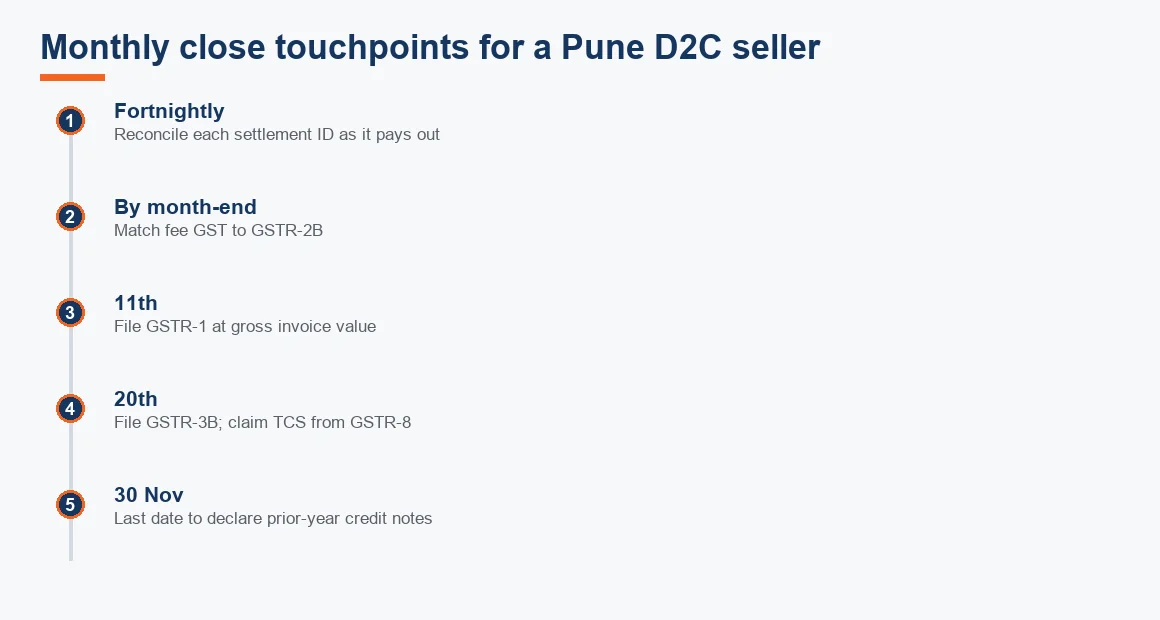
The mechanics are the same whether you outsource or run it in-house, and they sit alongside the broader monthly bookkeeping and MIS checklist for Pune businesses. If you are still deciding who should own the close, our guide to choosing an accountant in Pune (Hinjewadi, Kharadi, Baner) and the 2026 cost benchmarks for accounting and bookkeeping in Pune are the practical next reads. For a general ledger hygiene check, running the same bank reconciliation discipline across all your accounts keeps the settlement gap honest.
Marketplace reconciliation shares its logic with other Pune sectors: a Chakan-Pimpri auto-component maker faces the same order-to-cash discipline in our costing and inventory accounting for Pune auto-component makers guide, while Startup Accounting Services India and our SaaS Accounting Services (IT & SaaS) and IT & software company accounting pages carry the equivalent revenue-recognition detail for subscription models. Where marketplace receivables age or turn doubtful, a provisioning view helps, and our ECL estimator gives a quick expected-credit-loss read. Pune sellers who also run physical stores can cross-reference retail accounting services in Pune, and a general books setup starts with accounting and bookkeeping services in Pune or the sector-specific startup accounting services in Pune. The full commercial scope for online sellers lives on our E-Commerce Accounting Services hub.
Key terms
- Marketplace Settlement Reconciliation: matching each operator payout to orders, fees, returns and taxes.
- Section 52 TCS under GST: 0.5% tax the operator collects on net taxable supplies and reports in GSTR-8.
- Return to Origin (RTO) Provisions: accounting for shipments that never reached the buyer and come back to stock.
- GSTR-2B Input Tax Credit Matching: claiming fee GST only once the operator's invoice appears in GSTR-2B.
- Bank Reconciliation: proving that ledger balances agree with the bank feed to the rupee.
Key takeaways
- The bank credit is the residue, not the turnover; GSTR-1 always carries gross invoice value.
- GST TCS at 0.5% and Section 194-O TDS at 0.1% are receivables you reclaim, never expenses.
- Claim fee input credit only from GSTR-2B, never from the settlement statement.
- Reverse returns and RTO through credit notes and restock at cost within the 30 November window.
- Reconcile every fortnight against the settlement ID to protect fee disputes and TCS credit.
Decision guide