In this guide
Costing and inventory accounting for an MIDC manufacturer means recording material, labour and factory overhead so that you can state the true cost of what your line produced in a period, before any profit is measured. For a unit in the Andheri, Marol or SEEPZ belt, that discipline sits on top of the usual GST and TDS work: you have raw material moving to job workers, plant running on metered power, and B2B invoices that now need an IRN. This explainer walks through how the numbers are put together. If you want the work done for you, that sits with our Manufacturing Accounting Services and the local Manufacturing Accounting Services Mumbai page; here we stay on the how-it-works side.
What costing and inventory accounting means for an MIDC manufacturer
A trading business buys and sells finished goods, so its books are relatively flat. A manufacturer converts one thing into another, and the accounts have to follow that conversion. Material enters as raw stock, sits part-finished as work in progress on the shop floor, then becomes finished goods ready for despatch. Each stage is a separate inventory account with its own opening and closing balance. Around that flow you attach the costs of conversion: the wages of the people who run the machines, and the factory overheads that keep the shed working. Getting this right is what lets you price a job, defend a margin and pass an audit without surprises. For a deeper read on tidying older books before a review, our audit-readiness and book-cleanup checklist for Mumbai businesses covers the cleanup steps.
The three inventory accounts and three manufacturing costs
The structure most owners find useful is the one taught as three-and-three. The three inventory accounts are raw material, work in progress and finished goods. The three manufacturing costs are direct material, direct labour and factory (works) overhead. Direct material is the steel, resin or component that ends up in the product. Direct labour is the wage of the worker who converts it. Factory overhead is everything else the shed consumes to run: power, factory rent, repairs, consumables and depreciation on plant.
The line that trips people up is which costs are direct and which are overhead. The table below shows where each common factory cost lands and where it flows in the books.
| Cost item | Classification | Flows to |
|---|---|---|
| Steel, resin, components consumed | Direct material | Work in progress |
| Machine operator wages | Direct labour | Work in progress |
| Storekeeper, security, supervisor pay | Indirect labour (overhead) | Factory overhead |
| Power and fuel for the line | Factory overhead | Cost of production |
| Depreciation on plant and machinery | Factory overhead | Cost of production |
| Office salaries, sales commission | Not factory cost | Profit and loss (period cost) |
How to prepare a manufacturing account, step by step
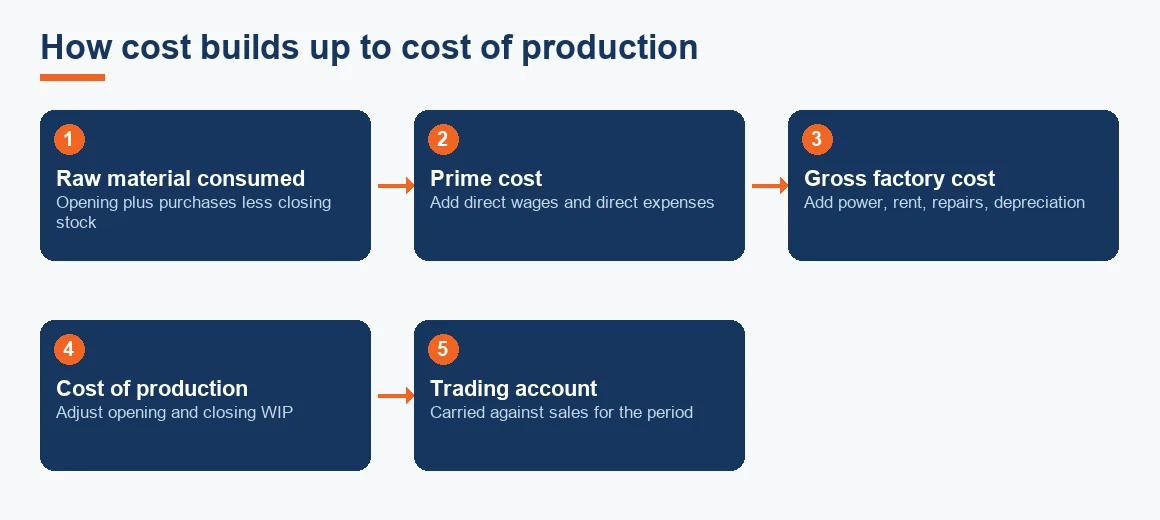
A manufacturing account is the statement you draw up before the trading account to arrive at the cost of production. The sequence is mechanical once you have your stock figures.
- Start with raw material consumed: opening raw material plus purchases (including freight inward) less closing raw material.
- Add direct wages and any direct expenses such as outside job charges to get prime cost.
- Add factory overheads (power, factory rent, repairs, consumables, depreciation on plant) to get gross factory cost.
- Adjust for work in progress: add opening WIP and subtract closing WIP.
- The result is the cost of production, which carries into the trading account against sales.
The valuation of that closing WIP is where judgement enters, and it is worth doing consistently rather than by feel; see the note on work-in-progress valuation. Whether you cost issues on FIFO or weighted average should be a policy you fix and disclose, not a switch you flip to flatter a bad month.
Job work, delivery challans and ITC-04 for MIDC units
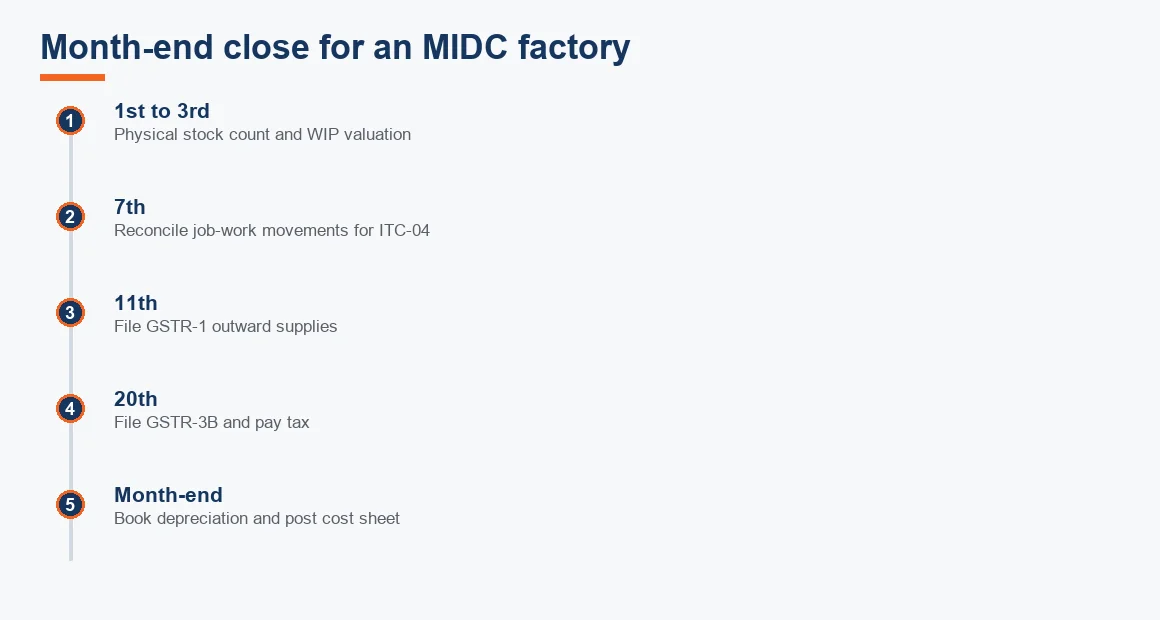
Sending material out for plating, machining or heat treatment is routine in the MIDC belt, and it is not a sale. Under Rule 55 of the CGST Rules the goods leave on a delivery challan, in triplicate, showing quantity, description, HSN and the value for challan purposes, with an e-way bill where the consignment crosses the state threshold. Because nothing is sold, the material stays in your inventory as stock lying with the job worker until it returns or is sold from his premises. The principal manufacturer reports this movement in Form ITC-04, and the timelines and rules sit with the CBIC (see the CBIC GST portal).
E-invoicing for Andheri manufacturers: the Rs 5 crore rule
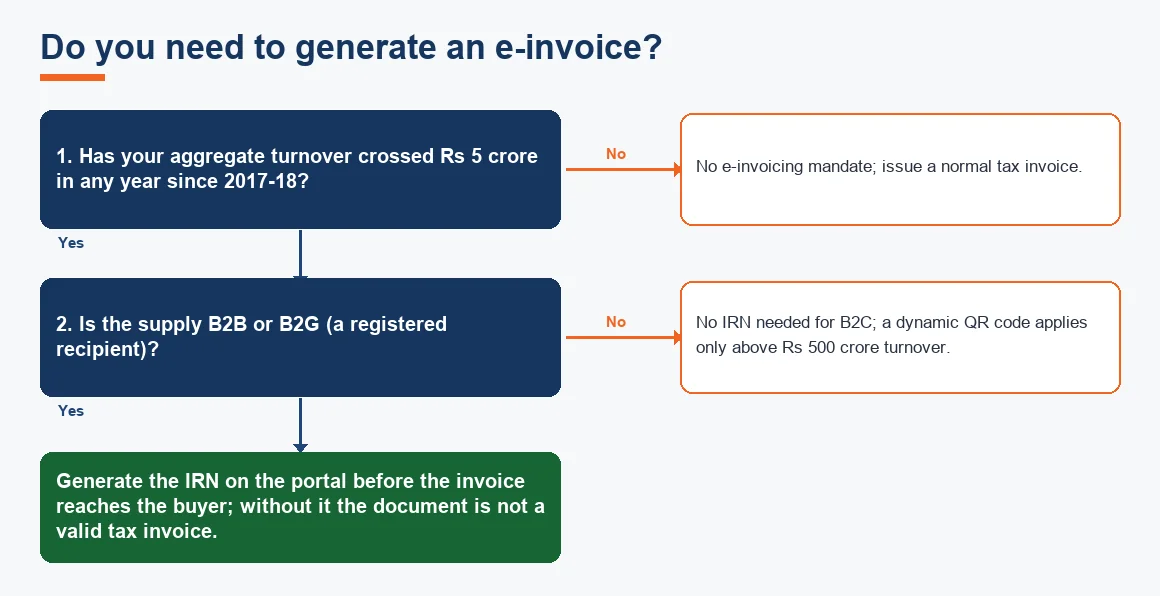
E-invoicing is mandatory once your aggregate turnover has crossed Rs 5 crore in any financial year since 2017-18. Practically, that means most established Andheri and MIDC units are inside the mandate. The Invoice Reference Number (IRN) must be generated on the portal before the invoice reaches the customer; without a valid IRN the document is not a tax invoice, and your buyer loses the input tax credit. B2C sales sit outside the mandate, though a dynamic QR code obligation applies far higher up, above Rs 500 crore turnover. The rate and threshold history is maintained on the GST portal. Getting IRN generation wired into your billing before month-end is the single most useful fix for a factory that has just crossed the line.
Worked example: monthly cost of production for an MIDC unit
Take a small fabrication unit in Andheri MIDC for one month. The figures below are indicative and shown Exl GST; they follow the five steps above straight down the page.
| Line | Amount (Rs) |
|---|---|
| Opening raw material | 8,00,000 |
| Add: purchases (incl. freight inward) | 42,00,000 |
| Less: closing raw material | (6,00,000) |
| Raw material consumed | 44,00,000 |
| Add: direct wages | 12,00,000 |
| Add: direct expenses (outside job charges) | 3,00,000 |
| Prime cost | 59,00,000 |
| Add: power and fuel | 6,00,000 |
| Add: factory rent | 2,00,000 |
| Add: depreciation on plant | 1,50,000 |
| Add: repairs and consumables | 50,000 |
| Gross factory cost | 69,00,000 |
| Add: opening work in progress | 4,00,000 |
| Less: closing work in progress | (5,00,000) |
| Cost of production | 68,00,000 |
That Rs 68,00,000 is what carries into the trading account. Divide it by units produced and you have a per-unit cost you can actually quote against, and once it flows through to cost of goods sold it drives your gross margin. The depreciation figure here is a placeholder; to work out the real charge on your plant under Schedule II, our depreciation calculator does the schedule for you.
Allocating power, fuel and overheads to product cost
Factory overhead only tells you the truth if it is allocated on a sensible basis. Power is allocated on metered consumption where sub-meters exist, and otherwise on connected load multiplied by run hours for each machine. A plant paying Rs 12,00,000 a year for a line that runs 3,000 hours loads Rs 400 an hour of power onto the jobs on that line. Where formal cost records apply, Form CRA-1 requires utilities to be shown as a separate cost head with the allocation basis stated, so the method you pick should be defensible, not convenient. The distinction between costs that attach to product and costs that are period expenses is set out under direct versus indirect factory overheads, and if you build product costs from a recipe, keep your bill of materials costing current so standard costs do not drift from reality.
Local Maharashtra points: professional tax, the MSME clock and sibling industries
Two local items catch Mumbai manufacturers. First, Maharashtra professional tax is deducted monthly from each employee above the exemption limit and paid over under your PTRC registration; the mechanics of PTRC and PTEC are in our note on Maharashtra professional tax and Shops Act compliance. Second, the Section 43B(h) MSME clock disallows a deduction for amounts owed to a registered micro or small supplier that you pay beyond the agreed period (capped at 45 days), which for a factory buying material on credit is a real year-end trap; the Income Tax Department's guidance is on the income tax portal. Manufacturers in an SEZ pocket such as SEEPZ have their own export and duty treatment, which is a separate topic from the domestic-tariff-area costing above.
If your operation straddles software or product-plus-service, the costing logic differs, and the industry-specific pages are the right home for that: our IT and software company accounting services, SaaS accounting services and startup accounting services each handle their own revenue and cost quirks. For the plain-vanilla books-and-GST work across any Mumbai business, the general accounting and bookkeeping services in Mumbai page is the starting point. On what all this should cost, our 2026 price benchmarks for outsourced accounting in Mumbai and the guide to choosing an accountant in Mumbai are more useful than a quote pulled from thin air.
Key terms
- Work-in-Progress (WIP) Valuation: valuing part-finished goods on the shop floor at material plus a share of conversion cost.
- Form ITC-04 Job Work Tracking: the GST return that reports goods sent to and received from a job worker.
- Direct vs Indirect Factory Overheads: whether a cost attaches to a specific job or supports the factory generally.
- Bill of Materials (BOM) Costing: building product cost from the recipe of components and quantities.
- MIDC Industrial Area Compliance: the local licensing and area obligations that come with an MIDC plot.
Key takeaways
- Run three inventory accounts and three cost heads; keep office and selling costs out of the factory account.
- Prepare the manufacturing account before the trading account to land a defensible cost of production.
- Job work moves on a Rule 55 challan and is reported in ITC-04, not booked as a sale.
- Generate the IRN before the invoice reaches a B2B buyer once turnover crosses Rs 5 crore.
- Allocate power and overhead on a stated, defensible basis, and mind the 43B(h) 45-day MSME clock at year-end.
Decision guide