

Talk to an Expert
Talk to an Expert ✆ +91 945 945 6700
Trusted by 10,000+ Businesses
Delhi, Delhi

Startup Accounting Services in Delhi

Reviewed by CA and CS Team, Patron Accounting LLP ICAI & ICSI Registered| 15+ Years Experience| Last Updated: July 2026 Verify Credentials →

Cap table the register supports: Your working cap table, the statutory register of members and the share capital in the books all carry the same holdings.

Option grants that stand up: Your option grants, vesting, exercises and lapses sit in the Form SH-6 register, with board and shareholder approvals behind them.

Investor metrics traceable to ledger: Your burn, runway and revenue metrics are rebuilt from the trial balance on your own definitions. Any gap against the deck is explained.

Convertible instruments in the right place: We classify compulsorily convertible preference shares or debentures from the actual instrument terms, and treat round costs on a stated basis.

15+ YearsIndustry Experience
CA & CSCertified Experts
4.9
Based on real Google reviews

Get Free Consultation

Talk to a CA/CS expert today

🇮🇳 +91

Our team will get back to you shortly. No spam.

Real Stories from Real People

Verified Google reviews from founders and businesses Patron works with across India.

Join 3,000+ Founders and Businesses on Patron

Rated 4.9 on Google - trusted for startup accounting since 2019.

Talk to an Expert
10,000+Businesses ServedGST compliance and litigation support across India.
15+Years ExperienceDeep expertise in IP registration, GST & business compliance.
50,000+Documents FiledReturns, appeals, and filings handled accurately.
4.9★Client RatingTrusted by entrepreneurs, startups, and growing businesses.
ISO CertifiedProfessional standards and documented processes.
SSL SecureYour financial and business data is fully protected.

What Startup Accounting Costs and Covers for Delhi Businesses

📌 TL;DR - Startup Accounting Services at a Glance

Startup accounting services in Delhi keep the cap table and the books aligned before an investor tests them. ESOP perquisite TDS and Section 80-IAC claims are handled to date, and Delhi charges no professional tax, so early payroll setup stays light. Patron produces burn and runway MIS for founders in Connaught Place and Saket. Typically chosen by funded startups across the capital.

Two ledgers usually disagree in an early-stage company: the revenue the billing tool reports and the cash the bank actually received. Patron matches them entry against entry each month, splitting deferred revenue from collections, tagging refunds and writing off what will not arrive at all, so the startup accounting numbers a Delhi founder quotes to an investor survive the audit later in the year. Founders chasing DPIIT recognition start from that same reconciled base.

Headcount, funding rounds and how the registration list grows move effort most. A second entity moves it further: founders holding two companies from one Netaji Subhash Place floor need each set of books kept apart and the dealings between them disclosed. Startup accounting in Delhi absorbs that, with returns lodged through the central GST portal. Valuation certificates and secretarial filings are billed separately.


What Do Startup Accounting Services Mean for Delhi Businesses?

An investor's first look demands books that show three things without contradiction. A cap table must tie to the share register. Cash spent has to be set against cash left, month by month. And the options granted to staff need a proper charge. Startup accounting services in Delhi are built to produce exactly that, keeping the statutory ledger and the founder's own numbers drawn from one source rather than reconciled after the fact.

Getting there means treating an early-stage company on its own terms. Share-based payment is expensed under the relevant standard, funding instruments are classified before they distort equity, and burn and runway are reported each month rather than estimated at a raise. Delhi levies no profession tax, so the payroll layer of the books stays light in the first hires. Startup accounting services in Delhi hold all of this on one ledger a board, a founder and an assessing officer can each read.

Key Terms for Startup Accounting:

What Are Startup Accounting Services. A funded company's ledger has to agree, at all times, with its cap table and in Delhi

Who Needs Startup Accounting Services in Delhi: From Connaught Place to Growing SMEs

In Delhi, a funded venture is judged as much by its cap table as by its returns. Startup accounting services in Delhi suit companies near Nehru Place and Connaught Place whose investor reporting has outgrown a founder spreadsheet.

  • DPIIT-registered companies claiming the Section 80-IAC holiday, who must hold every condition through the exemption years.
  • Ventures that raised on CCPS or convertible notes and must classify each instrument on the balance sheet.
  • Teams that promised options over email, now needing a vesting-backed register the next round will inspect.
  • Founders near Connaught Place whose investors want burn and runway reconciled to the ledger, not the deck.
  • Angel-funded companies facing their first diligence, where a mismatched related-party ledger stalls the round.
  • Startups carrying founder loans and non-resident investor inflows that each need FEMA-correct recording.
  • Founders running two companies from one Okhla floor, each needing its own set of books.

Startup Accounting Services Included for Delhi Businesses

ServiceWhat We Do
Cap table and share register upkeepCap table tied to the register of members for founders across Okhla and Nehru Place, core to startup accounting services in delhi On event / as needed
Burn rate and runway reportingMonthly burn and cash runway calculated from the ledger so founders and investors see the same numbers each month Monthly
Investor-ready MIS packInvestor MIS tied back to the ledger with MRR, cohort and metric definitions, the reporting bookkeeping for startups in delhi supports Monthly
Funding round instrument accountingCCPS, CCD and share premium positions recorded correctly at each round so convertible instruments sit in the right place On event / as needed
ESOP charge and option registerESOP cost accounted and the option register in Form SH-6 maintained so grants and vesting stay documented and current Quarterly
Statutory books and deduction supportDay-to-day books kept with GST return workings and TDS computation support, in line with Startup Accounting Services India Monthly
Our Process

How Startup Accounting Services Work in Delhi — Step by Step

How Patron delivers startup accounting for Delhi businesses, step by step.

Step 1

Cap table to register tie-out

The working cap table is agreed to the statutory register of members and to every allotment record, then to share capital and securities premium in the books. Where the three disagree, the statutory register governs and the cap table is corrected.

Illustration for Cap table to register tie-out: The working cap table is agreed to the statutory register of members and to in Delhi
Step 2

Funding round instrument accounting

Term sheet, SHA or SSA and the instrument terms are read to decide how compulsorily convertible preference shares or debentures sit in the balance sheet, and how round costs are treated. The valuation relied on at each round is filed with the working.

Illustration for Funding round instrument accounting: Term sheet, SHA or SSA and the instrument terms are read to decide how in Delhi
Step 3

Share premium position papering

For rounds closed before 1 April 2025 the valuation basis and investor detail are preserved, because the premium provision applied to those years and assessments remain open. Rounds from that date onward are documented as outside it.

Illustration for Share premium position papering: For rounds closed before 1 April 2025 the valuation basis and investor in Delhi
Step 4

ESOP charge and option register

Grant letters, the scheme document and the board and shareholder approvals give the vesting schedule, from which the share-based payment charge is spread. Grants, vesting, exercises and lapses are entered in the Register of Employee Stock Options in Form SH-6.

Illustration for ESOP charge and option register: Grant letters, the scheme document and the board and shareholder approvals in Delhi
Step 5

Investor MIS tie-back

Burn, runway and the revenue metrics already reported to investors are rebuilt from the ledger using the definitions the company itself uses. Where the deck and the trial balance disagree, the difference is reconciled rather than restated.

Illustration for Investor MIS tie-back: Burn, runway and the revenue metrics already reported to investors are rebuilt from in Delhi
Step 6

Founder and related party review

Founder agreements, director current accounts and any loan to or from a director are examined against the restrictions on loans to directors and on related-party transactions. The approvals actually obtained are matched to the entries in the books.

Illustration for Founder and related party review: Founder agreements, director current accounts and any loan to or from a in Delhi
Step 7

DPIIT and deduction condition tracking

DPIIT recognition and, where obtained, the Section 80-IAC approval are checked each year against the conditions attached to them, including turnover and incorporation-date limits. The year in which the deduction is claimed is then a decision on record.

Illustration for DPIIT and deduction condition tracking: DPIIT recognition and, where obtained, the Section 80-IAC approval in Delhi

Documents Required for Startup Accounting Services

Cap table and investor agreements lead, and Delhi adds its establishment registration, the welfare fund statement, and STPI filings for a registered exporter.

  • Cap table with the share register (Section 88 register of members) and all share allotment records
  • Investment documents: term sheet, SHA/SSA, CCPS or CCD terms, and the valuation used at each round
  • ESOP scheme document, board and shareholder approvals, grant letters, and the Register of Employee Stock Options in Form SH-6
  • Investor reporting pack and MIS definitions: the burn, runway, MRR and cohort metrics already reported to investors
  • DPIIT recognition certificate and, if claimed, the Section 80-IAC approval
  • Bank statements for all accounts, including foreign currency and any overseas subsidiary account
  • Sales invoices and customer contracts
  • Registration certificate under the Delhi Shops and Establishments Act, 1954
  • Delhi Labour Welfare Fund Form A statement and half-yearly contribution challan (six months ending 30 June and 31 December)
  • STPI registration/Letter of Permission with MPR, Annual Performance Report, and SOFTEX certifications (or the Export Declaration Form for periods from 1 October 2026), only where you are STPI-registered
Client Portal

How You Work With Patron

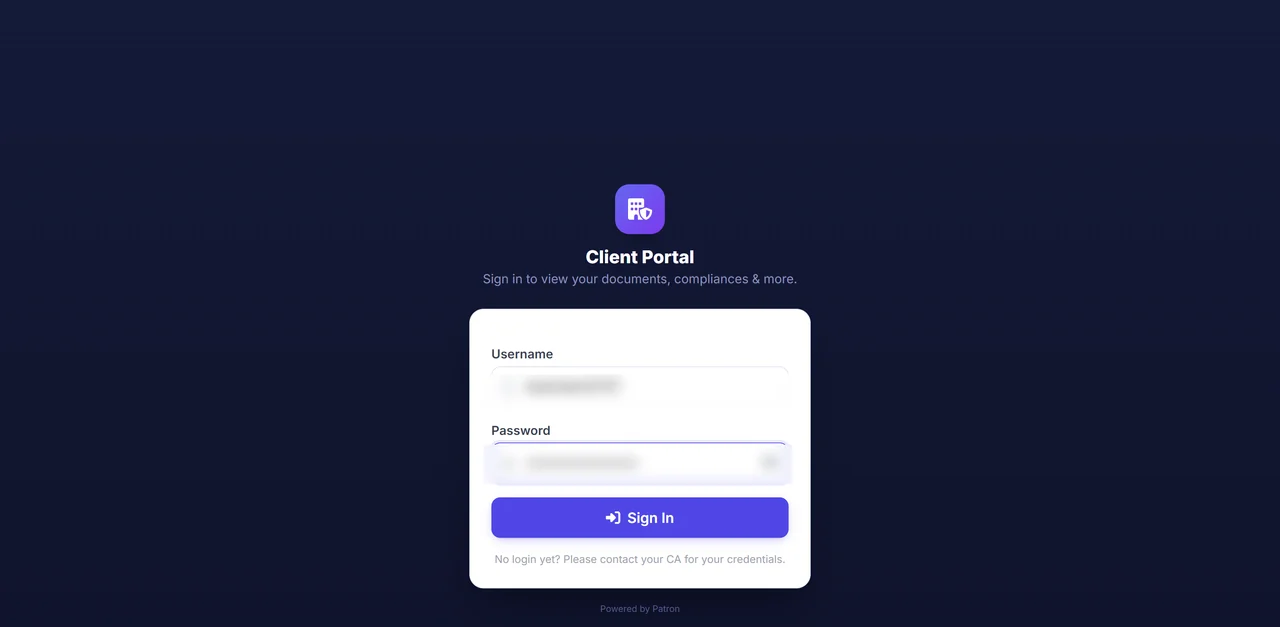
Everything happens in one secure login. You can see your active services, the Patron team on your account, and anything still pending. Once you raise a request, it moves through the same clear steps every time, so you always know exactly where your work stands.

Secure client portal login screen
1

Sign in securely

Your books, documents and requests all sit behind one private, password protected login. The team handling your account is shown on screen, so nothing sensitive ever needs to travel over email or WhatsApp.

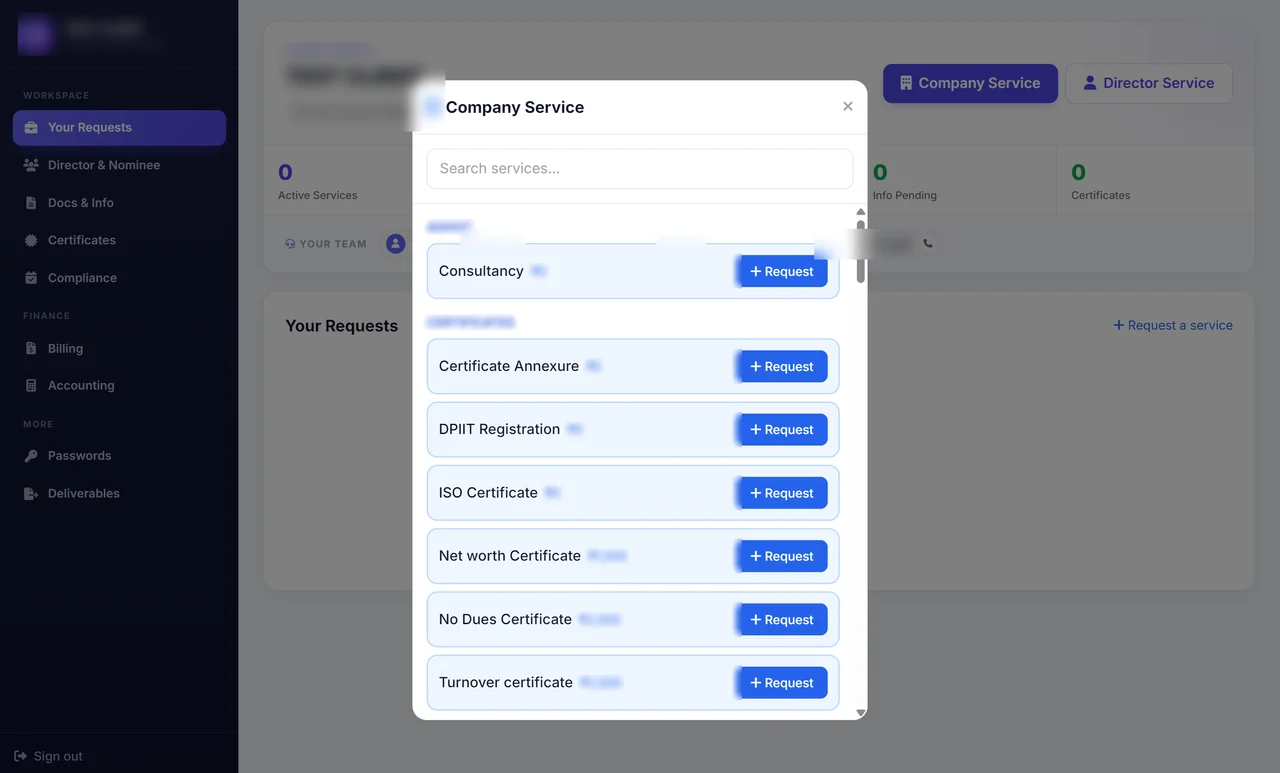
Service catalogue inside the client portal
2

Raise your request

Choose the service you need from the menu inside the portal, where the price is shown before you go ahead. Your request is logged the moment you send it, with no phone calls or reminder emails to wait on.

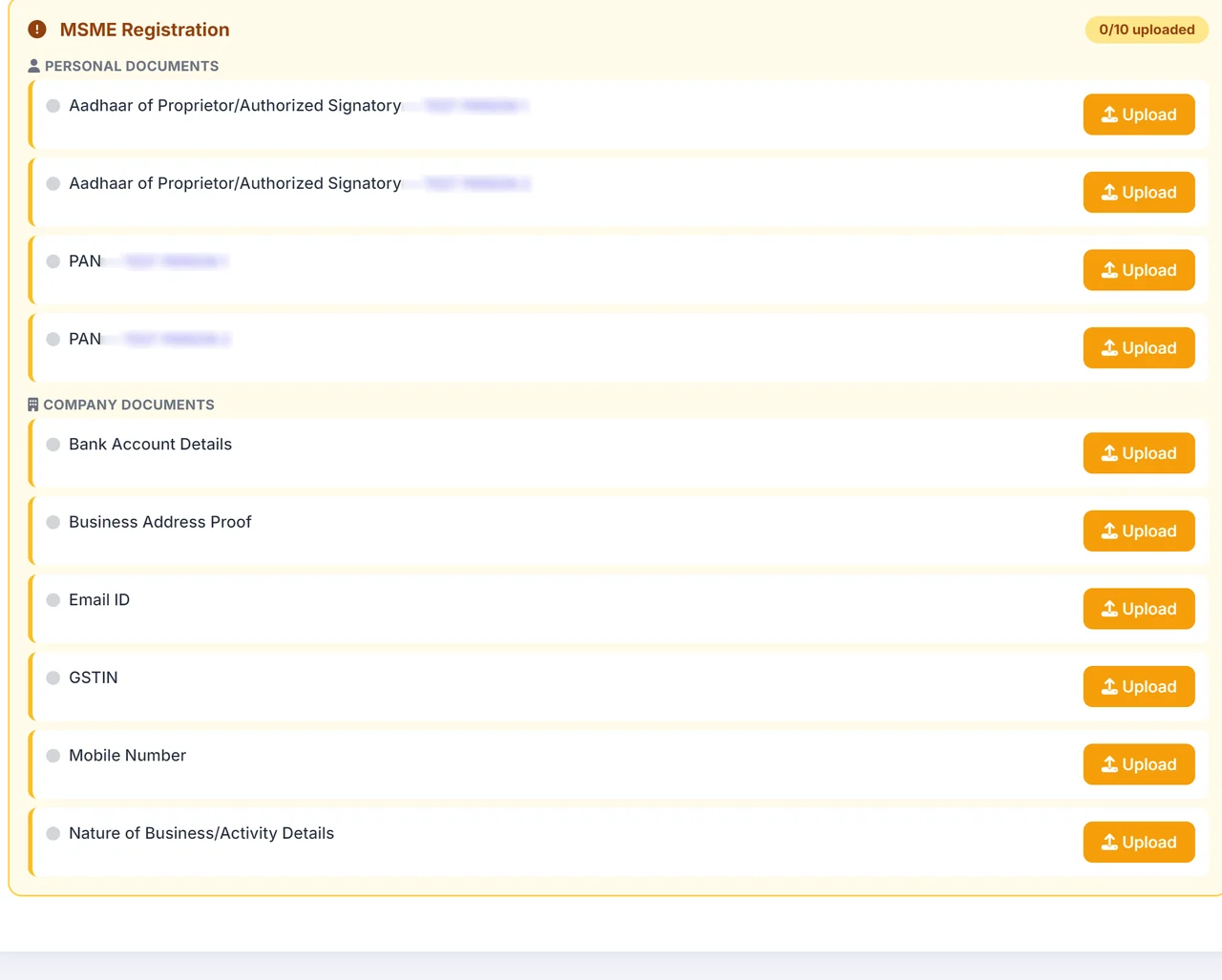
MSME and Udyam registration document checklist in the client portal, with an upload button beside each item
3

Share what the service asks for

For every service, the portal lists the exact documents it needs, each with its own upload button. The example shown here is the MSME (Udyam) registration checklist. When a service needs nothing from you, it simply asks for nothing.

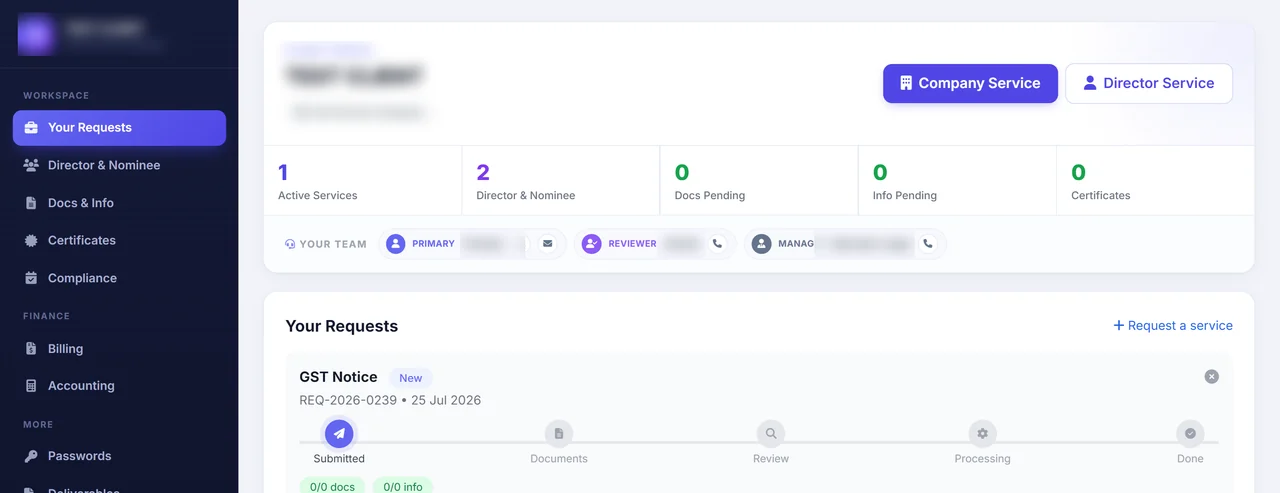
Live request tracker inside the client portal
4

We review, prepare and file

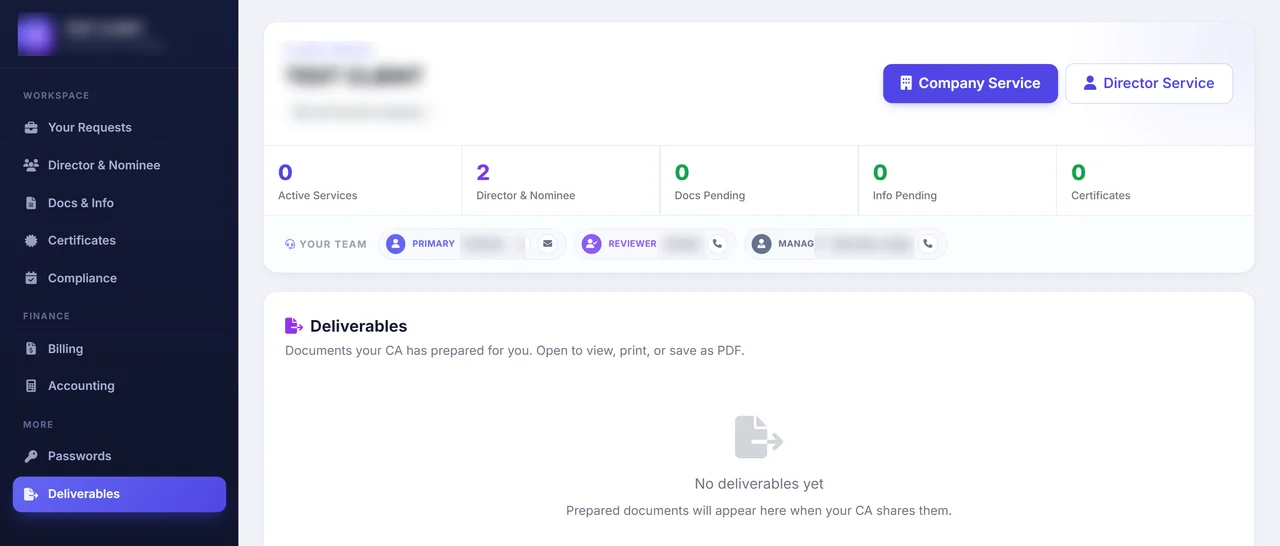
Once your documents are in, your team checks them, prepares the work and files it for you. A live tracker shows each stage as it happens, from review to processing to done, so you never have to ask where things stand.

Deliverables area of the client portal
5

Collect your finished work

Every completed return, computation and certificate is placed in your Deliverables area. You can open, print or download any of them as a PDF whenever you need a copy.

Startup Accounting Challenges Specific to Delhi: MCD Trade Licensing and NCR Inter-State GST Reconciliation

ChallengeImpactHow Patron Accounting Solves It
A priced angel round booked without a valuation report backing itWithout a valuation on file, the premium is hard to defend in investor diligence and any foreign-investment pricing check.Patron keeps a valuation report reconciled to the cap table; see startup accounting for Delhi founders.
A startup at an Okhla incubator booking grant funds as incomeGrant money inflates revenue and hides the true burn, so runway looks longer than it is.Our team defers grant income and recognises it only as the funded conditions are met.
ESOP grants to the team carry no accounting chargeThe option cost stays off the books, so employee expense and losses understate before a round.Patron measures the ESOP fair value and spreads the charge over the vesting period under Ind AS 102.
Annual SaaS contracts recognised as revenue on invoicingRevenue and MRR overstate up front, so growth and margin trends mislead investors.Our team defers subscription revenue and releases it monthly across the contract, so MRR reads true.
SaaS billed from Connaught Place to clients across NCR statesPlace of supply is read wrong, so the IGST versus CGST and SGST split leaves credit mismatched.Patron maps place of supply per client state, so each NCR invoice carries the right tax head.

Startup Accounting Fees in Delhi

Fee ComponentAmount
Starter — one early-stage entity with routine monthly volumeINR 2,499 per month
Excl. GST & Government Charges
Growth — cap-table events, higher burn lines or a second entityOn quote
Managed — multi-entity books with custom investor and burn reportingOn quote

Delhi startups pay our national Starter fee of INR 2,499 per month; price tracks scope, entity stage, cap-table events and monthly burn, never postcode. More cap-table activity or a second entity moves the tier. Local registration charges, where they apply, are billed at actuals. Get a scope-based quotation on +91 94594 56700.

Fees exclude GST and government charges. Final quote confirmed after a scoping review.

All fees and charges listed are indicative only and do not constitute a binding offer. Final amounts may vary depending on the volume of work and the complexity involved.

Professional accounting and compliance charges are scoped to your number of entities, funding stage and monthly transaction volume, and are separate from statutory and government charges. Contact us for a detailed, fixed quote.

Get a free Startup Accounting consultation - Call +91 945 945 6700 or WhatsApp us. No-obligation assessment.

Startup Accounting Compliance Calendar 2026 for Delhi Businesses

ComplianceDue DateApplies To
TDS / TCS deposit (Challan ITNS-281)7th of every month (30 April for March)Every business that deducts tax at source on salaries, rent, contractor or professional fees
Provident Fund (ECR) and ESI contribution15th of every monthEmployers registered under EPF and ESI
GSTR-3B (summary return and tax payment)20th monthly for turnover above Rs 5 crore; 24th quarterly under QRMP for turnover up to Rs 5 crore (Category Y)GST-registered businesses in Delhi
ESOP perquisite TDS deposit on allotment7th of the month after allotmentEmployers allotting shares under an approved ESOP
Advance tax first instalment (15%)15 June 2026Companies, firms and individuals with a tax liability of Rs 10,000 or more
Director KYC (DIR-3 KYC)30 September 2026Every director holding a DIN as on 31 March
Income-tax return, audit cases31 October 2026Companies and audit-liable firms
Financial statements filing (Form AOC-4)Within 30 days of the AGM (by 29 October 2026 for a 30 September AGM)Companies filing audited financials with the ROC
Annual return (Form MGT-7 / MGT-7A)Within 60 days of the AGM (by 28 November 2026 for a 30 September AGM)Companies filing the annual return with the ROC

For a Delhi startup the ESOP perquisite TDS on the 7th after allotment and GSTR-3B on the 24th recur, with the 80-IAC claim window the date not to miss. Delhi levies no professional tax, so the local rhythm stays GST and TDS led. For startup accounting services in Delhi, download Patron's 2026 calendar or call +91 94594 56700; our local guide has more.

Key Benefits

Why Professional Startup Accounting Matters

Cap table the register supports

Your working cap table, the statutory register of members and the share capital in the books all carry the same holdings.

  • working cap table tied to the Section 88 register of members
  • share capital and securities premium in the books agree
  • Without it, allotments retraced under an investor's counsel in diligence

Option grants that stand up

Your option grants, vesting, exercises and lapses sit in the Form SH-6 register, with board and shareholder approvals behind them.

  • grants, vesting, exercises and lapses in the Form SH-6 register
  • share-based payment charge spread over the vesting schedule
  • Without it, informal email grants leave options the company cannot evidence

Investor metrics traceable to ledger

Your burn, runway and revenue metrics are rebuilt from the trial balance on your own definitions. Any gap against the deck is explained.

  • burn, runway and revenue rebuilt from the trial balance
  • your own definitions used, gap against the deck explained
  • Without it, a fund's analyst arrives at a different figure

Convertible instruments in the right place

We classify compulsorily convertible preference shares or debentures from the actual instrument terms, and treat round costs on a stated basis.

  • CCPS and CCD terms read to decide balance sheet treatment
  • round costs treated on a stated basis
  • Without it, equity misread by a lender or later investor

Related party dealings on record

You know which founder dealings the company actually approved. We match director accounts, founder agreements and director loans to the approvals obtained.

  • director current accounts, founder agreements and director loans matched to approvals
  • loans to directors tested against approvals obtained
  • Without it, an unapproved entry left standing for auditors and reviewers

A deduction claim you can support

You claim the Section 80-IAC deduction in a year on record, because we test DPIIT recognition and its conditions each year.

  • DPIIT recognition and 80-IAC conditions tested each year
  • turnover and incorporation-date limits checked before the claim
  • Without it, a claim made in a year the company no longer qualifies

Why Startup Accounting Services Clients in Delhi Choose Patron Accounting

Five things a founder can check before handing over the books. Each is a claim with the proof behind it.

Cap table and books that agree before diligence

With 15+ years across 3,000+ businesses, we keep your equity register and ledger tied together, so convertible notes, CCPS and option grants reconcile long before an investor's diligence opens them.

DPIIT recognition, Section 80-IAC and ESOP timing

DPIIT recognition, the Section 80-IAC tax holiday and ESOP perquisite timing are routine filings for us, part of the 25,000+ filings completed, kept correct so an eligibility condition never slips.

Zoho Books or Xero set up to scale

We work across Zoho Books and Xero, and we set the chart of accounts, classes and reporting to hold from seed through a priced round without a rebuild.

Investor MIS with burn and runway monthly

Each month we produce investor MIS covering burn, runway and cohort retention, with GST and TDS filed before the deadline, part of the 25,000+ filings we have completed.

Near Connaught Place and Barakhamba Road founders

Our Delhi team supports founders around Connaught Place and Barakhamba Road with MCD licensing, inter-state place-of-supply and Delhi Shops and Establishment registration, backed by 3,000+ businesses served since 2019.

Figures reflect Patron Accounting LLP engagements since 2019. Scope and turnaround are confirmed in your engagement letter.

Founder-Led Books vs Outsourced Startup Accounting: for Delhi Businesses

CriterionFounder-Led BooksOutsourced Startup Accounting
Monthly costLow visible cost, but founder hours on the books are pulled away from product and fundraising.A predictable fee that buys a trained team and defined monthly deliverables.
Compliance riskHigher risk of missed returns, a real exposure with inter-state NCR supplies from Nehru Place vendors.A managed calendar reduces missed filings and reconciles Delhi and cross-border NCR transactions.
Expertise depthLimited to what the founder knows, with gaps around cap table, ESOP and revenue recognition.Access to qualified accountants who handle equity, investor reporting and statutory nuance.
ScalabilityBreaks down as transaction volume and headcount rise past the early stage.Capacity flexes to demand without hiring and training a finance team.
ContinuityBooks stall when the founder travels, raises, or falls ill.A firm covers leave and turnover, so records stay current.
Investor readinessAd hoc records slow due diligence and rushed clean-ups before a round.Clean, traceable ledgers stand up to investor and lender scrutiny.
VerdictFor most Delhi startups juggling MCD licensing and inter-state NCR GST, outsourced startup accounting services in Delhi give better compliance and continuity than founder-led books. A funded company scaling fast may justify an in-house team; see Startup Accounting Services India.

Delhi Rules for Startups — Delhi's Nil Professional Tax, Section 80-IAC and ESOPs

A Delhi startup gets one compliance for free that a Mumbai one does not: with no profession tax in the capital, its early payroll carries no PTRC deduction. What it still has to manage is a municipal trade licence and, where it opens an NCR branch, the distinct-persons rule under GST.

So the local layer is lighter on payroll but alive on registration, and it sits under the central startup reliefs. The 80-IAC deduction and ESOP perquisite timing depend on records kept as events happen, which is why a live Monthly Burn Rate is set up early. Startup accounting services in Delhi answer to the provisions below.

  • No profession tax in DelhiThe startup's early payroll carries no profession-tax deduction, unlike its peers in Maharashtra.
  • Section 80-IAC, Income-tax Act 1961Can take a complete profit deduction for three back-to-back years out of its opening ten.
  • Section 17(2)(vi) with Section 192, Income-tax Act 1961The ESOP perquisite arises on exercise, though an eligible startup may defer the TDS under Section 191(2)/192(1C)
  • Section 25(4), CGST Act 2017A Delhi office and an NCR branch are distinct persons under GST, so inter-branch supplies are invoiced and valued.
  • Section 128 with Rule 3(1), Companies (Accounts) Rules 2014The books stay on accrual with the audit trail live for diligence. Full national detail sits on the parent startup page.

Official sources: Ministry of Corporate Affairs · Income Tax Department · GST Portal · Startup India (DPIIT)

How is the Section 80-IAC tax holiday claimed by a DPIIT-recognised Connaught Place startup?

Section 80-IAC gives a 100% deduction of eligible profits for three consecutive years out of the first ten, but only after a separate application to the Inter-Ministerial Board over and above DPIIT recognition. You choose which three years, so we model the claim against projected profits and keep audited accounts and incorporation evidence ready before the board takes it up.

When does TDS on ESOP perquisites fall due for a Delhi startup?

TDS on the ESOP perquisite arises when shares are allotted on exercise and is otherwise payable by the 7th of the following month. A DPIIT-recognised eligible startup can defer that deposit under Section 192(1C) for up to 48 months from the end of the relevant assessment year, or until sale or the employee leaving, whichever is earliest. We track each exercise event.

Does a startup registered in Delhi pay professional tax on employee salaries?

No. Delhi levies no professional tax at all, so there is no PTRC or PTEC registration for a Connaught Place or Okhla office, unlike Maharashtra or Karnataka. Payroll compliance is limited to Section 192 TDS, plus PF and ESI once thresholds are crossed. If you hire staff based in a professional-tax state, the obligation follows their state of employment.

Does a Delhi-registered company with teams in Gurugram and Noida need more GST registrations?

A separate GSTIN is needed in every state where you have a fixed place of business, so a leased Gurugram office needs a Haryana registration even though the company sits in Delhi, while fully remote employees generally do not create one. We map billing entity, place of supply and vendor invoicing across the NCR so input credit is not stranded in the wrong state.

Can a Nehru Place or Okhla coworking desk be the registered office for GST and MCA?

Yes, provided the operator issues a no-objection certificate, a signed agreement and a utility bill in its name, which Delhi GST officers routinely demand during physical verification. The MCA registered office additionally needs a board resolution and Form INC-22 filed within thirty days of any change. We assemble that address pack before filing so the application does not come back queried.

What does investor-ready MIS actually mean for a seed-stage Delhi startup?

It means books closed monthly by the 10th, reporting revenue, gross margin, burn, runway and headcount on the same basis every month, with a cap table that agrees to your MGT-7 and issued share certificates. Diligence teams routinely ask for 24 months of consistent figures, and restating a year of Delhi startup books under time pressure costs far more than closing monthly.

How should founder-paid expenses and money founders put into the company be recorded?

Founder-paid costs are booked as reimbursements against a director current account with the underlying bills attached, never as capital, and money left in the company is documented as an unsecured loan or share application money with a board resolution. Unexplained director credits are the most common Section 68 addition raised in scrutiny of Delhi startups, and the fix is contemporaneous paperwork.

How should a Delhi startup account for a government grant or an accelerator cheque?

A grant tied to specified expenditure is recognised as income only as the matching cost is incurred, while an equity-linked accelerator cheque is share capital and never revenue. Treating either as turnover inflates revenue and can drag you into a GST registration or audit you did not need. We maintain a utilisation statement per grant, which is what the granting body asks for.

What does startup accounting cost in Delhi?

Pricing tracks monthly transaction volume, headcount on payroll and whether cap-table and investor MIS work is included, not how much you have raised. A pre-revenue Okhla startup with one bank account is far cheaper than a Series A company with multi-currency billing and a live ESOP pool. We quote a fixed monthly retainer. Fees exclude GST and government charges.

Is the work done from the client's Delhi office, and who holds the accounting login?

Work is handled remotely, with on-site visits to your Delhi premises by arrangement for board meetings, diligence support and year-end audit coordination; there is no walk-in office in Delhi. Bank statements, invoices and payroll inputs move through a shared secure folder, and the ledger stays in your own accounting subscription, so your data never sits locked inside someone else's login.

Quick Answers

Two ledgers usually disagree in an early-stage company: the revenue the billing tool reports and the cash the bank actually received. Patron matches them entry against entry each month, splitting deferred revenue from collections, tagging refunds and writing off what will not arrive at all, so the startup accounting.

Startup Accounting Deadlines in Delhi You Cannot Afford to Miss

TDS / TCS deposit (Challan ITNS-281) is due 7th of every month (30 April for March). Provident Fund (ECR) and ESI contribution is due 15th of every month. GSTR-3B (summary return and tax payment) is due 20th monthly for turnover above Rs 5 crore; 24th quarterly under QRMP for turnover up to Rs 5 crore (Category Y). Patron tracks each against your books so nothing is reconstructed after the fact. Call +91 94594 56700 to set up a filing-reminder schedule.

Start Your Startup Accounting Services in Delhi with Patron Accounting

By the time a diligence request list arrives, the position is already set. It asks for monthly numbers going back several years, board minutes that match each decision, and a schedule behind every balance in the accounts. Founders in Delhi find out then whether their records were kept for the company or only for the return.

The close then lands on a date instead of on demand. Feeds are pulled early in the month, revenue is cut off, and the schedules a funder wants are produced as part of the routine. Startup accounting in Delhi draws the investor pack from that closed ledger.

A second address is worth raising early. Where the company here also runs a team in Gurugram, the two are distinct persons under GST. Salaries recharged from one to the other become a taxable supply, and our national startup practice invoices it.

Book a Free Consultation - No Obligation.

Startup Accounting Across Key Cities

Your city is highlighted below — we run the same on-ground service across these cities too.

Reviewed by the CA & CS Team, Patron Accounting LLP
ICAI & ICSI registered  ·  15+ years in Indian accounting & compliance  ·  Last reviewed 23 July 2026  ·  Next review 23 October 2026