
In this guide
Manufacturers running units in Bawana, Okhla, Narela or Mangolpuri face a slightly different bookkeeping job from a trading or services business: alongside GST and TDS, they must track raw material, work-in-progress and finished goods, and turn all of that into a cost of goods manufactured. This guide explains, in plain terms, how GST and inventory accounting fit together for a Bawana or Okhla manufacturing unit, and which Delhi-specific rules change the picture. It is an explainer, not a sales page. If you want a firm to run the books, that belongs on our Manufacturing Accounting Services Delhi page.
What manufacturing accounting means for a Bawana or Okhla unit
A factory converts inputs into output, so its accounts must capture that conversion. Where a trader records purchases and sales, a manufacturer records raw material consumed, the direct labour and expenses that shape it, the factory overhead absorbed along the way, and the movement of goods through three inventory stages. The central output is the manufacturing account, prepared before the trading account, whose balancing figure is the cost of goods manufactured. Units in the Bawana Industrial Area or the Okhla Industrial Estate typically run job work in and out, hold plant and machinery on which depreciation matters, and deal with scrap, so each of those needs a clean home in the ledger.
For the day-to-day book-keeping mechanics that sit under all of this, our general Accounting and Bookkeeping Services Delhi page and the broader Manufacturing Accounting Services guide cover the ground; here we stay on the factory-specific costing and the Delhi angle.
The three inventory accounts and three manufacturing costs
Two simple lists anchor factory accounting. The three inventory accounts are raw materials, work-in-progress and finished goods. The three manufacturing costs are direct materials, direct labour and manufacturing (factory) overhead. Direct materials and direct labour together form the prime cost; add factory overhead and you have the factory cost. Overhead splits into direct and indirect, and telling them apart is where many units slip. Factory rent, power for machinery, supervisor salaries and machine depreciation are factory overhead; office rent, sales commission and directors' fees are not, and belong below the manufacturing account.
How do you prepare a manufacturing account?
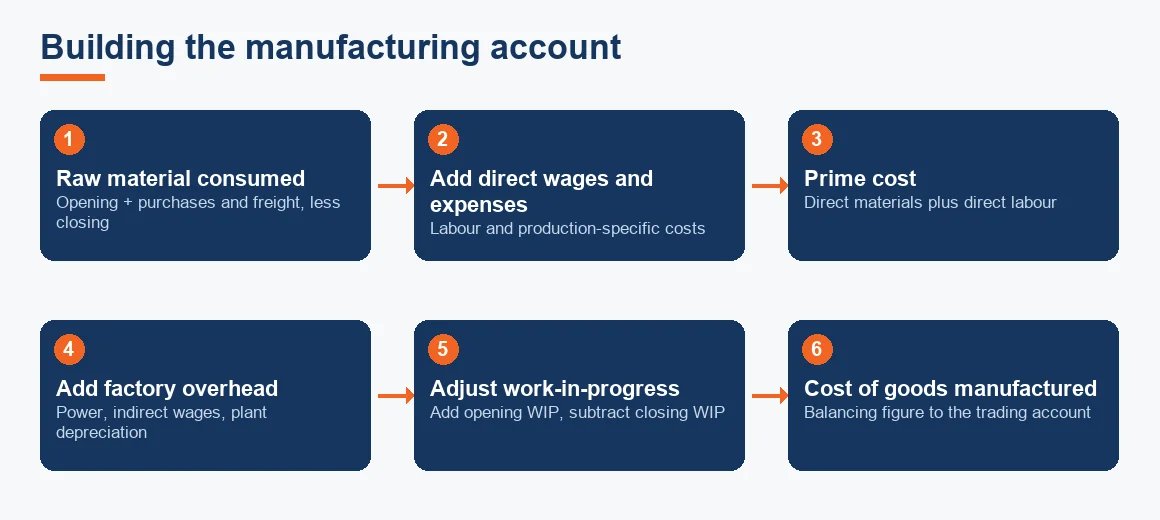
The build runs in a fixed order. Follow it and the balancing figure falls out on its own.
- Start with raw material consumed: opening raw material stock, plus purchases and inward freight, less closing raw material stock.
- Add direct wages, the labour that physically works on the product.
- Add direct expenses such as royalty on production, hire of a specific machine or carriage on a bought-in component.
- This subtotal is the prime cost.
- Add factory overhead: indirect factory wages, power and fuel, factory rent and rates, consumable stores and depreciation on plant and machinery.
- Adjust for work-in-progress: add opening WIP and subtract closing WIP.
- The balancing figure is the cost of goods manufactured, which transfers to the trading account.
Companies filing under Schedule III do not present a separate manufacturing account. The same numbers reappear as cost of materials consumed, changes in inventories of finished goods and work-in-progress, and the relevant expense lines, but the underlying logic is identical.
Valuing inventory and work-in-progress
Closing stock at each stage must be valued at the lower of cost and net realisable value, following AS 2. For cost flow, a unit picks either first-in-first-out or weighted average and applies it consistently; the choice changes the closing figure when input prices move, so it is not a free switch year to year. Work-in-progress valuation is the fiddly part, because a half-finished batch carries full material but only part of its labour and overhead. A defensible method, a documented bill of materials and consistent overhead absorption keep the closing WIP figure audit-ready.
GST and job work for a Delhi manufacturing unit
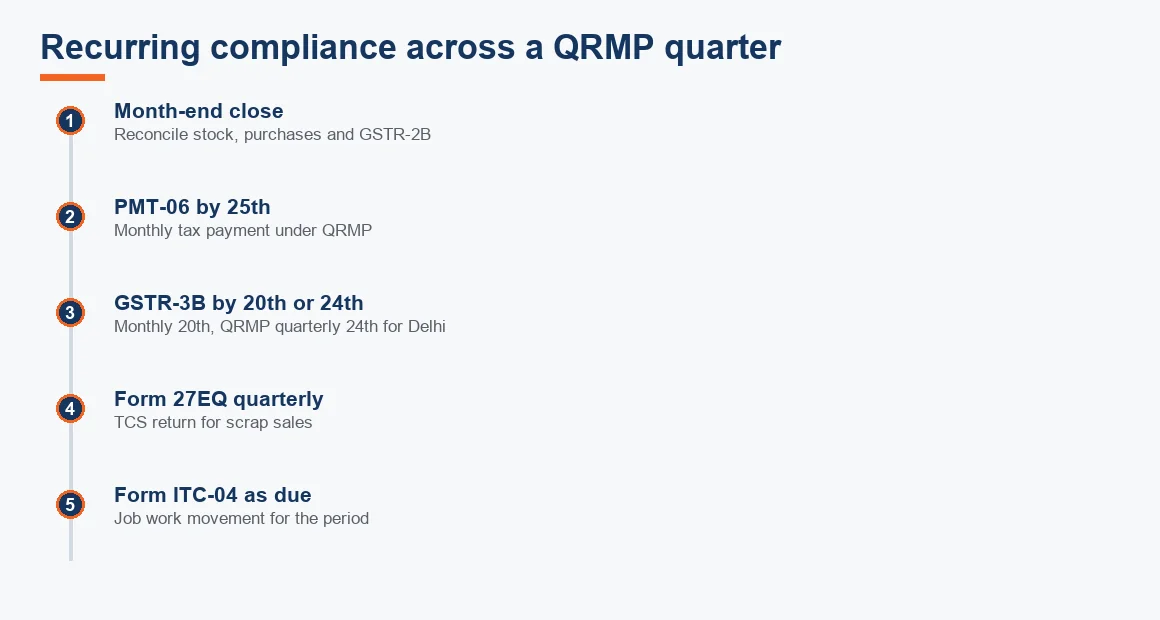
GST for a factory is mostly ordinary output tax, input tax credit and returns, with two wrinkles that manufacturers meet more than most. First, job work: when you send inputs or semi-finished goods to a job worker, the movement goes on a delivery challan and is tracked in Form ITC-04, and the goods should return within the prescribed period (one year for inputs, three years for capital goods) or the sending is treated as a supply. Second, credit discipline: match your purchase register against the auto-drafted GSTR-2B every month so no eligible credit is missed and no ineligible credit is claimed.
On timing, monthly filers submit GSTR-3B by the 20th of the following month. A Delhi unit with turnover up to Rs 5 crore that has opted into the QRMP scheme files GSTR-3B by the 24th of the month after the quarter and pays tax monthly in Form PMT-06 by the 25th, because Delhi sits in the second staggered group alongside Haryana. The due dates and the QRMP rules are set out on the GST portal and by CBIC. Our GST and TDS health-check for Delhi MSMEs walks through a self-review if you want to test your own filings.
Tax collected at source on scrap sales
Scrap is a normal by-product of machining, moulding and fabrication, and its sale carries a specific obligation. Under section 206C(1) of the Income Tax Act, a seller of scrap must collect tax at source at 1 percent at the time of debiting the buyer's account or receiving payment, whichever is earlier. Scrap here means waste and scrap from the manufacture or mechanical working of materials which is definitely not usable as such. Two practical points matter: obtain a declaration in Form 27C from any buyer who will use the material in manufacturing (which removes the collection), and file the quarterly TCS return in Form 27EQ. The statutory text sits on the Income Tax Department site.
What Delhi's tax setup changes
The biggest Delhi-specific point is a relief: Delhi levies no professional tax. Nothing is deducted from wages at a Bawana or Okhla unit on that count, and there is no professional tax registration to maintain, unlike a factory in Maharashtra or Gujarat. Statutory payroll deductions for a Delhi factory come down to EPF, ESI and TDS under the Income Tax Act. If you also run a branch in a state that does levy professional tax, you register and deduct there, not in Delhi. Because the NCR spans three tax jurisdictions, an inter-state footprint also means reconciling GST across state registrations. Our Delhi Shops and Establishment plus GST and TDS guide for employers covers the employer-side compliance in more depth.
Do you have to maintain cost records?
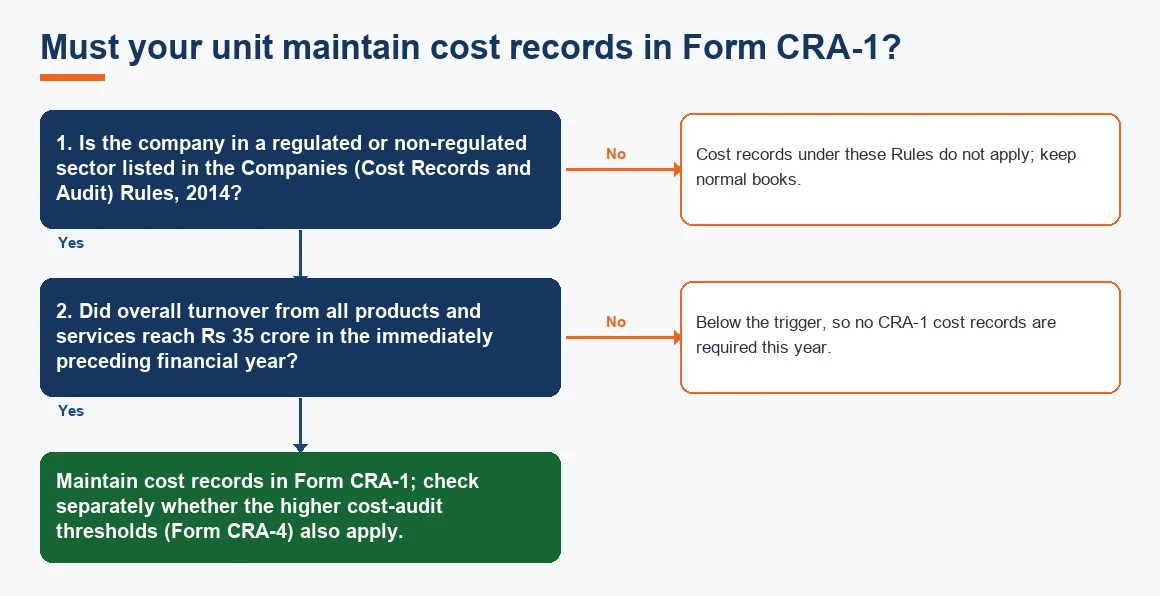
Cost records are not universal. Under the Companies (Cost Records and Audit) Rules, 2014, a company in a listed regulated or non-regulated sector must maintain cost records in Form CRA-1 once overall turnover from all products and services reaches Rs 35 crore in the immediately preceding financial year. Cost audit, reported in Form CRA-4, applies only at higher product-wise thresholds. Many Bawana and Okhla units, being smaller and often non-corporate, fall below the trigger altogether. The rules and forms are hosted by the Ministry of Corporate Affairs. Separately, watch the section 43B(h) MSME clock: payments to micro and small suppliers are deductible only when actually paid within the agreed period, which is a real cash-flow item for a factory buying components on credit.
Worked example: cost of goods manufactured for a Bawana unit
Take a small fabrication unit for a single year. All figures are illustrative. The manufacturing account builds to the cost of goods manufactured, which then feeds the trading account.
| Line | Amount (Rs) |
|---|---|
| Opening raw material stock | 4,00,000 |
| Add: Raw material purchases and inward freight | 28,00,000 |
| Less: Closing raw material stock | (3,00,000) |
| Raw material consumed | 29,00,000 |
| Add: Direct wages | 9,00,000 |
| Add: Direct expenses (job work out, hire) | 2,00,000 |
| Prime cost | 40,00,000 |
| Add: Factory overhead (power, indirect wages, plant depreciation) | 7,50,000 |
| Add: Opening work-in-progress | 1,50,000 |
| Less: Closing work-in-progress | (2,00,000) |
| Cost of goods manufactured | 47,00,000 |
The plant depreciation inside factory overhead is computed on the written-down or straight-line basis under Schedule II; our depreciation calculator handles the schedule so the overhead figure is defensible. From here, the cost of goods manufactured plus opening finished goods, less closing finished goods, gives the cost of goods sold in the trading account.
Key terms
- Work-in-Progress (WIP) Valuation: valuing part-finished goods carrying full material but partial labour and overhead.
- Direct vs Indirect Factory Overheads: splitting factory costs that attach to a product from those that support the plant generally.
- FIFO vs Weighted Average Cost: the two permitted cost-flow methods for valuing inventory.
- Form ITC-04 Job Work Tracking: the GST return that tracks goods sent to and returned from a job worker.
- Delhi Nil Professional Tax Regime: Delhi's absence of professional tax on wages.
A simple monthly and quarterly rhythm
Most of the burden is calendar-driven, so a fixed monthly close keeps it manageable. The timeline below shows the recurring dates a Delhi unit tracks across a QRMP quarter.
If you are weighing whether to bring this in-house or outsource it, and at what price, our cost of accounting services in Delhi guide and how to choose an accountant in Delhi cover both questions. Manufacturers who also run a software or startup arm can cross-refer our startup accounting and SaaS accounting guides for those parts of the group, and the wider NCR inter-state GST reconciliation point applies whenever a unit registers across Delhi, Haryana and Uttar Pradesh.
Key takeaways
- Build the manufacturing account in order: raw material consumed, prime cost, factory cost, adjust WIP, arrive at cost of goods manufactured.
- Keep factory overhead clean; office and selling costs sit below the line.
- Delhi charges no professional tax, so wage deductions are EPF, ESI and TDS only.
- Collect 1 percent TCS on scrap unless a valid Form 27C is on file, and file Form 27EQ quarterly.
- Match GSTR-2B monthly, track job work in Form ITC-04, and file GSTR-3B by the 20th or the QRMP 24th.
Decision guide