


Talk to an Expert
Talk to an Expert ✆ +91 945 945 6700
Trusted by 10,000+ Businesses
Delhi, Delhi

Manufacturing Accounting Services in Delhi

Reviewed by CA and CS Team, Patron Accounting LLP ICAI & ICSI Registered| 15+ Years Experience| Last Updated: July 2026 Verify Credentials →

A defensible cost per unit: You get a cost per unit built from the rates material is actually issued at and current conversion cost.

Stock valued stage by stage: You value raw material, work in progress, finished goods, stores and scrap each against count sheets, not one closing figure.

Stock statement agreed to the ledger: The stock and receivables statement you file with your bank agrees to the ledger on the same date.

Job-work quantities fully accounted: Material lying with job workers stays on your books, challan by challan, so what returns reconciles to what you sent.

15+ YearsIndustry Experience
CA & CSCertified Experts
4.9
Based on real Google reviews

Get Free Consultation

Talk to a CA/CS expert today

🇮🇳 +91

Our team will get back to you shortly. No spam.

Real Stories from Real People

Verified Google reviews from founders and businesses Patron works with across India.

Join 3,000+ Founders and Businesses on Patron

Rated 4.9 on Google - trusted for startup accounting since 2019.

Talk to an Expert
10,000+Businesses ServedGST compliance and litigation support across India.
15+Years ExperienceDeep expertise in IP registration, GST & business compliance.
50,000+Documents FiledReturns, appeals, and filings handled accurately.
4.9★Client RatingTrusted by entrepreneurs, startups, and growing businesses.
ISO CertifiedProfessional standards and documented processes.
SSL SecureYour financial and business data is fully protected.

What Manufacturing Accounting Costs and Covers for Delhi Businesses

📌 TL;DR - Manufacturing Accounting Services at a Glance

Manufacturing accounting services in Delhi cost each build to its bill of materials and return job work on ITC-04. Below Rs 5 crore, the capital's cycle ends on the 24th. Patron keeps the cost record file current for units in Okhla and Mayapuri. Ideal where a unit runs job work across more than one industrial area.

The division of labour is usually clear. Your stores team carries on issuing and receiving material on the shop floor, and the manufacturing accounting service in Delhi picks it up from the ledger inwards, converting those movements into valued entries and closing the month once consumption is valued. On a Bawana plot the fixed-asset register is built separately too, leasehold premium and ground rent carried apart from building and plant. Relocated units read what the asset file usually misses first.

An unreconciled job-work position becomes a demand on goods that never left the group, and material sent to a finisher in Okhla and returned late is exactly how that gap opens. Manufacturing accounting in Delhi is scoped tightly around the stock ledger, the challan record and the input credit matched against the central GST portal. Departmental replies and appeals sit outside the retainer.
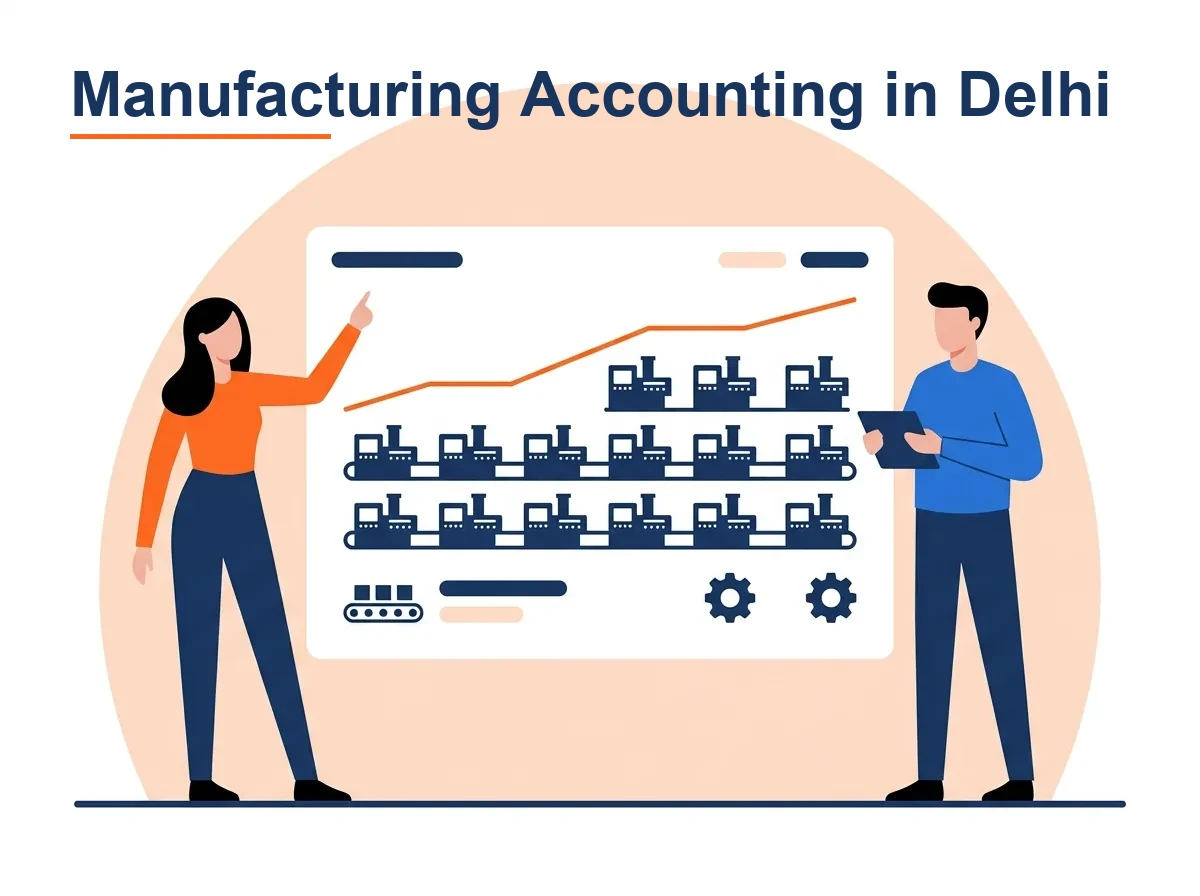

What Do Manufacturing Accounting Services Mean for Delhi Businesses?

Every movement of material is what this work is built to capture. Every issue to the floor, every transfer to a job worker and every receipt of finished goods is an event the ledger must value and place. Manufacturing accounting services in Delhi convert those shop-floor movements into costed entries, so consumption, work in progress and finished stock each carry a figure built from actual usage rather than a guess.

Two local wrinkles are worth naming. The capital levies no professional tax, so the payroll layer is thin and effort moves to the stock and cost records. And because a rented godown just over the state line is a separate registration, goods stored there open a second stock ledger and a reconciliation between the two. Manufacturing accounting services in Delhi are scoped around the stock ledger, the challan file and the input credit matched to it, keeping the costed position current. One plot or several, the method is the same.

Key Terms for Manufacturing Accounting:

What Are Manufacturing Accounting Services. At the close of a manufacturing month, the books have to show one number in Delhi

Who Needs Manufacturing Accounting Services in Delhi: From Connaught Place to Growing SMEs

Manufacturing accounting services in Delhi fit units where the cost of a product turns on how material, labour and overhead move through the floor. On a Mayapuri or Naraina plot, the books only make sense once production, stock and job work are posted together.

  • Batch and process units in Naraina where yield and scrap shift from one run to the next.
  • Engineering shops sending materials to job workers, needing every challan tied back to the stock ledger and reconciled across the state line.
  • Assembly makers with multi-level bills of material, where one wrong rate distorts each finished good.
  • Manufacturers borrowing against stock, whose bank stock statement must agree with the ledger.
  • Units in regulated sectors where cost records are mandatory, needing machine-hour rates maintained monthly, the heart of cost accounting for manufacturers.
  • MSME suppliers caught by the 43B(h) 45-day payment rule on what they owe vendors.
  • Foundries with heavy scrap, where abnormal loss must stay out of cost.

Manufacturing Accounting Services Included for Delhi Businesses

ServiceWhat We Do
WIP valuation and stock recordsFor workshops around Okhla and Nehru Place, we value work in progress and finished goods stage by stage and maintain full inventory records Monthly
Job-work register and ITC-04 workingsGoods sent to and returned from job workers are tracked on Rule 55 challans, forming the manufacturing accounting services in Delhi that keep quantities accounted Quarterly
Cost sheet and overhead absorptionA cost sheet per product absorbs overhead on normal capacity, giving cost accounting services in Delhi that keep abnormal loss out of unit cost Monthly
Bank stock statement reconciliationYour monthly stock and receivables statement to the bank is tied back to the ledger, so drawing power reflects the real inventory position Monthly
Inventory accounting and valuationRaw material, stores, WIP, finished goods and scrap are valued and reconciled to physical counts, delivering inventory accounting services in Delhi you can trust Monthly
GST reconciliation and management accountsE-way bill and GST purchase and sales reconciliation, plus monthly MIS, from our Manufacturing Accounting Services menu for producers Monthly, annually
Our Process

How Manufacturing Accounting Services Work in Delhi — Step by Step

How Patron delivers manufacturing accounting for Delhi businesses, step by step.

Step 1

Bill of materials validation

The bill of materials and standard cost per SKU are tested against the rates at which material is actually being issued and against current conversion cost. Standards that have gone stale are refreshed, because a stale standard makes every variance meaningless.

Illustration for Bill of materials validation: The bill of materials and standard cost per SKU are tested against the rates in Delhi
Step 2

Production and yield posting

Daily production reports and batch or job cards are posted so raw material converts into work-in-progress and then finished goods at each stage. Yield is measured against standard, and normal wastage is separated from abnormal loss.

Illustration for Production and yield posting: Daily production reports and batch or job cards are posted so raw material in Delhi
Step 3

Job work movement control

Goods sent to and returned from job workers are tracked challan by challan under the delivery challan rule. Quantities are reconciled including waste retained by the job worker, and the position is carried into the periodic job-work return already filed.

Illustration for Job work movement control: Goods sent to and returned from job workers are tracked challan by challan under in Delhi
Step 4

Overhead absorption on capacity

Power and fuel are allocated on the stated basis, and fixed overhead absorbed using normal capacity rather than actual output. On a DSIIDC plot at Bawana, Narela or Okhla the allotment premium is capitalised as a leasehold right and amortised, while lease rent is an occupancy cost of the year.

Illustration for Overhead absorption on capacity: Power, fuel and utility consumption is allocated on the stated basis, and in Delhi
Step 5

Stage-wise stock valuation

Physical count sheets are compared with book stock separately for raw material, work-in-progress, finished goods, stores and scrap. Differences are investigated by stage, and each stage is valued at the lower of cost and net realisable value.

Illustration for Stage-wise stock valuation: Physical count sheets are compared with book stock separately for raw material, in Delhi
Step 6

Bank stock statement reconciliation

The stock and receivables statement submitted to the bank for drawing power is reconciled to the ledger for the same date. Differences in valuation basis, goods at job workers and creditor deductions are explained in writing rather than left open.

Illustration for Bank stock statement reconciliation: The stock and receivables statement submitted to the bank for drawing in Delhi
Step 7

Cost records upkeep

Where the company's product falls within the prescribed list and it crosses the turnover trigger, cost records are maintained in the prescribed form through the year. They are reconciled to the financial accounts, so the year-end reconciliation is not built from scratch.

Illustration for Cost records upkeep: Where the company's product falls within the prescribed list and it crosses the in Delhi

Documents Required for Manufacturing Accounting Services

After the factory records, Delhi contributes an establishment certificate, the welfare fund statement, and a DSIIDC lease deed where the plot is an industrial allotment.

  • Bill of Materials and standard costing sheet per product or SKU
  • Production and manufacture records: daily production report, batch or job cards, yield and scrap/wastage report
  • Stock records for raw material, work-in-progress, finished goods, stores/spares and scrap, with physical verification sheets
  • Job-work records: delivery challans under Rule 55 for goods sent to and returned from job workers, and Form ITC-04 already filed
  • Cost records in Form CRA-1, where applicable
  • Purchase invoices, GRNs and e-way bills
  • Sales invoices, and e-invoice/IRN records where turnover exceeds Rs 5 crore
  • Registration certificate under the Delhi Shops and Establishments Act, 1954
  • Delhi Labour Welfare Fund Form A statement and half-yearly contribution challan (six months ending 30 June and 31 December)
  • DSIIDC/DSIDC industrial plot lease deed and allotment letter, with the premium receipt and annual lease-rent demand notes, only where the plot is a DSIIDC industrial allotment
Client Portal

How You Work With Patron

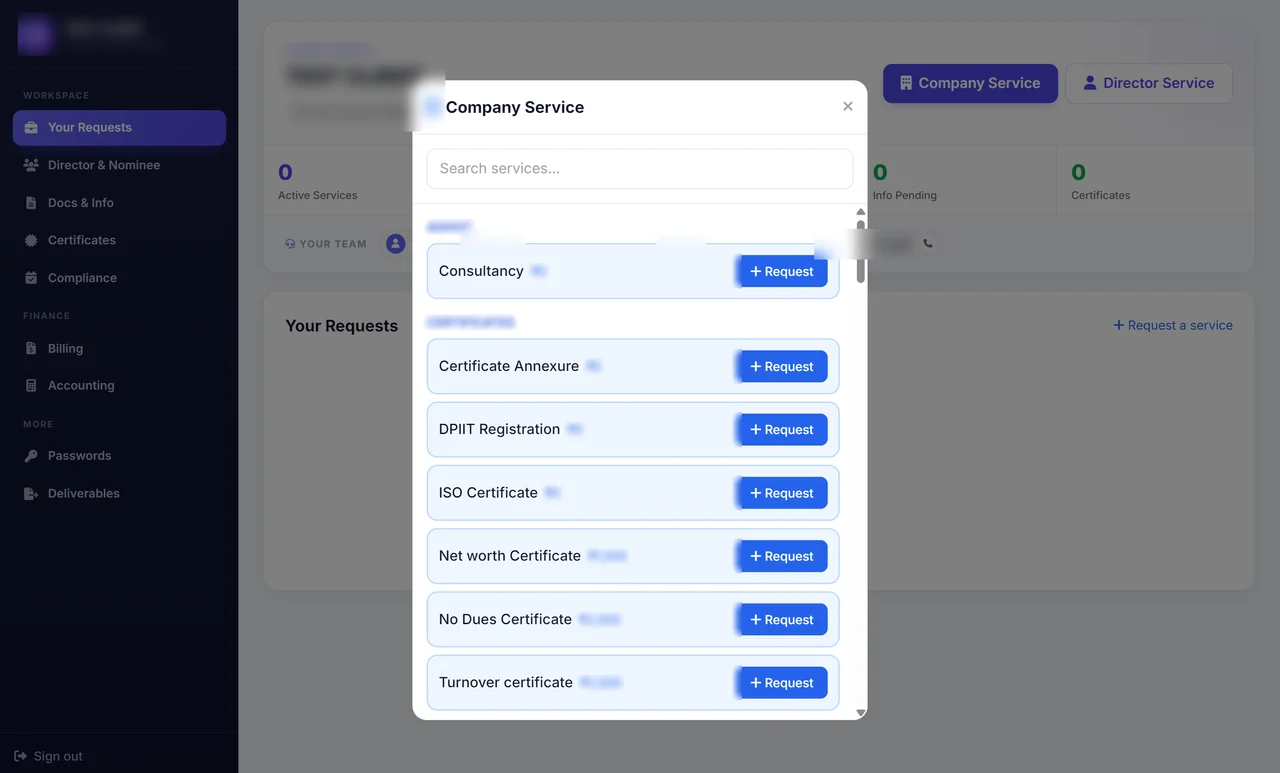
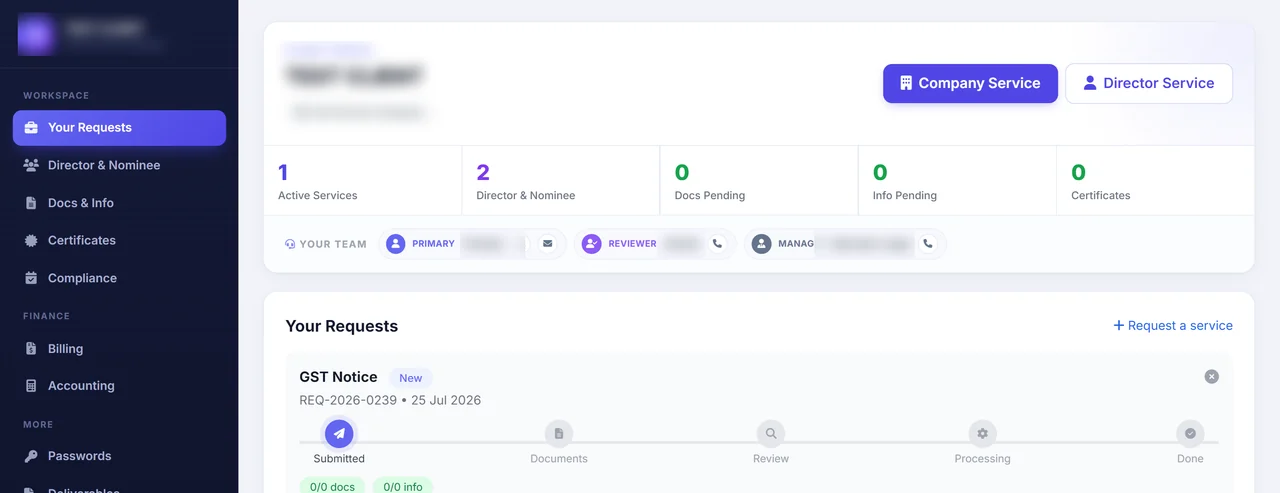
Everything happens in one secure login. You can see your active services, the Patron team on your account, and anything still pending. Once you raise a request, it moves through the same clear steps every time, so you always know exactly where your work stands.

Secure client portal login screen
1

Sign in securely

Your books, documents and requests all sit behind one private, password protected login. The team handling your account is shown on screen, so nothing sensitive ever needs to travel over email or WhatsApp.

Service catalogue inside the client portal
2

Raise your request

Choose the service you need from the menu inside the portal, where the price is shown before you go ahead. Your request is logged the moment you send it, with no phone calls or reminder emails to wait on.

GST registration document checklist in the client portal, with an upload button beside each item
3

Share what the service asks for

For every service, the portal lists the exact documents it needs, each with its own upload button. The example shown here is the GST registration checklist. When a service needs nothing from you, it simply asks for nothing.

Live request tracker inside the client portal
4

We review, prepare and file

Once your documents are in, your team checks them, prepares the work and files it for you. A live tracker shows each stage as it happens, from review to processing to done, so you never have to ask where things stand.

Deliverables area of the client portal
5

Collect your finished work

Every completed return, computation and certificate is placed in your Deliverables area. You can open, print or download any of them as a PDF whenever you need a copy.

Manufacturing Accounting Challenges Specific to Delhi: MCD Trade Licensing and NCR Inter-State GST Reconciliation

ChallengeImpactHow Patron Accounting Solves It
E-way bills raised for despatches never matched to sales invoicesGoods movement and booked sales diverge, and the gap surfaces only in a GST noticeOur team reconciles e-way bills to invoices and GRNs for Okhla and Mayapuri units, so despatches and recorded sales agree.
Job-work goods sent to Bawana units not returned within twelve monthsDeemed supply is triggered and unreturned stock inflates inventory that has effectively leftPatron ages job-work challans by despatch date, flagging Bawana movements nearing the twelve-month limit; see Delhi manufacturers in Bawana and Okhla.
Stock transferred between Delhi and NCR units valued inconsistentlyInter-state branch transfers misstate location inventory and distort each unit's cost of productionWe value NCR inter-state stock transfers on one consistent basis, so branch inventories reconcile to the group stock ledger.
Okhla plant expansion costs left in expenses, not capital work-in-progressConstruction-period spend and borrowing cost miss the asset, so profit and the asset base distort.Patron gathers expansion spend into capital work-in-progress with borrowing cost, capitalising it when the line commissions.
Slow-moving finished stock carried at cost, above realisable valueInventory sits overstated and margin looks healthier than the market will actually pay.Our team reviews finished stock each close and writes it down to net realisable value where lower.

Manufacturing Accounting Fees in Delhi

Fee ComponentAmount
Starter — one plant, single production line and routine monthly volumeINR 3,499 per month
Excl. GST & Government Charges
Growth — deeper bills of material and additional cost centresOn quote
Managed — multi-plant books with custom WIP valuation and reportingOn quote

A Delhi plant is billed the same INR 3,499 per month as anywhere, priced by scope rather than address. The fee grows with a deeper bill of materials, more cost centres and heavier work-in-progress valuation. Delhi charges no profession tax, so only statutory charges like Shops Act registration bill at actuals. Speak with an accounting specialist on +91 94594 56700.

Fees exclude GST and government charges. Final quote confirmed after a scoping review.

All fees and charges listed are indicative only and do not constitute a binding offer. Final amounts may vary depending on the volume of work and the complexity involved.

Professional accounting and compliance charges are scoped to your number of entities, funding stage and monthly transaction volume, and are separate from statutory and government charges. Contact us for a detailed, fixed quote.

Get a free Manufacturing Accounting consultation - Call +91 945 945 6700 or WhatsApp us. No-obligation assessment.

Manufacturing Accounting Compliance Calendar 2026 for Delhi Businesses

ComplianceDue DateApplies To
TDS / TCS deposit (Challan ITNS-281)7th of every month (30 April for March)Every business that deducts tax at source on salaries, rent, contractor or professional fees
GSTR-1 (outward supplies)11th of every month for monthly filersGST-registered Delhi businesses filing monthly returns
GSTR-3B (summary return and tax payment)20th monthly for turnover above Rs 5 crore; 24th quarterly under QRMP for turnover up to Rs 5 crore (Category Y)GST-registered businesses in Delhi
Advance tax first instalment (15%)15 June 2026Companies, firms and individuals with a tax liability of Rs 10,000 or more
Tax audit report (Form 3CA/3CB-3CD)30 September 2026Businesses crossing the Section 44AB turnover threshold
Income-tax return, audit cases31 October 2026Companies and audit-liable firms
Job-work movement return (ITC-04)25 October 2026 (Apr-Sep) and 25 April (Oct-Mar) for turnover above Rs 5 crore; annually otherwiseManufacturers sending inputs or capital goods to job workers
Annual GST return GSTR-9 and reconciliation GSTR-9C31 December 2026GST-registered Delhi businesses above the annual-return and audit thresholds

For a Delhi factory the ITC-04 job-work return on 25 October sits beside GSTR-3B on the 24th. The cost-record close at year-end depends on input movement tracked all year. Delhi levies no professional tax, so the local rhythm stays GST and TDS led. Talk to a Patron CA about manufacturing accounting services in Delhi on +91 94594 56700; start with our local guide.

Key Benefits

Why Professional Manufacturing Accounting Matters

A defensible cost per unit

You get a cost per unit built from the rates material is actually issued at and current conversion cost.

  • We refresh stale standard costs from current issue and conversion rates
  • Grounded in the bill of materials and per SKU standard costing sheet
  • Without it you quote a revised rate off a stale standard

Stock valued stage by stage

You value raw material, work in progress, finished goods, stores and scrap each against count sheets, not one closing figure.

  • Value each stage against count sheets, not a single closing number
  • Held in stock records with physical verification sheets
  • Without it an unexplained difference repeats at every physical count

Stock statement agreed to the ledger

The stock and receivables statement you file with your bank agrees to the ledger on the same date.

  • Reconciled against the ledger on the statement date
  • Valuation basis, job worker goods and creditor deductions each explained in writing
  • Without it you give the bank reason to reduce drawing power mid season

Job-work quantities fully accounted

Material lying with job workers stays on your books, challan by challan, so what returns reconciles to what you sent.

  • Waste retained by the worker included in the reconciliation
  • Tracked on Rule 55 delivery challans and Form ITC-04 filed
  • Without it goods written out never return on paper

Abnormal loss kept out of cost

We measure yield against standard, so normal wastage stays in product cost while abnormal loss comes out on its own.

  • Yield measured against standard on the yield and scrap report
  • Abnormal loss shown separately, out of product cost
  • Without it a bad month reads as an expensive product

Cost records kept through the year

Where your product is listed and you cross the turnover trigger, you hold cost records in the prescribed form all year.

  • Records tie back to the financial accounts throughout the year
  • Kept in Form CRA-1 under Section 148 and the Cost Records and Audit Rules 2014
  • Without them you rebuild cost records retrospectively under audit

Why Manufacturing Accounting Services Clients in Delhi Choose Patron Accounting

Five things a founder can check before handing over the books. Each is a claim with the proof behind it.

BOM-level costing and WIP valuation

We cost each finished good from its bill of materials and value work in progress at each stage of production. Our 15+ years across 3,000+ businesses served keep this routine.

Section 148 cost records, ITC-04 and AS 2 valuation

We maintain cost records under Section 148, file ITC-04 for every job-work challan and value stock to AS 2. This sits within the 25,000+ filings we have completed.

Tally Prime and Odoo modules configured to your routing

We work in your Zoho Books, Xero, Tally Prime or Odoo, setting up manufacturing modules to match your routing and BOM structure.

Plant-wise cost sheet and variance report monthly

Every month we deliver a plant-wise cost sheet and variance report tied to your BOM, alongside GST and TDS filed on time, work behind our 25,000+ filings completed.

On-ground for Okhla and NSP industrial units

Our Delhi team serves manufacturers around Okhla and Netaji Subhash Place. We handle MCD licensing, inter-state place-of-supply and Labour Welfare Fund dues, backed by 15+ years and a 4.9 star rating.

Figures reflect Patron Accounting LLP engagements since 2019. Scope and turnaround are confirmed in your engagement letter.

Job Costing vs Process Costing for Your Plant: for Delhi Businesses

CriterionJob CostingProcess Costing for Your Plant
What the method isCost gathered per job, order or batch, each priced on its own.Cost pooled by process stage then averaged over identical units produced.
Fit for Okhla unitsSuits Okhla light-engineering and garment units producing discrete, made-to-order batches.Suits continuous plants running identical output, rarer inside Delhi's Okhla estates.
WIP valuationWIP valued job by job from actual materials, labour and overhead booked.WIP valued using equivalent units at each stage, then costed on average.
Inter-state cost captureJob records tie inter-state NCR input GST to the specific order consuming it.Process pooling blends NCR input GST across output, needing careful reconciliation.
MIS and pricingClear cost per order helps when quoting bespoke or short-run jobs.Stable per-unit cost aids pricing where volumes are genuinely continuous.
Records and job workJob cards support cost records and Form ITC-04 job-work quantity tracking.Process logs feed cost records; stock valued under AS 2, not LIFO.
VerdictDelhi's Okhla estates lean to discrete job-order work, so job costing fits most units while genuinely continuous plants use process costing; output type decides. Reliable manufacturing accounting services in delhi reconcile inter-state NCR GST cleanly. See Manufacturing Accounting Services.

Delhi Rules for Manufacturers — Delhi's Nil Professional Tax, Section 148 Cost Records

Unlike a Maharashtra plant, a Delhi manufacturer runs no profession-tax deduction on its factory payroll, because the capital does not levy the tax at all. What it does face is the NCR border: many units keep a Delhi office and a plant in a neighbouring state, and those are distinct persons under GST.

So the books pair a lighter payroll layer with the central costing regime and an inter-branch discipline. Stock is valued under AS 2, a notified unit maintains cost records, and transfers across the NCR line are invoiced at value. That is why an NCR Inter-State GST Reconciliation runs alongside the cost ledger. Manufacturing accounting services in Delhi answer to the provisions below.

  • No profession tax in DelhiThe factory payroll carries no profession-tax deduction, unlike its counterparts in Maharashtra or Gujarat.
  • Section 148, Companies Act 2013 with the Companies (Cost Records and Audit) Rules 2014Holds cost records and, above the notified thresholds, is subject to a cost audit in Form CRA-3.
  • AS 2 / Ind AS 2, Valuation of InventoriesAre measured at the lower of cost or net realisable value, overheads apportioned on normal capacity.
  • Section 25(4), CGST Act 2017A Delhi office and a plant across the NCR border are distinct persons, so stock and services moved between them are invoiced and valued.
  • Section 128 with Rule 3(1), Companies (Accounts) Rules 2014The books stay on accrual with the audit trail enabled. Full national detail sits on the parent manufacturing page.

Official sources: Ministry of Corporate Affairs · Income Tax Department · GST Portal · Startup India (DPIIT)

When must a Delhi manufacturer file ITC-04 for goods sent to job workers?

ITC-04 is half-yearly for turnover above Rs 5 crore and annual for turnover up to that, covering inputs and capital goods sent to job workers and received back. Delhi units moving parts to Bawana, Faridabad or Noida job workers miss it most. Inputs not returned within one year, or capital goods within three years, are treated as a supply on the original despatch date.

Is professional tax deducted from factory workers at a Bawana unit?

No. Delhi levies no professional tax, so nothing is deducted on that head from workers at a Bawana or Naraina plant. Your payroll statutory heads are EPF, ESI, TDS under Section 192 and Delhi minimum wage compliance. If you also run a plant in Maharashtra or Gujarat, professional tax applies there, so we keep the payroll registers plant-wise and state-wise.

Does a Delhi manufacturing company have to maintain cost records?

Cost records under Section 148 of the Companies Act apply to specified industries once turnover crosses the prescribed threshold, and cost audit becomes compulsory above a higher one. Several Okhla and Bawana engineering and pharma units cross it without noticing. We build the cost ledger alongside financial books so product-wise cost, overhead absorption and reconciliation to the profit and loss are ready before the cost auditor asks.

What do the books need when a unit is in Bawana and the job worker is in Faridabad?

Each despatch to a Faridabad or Noida job worker needs a delivery challan, plus an e-way bill for inter-state consignments above Rs 50,000, and that challan series must tie back to your ITC-04. NCR movement crosses a state border, so it is inter-state for place of supply even when the truck runs thirty kilometres. We reconcile challans issued, goods returned and scrap retained monthly.

Can WIP and job costing be run for a small Naraina unit with no ERP?

Yes. We run job-wise WIP in Tally using a cost centre per work order, so raw material issue, labour and factory overhead attach to the job without an ERP licence. Naraina and Okhla units usually start with nothing more than production slips and a stock register. Within two closes you get gross margin per product line monthly instead of one annual figure.

How do you value closing stock for a Delhi factory?

Closing stock is valued at the lower of cost and net realisable value under AS 2, with cost covering materials, labour and a normal allocation of production overhead, excluding abnormal wastage and selling costs. We fix the absorption basis at the start of the year, so raw material, work in progress and finished goods are valued consistently. Statutory auditors question this schedule more than any other.

How is scrap and process loss accounted for at a Delhi plant?

Scrap sale is booked as revenue with GST at the applicable rate, normal process loss is absorbed into product cost, and abnormal loss goes straight to the profit and loss rather than into inventory. Scrap retained by a job worker is a supply from you and has to be invoiced. Delhi units selling scrap informally to local traders create the largest reconciliation gap we see.

How fast can a Delhi manufacturing month-end close get after outsourcing?

Most Delhi manufacturing clients move from a fifteen to twenty day close down to five working days within two cycles, once purchase booking, GRN entry and production postings shift to a fixed daily cut-off. The delay is almost never the accountant; it is stores paperwork reaching accounts late. We agree the cut-off calendar with your plant supervisor during the first month.

What does manufacturing accounting cost in Delhi?

Fees depend on transaction volume, SKU count, whether job work and cost records are in scope, and how many plants you run, rather than a single monthly figure. One Bawana unit with 200 SKUs costs materially less than a three-location operation under cost audit. We quote after reviewing a month of purchase, production and despatch data. Amounts are exclusive of GST and government charges.

Do you come to the factory for stock counts, or is everything remote?

Physical verification at your Bawana, Naraina or Okhla plant is scheduled as an on-site visit, normally at year end and once mid-year, while routine bookkeeping runs remotely. We keep no Delhi office. Challans, GRNs and production slips are scanned into a shared folder daily, and we take over your existing Tally data with a documented backup and signed opening balances.

Quick Answers

The division of labour is usually clear. Your stores team carries on issuing and receiving material on the shop floor, and the manufacturing accounting service in Delhi picks it up from the ledger inwards, converting those movements into valued entries and closing the month once consumption is valued. On a Bawana plot.

Manufacturing Accounting Deadlines in Delhi You Cannot Afford to Miss

TDS / TCS deposit (Challan ITNS-281) is due 7th of every month (30 April for March). GSTR-1 (outward supplies) is due 11th of every month for monthly filers. GSTR-3B (summary return and tax payment) is due 20th monthly for turnover above Rs 5 crore; 24th quarterly under QRMP for turnover up to Rs 5 crore (Category Y). Patron tracks each against your books so nothing is reconstructed after the fact. Call +91 94594 56700 to set up a filing-reminder schedule.

Start Your Manufacturing Accounting Services in Delhi with Patron Accounting

A second stock point outside Delhi is usually what starts this. Goods kept in another state need a registration in that state, so a rented godown across the border turns one set of books into two. The stores register that covered a single plot stops being enough. That is when the call usually comes.

Stock acquires a value on any date, not only at year end. Manufacturing accounting in Delhi produces a month-end figure that has been valued rather than estimated, showing how much cash is standing on the floor as material. It also shows whether last quarter's purchase decision still holds.

Numbers of job workers come first, along with the date stock was last counted and by whom. A unit sending material to four finishers keeps a different challan discipline from one sending to forty, and that count decides how our job work reconciliation approach is staged.

Book a Free Consultation - No Obligation.

Manufacturing Accounting Across Key Cities

Your city is highlighted below — we run the same on-ground service across these cities too.

Reviewed by the CA & CS Team, Patron Accounting LLP
ICAI & ICSI registered  ·  15+ years in Indian accounting & compliance  ·  Last reviewed 23 July 2026  ·  Next review 23 October 2026